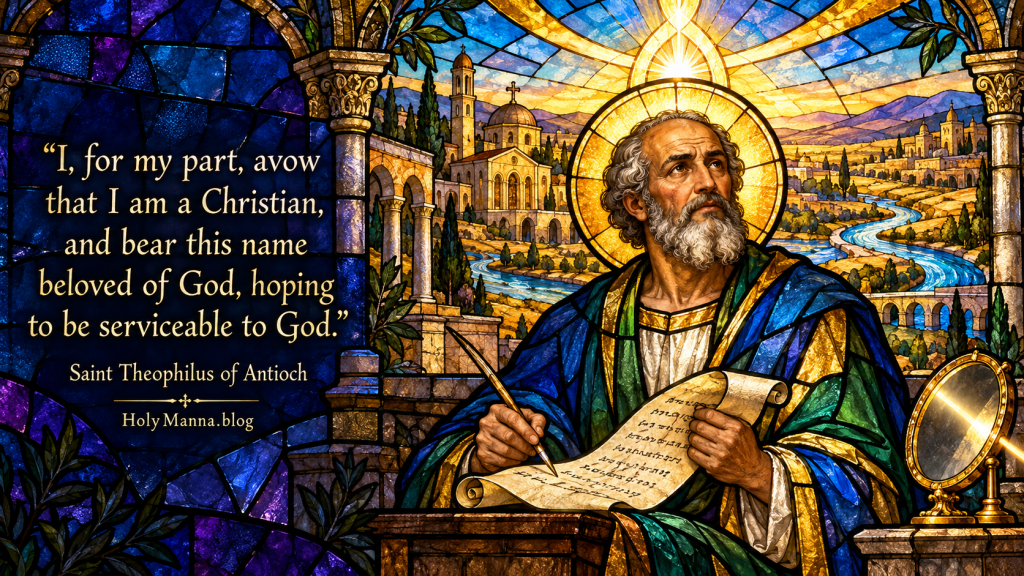
Show Me Yourself
On October 13th, the Church remembers a saint most Catholics have never heard of, yet every Catholic uses his vocabulary. Saint Theophilus of Antioch, a second century bishop and one of the earliest defenders of the Christian faith, is the first writer in all of surviving Christian literature to use the word “Trinity.” Before the great councils, before the creeds were hammered out, before Saint Augustine wrote his masterwork on the subject, a converted pagan in Antioch put the word on paper as if his readers already knew it well. The Roman Martyrology commemorates him on this day with quiet solemnity: “At Antioch, the holy Bishop, Theophilus, who held the pontificate in that Church and City, the sixth after the blessed Apostle, Peter.”
His very name means “friend of God” or “beloved of God,” and he lived up to it. He was a scholar, a pastor, an apologist, and a convert who came to the faith the hard way, through skepticism, study, and the slow surrender of a proud mind to the truth. The Catechism teaches that “the desire for God is written in the human heart, because man is created by God and for God” (CCC 27), and the life of Theophilus is that paragraph walking around in sandals. He searched, he doubted, he read, and he found. In an age drowning in idols, slander, and persecution, he stood up in the greatest city of the East and declared himself a Christian without apology. His story deserves to be told, because it is, in many ways, the story of every modern seeker who picks up a Bible intending to argue with it.
Converted by the Prophets
Theophilus was born a pagan in the early second century, in the lands near the Tigris and Euphrates Rivers in Mesopotamia, in what is today the region of Iraq. Almost nothing is known about his family, which is itself worth noting honestly; the ancient sources preserve his mind and his ministry far better than his childhood. What is certain from his own writings is that he received a thorough Greek education. He knew the poets, the philosophers, the historians, and the myths, and he could quote Homer and Plato as easily as any sophist of his day. He was, in modern terms, a well-read, cultured, skeptical intellectual, exactly the kind of man the early Church was constantly accused of being unable to reach.
His conversion came as an adult, and it came through Scripture. Theophilus did not meet Christ through a vision or a dramatic miracle. He met Christ through reading, and by his own account he began that reading as an unbeliever. The tradition handed down in the Church’s commemorations holds that he took up the Scriptures with a critical eye, and the Scriptures won. He tells the story himself in his own voice, and his testimony is one of the most relatable conversion accounts of the ancient world: “Therefore, do not be sceptical, but believe; for I myself also used to disbelieve that this would take place, but now, having taken these things into consideration, I believe. At the same time, I met with the sacred Scriptures of the holy prophets, who also by the Spirit of God foretold the things that have already happened, just as they came to pass” (To Autolycus, Book I, Chapter 14).
Notice what convinced him. It was fulfilled prophecy, the evidence of a God who speaks in history and keeps His word. The Catechism affirms this same path to faith when it teaches that the proofs of divine Revelation, including “the fulfilled prophecies”, are given “so that the submission of our faith might nevertheless be in accordance with reason” (CCC 156). Theophilus did not check his brain at the door of the church. He brought it with him, and God sanctified it.
Around the year 169, in the 8th year of the reign of the Emperor Marcus Aurelius according to the historian Eusebius, Theophilus was elected Bishop of Antioch. This was no small appointment. Antioch was the third city of the Roman Empire, the place where, as The Acts of the Apostles records, “the disciples were first called Christians” (Acts 11:26). Saint Peter himself had shepherded that Church before going to Rome, and Saint Ignatius of Antioch had been dragged from that same see to the lions a generation or two earlier. Eusebius and the Roman Martyrology count Theophilus as the sixth bishop after Peter, though some later sources number him seventh by including Peter in the count. Either way, Theophilus inherited a chair soaked in apostolic memory and martyr’s blood, and he knew it.
A Shepherd of Antioch
Honesty requires saying something plainly at the start of this section: no miracles are recorded of Saint Theophilus, either during his life or after his death. The ancient sources preserve no healings, no prodigies, no dramatic signs attached to his name. For a modern reader raised on the more spectacular lives of the saints, that can feel like a letdown. It should not. The Church has always venerated confessors alongside martyrs and wonderworkers, because holiness is measured by fidelity, not by fireworks. The Catechism teaches that “all Christians in any state or walk of life are called to the fullness of Christian life and to the perfection of charity” (CCC 2013), and Theophilus reached for that perfection with the tools God gave him: a pen, a diocese, and a razor-sharp mind.
His great surviving work is To Autolycus, an apology for Christianity in three books, written at different times to a real person. Autolycus was a learned pagan friend who mocked the faith, boasted of his idols, and threw the name “Christian” at Theophilus as an insult. The bishop’s response opens with one of the most confident self-introductions in early Christian literature: “I, for my part, avow that I am a Christian, and bear this name beloved of God, hoping to be serviceable to God” (To Autolycus, Book I, Chapter 1). There is no cringing there, no embarrassment, only a man happy to be exactly what his critic despises.
Then comes the exchange that has echoed for more than 18 centuries. Autolycus demanded, in effect, that the bishop prove it and produce this God of his. Theophilus answered: “But if you say, ‘Show me your God,’ I would reply, ‘Show me yourself, and I will show you my God’” (To Autolycus, Book I, Chapter 2). A popular paraphrase of this line circulates online as “show me your man, and I will show you my God”, and while the sense is faithful, the translation above is the actual wording of the standard English text. His point is devastating and pastoral at the same time. The problem is not that God is invisible; the problem is that sin blinds the one looking. He continues: “For God is seen by those who are enabled to see Him when they have the eyes of their soul opened”, and then, in an image worth memorizing, “As a burnished mirror, so ought man to have his soul pure” (To Autolycus, Book I, Chapter 2). Rust on a mirror hides the face looking into it; sin on a soul hides God. The Catechism teaches the very same truth when it explains the sixth beatitude, promising that the pure in heart will see God, since purity of heart is the precondition of the vision of God (CCC 2518). Theophilus got there first, and he got there in a letter to a friend.
He did not leave Autolycus staring at a dirty mirror with no remedy. He pointed him to the only one who can clean it: “Entrust yourself to the Physician, and He will couch the eyes of your soul and of your heart” (To Autolycus, Book I, Chapter 7). He argued for God’s existence from the beauty and order of creation, from the seasons, the stars, the rains, and the harvests, anticipating what the Catechism calls the ways of coming to know God, in which “starting from movement, becoming, contingency, and the world’s order and beauty, one can come to a knowledge of God” (CCC 32). He defended the resurrection of the body with homely images any farmer could grasp: “A seed of wheat, for example, or of the other grains, when it is cast into the earth, first dies and rots away, then is raised, and becomes a stalk of grain” (To Autolycus, Book I, Chapter 13). He even offered a lovely explanation of the name Christian itself: “Wherefore we are called Christians on this account, because we are anointed with the oil of God” (To Autolycus, Book I, Chapter 12).
And then there is the sentence that secured his place in the history of doctrine. Commenting on the days of creation in The Book of Genesis, Theophilus wrote: “In like manner also the three days which were before the luminaries, are types of the Trinity, of God, and His Word, and His wisdom” (To Autolycus, Book II, Chapter 15). That is the earliest surviving use of the word “Trinity,” in Greek “Trias,” in all of Christian literature. Just as striking is how casually he uses it. He does not announce a new term or defend a novelty; he writes as a man using a word his community already knows. The doctrine was not invented at Nicaea in 325; it was believed, prayed, and named in Antioch a century and a half earlier. The Catechism teaches that “the mystery of the Most Holy Trinity is the central mystery of Christian faith and life” (CCC 234), and that this mystery is one “inaccessible to reason alone”, known because God has revealed it (CCC 237). Theophilus stands near the headwaters of the Church’s effort to speak that mystery rightly. In the same work he also quotes the opening of The Gospel of John, naming John among the inspired writers, which makes him one of the earliest authors on record to cite the Fourth Gospel explicitly as Scripture.
If there is a wonder in this saint’s life, it was worked in ink. A pagan skeptic became the pen through which the Church first wrote the name of her deepest mystery. That is not a miracle in the canonical sense, and it will not be claimed as one here. But it is unmistakably the fingerprint of grace.
A Confessor Under the Shadow of Marcus Aurelius
Theophilus was never martyred, and the Church honors him as a confessor. His hardships were real all the same, and they came from three directions at once: a hostile empire, a mocking culture, and heresy gnawing at the Church from within.
He governed Antioch during the reign of Marcus Aurelius, a period remembered by philosophy students for the emperor’s Meditations and remembered by the Church for blood. It was in those same years, around 177, that the martyrs of Lyons went to their deaths amid hideous public tortures. Christians across the empire lived under standing suspicion, and the popular slanders of the age were vile: Christians were accused of atheism for refusing the gods, of cannibalism because of garbled rumors about the Eucharist, and of secret immorality in their gatherings. Theophilus spent much of the third book of To Autolycus answering exactly these libels, defending the moral seriousness of Christian life and demonstrating from chronology that the Scriptures were older and more trustworthy than the fables of the poets. He even calculated the age of the world from the biblical record to prove that Moses predated the sages of Greece, making him one of the first Christian chronographers. To be a bishop in such a time was to live with a target on one’s back. The see he occupied had already sent Ignatius to the beasts, and every bishop of that era knew the same summons could come for him. It is reasonable to describe his episcopate as a long, watchful endurance, though no account of any arrest or trial of Theophilus survives, and none will be invented here.
The second front was intellectual. Autolycus was not a strawman; he was a flesh and blood friend who thought the faith was foolishness and said so to the bishop’s face. Theophilus answered ridicule with reasons, mockery with patience, and contempt with an invitation. He took seriously what Saint Peter had commanded a century before: “Always be prepared to make a defense to any one who calls you to account for the hope that is in you” (1 Peter 3:15). The Catechism echoes that same duty for every believer, teaching that the disciple of Christ must be ready to “be a witness to it” and “spread it” (CCC 1816).
The third front was heresy. The historian Eusebius and Saint Jerome record that Theophilus wrote a treatise against Marcion, the heretic who tried to amputate the Old Testament and its God from the Christian faith, and Eusebius credits that work as genuinely effective in combating the error. He also wrote against Hermogenes, who taught that God formed the world out of eternally existing matter rather than creating it from nothing. Those works are lost, along with his catechetical writings and a harmony of the four Gospels with commentary that Jerome mentions having read. Jerome also saw commentaries on the Gospels and on The Book of Proverbs circulating under Theophilus’s name, but doubted their authenticity because the style did not match; that ancient scholarly caution is worth repeating rather than smoothing over. Against Hermogenes in particular, Theophilus championed the doctrine the Catechism states plainly: “We believe that God needs no pre-existent thing or any help in order to create” (CCC 296). Defending creation from nothing and the unity of the two Testaments in the 170s was trench warfare for the soul of Christianity, and Theophilus fought it faithfully.
He died sometime between about 181 and 185. The sources genuinely conflict on the year, with dates of 180, 181, 183, and 185 all appearing in reputable references, and his own third book shows he was still alive after the death of Marcus Aurelius in 180. The honest summary is that he finished his course in peace, in his own city, in the early 180s, a confessor to the end.
A Quiet Grave and a Word That Conquered the World
Here, too, honesty comes first: no miracles after his death are recorded for Saint Theophilus in the sources, no healings at a tomb, no translations of relics, no shrine, and no pilgrimage tradition. There are no unverifiable miracle stories circulating about him to pass along, which is itself unusual among the ancient saints, and so none will be told. His canonization was of the earliest kind, pre-congregation, meaning the Church recognized his sanctity by ancient acclaim and liturgical memory long before formal canonization processes existed. He is venerated not only in the Catholic Church but also among the Eastern Orthodox and the Oriental Orthodox, a quiet sign that his witness predates the later divisions of Christendom.
His real posthumous impact is measured in doctrine rather than in prodigies. The word he first set down, Trinity, became the Church’s permanent name for the mystery of God, enshrined in the creeds, the liturgy, and every Sign of the Cross traced by every Catholic who has ever lived. The Catechism teaches that “the Church uses (I) the term ‘substance’… (II) the term ‘person’… and (III) the term ‘relation’” to articulate the dogma of the Trinity, and that in doing so she gave these words “an unprecedented meaning” (CCC 252). That long labor of finding words for God began with men like Theophilus. His theology of the Logos, the Word who was with God from eternity and through whom all things were made, fed directly into the stream that produced the Council of Nicaea’s confession of the Son as true God from true God. His apologetic method, arguing from creation, from conscience, from fulfilled prophecy, and from the moral fruit of the Gospel, became a template the Church still uses, and the Catechism itself walks the same path when it presents the ways of coming to know God (CCC 31 to CCC 35).
His fame among theologians faded after the patristic era, and for centuries he was largely a footnote. Yet his one surviving work kept being copied, translated, and read, and today, in an age full of educated skeptics who sound remarkably like Autolycus, his star is quietly rising again. Attentive readers of the Church Fathers keep rediscovering him, and his feast on October 13th gives the whole Church an annual reason to do the same. One caution belongs to his legacy: lists circulating online name him as patron of various cities, but no such patronage is documented in the standard Catholic sources, and he should not be confused with the several other saints named Theophilus on the calendar, nor with the Theophilus to whom Saint Luke addressed his Gospel.
Polishing the Mirror of the Soul
What does a second century bishop from Mesopotamia have to say to a 28 year old scrolling through arguments about God at midnight, or a 42 year old whose coworkers treat faith as a punchline? Almost everything.
First, Theophilus baptizes the skeptic’s starting point. He did not believe, and he said so. He read the Scriptures the way many people today read them, looking for cracks, and he found instead a God who keeps His promises. His witness gives full permission to bring hard questions to the faith, because the faith can bear them. When was the last time you read Scripture slowly, not to win an argument, but to let it read you? The Catechism urges exactly this, teaching that the Church “forcefully and specifically exhorts all the Christian faithful… to learn the surpassing knowledge of Jesus Christ, by frequent reading of the divine Scriptures”, adding the famous warning of Saint Jerome that “ignorance of the Scriptures is ignorance of Christ” (CCC 133).
Second, Theophilus insists that seeing God is a moral project before it is an intellectual one. His mirror image deserves a permanent place in any examination of conscience. Rust on the mirror, sin on the soul; the face of God is not absent, it is obscured. Regular Confession is the burnishing cloth. The Catechism teaches that through the sacrament of Penance the sinner is restored and the Church is renewed, calling conversion “an uninterrupted task for the whole Church” (CCC 1428). What rust has been allowed to sit on the mirror lately, and what would it take to bring it to the Physician this week?
Third, he models apologetics as friendship. Autolycus was not an enemy to crush but a friend to win, and Theophilus answered his scorn with three patient books rather than one withering comeback. Most people will never be argued into the Kingdom, but many have been loved and reasoned toward it over years. Is there an Autolycus in your life, a friend who mocks what you believe, and have you been answering with patience, clarity, and prayer, or just avoiding the subject?
Finally, Theophilus consecrates ordinary, unspectacular fidelity. No visions, no miracles, no martyrdom, just decades of teaching, writing, defending, and shepherding, and the Church has honored him for more than 1,800 years. Holiness in daily work, done faithfully for God, is still holiness. If no one ever wrote a dramatic story about your life, would the quiet facts of it still point to Christ?
Engage With Us!
Saint Theophilus answered a mocking friend with patience and truth, and his words are still converting hearts 18 centuries later. Now it is your turn to join the conversation. Share your thoughts, your questions, and your own story in the comments below; someone reading may need exactly what you have lived. Consider these questions as a starting point:
- Theophilus came to faith by studying the prophets and seeing their words fulfilled. What piece of evidence, experience, or person first made Christianity credible to you?
- He taught that sin coats the soul like rust on a mirror. What habit, if surrendered in Confession, would most clear your vision of God right now?
- Autolycus ridiculed the faith, and Theophilus responded with three books written in friendship. How do you respond when someone close to you dismisses what you believe?
- Theophilus was the first to write the word Trinity. When you pray the Sign of the Cross, do you pause to mean it, and how might you pray it more deliberately this week?
- He served faithfully with no recorded miracles and no dramatic ending. Where is God asking you to be faithful in hidden, ordinary ways?
Saint Theophilus spent his life showing a skeptical world the face of God, one purified soul at a time, beginning with his own. Go and do the same. Keep the mirror of your soul polished, keep your answers gentle and ready, and keep loving the Autolycus God has placed in your path. Do everything, the arguing and the forgiving, the studying and the serving, with the love and mercy that Jesus taught us, and one day, with eyes fully opened, you will see the God that Theophilus so longed to show his friend.
Saint Theophilus of Antioch, pray for us!
Follow us on YouTube, TikTok, Instagram and Facebook for more insights and reflections on living a faith-filled life.


Leave a Reply