Tuesday of the Twenty-eighth Week in Ordinary Time – Lectionary: 468
The Freedom That Starts on the Inside
Everyone wants to be free, yet very few people agree on what freedom actually means. The world tends to define it as the absence of limits. The readings for Tuesday of the Twenty-eighth Week in Ordinary Time, October 13th, tell a far better story. In the Letter to the Galatians, Saint Paul declares, “For freedom Christ set us free,” and pleads with a young church not to crawl back under a yoke of religious performance. In Psalm 119, the longest prayer in the entire Bible, the psalmist discovers that obedience is not a cage at all; he walks “at liberty” precisely because he seeks God’s precepts. And in The Gospel of Luke, Jesus sits at a Pharisee’s table, skips the ceremonial handwashing on purpose, and announces that the God who made the outside of a person also made the inside.
One golden thread runs through all three readings: true freedom and true purity are born on the inside. Neither can be earned by external performance; both are received as gifts of grace and then lived out in love. Paul compresses the whole mystery into one phrase that Catholic theology has treasured ever since: “faith working through love” (Galatians 5:6). These readings arise from real first-century controversies, from the circumcision crisis to the ritual washings of the Pharisees, yet the question beneath them is timeless. God has never been satisfied with a polished exterior. He wants the heart, and once He has it, freedom, delight, and generosity pour out of it like water from a spring.
First Reading — Galatians 5:1-6
When Freedom Was Worth a Fight
Saint Paul had planted the churches of Galatia, in central Asia Minor, on his missionary journeys. Soon after he moved on, teachers often called the Judaizers arrived and told the Gentile converts that faith in Christ was not enough; to be saved, they also needed circumcision and full observance of the Mosaic Law. Paul wrote Galatians in the heat of that crisis, during the same era in which the Church settled the question at the Council of Jerusalem (Acts 15, around the year 49). The letter is his most impassioned; it famously skips the warm thanksgiving that opens his other epistles and goes straight to the point. Today’s passage opens the letter’s final movement and serves as its thesis. Freedom is not a wage paid for religious performance; it is a gift purchased at the price of the Cross.
Galatians 5:1-6
Brothers and sisters:
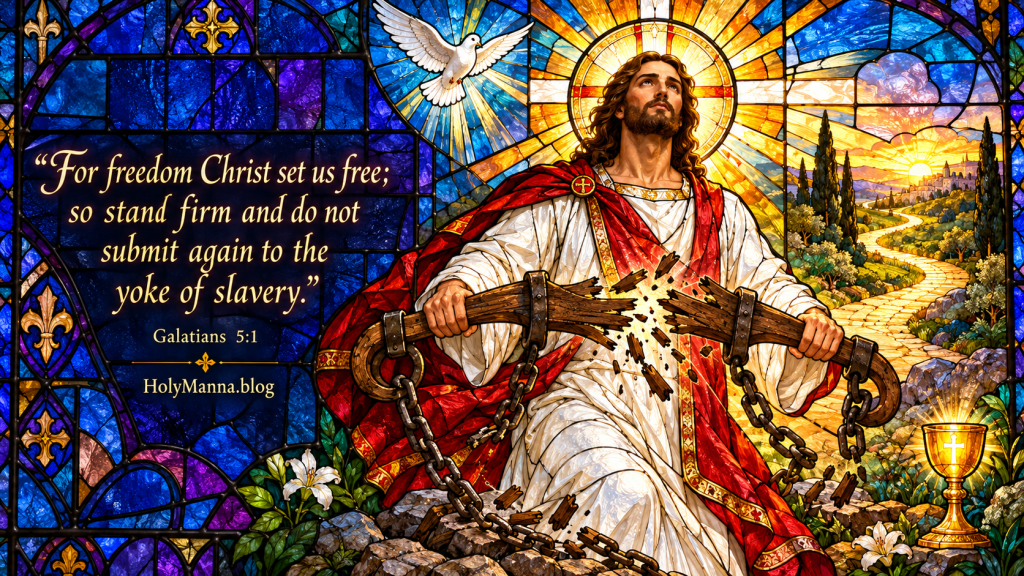
For freedom Christ set us free;
so stand firm and do not submit again to the yoke of slavery.It is I, Paul, who am telling you
that if you have yourselves circumcised,
Christ will be of no benefit to you.
Once again I declare to every man who has himself circumcised
that he is bound to observe the entire law.
You are separated from Christ,
you who are trying to be justified by law;
you have fallen from grace.
For through the Spirit, by faith, we await the hope of righteousness.
For in Christ Jesus,
neither circumcision nor uncircumcision counts for anything,
but only faith working through love.
Detailed Exegesis
Verse 1: “For freedom Christ set us free; so stand firm and do not submit again to the yoke of slavery.”
Paul begins with a fact and follows it with a command. Freedom has already been won, and not by human effort; the only task left is to stand firm in it. A yoke was the wooden beam laid across the necks of oxen; Saint Peter called the Law as a path to salvation a “yoke that neither our ancestors nor we have been able to bear” (Acts 15:10). Saint John Chrysostom presses the point: “It is Another who has redeemed you, it is Another who has paid the ransom for you” (Homily 5 on Galatians). The Catechism makes this verse its own: “By his glorious Cross Christ has won salvation for all men. He redeemed them from the sin that held them in bondage” (CCC 1741).
Verse 2: “It is I, Paul, who am telling you that if you have yourselves circumcised, Christ will be of no benefit to you.”
Paul throws his full apostolic authority behind the warning. The issue is not circumcision itself; Paul had Timothy circumcised for the sake of the mission (Acts 16:3). The issue is circumcision embraced as a requirement for salvation, which quietly declares the Cross insufficient. Chrysostom diagnoses the inner logic: “He who is circumcised is circumcised as fearing the law: but he who fears the law distrusts the power of grace: and he who distrusts gains nothing from that which he distrusts” (Homily 5 on Galatians).
Verse 3: “Once again I declare to every man who has himself circumcised that he is bound to observe the entire law.”
The Law is a package deal. Anyone who enters it as a system of self-justification cannot pick favorite precepts; he answers for all of them, since whoever stumbles in one point “has become guilty in respect to all of it” (James 2:10). Paul is exposing the fine print the Judaizers never mentioned.
Verse 4: “You are separated from Christ, you who are trying to be justified by law; you have fallen from grace.”
These are the most sobering words in the passage. Grace is not a legal status filed away in heaven; it is a living relationship, and a relationship can be abandoned. Chrysostom observes that the person who tries to stand between the Law and Christ “believes neither Christ nor the Law, but stands between them, desiring to benefit both by one and the other, whereas he will reap fruit from neither” (Homily 5 on Galatians).
Verse 5: “For through the Spirit, by faith, we await the hope of righteousness.”
After the warning comes the alternative, and it is quietly Trinitarian. The Christian life runs through the Spirit, rests on faith in the Son, and waits in hope for the Father’s gift of righteousness. The posture is expectant trust rather than anxious self-sufficiency.
Verse 6: “For in Christ Jesus, neither circumcision nor uncircumcision counts for anything, but only faith working through love.”
Here is the summit. What matters in Christ is a living faith that expresses itself in charity. This single phrase holds together everything the Church teaches about faith and works: faith is not bare intellectual agreement, and works are not wages that purchase heaven; grace produces a faith that breathes, and love is how it breathes. The Catechism echoes the verse directly: “To live, grow, and persevere in the faith until the end we must nourish it with the word of God; we must beg the Lord to increase our faith; it must be ‘working through charity,’ abounding in hope, and rooted in the faith of the Church” (CCC 162).
Teachings
Chrysostom locates the root of the Galatian crisis not in the mind but in the heart: “Had you loved Christ as you ought, you would not have deserted to bondage, nor abandoned Him who redeemed you, nor treated with contumely Him who gave you freedom” (Homily 5 on Galatians). Legalism, in other words, is a symptom of cooling love. The Catechism describes the life Paul is defending: “The New Law is called a law of love because it makes us act out of the love infused by the Holy Spirit, rather than from fear; a law of grace, because it confers the strength of grace to act, by means of faith and the sacraments; a law of freedom, because it sets us free from the ritual and juridical observances of the Old Law” (CCC 1972). The Council of Jerusalem, the Church’s first council, sealed the matter, declaring, “It is the decision of the holy Spirit and of us not to place on you any burden beyond these necessities” (Acts 15:28). What Paul argued as a pastor, the Church confirmed in council.
Reflection
The yoke of slavery still gets repackaged every generation. For some it looks like perfectionism, earning God’s approval through flawless performance. For others it looks like scrupulosity, or a checklist Catholicism that counts devotions while the heart stays far away. Others swing to the opposite error and treat freedom as a license, which Paul addresses later in the same chapter. Christ offers something better: a freedom received as gift and spent on love. Begin each morning this week by thanking Jesus that salvation is His accomplishment, not yours. Return to Confession as a personal encounter with the mercy that sets prisoners free. Then choose one hidden act of charity each day, so faith has room to work through love. Where in your spiritual life are you still trying to earn what God wants to give you freely? If someone watched your week from the outside, would they see a faith that works through love?
Responsorial Psalm — Psalm 119:41, 43-45, 47-48
A Love Song to the Law of the Lord
Psalm 119 is the longest psalm and the longest chapter in the entire Bible, running 176 verses. It is an acrostic poem of 22 stanzas, one for each letter of the Hebrew alphabet, with every verse in a stanza beginning with that stanza’s letter. Today’s verses come from the Waw stanza. Throughout the psalm, the writer rotates through roughly eight terms for God’s revelation, including law, precepts, statutes, commands, ordinances, decrees, word, and promise. For this poet, the law of the Lord is not a burden to be endured but a love letter to be treasured. The Lectionary places this stanza between Paul and Jesus for a reason, and the refrain announces it: “Let your mercy come to me, O Lord.” Everything the psalmist promises to do rests first on what he begs God to give.
Psalm 119:41, 43-45, 47-48
R. (41a) Let your mercy come to me, O Lord.
Let your mercy come to me, O LORD,
your salvation according to your promise.
R. Let your mercy come to me, O Lord.
Take not the word of truth from my mouth,
for in your ordinances is my hope.
R. Let your mercy come to me, O Lord.
And I will keep your law continually,
forever and ever.
R. Let your mercy come to me, O Lord.
And I will walk at liberty,
because I seek your precepts.
R. Let your mercy come to me, O Lord.
And I will delight in your commands,
which I love.
R. Let your mercy come to me, O Lord.
And I will lift up my hands to your commands
and meditate on your statutes.
R. Let your mercy come to me, O Lord.
Detailed Exegesis
Verse 41: “Let your mercy come to me, O LORD, your salvation according to your promise.”
The stanza opens not with resolve but with petition. The word behind mercy is the great covenant term hesed, God’s steadfast, loyal love, and salvation arrives “according to your promise,” which means grace comes before obedience ever begins. Saint Augustine, preaching on this very verse, explains that the psalmist prays “that through His loving mercy who commanded, he may perform the commandments which he has coveted,” and adds: “Christ Himself is the Salvation of God” (Exposition on Psalm 119). The Old Testament poet was asking, without fully knowing it, for Jesus.
Verse 43: “Take not the word of truth from my mouth, for in your ordinances is my hope.”
This is a prayer for perseverance in witness. The psalmist dreads a mouth emptied of God’s truth through fear or compromise. Augustine saw in this verse the story of Saint Peter, who denied the Lord for an hour yet was restored and later bore witness unto death. Hope anchored in God’s ordinances survives storms that sink hope anchored in circumstances.
Verse 44: “And I will keep your law continually, forever and ever.”
Forever and ever stretches past the grave, which raises a question: what law can possibly be kept in eternity? Augustine answers by pointing to the Apostle: the law kept forever is charity, for “love is the fulfillment of the law” (Romans 13:10). Ritual observances end; love never does.
Verse 45: “And I will walk at liberty, because I seek your precepts.”
Here is the hinge of the entire day. The Hebrew image is walking in a wide, open space, the opposite of being hemmed in. The world assumes that commandments shrink a life, yet the psalmist testifies to the reverse. Sin promises open country and delivers a cell; obedience looks narrow at the gate and opens onto a plain. This verse is Galatians 5:1 set to music.
Verse 47: “And I will delight in your commands, which I love.”
Delight and love are affective words, not legal ones. Duty has been transfigured into desire. Nobody climbs to heroic virtue on willpower alone; the saints obeyed greatly because they loved greatly.
Verse 48: “And I will lift up my hands to your commands and meditate on your statutes.”
Lifted hands are the biblical gesture of prayer and homage, normally directed to God Himself. The psalmist directs them toward God’s commands because God’s word carries God’s presence. The slow, repeated pondering he describes is the ancient root of lectio divina.
Teachings
Augustine saved this psalm for last among all his expositions of the Psalter, admitting he had postponed it for years because its depths exceeded him. When he finally treated the Waw stanza, he explained why liberty and law belong together: “He then loved the commandments of God because he walked at liberty; that is, through the Holy Spirit, through whom love itself is shed abroad, and enlarges the hearts of the faithful” (Exposition on Psalm 119). Remarkably, Augustine even quotes today’s first reading inside his commentary on this psalm, describing its spirituality as “the law of faith, not a vain faith, but that which works through love” (Exposition on Psalm 119, citing Galatians 5:6). The Catechism gathers the whole teaching into one paragraph: “The practice of the moral life animated by charity gives to the Christian the spiritual freedom of the children of God. He no longer stands before God as a slave, in servile fear, or as a mercenary looking for wages, but as a son responding to the love of him ‘who first loved us’” (CCC 1828). That same paragraph quotes Saint Basil the Great, who distinguishes three ways of obeying: the slave obeys from fear of punishment, the mercenary obeys for wages, and the child obeys out of love for the One who commands.
Reflection
Most people carry a quiet suspicion that God’s commandments exist to keep them from the good stuff. Psalm 119 dismantles that suspicion from the inside. Try a simple experiment: pray one stanza of this psalm each day for the next 22 days, asking for the grace to love what God commands. Memorize verse 45 and repeat it whenever obedience feels like confinement. When a teaching of the Church chafes, replace one complaint with one honest prayer for delight. Do you picture God’s commandments as walls closing in or as a map to open country? Which command do you currently obey only from fear, and what would it take to begin obeying it from love?
Holy Gospel — Luke 11:37-41
The Dinner Guest Who Skipped the Handwashing
This scene unfolds during the travel narrative of The Gospel of Luke, as Jesus makes His way toward Jerusalem. Luke records Jesus dining with Pharisees three times (Luke 7:36, Luke 11:37, Luke 14:1), and each table becomes a classroom. The washing at issue here was not hygiene, and it was not a commandment of the Mosaic Law binding on lay people. It belonged to the tradition of the elders, an extension of priestly purity rules to the ordinary table, which the Pharisees treated as a mark of serious devotion (Mark 7:3-4). Jesus, who fulfilled the Law perfectly, deliberately bypasses a human custom to expose a spiritual disease, for the God who inspects the inside of the cup has been insisting all day, through Paul and the psalmist, that freedom and purity begin within.
Luke 11:37-41
After Jesus had spoken,
a Pharisee invited him to dine at his home.
He entered and reclined at table to eat.
The Pharisee was amazed to see
that he did not observe the prescribed washing before the meal.
The Lord said to him, “Oh you Pharisees!
Although you cleanse the outside of the cup and the dish,
inside you are filled with plunder and evil.
You fools!
Did not the maker of the outside also make the inside?
But as to what is within, give alms,
and behold, everything will be clean for you.”
Detailed Exegesis
Verse 37: “After Jesus had spoken, a Pharisee invited him to dine at his home. He entered and reclined at table to eat.”
Jesus accepts the invitation of a man from the very group He has just been correcting, because His mercy refuses no table. Reclining was the posture of a formal banquet. Saint Cyril of Alexandria sees strategy in the acceptance: “The Savior of all submits to this for providence’s sake. He made the matter an opportunity of giving instruction, not consuming the time of their meeting in the enjoyment of food and delicacies but in the task of making those who were assembled there more virtuous” (Commentary on Luke, Homily 83).
Verse 38: “The Pharisee was amazed to see that he did not observe the prescribed washing before the meal.”
The amazement is scandal. The host assumed that a rabbi with a reputation for holiness would certainly keep the ritual washing, yet nothing in the Torah required it of a lay guest. The Pharisee’s reaction reveals his measuring stick: holiness equals visible compliance with the customs of his circle. He is inspecting the outside of Jesus while Jesus is reading the inside of him.
Verse 39: “The Lord said to him, ‘Oh you Pharisees! Although you cleanse the outside of the cup and the dish, inside you are filled with plunder and evil.’”
Luke’s solemn title, the Lord, signals that judgment is coming. The image is devastating in its simplicity: a cup scrubbed to a shine on the outside while the inside holds rot. The word rendered plunder points to greed and extortion, gain raked in at the expense of others. Religious polish, Jesus warns, can coexist with an acquisitive heart, and the polish makes the rot harder to see.
Verse 40: “You fools! Did not the maker of the outside also make the inside?”
In Scripture, the fool is not a person of low intelligence but one who leaves God out of account. The argument is from creation: the same God fashioned the visible and the hidden dimensions of the person, so curating the exterior while ignoring the interior insults His design. The principle runs deep in the Old Testament, where God tells Samuel, “God does not see as a mortal, who sees the appearance. The LORD looks into the heart” (1 Samuel 16:7).
Verse 41: “But as to what is within, give alms, and behold, everything will be clean for you.”
Here is the surprising remedy. Jesus does not prescribe a better washing; He prescribes generosity flowing from within. The Greek phrase ta enonta, the things inside, suggests giving what is within, the interior self pouring outward in mercy. Almsgiving does not purchase forgiveness; it is the visible overflow of a converted heart, a conviction Scripture already carried: “almsgiving saves from death, and purges all sin” (Tobit 12:9). When love moves from the inside out, the whole person becomes clean, the exact reversal of the Pharisee’s program.
Teachings
Cyril of Alexandria turns the Pharisee’s own standard against him: “O foolish Pharisee, you boast much of your knowledge of the sacred Scriptures. You are always quoting the law of Moses. Tell us where Moses gave you this commandment?” (Commentary on Luke, Homily 83). Human custom had been elevated above divine intention, while the true cleansing the washings prefigured arrives in Baptism. The Catechism gathers Jesus’ remedy into its teaching on mercy: “The works of mercy are charitable actions by which we come to the aid of our neighbor in his spiritual and bodily necessities. Instructing, advising, consoling, comforting are spiritual works of mercy, as are forgiving and bearing wrongs patiently. The corporal works of mercy consist especially in feeding the hungry, sheltering the homeless, clothing the naked, visiting the sick and imprisoned, and burying the dead. Among all these, giving alms to the poor is one of the chief witnesses to fraternal charity: it is also a work of justice pleasing to God” (CCC 2447). It likewise insists on where conversion begins: “Jesus’ call to conversion and penance, like that of the prophets before him, does not aim first at outward works, ‘sackcloth and ashes,’ fasting and mortification, but at the conversion of the heart, interior conversion” (CCC 1430). In his General Audience of March 28th, 1979, Saint John Paul II explained that almsgiving “means in the first place an interior gift” and called that readiness to share “an indispensable factor of ‘metanoia’, that is, conversion.”
Reflection
The modern world has industrialized the outside of the cup. Social media invites everyone to curate a gleaming exterior, and even faith can become part of the branding, while the interior goes unexamined. Jesus’ question at the Pharisee’s table lands squarely on this generation: the Maker of the profile also made the heart behind it. Take up a nightly examination of conscience and ask about motives, not just actions. Get to Confession this month, where the Divine Physician cleanses the inside no ritual can reach. Then build a concrete almsgiving plan: a percentage of income, a specific charity, or better yet a name and a face, and keep the gift as hidden as possible. Which part of your life gets polished for an audience while the inside goes unexamined? What is one possession, comfort, or hour of your week that God may be inviting you to turn into alms?
Walk Out Into Wide Open Country
Set the three readings side by side and they tell a single story, like three panels of one stained-glass window. Paul stands in the first panel, pointing to the Cross and crying out that freedom has already been purchased, so no one need kneel again to the yoke of performance. The psalmist fills the second panel, striding through open country with lifted hands, living proof that the person who loves God’s precepts walks at liberty. And in the third panel sits Jesus at a Pharisee’s polished table, tapping the rim of a gleaming cup and asking the question that unlocks everything: did not the Maker of the outside also make the inside?
Grace comes first. Freedom is received, never earned. Love is the way freedom breathes. That is the Gospel compressed into a Tuesday in Ordinary Time, wonderfully good news for anyone exhausted by performance. God is not waiting at the finish line with a clipboard; He is standing at the starting line with a gift.
So take the gift. Get to Mass and receive the One who paid the ransom. Bring the inside of the cup to Confession and let Him make it clean. Pick one act of hidden generosity this week and let faith do what living faith does: work through love. Then watch the walls move outward. The command that once felt like a cage begins to feel like a doorway, and the doorway opens onto the wide country where the children of God have always walked at liberty.
Engage With Us!
Reflections like these are better when shared, so add a comment below and tell this community what the Lord stirred in your heart today. Here are questions to pray with first:
- In Galatians 5:1-6, Saint Paul warns against submitting again to a yoke of slavery after Christ has won freedom for His people. What yoke of perfectionism, fear, or performance do you need to lay down, and what would it look like for your faith to work through love this week?
- In Psalm 119:41, 43-45, 47-48, the psalmist walks at liberty because he seeks God’s precepts. Which commandment have you personally experienced as a doorway into freedom rather than a restriction, and how did that change of heart happen?
- In Luke 11:37-41, Jesus teaches that the God who made the outside also made the inside, and that giving alms from within makes everything clean. What is one concrete act of generosity you can offer this week as the overflow of interior conversion?
- Taking all of today’s readings together, where is God inviting you to stop polishing the outside and let His grace transform you from within, so that faith working through love becomes the signature of your life?
Whatever you share, know that this walk of faith is never taken alone. The same Christ who set the Galatians free, who widened the psalmist’s heart, and who sat patiently at the Pharisee’s table is at work in you right now. Live this day in His freedom, and do everything with the love and mercy Jesus taught us.
Sacred Heart of Jesus, we trust in You!
Immaculate Heart of Mary, pray for us!
Saint Michael the Archangel, defend us in battle!
Follow us on YouTube, TikTok, Instagram and Facebook for more insights and reflections on living a faith-filled life.


Leave a Reply