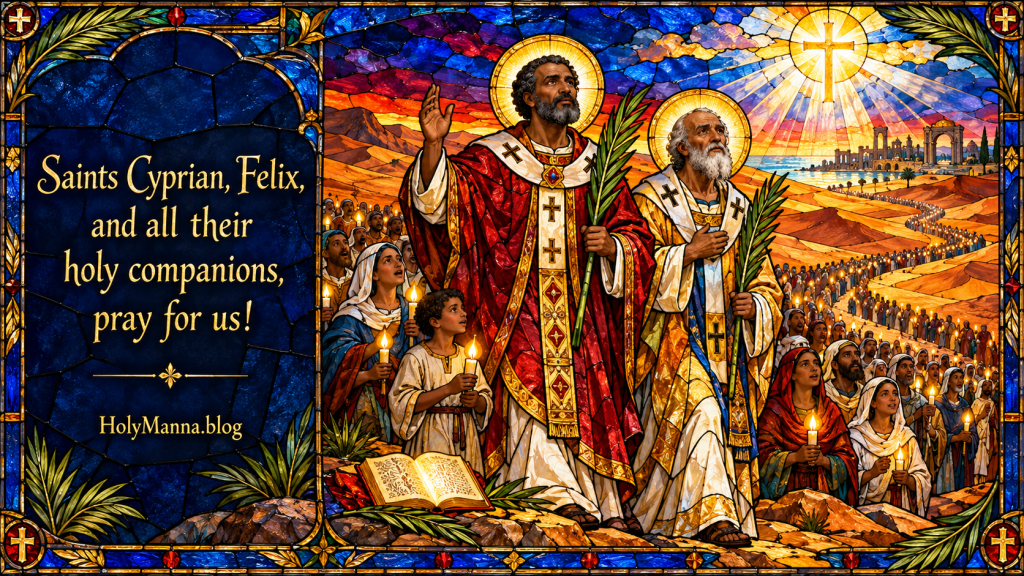
Singing Into the Desert
Every October 12th, the Church pauses to remember one of the most staggering acts of collective courage in her history. The Roman Martyrology for this day commemorates “four thousand nine hundred and sixty-six holy confessors and martyrs, in the persecution of the Vandals under the Arian king Hunneric”, a vast company of bishops, priests, deacons, and ordinary lay faithful who were driven out of their homes in Roman North Africa and marched into the Sahara because they refused to deny that Jesus Christ is true God. At the head of this company stand two bishops, Saint Cyprian and Saint Felix, whom the Martyrology names as the principal figures among them.
Their story is not the story of two famous individuals. It is the story of an entire local Church that chose exile, suffering, and death over a comfortable lie. In an age when faith often costs little more than an awkward conversation, these martyrs ask a piercing question of every believer. The Catechism teaches that “Martyrdom is the supreme witness given to the truth of the faith: it means bearing witness even unto death” (CCC 2473). Cyprian, Felix, and their 4,966 companions gave exactly that witness, and they gave it not in a single dramatic moment before a judge, but step by agonizing step along a desert road.
One important clarification belongs right at the start. The Cyprian honored on October 12th is not the famous Saint Cyprian of Carthage, the great third century bishop and Doctor of the early Church who was beheaded in the year 258 and is celebrated on September 16th. The Cyprian of October 12th lived more than two centuries later, under a very different persecutor, and his glory is of a different kind, quieter, hidden, and bound up with thousands of others.
Two Shepherds of a Suffering Church
Honesty demands a plain admission at the outset of their story. History has preserved almost nothing about the early lives of Cyprian and Felix. No source records their birthplaces, their parents, their childhoods, or the paths that led them to the priesthood and the episcopacy. What the Church knows of them comes almost entirely from one remarkable book, the History of the Vandal Persecution by Victor of Vita, an African churchman who lived through these events and wrote his account in or shortly after the year 484. Rather than inventing details that do not exist, it is better to understand the world that formed these two men, because that world explains everything about who they became.
Roman North Africa, the territory of modern Tunisia and Algeria, was one of the glories of ancient Christianity. This was the land of Tertullian, of Saint Cyprian of Carthage, of Saint Monica and her son Saint Augustine. Its councils shaped the Church’s understanding of the sacraments and of grace. Its martyrs, like Saints Perpetua and Felicity, were honored across the Christian world. By the early 400s, hundreds of bishops shepherded a dense network of dioceses across the African provinces.
Then the world broke. In 429, the Vandals, a Germanic people, crossed from Spain into Africa under their king Geiseric, and by 439 they had taken Carthage itself. The Vandals were not pagans. They were Arians, followers of the heresy that denied the full divinity of the Son of God, the very error the Council of Nicaea had condemned in 325. The Church confesses against that error that the Son of God is “begotten, not made, consubstantial with the Father” (CCC 465). For the Vandal kings, Arianism was not merely a theological opinion; it was the religion of the conquerors, and the Catholic faith of the Roman population was treated as disloyalty. Catholic clergy were exiled, churches were seized, and Catholic worship was choked off.
Geiseric died in 477 and was succeeded by his son Huneric, whose reign from 477 to 484 began with a measure of restraint and then descended into one of the most savage religious persecutions the Western Church had yet seen. Around the year 480, Huneric moved against Catholic clergy and consecrated virgins. By February of 484 he would issue a general edict against the Catholic faith and exile nearly all the Catholic bishops of Africa. It was in the years just before that edict, around 482 or 483, that the event commemorated on October 12th took place. The sources differ on the exact year, and that difference is noted here honestly rather than smoothed over.
Cyprian was bishop of a town called Unizibir, and Felix was bishop of a town called Abbir. Both towns lay in the African provinces under Vandal rule. Victor of Vita preserves one precious detail about Felix: he had served as a bishop for 44 years. A man does not shepherd a flock for 44 years through conquest, confiscation, and harassment without a faith forged in iron. Of Cyprian, the record shows his character through his actions, which the next section will tell. These were not young firebrands seeking glory. They were old, tested pastors who had already given their lives to Christ long before anyone asked them to die for Him.
Charity Poured Out on the Road to Exile
Huneric’s plan was as cruel as it was calculated. Rather than creating public martyrs in the cities, where the example of their courage might inspire the faithful, he ordered a mass deportation. A total of 4,966 people, the number Victor of Vita records and the Roman Martyrology preserves to the exact digit, were rounded up from across the African provinces. They were bishops and priests, deacons and religious, and with them a great multitude of ordinary lay believers, men and women whose only crime was fidelity to the Catholic faith. Victor records that they were concentrated in the towns of Sicca Veneria and Lares, packed into confinement so crowded and so filthy that the holding itself was a torture, before being handed over to Moorish escorts with orders to drive them south into the desert to die slowly, out of sight.
It is here, on this terrible road, that Saint Cyprian steps into the light of history. Victor of Vita relates that Cyprian, bishop of Unizibir, came to the exiles and gave them everything he had. He spent his time, his strength, and his material resources caring for the condemned, consoling them, strengthening the wavering, and encouraging them all to hold fast to the crown that awaited them. The account adds that he longed to share their fate fully. In the end, he received that wish; Cyprian was himself seized, exiled, and died of the brutal treatment he suffered. His whole recorded life is a single act of self-emptying charity.
Here the honesty that these saints deserve requires another plain statement. No miracles, in the sense of healings or wonders, are attributed to Cyprian or Felix in the sources, either during their lives or afterward. Readers who come to the lives of the saints expecting dramatic supernatural episodes will not find them here, and nothing will be invented to supply them. Yet in a deeper sense, what happened on that road was itself a work of God that no natural explanation covers. The Catechism teaches that “The disciple of Christ must not only keep the faith and live on it, but also profess it, confidently bear witness to it, and spread it” (CCC 1816). Nearly 5,000 people, from aged bishops to mothers with children, did exactly that under conditions designed to break every one of them, and they did it singing. Grace that sustains such endurance is no less an intervention of God than a healing. His power was made perfect in their weakness, exactly as Scripture promises.
And there was singing. Victor of Vita records that as the great column of confessors was driven along, they chanted the psalm verse “This is the glory of all his saints” (Psalm 149:9). Picture it honestly. Thousands of exhausted, terrified, bleeding people, stripped of homes, parishes, and futures, answering spears and stones with the Psalter. That detail alone explains why the Church has refused to forget them for more than 1,500 years.
The Long March of 4,966
The march itself was an engineered martyrdom. The Roman Martyrology describes it without flinching, recording that many of the exiles were “with sharp-pointed spears and stones forced to hasten their march”, while others, no longer able to walk, had their feet bound and were “dragged like corpses through rough places and mangled in all their limbs”. Victor of Vita, who gathered his account from eyewitnesses in those very years, adds that many died along the route and were buried where they fell, and that the survivors who reached the desert perished there under continued abuse, hunger, and exposure. The Martyrology sums up their end with sober majesty: they were tortured in different manners and won the honors of martyrdom.
Two scenes from Victor’s account deserve to be told in full, because they carry the whole meaning of this feast.
The first belongs to Saint Felix. The bishop of Abbir was by now an old man, and after 44 years of episcopal ministry he had been struck down by paralysis so complete that, in Victor’s description, he could neither feel nor speak. He was, by every worldly measure, harmless. Some around the king suggested the obvious, that the dying old man simply be left behind to end his days where he lay. Huneric refused any mercy. The paralyzed bishop would go into exile with the rest, and so Felix was tied crosswise over the back of a mule, strapped on like a piece of baggage, and carried into the desert with his people. The scene is grotesque, and it is also, read with the eyes of faith, strangely glorious. A man who could no longer preach a single word became one of the most eloquent preachers in the history of Africa. His silent, helpless body, carried toward death rather than surrendered to heresy, proclaimed the divinity of Christ louder than any sermon. In him the words of The Letter to the Hebrews about the persecuted faithful find a home: “of whom the world was not worthy, wandering over deserts and mountains” (Heb 11:38).
The second scene belongs to the people. As the column of confessors passed, crowds of the Catholic faithful poured out to meet them, carrying candles as if walking in a liturgical procession, because that is exactly how they understood the moment. Victor of Vita records that mothers held up their little children before the martyrs and cried out words to this effect: “To whom do you leave us in our misery, as you go on to your crowns? Who will baptize these little ones in the fonts of everlasting water?” That lament has echoed through the centuries, and it should pierce the modern reader as sharply as it pierced those who first heard it. These families were watching their entire sacramental life being marched away from them. No priests would mean no Baptism, no absolution, no Eucharist, no anointing of the dying. The Church teaches that in Baptism children are freed from the power of darkness and brought into the freedom of the children of God, which is why the Church and parents would deny a child “the priceless grace of becoming a child of God” were Baptism to be withheld soon after birth (CCC 1250). Those African mothers understood that teaching in their bones, and their cry is one of the most haunting testimonies to the value of the sacraments ever recorded.
Why did it all happen? Because these believers would not confess that the Son of God is a creature. That was the whole dispute. Huneric offered the usual bargain of persecutors, conformity in exchange for peace, property, and life. The 4,966 answered with their feet, their wounds, and their psalms. The Church calls some of them martyrs and some confessors, since some died on the road or soon after, while others endured prolonged suffering for the faith, and the Martyrology honors both together. In either case the witness is one, and it is the witness Jesus blessed in advance: “Blessed are those who are persecuted for righteousness’ sake, for theirs is the kingdom of heaven” (Matthew 5:10).
A Memory the Desert Could Not Bury
Huneric intended the desert to swallow these people and their memory together. He failed on both counts, and the manner of his failure is its own lesson.
No miracles are recorded at the tombs of Cyprian, Felix, and their companions, and no shrine rose over their graves, for the simple and sorrowful reason that most of them have no known graves at all. They were buried along a desert road or left where they fell. Yet the Church did for them what she has always done for her martyrs. The Catechism teaches that “The Church has painstakingly collected the records of those who persevered to the end in witnessing to their faith. These are the acts of the Martyrs” (CCC 2474). Victor of Vita’s History of the Vandal Persecution, written within a year or two of Huneric’s death, became exactly such a record, and through it the names of Cyprian and Felix, the count of 4,966, the strapped mule, the candles, and the mothers’ lament all survived. The Roman Church received their memory into the Roman Martyrology, where they have been commemorated on October 12th century after century, and where the 2004 Martyrologium Romanum commemorates them still.
Their relics have their own quiet afterlife. Relics identified as those of Saints Cyprian and Felix rest today in the reliquary chapel of the Basilica of the Sacred Heart at the University of Notre Dame in the United States, where students and pilgrims can venerate the remains of two African bishops who died 1,500 years before their university existed. There is no major pilgrimage attached to these saints, no national patronal festival, and no formally documented patronage. Their cult is of the oldest and simplest kind, the kind that predates formal canonization processes entirely, resting on the ancient and continuous veneration of the Church recorded in her Martyrology.
History also delivered its verdict on the persecution itself. Huneric died in December of 484, within roughly two years of the great deportation. The Vandal kingdom he tried to secure through religious terror lasted barely another half century before it was swept away in 533 and 534, and Catholic worship was restored across Africa. The Arianism for which he exiled 4,966 believers is today a historical footnote, while the Nicene faith those believers carried into the desert is confessed every Sunday by well over a billion Catholics in the very Creed the martyrs refused to abandon. The communion between those ancient sufferers and today’s Church is not a figure of speech. The Catechism teaches that the union of the pilgrim Church with the saints in heaven is a real exchange of spiritual goods, so that “the union of the whole Church in the Spirit may be strengthened” through devotion to their memory (CCC 957). Cyprian, Felix, and their companions are not characters in an old book. They are living members of the Body of Christ, interceding now for a Church that still suffers persecution in many lands.
When Faith Costs Something
It would be easy to file this story under ancient history and move on, but these martyrs have an uncomfortable amount to say to believers living right now.
Start with the obvious. Most Christians in the modern West will never face spears and forced marches, yet the underlying bargain Huneric offered has never gone out of circulation. Trim the faith here, stay quiet there, treat the divinity of Christ and the teachings of His Church as private opinions best kept indoors, and life gets smoother. The 4,966 refused a version of that same bargain when the asking price was everything. What is the asking price in your own life, and have you already been quietly paying it? The honest answer to that question is where imitation of these saints begins.
Saint Cyprian offers a model for anyone who feels helpless in the face of suffering they cannot stop. He could not cancel the deportation, overturn the king, or save a single life. So he did what he could do. He showed up, spent himself, and stayed. There is a profound vocation hidden in that pattern for every believer who has a friend in hospice, a family member in addiction, a parish in decline, or a suffering Church abroad they can barely help. Presence, generosity, and encouragement are not consolation prizes for people who cannot fix things; they are the very charity by which Christ Himself is served. Who in your life is on a hard road right now, and what would it look like to walk beside them this week with your time, your resources, and your encouragement?
Saint Felix speaks to everyone whose usefulness the world has written off. Paralyzed, mute, and carried like cargo, he could produce nothing, and yet his mere perseverance in the faith became an imperishable sermon. Every elderly Catholic in a nursing home, every chronically ill believer offering up quiet days, every person who feels their faith amounts to simply enduring, should know Felix as a friend. Fidelity itself is fruitfulness. Where has God asked you simply to endure faithfully, and can you believe that this endurance is itself a powerful witness?
Finally, the mothers with their candles put a question to every Catholic parent and godparent. Those families grieved the loss of the sacraments as the loss of life itself. Many today have free access to Baptism, Confession, and the Holy Eucharist and treat them as optional extras. The Catechism teaches that the Eucharist is “the source and summit of the Christian life” (CCC 1324). A practical resolution worthy of this feast would be to receive the sacraments this week with something of the hunger those African families felt watching their priests disappear over the horizon. If the sacraments were taken from you tomorrow, what would you regret not having received today?
Engage With Us!
The story of Saints Cyprian, Felix, and their 4,966 companions deserves to be talked about, so readers are warmly invited to share their thoughts, reactions, and reflections in the comments below. Which moment of this story struck the deepest? Here are a few questions to spark the conversation.
- The exiles answered spears and stones by singing Psalm 149. What is your honest first response when suffering enters your life, and what would it take to make praise part of that response?
- Saint Cyprian could not stop the persecution, so he poured himself out in charity instead. Who is one person you could serve this week in a situation you cannot fix?
- Saint Felix witnessed to Christ without being able to move or speak. Have you ever experienced, or seen in someone else, a faith that preached powerfully through simple endurance?
- The African mothers wept over losing access to Baptism and the other sacraments. How would your appreciation of the Mass change if you could no longer attend freely?
- The 4,966 were ordinary clergy and laypeople, not famous heroes. What does their collective witness say about what God can do with an ordinary parish community that refuses to compromise?
These nearly 5,000 martyrs walked into the desert with nothing left but Christ, and they discovered that He was enough. Their feast is a summons to live boldly for the same Lord, to cling to the sacraments He gave His Church, and to spend each day, as they spent their last ones, with the love and mercy that Jesus taught us.
Saints Cyprian, Felix, and all their holy companions, pray for us!
Follow us on YouTube, TikTok, Instagram and Facebook for more insights and reflections on living a faith-filled life.


Leave a Reply