The First Millennial Saint
Every generation of the Church produces saints who look like that generation, and on September 7th, 2025, in a packed Saint Peter’s Square, Pope Leo XIV gave the millennial generation its first. Saint Carlo Acutis was a Milanese teenager who wore jeans and sneakers, played video games, laughed at his own home movies, and taught himself to code. He also attended Mass every single day, made a holy hour before the tabernacle, prayed the Rosary without fail, and spent his short life building a digital exhibition on the Eucharistic miracles of the world that has since traveled to thousands of parishes on five continents. He died of fulminant leukemia on October 12th, 2006, at just 15 years old, and in less than two decades the Church raised him to the altars, with his memorial now kept on October 12th, the day he entered eternal life. The press calls him “God’s influencer.” The Church calls him something far better, a saint, which the Catechism explains is the Church’s solemn recognition that a person “practiced heroic virtue and lived in fidelity to God’s grace” (CCC 828). His whole witness can be summed up in the saying that defined him, one he repeated so often that Pope Francis quoted it in a papal exhortation: “All of us are born as originals, but many of us die as photocopies” (Christus Vivit 106). Carlo refused to be a photocopy, and he shows every young Catholic scrolling through a noisy world how to refuse it too.
A Mother Converted by Her Son
Carlo Acutis was born in London on May 3rd, 1991, to Andrea Acutis and Antonia Salzano, Italian parents living in England for work. A few months later the family returned to Milan, and that elegant, busy, thoroughly modern city became the backdrop of his entire life. The Acutis home was comfortable and loving, but it was not especially religious. His mother has said openly, in interviews given around his beatification and canonization, that before Carlo she had been to Mass only a handful of times in her life. According to the family’s own testimony, a Polish caregiver in the household named Beata helped nurture the little boy’s first prayers and his tenderness toward Our Lady; since this account has come down through the family’s recollections rather than independent documentation, it is best received as their cherished account of how grace first reached him.
What is beyond dispute is what happened next. From early childhood Carlo was drawn to Jesus with a directness that startled the adults around him. He asked to visit churches they passed on walks. He brought flowers to statues of the Blessed Mother. He asked questions about God that his mother could not answer, and her search for answers became her own return to the faith. She has repeatedly credited her son as, in effect, her evangelist, a living illustration of what the Catechism teaches about the home, that “the Christian family is the first place of education in prayer” (CCC 2685), even when, in God’s humor, the teacher turns out to be the child.
By special permission, Carlo received his First Holy Communion at age 7, on June 16th, 1998, at the Bernaga monastery of the Romite Ambrosiane outside Milan. That day set the course for everything that followed. From then on he resolved to attend Mass daily whenever he could, to make time in adoration before or after Mass, to confess weekly, and to pray the Rosary every day. He later attended the Jesuit-run Istituto Leone XIII in Milan, where classmates remembered him not as a plaster statue of piety but as the kid who defended the bullied, befriended the disabled, and made everyone laugh. He was, by every account, startlingly normal. That is precisely the point of his sainthood.
The Highway to Heaven
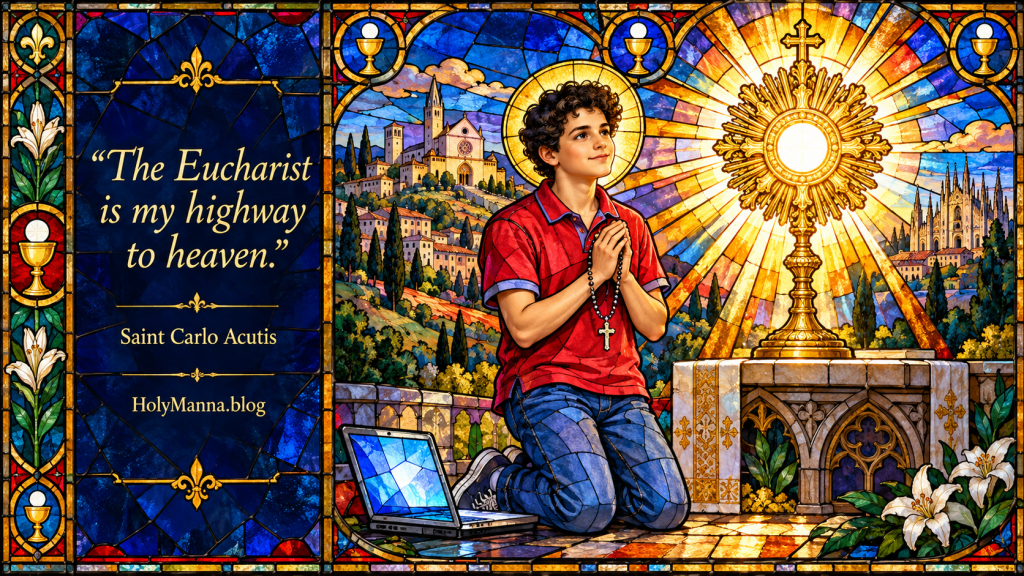
If one sentence unlocks Saint Carlo Acutis, it is the one he made famous: “The Eucharist is my highway to heaven.” For Carlo this was not a slogan but a daily itinerary. The Church teaches that the Eucharist is “the source and summit of the Christian life” (CCC 1324), and that in it “the body and blood, together with the soul and divinity, of our Lord Jesus Christ and, therefore, the whole Christ is truly, really, and substantially contained” (CCC 1374). Carlo believed that with the simplicity of a child and the seriousness of a theologian. He reasoned that if people truly understood who waits for them in the tabernacle, the lines for Communion would look like the lines outside a stadium. So he set out to help them understand, using the one tool his generation knew best.
Carlo was a self-taught programmer. As a boy he worked through university-level computing textbooks for fun, learned to build and manage websites, and did graphic design and video editing that impressed adults in the field. He put all of it at the service of the Gospel. He built and maintained the website for his parish, Santa Maria Segreta, and volunteered his skills for the Pontifical Academy Cultorum Martyrum in Rome. Then, beginning around age 11 and working over roughly two and a half years with his family’s help, he researched and catalogued the Eucharistic miracles recognized by the Church across the centuries, from Lanciano to Buenos Aires, and built a website presenting them. The project grew into a physical panel exhibition, The Eucharistic Miracles of the World, which premiered in 2005 during the Year of the Eucharist proclaimed by Pope Saint John Paul II. Since then it has been hosted by thousands of parishes, shrines, and schools on five continents, almost certainly the most widely traveled catechetical exhibition of the internet age, designed by a teenager who never lived to see its reach.
There are no miracles attributed to Carlo during his lifetime, and his cause never claimed any. What the Church documented instead was something quieter and, in its way, more demanding: heroic charity woven into an ordinary week. He saved his allowance to buy sleeping bags for Milan’s homeless and went out with hot drinks and food for them. He tutored classmates who were struggling. He stood between bullies and their targets. He befriended Rajesh, the family’s Hindu household helper, with such warmth and such transparent joy in his faith that Rajesh asked to be baptized and entered the Catholic Church, later testifying publicly that Carlo’s witness had converted him. The Catechism teaches that the works of mercy are “charitable actions by which we come to the aid of our neighbor in his spiritual and bodily necessities” (CCC 2447), and Carlo practiced both kinds before he was old enough to drive.
He was also, and this must be said plainly because it is what makes him so believable, a regular teenager. He loved soccer, his dogs and cats, his saxophone, and comedy videos he filmed with his pets. He loved video games, and here is the detail that lands hardest with anyone who has ever lost an evening to a screen: he limited himself to one hour of gaming per week, not because anyone forced him to, but as a freely chosen discipline, because he understood that attachments shrink the heart. He warned friends that the internet could enslave as easily as it could evangelize. Pope Francis saw in this the heart of his witness, writing that Carlo “knew how to use the new communications technology to transmit the Gospel, to communicate values and beauty” (Christus Vivit 105). The tool was never the point. The Person was. As Pope Leo XIV preached at the canonization, quoting the saint’s own refrain: “Not I, but God.”
Ten Days in October
Saint Carlo Acutis was not a martyr, but his final days were a passion all the same, compressed into little more than a week. At the start of October 2006, the 15-year-old came down with what everyone assumed was the flu. It was not. Doctors at San Gerardo Hospital in Monza diagnosed acute promyelocytic leukemia, one of the most aggressive forms of the disease, and it moved with terrible speed. Some popular summaries stretch or compress this timeline, but the reliable accounts agree that from diagnosis to death was a matter of days.
What stunned the adults around him was his serenity. When his mother tried to comfort him, he comforted her. He told his parents he was happy to die without ever having wasted a minute on things that displease God. And he spoke the sentence that his family treasured and his cause preserved: “I offer all the suffering I will have to suffer to the Lord, for the Pope and the Church.” A boy of 15 said that from a hospital bed. In doing so he lived out, without ever having studied it, what the Catechism teaches about redemptive suffering, that by his Passion Christ “has given a new meaning to suffering: it can henceforth configure us to him and unite us with his redemptive Passion” (CCC 1505). Carlo declined extraordinary fuss, endured the brutal progression of the disease with patience, and asked for one thing: to be buried in Assisi, the city of Saint Francis, the place where he said he felt happiest. He died on October 12th, 2006. Even his funeral preached: the church overflowed with the poor, the homeless, and the immigrants he had quietly served, people his own parents barely knew he knew.
A Glass Tomb in Assisi
The Church teaches that the saints in heaven “do not cease to intercede with the Father for us” and that “their intercession is their most exalted service to God’s plan” (CCC 956). With Carlo, that intercession showed itself quickly, and the Church tested it with her full rigor.
The first approved miracle occurred in Campo Grande, Brazil, on October 12th, 2013, seven years to the day after Carlo’s death. A small boy named Matheus Vianna had been born with annular pancreas, a congenital malformation that made normal eating nearly impossible; he survived on liquids and vomited constantly, and surgeons saw no good options. At a prayer service where a relic of Carlo was present at the parish of Our Lady Aparecida, Matheus touched the relic and, in his own child’s words, asked to stop vomiting. That day he ate a full meal, kept it down, and never relapsed. Subsequent examinations found no trace of the anomaly. The Vatican’s medical consultors reviewed the case and gave a positive judgment in November 2019, and Pope Francis approved the miracle in February 2020, opening the way to beatification. Carlo was beatified on October 10th, 2020, at the Basilica of Saint Francis in Assisi.
The second approved miracle came from Florence. On July 2nd, 2022, Valeria Valverde, a 21-year-old Costa Rican student, fell from her bicycle and suffered catastrophic head trauma requiring emergency brain surgery; her family was told she could die at any moment. On July 8th her mother made a pilgrimage to Carlo’s tomb in Assisi and left a written note begging his intercession for her daughter. That very day, Valeria began breathing on her own. The next day she recovered the use of her arms and some speech. A scan on July 18th showed that the hemorrhagic contusion in her brain had disappeared, and against every medical prediction she needed only a single week of physical therapy. On September 2nd, 2022, Valeria and her mother returned to Assisi together to give thanks at the tomb. Pope Francis approved this second miracle on May 23rd, 2024. Both of these healings passed the Church’s formal scrutiny and stand as recognized miracles, not mere pious reports.
The canonization itself became one of the great Catholic events of the decade. Originally scheduled for April 27th, 2025, during the Jubilee of Teenagers, it was postponed when Pope Francis died on April 21st. Pope Leo XIV rescheduled it, and on September 7th, 2025, in the first canonization Mass of his pontificate, he declared Carlo Acutis and Pier Giorgio Frassati saints of the universal Church before a crowd reported at some 70,000 to 80,000 pilgrims, with Carlo’s parents and his younger twin siblings present. The Holy Father preached that the two young saints are an invitation to everyone, especially the young, “not to squander our lives, but to direct them upwards and to make them masterpieces,” and he warned with bracing clarity: “The greatest risk in life is to waste it outside of God’s plan.”
Devotion to Saint Carlo now circles the globe. His body rests in a glass tomb at the Shrine of the Renunciation, the Church of Santa Maria Maggiore in Assisi, exposed for veneration since 2019, vested exactly as he lived, in jeans, sneakers, and a track jacket. Millions of pilgrims have filed past it, with numbers surging through the 2025 Jubilee Year. Honesty, which Carlo would insist on, requires one clarification the Diocese of Assisi itself made publicly: his body is intact but it is not incorrupt, and the serene face pilgrims see is a lifelike silicone reconstruction. The Church does not need to exaggerate her saints, and she did not exaggerate this one. His heart was removed as a major relic and has traveled internationally, including to the National Eucharistic Congress in Indianapolis in 2024, where enormous crowds venerated it. Parishes, schools, and youth centers from Italy to the United States now bear his name, and his Eucharistic miracles exhibition continues to tour the world he never got to see, doing precisely what he built it to do.
Living Like Carlo in a Scrolling World
Saint Carlo Acutis is dangerous to excuses. He cannot be dismissed as a figure from a simpler time; he had a smartphone-adjacent life, a gaming console, a busy city, and secular surroundings, and he became a saint anyway, in 15 years, without ever doing anything the average reader could not do tomorrow morning. That is what Pope Leo XIV meant when he reminded the Church at the canonization that the saints are not remote marble figures, for “it all began when, while still young, they said ‘yes’ to God and gave themselves to him completely, keeping nothing for themselves.”
Start where Carlo started, with the Eucharist. He did not begin with a website; he began with daily Mass and silent time before the tabernacle, and everything else flowed from that. The Catechism calls prayer “the raising of one’s mind and heart to God” (CCC 2559), and Carlo raised his daily, on a schedule, the way other people hit the gym. When was the last time you sat in silence before the Blessed Sacrament with no agenda at all? Even 15 minutes a week in an adoration chapel would put a reader on Carlo’s highway.
Then look at his screens. Carlo did not demonize technology and did not worship it; he mastered it, which meant ruling it rather than being ruled by it. One hour of gaming a week was his freely chosen fence. What would an honest audit of your screen time reveal about what actually has your heart? The question is uncomfortable precisely because Carlo makes it unavoidable. A practical imitation might be as simple as one tech-free hour a day given back to prayer, family, or the poor, or using an online platform deliberately, even once a week, to share something true and beautiful about the faith instead of only consuming.
Finally, take his charity seriously. Sainthood for Carlo looked like sleeping bags, tutoring, and sticking up for the unpopular kid. Nothing cinematic, everything costly. Who in your daily orbit, at work, at school, in your building, is the person Carlo would have already befriended? The reader does not need to found an apostolate this week. The reader needs to notice one person. Carlo’s genius was refusing the lie that holiness is for someday and for someone else. Originals act now. Photocopies wait.
Engage With Us!
Saint Carlo Acutis proves that heaven is within reach of a teenager with a laptop, a Rosary, and a heart surrendered to the Eucharist, so he is certainly within reach of you. Share your thoughts and reflections in the comments below; this community grows stronger every time someone speaks honestly about the journey. Consider these questions as you pray with his story this week:
- Carlo called the Eucharist his highway to heaven. What concrete change to your week, starting with this one, would move the Mass from the edge of your schedule to the center of it?
- Carlo limited his gaming to one hour a week because he refused to let anything own him. What attachment, digital or otherwise, is quietly making a photocopy out of you, and what fence could you build around it?
- Carlo’s witness converted his own mother and the family’s Hindu helper without a single argument. Who in your life might be reached not by your debating skills but by your visible joy?
- Facing death at 15, Carlo offered his suffering for the Lord, the Pope, and the Church. What suffering in your life right now could you stop merely enduring and start offering?
- Carlo used his one real talent, computers, entirely for God. What is your one real talent, and what would it look like placed completely at the service of the Gospel?
However old you are, whatever you have wasted, and however ordinary your life feels, you were born an original, stamped with the image of God and destined for His presence. Go to Jesus in the Eucharist, let Him love you there, and then carry that love out the door to everyone He puts in your path, doing everything, as Jesus taught us, with His own mercy and love.
Saint Carlo Acutis, pray for us!
Follow us on YouTube, TikTok, Instagram and Facebook for more insights and reflections on living a faith-filled life.


Leave a Reply