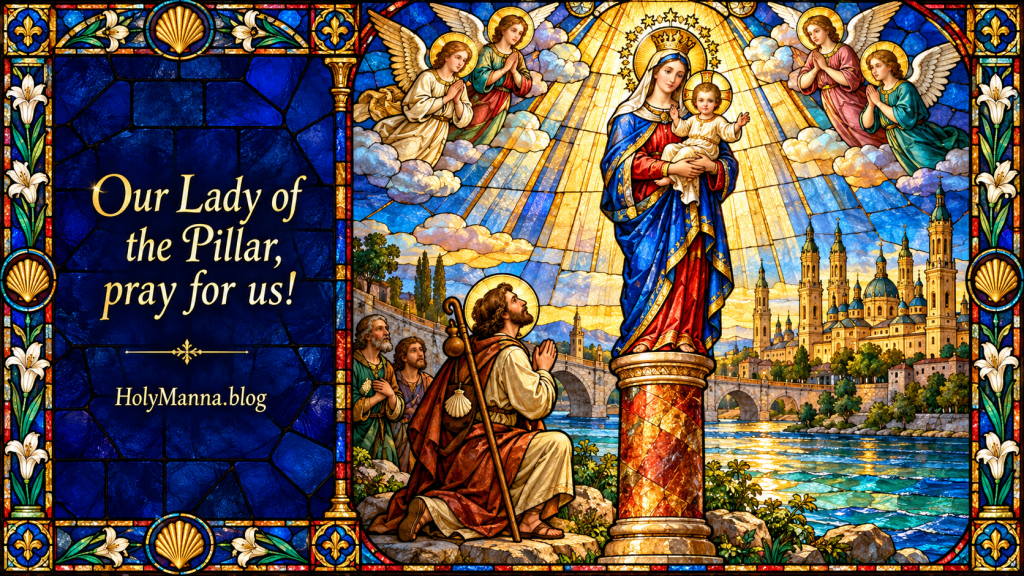
The Pillar on the Ebro
Every October 12th, the city of Zaragoza in northeastern Spain becomes the beating heart of the Hispanic Catholic world. Pilgrims fill the vast Plaza del Pilar, a mountain of flowers rises before a small carved image of the Virgin, and the bells of an immense baroque basilica ring out over the River Ebro. The celebration behind it all is Our Lady of the Pillar, Nuestra Señora del Pilar, kept as a Feast on the proper liturgical calendar of Spain and as a Solemnity in the Archdiocese of Zaragoza, where she is the principal patroness. According to a venerable tradition, the devotion reaches back to the year 40, when the Blessed Virgin Mary, still living her earthly life in the Holy Land, appeared on the banks of the Ebro to the Apostle Saint James the Greater to strengthen him in a mission that seemed to be failing. If that tradition is accurate, the little chapel Saint James then built became the first church in the world dedicated to the Mother of God.
Saint John Paul II stood in that sanctuary on November 6th, 1982, and declared that “The Pillar of Zaragoza has always been considered the symbol of the firmness of the faith of the Spanish people” (Homily at Zaragoza, November 6th, 1982, translated from the Spanish original). The celebration is central to Marian devotion because it gathers, into a single image, Mary’s maternal care for the Church’s missionaries, the apostolic roots of the faith in Spain, and the evangelization of an entire hemisphere that began, providentially, on this very date in 1492. The pillar has never moved; neither has the love of the Mother who stood upon it.
An Apostle Discouraged at the Edge of the Known World
The story begins after Pentecost, when the Apostles scattered across the earth in obedience to the Lord’s command: “Go into all the world and proclaim the gospel to the whole creation” (Mark 16:15). A tradition cherished in Spain since at least the early Middle Ages holds that Saint James the Greater, the son of Zebedee and brother of Saint John, one of the three Apostles closest to Jesus, carried the faith to Hispania, the Roman province at the western limit of the known world. Among its cities stood Caesaraugusta, a colony founded under the Emperor Augustus on the banks of the Ebro, today’s Zaragoza.
The mission was brutally hard. Tradition recounts that James found few converts among the pagans of the region, and that the small band of disciples who followed him, whom different accounts number at seven or eight, knew real exhaustion and discouragement. On the night of January 2nd in the year 40, according to the traditional dating, James was praying with his companions beside the river when heaven itself interrupted his discouragement; the next section tells that story in full. Afterward, the tradition continues, James built a modest chapel on the spot, roughly 16 feet long and 8 feet wide, left it in the care of his disciples, and returned to Jerusalem. There he became the first of the Apostles to die for Christ, beheaded under Herod Agrippa around the year 44, exactly as Scripture records: “He killed James the brother of John with the sword” (Acts 12:2). His relics came to rest at Santiago de Compostela, which grew into one of the great pilgrimage destinations of Christendom. Zaragoza and Compostela, the Pillar and Santiago, have formed the twin axes of Spanish spirituality ever since.
Honesty matters here. The apparition account is an ancient oral tradition; the earliest surviving written witnesses are 13th-century documents preserved at Zaragoza, including a manuscript dated 1297 kept in the archive of the Pilar. What is historically certain is that a church of Saint Mary stood in Zaragoza before the Muslim invasion of 711, and that when the city was reconquered in 1118 its bishop described that church as venerated from antiquity for its holiness and dignity, a detail Saint John Paul II himself recalled in his 1982 homily. A devastating fire in 1434 led to a Gothic-Mudéjar rebuilding completed in 1515, and the first stone of the present baroque temple was laid in 1686 on the feast of Saint James, with construction continuing for centuries afterward. Through every rebuilding, one thing never moved from its place: the column.
A Column of Jasper
What does the tradition actually describe? As James prayed in the darkness, he heard angels singing the greeting of Gabriel, Ave Maria, gratia plena, and then saw the Mother of God standing upon a column of jasper, radiant, accompanied by celestial light. She encouraged the weary Apostle, assured him that the faith of the people of that land would one day be as firm as the pillar on which she stood, and asked that a chapel be built there in her honor. Because the event, as tradition places it, occurred while Mary was still living on earth, years before her Assumption, Spanish piety treasures the striking detail that she came to Zaragoza “in mortal flesh,” en carne mortal; the commemoration of the Coming of the Virgin is still kept in Zaragoza every January 2nd.
The Church’s judgment should be stated plainly. The apparition of Our Lady of the Pillar is a pious tradition. It arose many centuries before the Church developed the formal procedures by which modern apparitions such as Lourdes or Fatima were investigated and approved, so it carries no canonical judgment of that kind, neither a formal approval nor any censure. What it has received instead is a long and remarkable series of marks of favor from the Holy See. A bull of Pope Callixtus III in 1456 granted indulgences to pilgrims visiting the sanctuary. On August 7th, 1723, the Sacred Congregation of Rites approved proper lessons recounting the tradition for the Divine Office of October 12th. In 1730 Pope Clement XII extended the Mass and Office of Our Lady of the Pillar to all of Spain and fixed the feast on October 12th, and Pope Pius VII raised its liturgical rank for Aragon in 1807. The Catechism of the Catholic Church keeps all of this in right order: private revelations “do not belong, however, to the deposit of faith,” and their role is “to help live more fully by it in a certain period of history” (CCC 67). No Catholic is bound to believe the apparition; every Catholic is invited to receive its message, which is simply the Gospel itself: Mary strengthens those who carry her Son to the world.
Her intercession under this title has a documented history that still astonishes. The most famous case is the Miracle of Calanda. Miguel Juan Pellicer, baptized in the Aragonese village of Calanda on March 25th, 1617, lost his right leg after a farm cart crushed it in 1637; surgeons at the royal hospital in Zaragoza amputated it below mid-thigh in late 1638. For over 2 years he begged at the doors of the sanctuary of the Pillar, attended Mass daily, and each day anointed his stump with oil from the lamps burning before the Virgin’s image. On the night of March 29th, 1640, back home in Calanda, his parents found him asleep with 2 legs; the amputated limb had been restored. A canonical process opened on June 5th, 1640, gathering sworn testimony that included the surgeons who had performed the amputation, and on April 27th, 1641, Archbishop Pedro Apaolaza of Zaragoza issued a formal sentence declaring that the restoration of the leg was not the work of nature but was wrought miraculously, and was to be recognized as a miracle. This is an official ecclesiastical approval, rendered after one of the most rigorously documented investigations of its kind, and the village of Calanda chose Our Lady of the Pillar as its patroness on April 22nd, 1641.
One more intervention is often recounted. On August 3rd, 1936, during the Spanish Civil War, bombs were dropped on the basilica and failed to explode; the casings are displayed in the temple to this day. The fact of the unexploded bombs is historical; their attribution to Our Lady’s protection is a matter of popular piety and carries no formal judgment of the Church. Through all of these accounts, one picture emerges clearly: Mary acts as mother, intercessor, and model of faith, deepening the Church’s understanding that her entire mission is to support the mission of her Son.
Why a Pillar? The Theology Beneath the Stone
The image of a pillar is not decorative; it is a compact theology lesson. In the Old Testament, God guided Israel through the wilderness by “a pillar of cloud by day” and “a pillar of fire by night” (Exodus 13:21), and Saint Paul calls the Church “the pillar and foundation of truth” (1 Timothy 3:15). Saint John Paul II noted that Spanish Christians have long seen in the Pillar of Zaragoza an analogy with that column which guided the pilgrim people of Israel toward the Promised Land, an analogy echoed in the proper Mass of the feast (Angelus, November 15th, 1987). Mary is the creature in whom the Church’s firmness is first realized, because she is the first and most perfect believer. The Catechism teaches that “The Virgin Mary most perfectly embodies the obedience of faith” (CCC 148), and holds her up as the one who persevered in the pilgrimage of faith even to the Cross (CCC 149, 165; Lumen Gentium, 58).
Everything in this feast flows from the central Marian dogma: Mary is truly the Mother of God, for the one she conceived by the Holy Spirit is the eternal Son of the Father (CCC 495). At Zaragoza in 1982, Saint John Paul II reminded Spain that its oldest great Marian treatise was a defense of her perpetual virginity by Saint Ildephonsus of Toledo, a Church Father of the 7th century, who wrote that Mary is “Virgin before the coming of the Son, virgin after the generation of the Son, virgin with the birth of the Son, virgin after the birth of the Son” (De Virginitate Perpetua Sanctae Mariae, 1, cited in the Homily at Zaragoza, 1982). The Church confesses exactly this when she calls Mary “Ever-virgin” (CCC 499).
The Pillar also illuminates Mary’s motherhood of the Church. The Catechism quotes Saint Augustine, who calls her “clearly the mother of the members of Christ” (CCC 963), and teaches that her union with her Son in the work of salvation continued “from the time of Christ’s virginal conception up to his death” (CCC 964). The scene by the Ebro dramatizes paragraph 969 in advance: “Taken up to heaven she did not lay aside this saving office but by her manifold intercession continues to bring us the gifts of eternal salvation” (CCC 969, citing Lumen Gentium, 62). At the Pillar, tradition shows her exercising that maternal care even before her Assumption, encouraging an apostle as she once prayed with the Apostles awaiting Pentecost (Acts 1:14; CCC 965).
Nor is the devotion ever about Mary in isolation. Saint Paul VI wrote in Marialis Cultus that “in the Virgin Mary everything is relative to Christ and dependent upon him” (Marialis Cultus, 25), a line Saint John Paul II quoted at the Pillar itself. The image venerated in Zaragoza shows Mary holding the Child and presenting him to the world, and the Pope drew out its meaning: she, with her Son in her arms, shows him unceasingly as “the way, and the truth, and the life” (John 14:6; Homily at Zaragoza, 1982). Her last recorded words in Scripture are the whole program of Marian devotion: “Do whatever he tells you” (John 2:5), words Saint Paul VI described as a permanent exhortation to openness to Jesus’ teaching (Marialis Cultus, 57). This is why the Catechism can say that devotion to the Blessed Virgin is intrinsic to Christian worship while remaining essentially distinct from the adoration given to God alone (CCC 971), and why Saint John Paul II could present Mary as the one who goes before the People of God on their pilgrimage of faith (Redemptoris Mater, 25-28). The Council summed her up as “a sign of certain hope and comfort to the pilgrim People of God” (Lumen Gentium, 68). A pillar, in other words: fixed, load-bearing, and pointing upward.
Kissing the Pillar
The Cathedral-Basilica of Our Lady of the Pillar dominates the Zaragoza skyline with its 4 towers and 11 brightly tiled domes, and it ranks among the most visited Marian sanctuaries on earth. Since 1675 it has shared cathedral status with the nearby Seo of San Salvador, and in 1948 Pope Pius XII honored it with the title of minor basilica. Inside, the devotional heart of the temple is the Santa Capilla, the Holy Chapel designed in the 18th century by Ventura Rodríguez under a project approved by King Ferdinand VI in 1751. Even the great Francisco de Goya, a son of Aragon, left his mark, painting frescoes in the basilica’s vaults.
There stands the column itself, a shaft of jasper about 6 feet tall, sheathed in bronze and silver, and upon it the beloved image: a late-Gothic carving of Mary with the Child Jesus, scarcely 15 inches high, dating to the 15th century. On the back of the chapel an oval of the bare jasper is left exposed, and for centuries pilgrims have lined up to kiss it; the stone is visibly worn by millions of lips. The image is clothed in ornate mantles that change with the liturgical seasons, except on the 2nd, 12th, and 20th of each month, when the Virgin appears without a mantle to commemorate the traditional apparition of January 2nd, the feast of October 12th, and the canonical coronation of May 20th, 1905, carried out with the authorization of Pope Saint Pius X and a crown he himself blessed.
Devotion around the Pillar has produced a whole ecosystem of confraternities and practices. The Corte de Honor de Damas, a women’s association founded in 1902, maintains a daily guard of honor and prayer before the Virgin, and the Caballeros de Nuestra Señora del Pilar, founded in 1928, do the same among men. Children have their own place too: the Infanticos, the boy choristers of the Pillar, sing at the Misa de Infantes celebrated in the Santa Capilla at dawn on the feast. Novenas, the daily Rosary, votive oil lamps like the ones that burned beside Miguel Juan Pellicer, and the simple act of entrusting a family, a job search, or a vocation to the Virgin of the Pillar continue to form pilgrims in the habits of trust. The devotion long ago crossed the oceans as well; in Zamboanga in the Philippines, the ramparts of the 17th-century Fort Pilar now serve as an open-air shrine where crowds pray to Our Lady of the Pillar every day, and churches under this title stand across Latin America, including the splendid 18th-century church of Nuestra Señora del Pilar in the Recoleta district of Buenos Aires. Pilgrimage to Zaragoza itself often weaves into the Camino, since the roads to Santiago and the river of the Pillar belong to the same apostolic geography.
Flowers on the Plaza, Faith Across an Ocean
Few Marian feasts have shaped a culture as visibly as this one. In Zaragoza, the Fiestas del Pilar transform the city for more than a week around October 12th, opening with a proclamation from the City Hall balcony. The summit of it all is the Ofrenda de Flores on the feast itself, when hundreds of thousands of people in the traditional dress of Aragon and of regions across Spain and Latin America process for hours through the Plaza del Pilar, each handing over flowers that are mounted into a towering floral mantle around an elevated image of the Virgin. The next day, October 13th, brings the Ofrenda de Frutos, an offering of the fruits of the harvest that are afterward given to the poor, and in the evening the Rosario de Cristal fills the streets, a luminous procession of glass floats depicting the mysteries of the Rosary. Through it all echoes the jota, the soaring folk song of Aragon, whose most famous verses are sung directly to the Virgin of the Pillar as declarations of a people’s loyalty to their Mother.
The reach of the feast extends far beyond Aragon because of a providence of history. On October 12th, 1492, the feast of the Pillar, the ships of Christopher Columbus first sighted land in the New World, and the evangelization of an entire hemisphere began under the sign of this Marian date. Spain keeps October 12th as its National Day, and much of the Spanish-speaking world marks the Día de la Hispanidad on the same date. The Church reads that coincidence through the eyes of faith: Saint John Paul II, arriving in Zaragoza on October 10th, 1984, before flying on to Santo Domingo to open the novena of years preparing the 5th centenary of the evangelization of America, said he had come to prostrate himself before the Virgin of the Pillar, Patroness of the Hispanidad, and preached that “here, in the firm and most ancient tradition of the Pillar, shines the apostolic dimension of the Church” (Homily at Zaragoza, October 10th, 1984, translated from the Spanish original). Pope Pius XII, in his radio message of October 12th, 1954, to Spain’s National Marian Congress gathered at Zaragoza, likewise held up the Virgin of the Pillar as uniquely rooted in the heart of her people, and he is reported to have extended the proper Mass of the feast to the Spanish-American nations.
The cultural footprint shows up in countless concrete ways. Pilar remains a beloved name for daughters across the Hispanic world. The nations of Latin America have donated mantles for the Virgin’s image, a wardrobe of the Americas kept at Zaragoza. Since the royal order of February 8th, 1913, Our Lady of the Pillar has been the patroness of Spain’s Guardia Civil, a formally documented patronage that the corps renews at her shrine. Kings and commoners alike have knelt at the column: Charles II declared her patroness of the Kingdom of Aragon in 1678, and the city of Zaragoza bound itself to her patronage in the 1640s and 1650s, with sources recording civic acts in both 1642 and 1653. Wherever Spanish is prayed, from Manila to Buenos Aires to San Antonio, the Pillar stands quietly behind the faith that got there.
Building a Life That Does Not Fall
Here is where the story stops being about the year 40 and starts being about you. Think about what Saint James was experiencing on that riverbank: he had left everything for Christ, worked himself to exhaustion, and had almost nothing to show for it. Perhaps you know that feeling, in a job that seems fruitless, a family member who wants nothing to do with the faith, a parish ministry that never grows, a prayer life that feels like dry stone. Notice carefully what Mary did and did not do. She did not remove the difficulty, hand James instant converts, or excuse him from his coming martyrdom. She came close, she encouraged him, and she left him something firm to build on. That is how the Mother of God usually works in a life: not by eliminating the battle, but by making sure you do not fight it alone. When discouragement comes for you, where do you turn first?
The Pillar also teaches something countercultural about firmness. The world between the ages of 20 and 45 is fluid by design: careers change, cities change, convictions are expected to bend with every trend. A pillar does one thing; it holds, so that something greater can be built upon it. Consider choosing 1 fixed point of daily prayer, a decade of the Rosary at the same time every day, Mass on a weekday, 15 minutes of Scripture before the phone comes out, and defending it the way Zaragoza defended its column through fire, invasion, and war. Small, immovable, load-bearing habits are how ordinary people become saints. Faith, after all, must become action, for “faith apart from works is dead” (James 2:26), and what counts is “faith working through love” (Galatians 5:6), the very verses Saint John Paul II preached at the Pillar.
Finally, become a pillar for someone else. Mary’s apparition was, at its core, a ministry of encouragement to a struggling missionary. Somewhere in your life there is a discouraged apostle: a friend drifting from the Church, a young parent drowning in responsibilities, a priest running on fumes. A text message, a Mass offered, an honest word of hope can be someone’s column of jasper this week. Entrust the effort to the Virgin of the Pillar with the very prayer Saint John Paul II left at her feet: “Increase our faith, strengthen our hope, enliven our charity” (Homily at Zaragoza, 1982). The Catechism promises that prayer in union with Mary can magnify the Lord with her and rely on her motherly intercession (CCC 2674, 2679); the Pillar simply gives that promise a shape you can touch.
Engage With Us!
Share your thoughts and reflections in the comments below. This story of a tired apostle, a faithful Mother, and a column that has outlasted empires belongs to the whole family of God, and hearing how it lands in your life encourages everyone who reads along.
- Saint James was exhausted and seemingly unsuccessful when Our Lady came to encourage him. Where in your life do you most need her encouragement right now?
- The pillar symbolizes firmness of faith. Which one fixed, daily spiritual habit could you commit to and defend, starting today?
- The Miracle of Calanda shows persevering prayer joined to the sacraments. How might you bring a long-standing intention before Jesus with Mary’s intercession this month?
- Mary’s words at Cana, recorded in The Gospel of John, were simply to do whatever Jesus says. What is one thing you sense Jesus telling you to do that you have been postponing?
- Who is the discouraged apostle in your life, and what concrete act of encouragement will you offer them before this feast ends?
Keep walking the road of faith with courage. The same Mother who steadied an apostle on the banks of the Ebro stands ready to steady you, and the pillar she left behind is a promise that grace does not crumble. May you live this feast with a heart full of trust, build your days on what cannot fall, and grow together in faith, one family of believers, under the guidance of our Blessed Mother.
Our Lady of the Pillar, pray for us!
Follow us on YouTube, TikTok, Instagram and Facebook for more insights and reflections on living a faith-filled life.


Leave a Reply