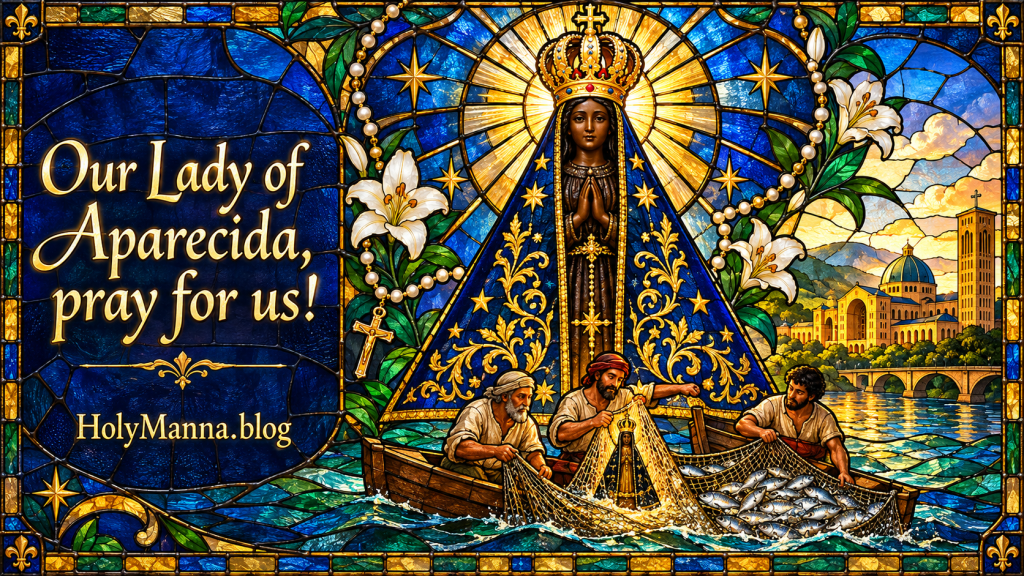
The Mother Who Rose from the River
Every October 12th, Brazil, the largest Catholic nation on earth, pauses to honor a dark terracotta image of the Blessed Virgin Mary that stands less than 40 centimeters tall. The celebration of Our Lady of Aparecida, known in Portuguese as Nossa Senhora da Conceição Aparecida, Our Lady of the Conception Who Appeared, is kept as a Solemnity on the liturgical calendar approved for Brazil and as a civil holiday for a country of more than 200 million people. The day commemorates an event that began not with a heavenly vision or a spoken message, but with 3 poor fishermen, an empty net, and a broken statue drawn from the waters of the Paraíba River in 1717.
The name itself tells the story. “Aparecida” means “appeared,” because the image appeared in the nets of men who had caught nothing all day. From that humble beginning grew the largest Marian shrine in the world, a devotion embraced by princesses and enslaved people alike, and a title of Mary that 3 popes have traveled in person to honor. When Pope Francis arrived at the shrine on July 24th, 2013, he opened his homily with words that capture what this celebration means to an entire people: “What joy I feel as I come to the house of the Mother of every Brazilian, the Shrine of our Lady of Aparecida!” (Homily at the Shrine of Aparecida, July 24th, 2013).
Marian celebrations like this one are never detours from the Gospel. The Catechism of the Catholic Church teaches that “the Church’s devotion to the Blessed Virgin is intrinsic to Christian worship” (CCC 971). Honoring Mary under the title of Aparecida leads directly to her Son, because the image pulled from the river is an image of the Immaculate Conception, the first and most perfect fruit of Christ’s redeeming grace. What follows walks through the history, the miracles, the theology, and the devotion that surround Brazil’s beloved Mother, and what her story offers to anyone who has ever hauled up an empty net.
The Catch That Changed Brazil
The year was 1717, and colonial Brazil was in the grip of a gold rush. Fortune seekers streamed inland toward the mines of Minas Gerais, and the road to the gold country ran through the Paraíba Valley. That October, Dom Pedro de Almeida e Portugal, the Count of Assumar and Governor of the Captaincy of São Paulo and Minas Gerais, was traveling to Vila Rica, the heart of the mining region. Records preserved by the Shrine of Aparecida place his visit to the village of Santo Antônio de Guaratinguetá between October 17th and 30th, 1717. A visit from the governor demanded a banquet, and a banquet demanded fish, so the townspeople sent their fishermen to the river even though it was the wrong season for a good catch.
Among them were Domingos Garcia, Filipe Pedroso, and João Alves, 3 ordinary men facing a long day of failure. They worked the Paraíba River for hours without success, beginning near the port of José Correa Leite and moving roughly 6 kilometers downstream to a spot called Porto Itaguaçu. The earliest written account of what happened next comes from Father José Alves Vilela, vicar of Guaratinguetá from 1725 to 1745, who recorded the memory of the community. Describing João Alves at Itaguaçu, the account reads: “he took out the body of the Lady, headless; and having cast the net lower again, he took the head of the same Lady, never knowing who cast it there” (account of Father José Alves Vilela). The 2 pieces fit together perfectly. What the river had surrendered was a small terracotta image of Our Lady of the Immaculate Conception, darkened by its years in the water and most likely crafted in the 17th century.
What happened immediately afterward became the first wonder associated with the image. When the fishermen cast their nets again, the nets filled with so many fish that their canoes were in danger of sinking, and the banquet for the governor was supplied in abundance. The scene cannot help but echo The Gospel of Luke, where Simon Peter protests to Jesus, “Master, we toiled all night and took nothing! But at your word I will let down the nets” (Luke 5:5), and then hauls in a catch so great that the nets begin to break.
One honest note on dates belongs here. The shrine and the liturgical calendar keep October 12th as the day of the finding, and Brazilian law now fixes the national feast on that date. The earliest account, however, says only that the discovery took place in the second half of October 1717, and the governor’s visit is documented between October 17th and 30th. The precise day cannot be established with certainty, so October 12th stands as the Church’s chosen commemoration rather than a date proven by the records.
After the catch, the fishermen brought the pieces of the statue to Silvana da Rocha Alves, who was Domingos’s wife, Filipe’s sister, and João’s mother. She joined the body and head with wax and placed the image on a small altar in the family home. For roughly 15 years the statue remained with Filipe Pedroso and his household, and on Saturdays the neighbors gathered before it to pray the Rosary. Around 1733 the image passed to Pedroso’s son, who built a small oratory at Itaguaçu, and in 1737 the vicar of Guaratinguetá raised a chapel on the Morro dos Coqueiros, the Hill of the Coconut Palms, where public devotion began in July 1745. From that day to this, the crowds have never stopped growing.
Mother and Intercessor
A point worth making clearly from the start: Aparecida is not an apparition in the usual sense. The Blessed Virgin never appeared visibly and never spoke a message at the Paraíba River. What “appeared” was her image, rising from the water into the nets of the poor. For this reason the Church has never issued the kind of formal judgment given to reported apparitions such as Lourdes or Fatima, because there was no reported apparition to judge. The finding of the image in 1717 is a documented historical event. What the Church has done, across 3 centuries, is approve and encourage the devotion itself through the most authoritative acts available to her: a canonical coronation authorized by Pope Saint Pius X in 1904, the proclamation of Mary under this title as Queen and Principal Patroness of Brazil by Pope Pius XI in 1930, the elevation of October 12th to a Solemnity on Brazil’s liturgical calendar, and the personal pilgrimages of 3 popes.
The graces and wonders attributed to Mary’s intercession at Aparecida belong to the realm the Catechism describes when it speaks of private revelation. Such favors are non-binding on the faithful, and the Catechism teaches of private revelations that “it is not their role to improve or complete Christ’s definitive Revelation, but to help live more fully by it in a certain period of history” (CCC 67). With that lens in place, the traditions of Aparecida can be told honestly. The miraculous catch of fish is recorded in Father Vilela’s early account and stands as the founding grace of the devotion. A second tradition, handed down at the shrine and known as the Miracle of the Candles, relates that during an evening of Rosary prayer in the first chapel, the candles before the image went out on their own and then relit by themselves before the eyes of those praying, and the shrine recounts that it greatly spread the devotion. A third account, a story told from the middle of the 19th century, concerns an enslaved man named Zacarias. Around 1850, bound in heavy chains, he passed the church where the image was kept and begged permission to pray before Our Lady. As he knelt, the story recounts, the chains opened and fell from his wrists. These traditions carry no individual canonical judgment; they are the devotional memory of a believing people, preserved and recounted by the shrine itself.
Why do accounts like these matter? Because they reveal how the faithful have experienced Mary under this title: as a mother who notices the exhausted, the enslaved, and the overlooked, and who brings their needs to her Son. The Catechism teaches that “taken up to heaven she did not lay aside this saving office but by her manifold intercession continues to bring us the gifts of eternal salvation”, and that for this reason “the Blessed Virgin is invoked in the Church under the titles of Advocate, Helper, Benefactress, and Mediatrix” (CCC 969). At Aparecida, Mary does what she did at the wedding feast of Cana. She sees the lack before anyone asks, she carries it to Jesus, and she tells every generation what she told the servants: “Do whatever he tells you” (John 2:5). The fishermen of 1717 had prayed to the Immaculate Conception before casting their nets, and the abundance that followed taught Brazil that her intercession is real, powerful, and always ordered to Christ.
The Immaculate Conception in River Clay
The little statue of Aparecida is not a generic image of Mary. It is an image of the Immaculate Conception, which means the entire celebration rests on one of the most Christ-centered truths the Church proclaims about the Mother of God. The Catechism states the principle plainly: “What the Catholic faith believes about Mary is based on what it believes about Christ, and what it teaches about Mary illumines in turn its faith in Christ” (CCC 487). When Blessed Pope Pius IX solemnly defined the dogma in Ineffabilis Deus in 1854, more than a century after the finding at the Paraíba, he confirmed what the fishermen had already been praying: that “the most Blessed Virgin Mary was, from the first moment of her conception, by a singular grace and privilege of almighty God and by virtue of the merits of Jesus Christ, Savior of the human race, preserved immune from all stain of original sin” (CCC 491, quoting Ineffabilis Deus). Mary’s sinlessness is not her own achievement; it is the first triumph of the Cross, applied to her in advance (CCC 490 to 493). Every pilgrim who honors the dark Madonna of Aparecida is, whether he knows it or not, celebrating the power of the Redeemer.
The celebration also illuminates Mary’s motherhood of the Church. Because she is truly the Mother of God, the Theotokos (CCC 495), and because from the Cross Jesus gave her to the beloved disciple with the words “Behold, your mother!” (John 19:27), the Church venerates her as mother of all the members of Christ (CCC 963). The Second Vatican Council devoted the entire 8th chapter of Lumen Gentium to this mystery, teaching that Mary’s maternal role takes nothing away from her Son’s unique mediation. The Catechism repeats the Council’s words: “Mary’s function as mother of men in no way obscures or diminishes this unique mediation of Christ, but rather shows its power” (CCC 970, quoting Lumen Gentium 60). Saint Paul VI’s apostolic exhortation Marialis Cultus of 1974 and Saint John Paul II’s encyclical Redemptoris Mater of 1987 develop the same teaching, insisting that authentic Marian devotion is biblical, liturgical, and always directed toward Christ. Popular devotions like Aparecida, rightly ordered, are precisely what Marialis Cultus sought to purify and encourage, and what the Catechism calls prayer sustained by the prayer of Mary and united with it in hope (CCC 2679).
The popes have attached their authority to this title again and again. On September 8th, 1904, with the authorization of Pope Saint Pius X, the image was solemnly crowned, a canonical coronation that marked the 50th anniversary year of the dogma of the Immaculate Conception. On July 16th, 1930, Pope Pius XI, through a decree signed by his Secretary of State, Cardinal Eugenio Pacelli, the future Pope Pius XII, proclaimed Our Lady of Aparecida Queen and Principal Patroness of Brazil, and on May 31st, 1931, the nation was solemnly consecrated to her. Saint Paul VI honored the shrine with a Golden Rose in 1967. On July 4th, 1980, Saint John Paul II became the first pope to visit Aparecida, consecrating the new basilica and opening his homily with the acclamation he had heard everywhere in Brazil: “Long live the Mother of God and ours, conceived without sin! Long live the Immaculate Virgin, Our Lady Aparecida!” (Homily at Aparecida, July 4th, 1980). The Immaculate Conception defined in Rome lives in the clay image of a Brazilian river, and the Church has judged that meeting to be a gift.
A House Built for Millions
The buildings tell the story of a devotion that refused to stop growing. The chapel of 1745 soon overflowed, and in 1834 construction began on a larger church on the Hill of the Coconut Palms, completed and inaugurated on December 8th, 1888, the feast of the Immaculate Conception. That church, known today as the Old Basilica, was raised to the rank of minor basilica in 1908 and still welcomes crowds of pilgrims. In 1894 the Redemptorist Missionaries arrived to serve the growing streams of the faithful, and the sons of Saint Alphonsus Liguori have cared for the shrine, its pastoral life, and its pilgrims ever since.
Even the Old Basilica proved too small. The cornerstone of a new basilica was laid on September 10th, 1946, major construction advanced from 1955, and on July 4th, 1980, Saint John Paul II consecrated the new church and granted it the title of minor basilica. The beloved image was transferred there on October 3rd, 1982, and in 1983 the National Conference of Bishops of Brazil declared it the National Shrine. Today the Basilica of the National Shrine of Our Lady of Aparecida is the largest Marian shrine in the world and, after Saint Peter’s in Rome, the largest Catholic church on earth, holding tens of thousands of worshipers at once. Estimates of annual pilgrims range from 8 million to 12 million, a range stated honestly because sources differ.
What do pilgrims actually do there? They do what the Catechism describes when it teaches about popular piety: “the religious sense of the Christian people has always found expression in various forms of piety surrounding the Church’s sacramental life, such as the veneration of relics, visits to sanctuaries, pilgrimages, processions” (CCC 1674). At Aparecida the sacraments stand at the center. Pilgrims attend Mass, wait in long lines for Confession, and pray the Rosary before the image, whose richly embroidered dark blue mantle and golden crown recall the gifts of Princess Isabel of Brazil in the 19th century; the mantles are changed to reflect the liturgical seasons. A traditional novena precedes October 12th each year. In the Room of Promises, pilgrims leave photographs, letters, crutches, and tokens of graces received. Every September 7th the shrine hosts the annual Pilgrimage of Workers, which draws laborers from across the country to entrust their work to the Queen who first revealed herself to working men.
The image itself has known suffering. In May 1978 an intruder seized the statue from the shrine, and it was shattered as he was apprehended. Restorers painstakingly reassembled the fragile terracotta, and the devotion of the faithful only deepened; the broken and repaired image seemed, if anything, closer to the people who loved her. Pilgrimage to Aparecida nourishes faith precisely by making the abstract concrete, placing the pilgrim’s feet on the road, his sins in the confessional, his intentions before the Mother, and his heart back in the hands of her Son.
When a Whole Country Stops for Its Mother
Few Marian celebrations shape a national culture the way Aparecida shapes Brazil. After Saint John Paul II’s visit in 1980, Brazilian law established October 12th as a national holiday in honor of Our Lady of Aparecida, and the date also coincides with Brazil’s Children’s Day, so the feast carries a family character that fills the shrine with parents and little ones. On the day itself, hundreds of thousands converge on the city of Aparecida. Masses begin before dawn and continue through the day, processions carry the image through seas of pilgrims, and the surrounding celebrations include theater performances, exhibitions, and community events. Many pilgrims arrive after days of walking or cycling along the roads of the Paraíba Valley, offering the journey itself as a prayer. Across the country, parishes keep the Solemnity with special Masses, and the acclamation Saint John Paul II quoted in 1980, hailing the Mother of God conceived without sin, still rings out wherever Brazilians gather to honor her. Her image stands in homes, shops, taxis, and roadside oratories from the Amazon to the southern border.
The title has also known hostility, and the response of the faithful says as much as the feast itself. On October 12th, 1995, a minister of a rival denomination mocked and struck a replica of the image on national television. The act wounded the country deeply, yet the result was not decline but an extraordinary surge of public love for the Mother of Brazil, with acts of reparation multiplying in the years that followed.
Aparecida’s influence now reaches far beyond Brazil. In May 2007, Pope Benedict XVI chose the shrine to inaugurate the Fifth General Conference of the Bishops of Latin America and the Caribbean, teaching in his homily that the Church does not grow by proselytism but “grows by ‘attraction’”, just as Christ draws all to Himself by the power of His love (Homily at Aparecida, May 13th, 2007). The bishops’ concluding text, known as the Aparecida Document, was drafted at the shrine under the coordination of then Cardinal Jorge Mario Bergoglio. When he returned 6 years later as Pope Francis, he told the pilgrims: “It can truly be said that the Aparecida Document was born of this interplay between the labours of the Bishops and the simple faith of the pilgrims, under Mary’s maternal protection” (Homily at the Shrine of Aparecida, July 24th, 2013). The tricentennial of the finding was celebrated in 2017 with national jubilation, and wherever Brazilians have emigrated, from the United States to Japan, chaplaincies and parish communities keep October 12th with processions, Brazilian hymns, and Masses in Portuguese, carrying the Queen of Brazil to the ends of the earth.
Casting the Net One More Time
The story of Aparecida begins where so many of your days end: with an empty net. The fishermen of 1717 had worked for hours with nothing to show for it, and it was precisely then, in the failure, that God chose to act. Maybe you know that feeling well: the job search that goes nowhere, the prayer that seems unanswered, the relationship you keep trying to mend, the habit you cannot seem to break. Aparecida whispers that the empty net is not the end of the story. What net have you stopped casting because the water seems empty? Pray Simon Peter’s words the next time you face a task that feels futile: “But at your word I will let down the nets” (Luke 5:5), and then cast again.
Notice, too, that the statue came up broken: the body first, then the head, joined with wax by a fisherman’s wife before the image was ever crowned with gold. God did not send Brazil a flawless masterpiece; He sent a broken image to poor men, and from that brokenness He built the largest Marian shrine on earth. Whatever is broken in you is not disqualified from grace. Bring it to Confession, where chains still fall the way the shrine’s story says they fell from Zacarias, and let the Lord do the restoring.
When Pope Francis stood before the image in 2013, he proposed “three simple attitudes: hopefulness, openness to being surprised by God, and living in joy” (Homily at the Shrine of Aparecida, July 24th, 2013). Those 3 attitudes are a practical program you can live this week. Hopefulness: begin each morning by entrusting the day’s hardest thing to God through Mary, perhaps with the Memorare. Openness to being surprised: say yes to one unplanned act of charity, the interruption that is really an invitation. Joy: thank God out loud, at the dinner table or in the car, for one concrete gift each day, because gratitude is joy spoken aloud.
Let Mary herself set the pattern. She received grace she did not earn, carried Christ to others in haste, and pointed everyone she met to her Son. You can imitate her this month in simple ways: pray a daily decade of the Rosary for your family, keep an image of Our Lady where you work as the Pedroso family kept hers at home, and gather friends to pray as the neighbors of Guaratinguetá gathered on Saturdays. If you are able, make a pilgrimage, even to a nearby church, and offer the trip for someone in chains of any kind. Compassion for the struggling, resilience in the long fruitless hours, and faith that casts the net once more: that is the school of Aparecida, and the Teacher is a Mother.
Engage With Us!
Share your thoughts and reflections in the comments below. Have you ever visited the Shrine of Aparecida, or do you keep a devotion to Our Lady under another title? Your story of an empty net that filled, or a chain that fell, might be exactly the encouragement another reader needs today. Take a moment with these questions and let one of them become your prayer this week:
- When has God surprised you in the middle of a failure, the way He surprised 3 fishermen at the end of a fruitless day?
- The fishermen cast their nets one more time after hours of nothing. Where is the Lord asking you to persevere in prayer right now?
- The image of Aparecida was found broken and was lovingly repaired before it was ever crowned. What brokenness in your life might God want to restore and then use for His glory?
- How does Mary’s Immaculate Conception, grace given entirely through the merits of Christ, deepen your trust in what His grace can do in you?
- What is one concrete devotion, a daily decade of the Rosary, the Memorare, or a small pilgrimage, that you can begin before October 12th?
Keep casting the net, friends. The same Mother who watched over 3 tired fishermen on the Paraíba River watches over every reader of these words, and she never tires of leading her children to Jesus. Live your faith boldly this week, bring someone with you to Mass, and keep growing together in faith under the guidance of our Blessed Mother.
Our Lady of Aparecida, pray for us!
Follow us on YouTube, TikTok, Instagram and Facebook for more insights and reflections on living a faith-filled life.


Leave a Reply