Monday of the Twenty-eighth Week in Ordinary Time – Lectionary: 467
When Heaven Stoops Down
Every so often a person discovers that the cell door was never locked. The chains were old habits, old fears, old debts already paid. That discovery sits at the heart of the readings for October 12th, Monday of the Twenty-eighth Week in Ordinary Time.
The Church is currently walking through The Letter to the Galatians, Saint Paul’s most passionate defense of the Gospel. Around the years 49 to 55, agitators had followed Paul into Galatia, a region of central Asia Minor, insisting that Gentile converts must be circumcised and keep the Law of Moses in order to be saved. Paul answers with a bold allegory drawn from The Book of Genesis: two mothers, two covenants, and one unshakable conclusion, namely that the baptized are children of the free woman, set free by Christ Himself.
Psalm 113 sings the melody underneath that argument. It is the first of the Hallel psalms, the Passover hymns Jesus Himself would have sung on the night before He died, and it praises the God who is enthroned above the heavens yet stoops down to lift the poor from the dust.
Then The Gospel of Luke delivers the warning. A crowd demands a sign, and Jesus offers only one: the sign of Jonah, His own death and Resurrection. Pagan Nineveh repented at far less. The queen of the south traveled across the known world for far less.
Here is the thread that ties the whole day together: the God who bends low to raise the lowly has set His children free in Christ, and the only fitting response is humble praise and wholehearted repentance, not sign-seeking, and not a quiet drift back into slavery.
First Reading — Galatians 4:22-24, 26-27, 31–5:1
Two Mothers, Two Covenants, and the Birth of the Free
Saint Paul founded the churches of Galatia on his missionary journeys, and he loved them like a father. Then word reached him that new teachers, often called the Judaizers, were convincing his converts that faith in Christ was not enough, and that salvation required circumcision and full observance of the Mosaic Law. For Paul this was not a small dispute over customs. It was a different gospel altogether. In today’s passage he reaches the summit of his argument with a daring move: he rereads the family story of Abraham in The Book of Genesis as a living allegory of the two covenants. The reading fits the day’s theme perfectly, because it reveals a God who builds His family not on human strength but on promise, and who gives freedom as a birthright to be guarded.
Galatians 4:22-24, 26-27, 31–5:1
Brothers and sisters:
It is written that Abraham had two sons,
one by the slave woman and the other by the freeborn woman.
The son of the slave woman was born naturally,
the son of the freeborn through a promise.
Now this is an allegory.
These women represent two covenants.
One was from Mount Sinai, bearing children for slavery;
this is Hagar.
But the Jerusalem above is freeborn, and she is our mother.
For it is written:
Rejoice, you barren one who bore no children;
break forth and shout, you who were not in labor;
for more numerous are the children of the deserted one
than of her who has a husband.
Therefore, brothers and sisters,
we are children not of the slave woman
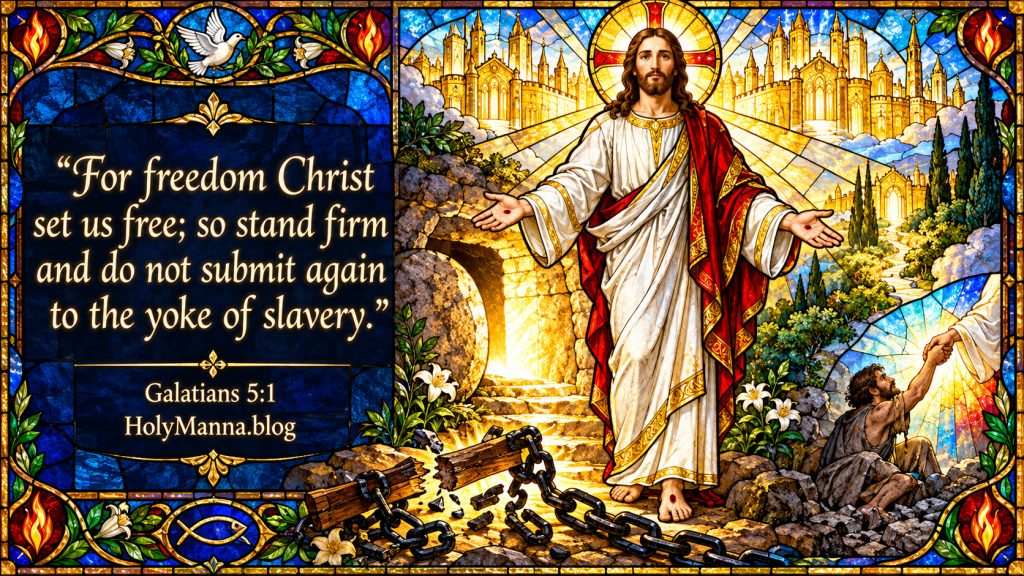
but of the freeborn woman.For freedom Christ set us free; so stand firm
and do not submit again to the yoke of slavery.
Detailed Exegesis
Verse 22: “It is written that Abraham had two sons, one by the slave woman and the other by the freeborn woman.”
Paul points back to Genesis 16 and Genesis 21. Ishmael was born to Hagar, Sarah’s Egyptian slave, and Isaac was born to Sarah herself. Saint John Chrysostom observes that Paul returns to Abraham because the patriarch’s fame was great among the Jews, and because the present reality of the Church was pictured beforehand in his household. The two sons are not merely ancestors. They are a prophecy.
Verse 23: “The son of the slave woman was born naturally, the son of the freeborn through a promise.”
Ishmael arrived through ordinary human effort, the attempt of Abraham and Sarah to force God’s plan along. Isaac arrived when Sarah was about ninety years old, long past hope, purely because God had spoken. Chrysostom marvels that a birth not after the flesh is “more marvellous and more spiritual.” Grace works precisely where human capacity has run out, which is very good news for anyone who has run out.
Verse 24: “Now this is an allegory. These women represent two covenants. One was from Mount Sinai, bearing children for slavery; this is Hagar.”
Paul is not denying the history. He is reading it the way the Church still reads the Old Testament, discovering in real events a deeper significance fulfilled in Christ. Hagar stands for the covenant of Sinai, which was holy and good, yet which could command obedience without conferring the power to obey. Law without grace leaves a soul enslaved to its own failures.
Verse 26: “But the Jerusalem above is freeborn, and she is our mother.”
Here stands one of the most tender titles of the Church in all of Scripture. The heavenly Jerusalem is not a distant city but a mother, bearing free children through Baptism. Every Catholic who has ever been carried to a font was carried into her arms.
Verse 27: “Rejoice, you barren one who bore no children; break forth and shout, you who were not in labor; for more numerous are the children of the deserted one than of her who has a husband.”
Paul quotes Isaiah 54:1, a song originally sung to Zion in exile, humiliated and seemingly abandoned. Chrysostom sees in the barren woman the Church drawn from the Gentiles, once without God and now astonishingly fruitful, whose children “have filled the country of the Greeks and of the Barbarians, the earth and sea, the whole habitable world.” The God of today’s Psalm, who lifts the lowly from the dust, is the same God who makes the barren woman sing.
Verse 31: “Therefore, brothers and sisters, we are children not of the slave woman but of the freeborn woman.”
Paul lands on identity. Before he gives a single command, he tells the Galatians who they are. Christian morality always works in that order. The baptized do not obey in order to become children of God. They obey because they already are.
Chapter 5, Verse 1: “For freedom Christ set us free; so stand firm and do not submit again to the yoke of slavery.”
The yoke was a wooden beam laid across the necks of oxen. Paul’s image is vivid: Christ has lifted the beam, and no one should ever help place it back on their own shoulders. Freedom, though, is not automatic. It must be defended with the posture of a soldier holding a line. Stand firm.
Teachings
The Catechism places this very verse at the center of its teaching on freedom. CCC 1741 declares: “Liberation and salvation. By his glorious Cross Christ has won salvation for all men. He redeemed them from the sin that held them in bondage. ‘For freedom Christ has set us free.’” Freedom, in Catholic teaching, is never license to do whatever one pleases. CCC 1733 explains: “The more one does what is good, the freer one becomes. There is no true freedom except in the service of what is good and just.”
The Church also treasures Paul’s maternal image. CCC 757 teaches that the Church is “that Jerusalem which is above” and is called “our mother.” Saint John Chrysostom, in his Homilies on Galatians, connects that motherhood directly to Baptism, teaching that in regeneration it is not nature but the words of God spoken by the priest “which in the Bath of water as in a sort of womb, form and regenerate him who is baptized.” Just as Isaac was born by promise rather than by human power, every Christian is born of water and the Spirit rather than of flesh.
Reflection
Slavery rarely announces itself. It usually creeps back in disguised as something respectable: perfectionism that treats God as a supervisor to appease, an old sin that keeps reclaiming its territory, an exhausting need for everyone’s approval, or a faith reduced to rule-keeping with no room left for love. Paul’s command is blunt and practical. Stand firm.
This week, name the one yoke you keep picking back up. Say it out loud in prayer. If it is sin, bring it to confession, where the children of the free woman are set free again. If it is fear or perfectionism, renew your baptismal promises slowly and deliberately, and let those words remind you whose child you are.
What yoke have you quietly submitted to again, even though Christ already lifted it from your shoulders? Do you relate to God more like a slave trying to earn a wage or like an heir who is already loved? What would standing firm in freedom look like in your home, your work, and your friendships this week?
Responsorial Psalm — Psalm 113:1b-7
The Hymn of the God Who Bends Low
Psalm 113 opens the Hallel, the collection of Psalms 113 through 118 that Jewish families have sung at Passover for well over two thousand years. When The Gospel of Mark records that Jesus and the Apostles sang a hymn after the Last Supper, these are almost certainly the songs they sang. That means this psalm of praise was on the lips of Jesus on the night He handed Himself over to set the world free. The Church places it today as the hinge between Galatians and Luke, because it names the pattern behind both readings: the Most High God delights to stoop down and lift up the lowly.
Psalm 113:1b-7
R. (see 2) Blessed be the name of the Lord forever.
or:
R. Alleluia, alleluia.
Praise, you servants of the LORD,
praise the name of the LORD.
Blessed be the name of the LORD
both now and forever.
R. Blessed be the name of the Lord forever.
or:
R. Alleluia, alleluia.
From the rising to the setting of the sun
is the name of the LORD to be praised.
High above all nations is the LORD;
above the heavens is his glory.
R. Blessed be the name of the Lord forever.
or:
R. Alleluia, alleluia.
Who is like the LORD, our God,
who looks upon the heavens and the earth below?
He raises up the lowly from the dust;
from the dunghill he lifts up the poor.
R. Blessed be the name of the Lord forever.
or:
R. Alleluia, alleluia.
Detailed Exegesis
Verse 1: “Praise, you servants of the LORD, praise the name of the LORD.”
The psalm summons servants, not celebrities. In Hebrew thought, to be a servant of the LORD was itself a title of honor, carried by Moses, David, and the prophets. Saint Augustine, preaching on this psalm, adds a sharp observation about who can actually obey this command, since “the proud know not how to praise Him.” Praise requires the humility of a child who knows the gift came from somewhere else.
Verse 2: “Blessed be the name of the LORD both now and forever.”
In Scripture the name stands for the person, and God’s revealed name was treasured by Israel as His personal gift. Augustine notices that the blessing begins now, at the very moment of speaking, and he urges the singer onward: “For you begin to praise, but praise ye without end.” Praise started today is meant to run straight into eternity.
Verse 3: “From the rising to the setting of the sun is the name of the LORD to be praised.”
The horizon of praise expands from this moment to every place on earth. The prophet Malachi picked up this very image to foretell a pure offering made to God among all the nations, and the Church has long seen that promise fulfilled in the Holy Mass, offered at every hour somewhere on the planet. At this very moment, the sun is rising on an altar.
Verse 4: “High above all nations is the LORD; above the heavens is his glory.”
Israel was a small nation squeezed between empires that worshipped sun, moon, and conquest. The psalmist answers all of them in a single line. Every throne, every superpower, and every trending ideology sits far below the glory of the LORD. This is not arrogance but relief, since no earthly power gets the final word over a human life.
Verses 5 and 6: “Who is like the LORD, our God, who looks upon the heavens and the earth below?”
The question expects the joyful answer that no one is like Him, and the reason is surprising. God’s incomparable greatness shows itself precisely in His willingness to look down, to notice, and to care. Augustine draws out the stunning conclusion that God “dwells in those whom He raises high, and makes them heaven for Himself.” The humble soul becomes God’s own address.
Verse 7: “He raises up the lowly from the dust; from the dunghill he lifts up the poor.”
The dunghill was the ash heap outside of town where the destitute scavenged and beggars sat, the very place where Job scraped his sores. This verse echoes the prayer of Hannah in The First Book of Samuel, a barren woman whom God made a mother, and it points forward to Mary, whose Magnificat in The Gospel of Luke sings that God “has thrown down the rulers from their thrones but lifted up the lowly.” One verse later, just past today’s selection, the psalm even praises God for giving the barren wife a home as a joyful mother of children, the very image Paul applies to the Church in the First Reading.
Teachings
The Catechism identifies what this psalm is doing and why it matters. CCC 2639 teaches: “Praise is the form of prayer which recognizes most immediately that God is God. It lauds God for his own sake and gives him glory, quite beyond what he does, but simply because HE IS.” Praise is love without an agenda. The Catechism also insists in CCC 2559 that “humility is the foundation of prayer,” which explains why this psalm belongs to servants and the lowly rather than to the proud.
The pattern of Psalm 113 finds its fullest expression in the Incarnation itself, when the Son who is high above all nations stooped lower than anyone, taking the form of a slave and accepting death on a cross, as Paul sings in The Letter to the Philippians. The God who lifts the poor from the dunghill did it by lying down in the dust Himself.
Reflection
Praise is the easiest prayer to postpone, because it asks for nothing and fixes nothing. That is exactly why it changes everything. A soul that begins the day with praise has already remembered who is God and who is not, before the inbox, the news, and the mirror make their competing claims.
Try a simple practice: pray Psalm 113 out loud once each morning this week, perhaps while the coffee brews. Then look for one lowly person to honor the way God does, whether the coworker nobody thanks, the elderly parishioner nobody greets, or the family member everyone takes for granted.
When was the last time you praised God simply because He is God, with no requests attached? Where do you see God bending low in your own story, lifting you from some dust you thought was permanent? Who around you is sitting on the dunghill, and how could you become the hands God uses to lift them up?
Holy Gospel — Luke 11:29-32
When the Only Sign Left Is an Empty Tomb
Jesus has set His face toward Jerusalem, and the road is crowded. Just before this scene He delivered a man from a demon, and some in the crowd, instead of rejoicing, demanded a sign from heaven, as Luke 11:16 records. Today He answers them, and the answer lands like a thunderclap. The background is the strange little story of The Book of Jonah: a prophet sent to Nineveh, the capital of Assyria, the most feared and hated empire of its age. This Gospel completes the day’s theme. The God who stoops low and sets His children free is not offering a buffet of proofs. He offers Himself, and any generation that shrugs at that gift will be judged by pagans who responded to far less.
Luke 11:29-32
While still more people gathered in the crowd, Jesus said to them,
“This generation is an evil generation;
it seeks a sign, but no sign will be given it,
except the sign of Jonah.
Just as Jonah became a sign to the Ninevites,
so will the Son of Man be to this generation.
At the judgment
the queen of the south will rise with the men of this generation
and she will condemn them,
because she came from the ends of the earth
to hear the wisdom of Solomon,
and there is something greater than Solomon here.
At the judgment the men of Nineveh will arise with this generation
and condemn it,
because at the preaching of Jonah they repented,
and there is something greater than Jonah here.”
Detailed Exegesis
Verse 29: “While still more people gathered in the crowd, Jesus said to them, ‘This generation is an evil generation; it seeks a sign, but no sign will be given it, except the sign of Jonah.’”
The crowds keep swelling, hungry for spectacle. Jesus names the problem underneath the request: this kind of sign-seeking is not honest searching but unbelief in disguise, always demanding one more proof before surrender. The charge recalls the wilderness generation that tested God even after the Red Sea. Jesus has already healed, taught, and cast out demons. What is missing is not evidence but willingness. So only one sign remains, the sign of Jonah.
Verse 30: “Just as Jonah became a sign to the Ninevites, so will the Son of Man be to this generation.”
Jonah arrived in Nineveh as a man who had, in effect, come through death. Swallowed by the great fish, entombed three days in the deep, he was given back to the living and sent to preach repentance. In Luke the sign is Jonah himself, a preacher carrying the mark of God’s rescue, and the Church, reading this alongside The Gospel of Matthew, has always heard the full depth: the Son of Man will descend into the heart of the earth and rise on the third day. Saint Ephrem the Syrian observed that “the sign of Jonah served the Ninevites in two ways,” bringing life to those who repented and judgment to those who refused.
Verse 31: “At the judgment the queen of the south will rise with the men of this generation and she will condemn them, because she came from the ends of the earth to hear the wisdom of Solomon, and there is something greater than Solomon here.”
The queen of the south is the Queen of Sheba from The First Book of Kings, who traveled an enormous distance, likely from the region of modern Yemen, well over a thousand miles by caravan, to test Solomon with hard questions. She spent treasure and months of her life chasing wisdom. At the judgment her hunger will shame a generation that had Wisdom in person standing in front of them and asked for a magic trick instead. The phrase about something greater is deliberately staggering, since in Israel’s memory nothing outranked the glory of Solomon except God Himself.
Verse 32: “At the judgment the men of Nineveh will arise with this generation and condemn it, because at the preaching of Jonah they repented, and there is something greater than Jonah here.”
Nineveh was a byword for cruelty, the capital of the empire that would one day annihilate the northern kingdom of Israel. Yet when one reluctant foreign prophet walked its streets with a sermon of a single sentence, the whole city repented in sackcloth, from the king down to the cattle. Saint John Chrysostom, as gathered in the Catena Aurea, presses the contrast between the two audiences: “To the former came a servant, to the latter the Master, of whom the one foretold destruction, the other preached the kingdom of heaven.” Pagans with every excuse repented instantly. The people with every advantage stalled.
Teachings
The Catechism confirms what the Church has always heard in this passage. CCC 994 teaches that Jesus announced His Resurrection ahead of time and “speaks of this unique event as the ‘sign of Jonah,’ the sign of the temple: he announces that he will be put to death but rise thereafter on the third day.” Saint Cyril of Alexandria says the same in his Commentary on Luke: “He said only the sign of Jonah will be given to them. This means the passion on the cross and the resurrection from the dead.” Pope Benedict XVI distilled it in Jesus of Nazareth with one line: “He himself is ‘the sign of Jonah.’”
The Catechism also explains why Jesus refuses the demand itself. His miracles invite faith, but CCC 548 notes that “they are not intended to satisfy people’s curiosity or desire for magic.” And the Catechism defines the response that Nineveh models so well. CCC 1431 teaches: “Interior repentance is a radical reorientation of our whole life, a return, a conversion to God with all our heart, an end of sin, a turning away from evil, with repugnance toward the evil actions we have committed.”
Reflection
Sign-seeking is alive and well. It sounds like waiting for a feeling before returning to the sacraments, demanding total certainty before making a commitment, or watching one more video about the faith instead of actually praying. Meanwhile the one sign Jesus promised has already been given. The tomb is empty, and it has been empty for roughly two thousand years.
Nineveh’s greatness was its speed. The city heard one sermon and changed that same day. So pick one Nineveh move this week: get to confession instead of circling it, read The Book of Jonah in a single sitting, since it takes about ten minutes, or act tonight on the good thing God has already made clear.
Where are you asking God for one more sign before obeying what He has already shown you? What would it look like to repent at Nineveh speed, today rather than someday? Does the Resurrection function in your life as a pleasant idea or as the sign that asks for everything?
Walking Out of an Unlocked Cell
The readings for October 12th tell a single story in three movements. Paul announces the gift: through Baptism, every believer is a child of the free woman, born of the Jerusalem above, and Christ did not win that freedom so that anyone would wander back into a cell and pull the door shut behind them. The psalmist sings the reason the gift is even possible: the God whose glory towers above the heavens is the same God who kneels in the dust to lift the poor. Then Jesus supplies the sobering postscript: when that God stands in front of a crowd, the worst possible response is to fold the arms and demand more proof.
The queen of the south crossed deserts for a taste of wisdom. Nineveh, the cruelest city of its age, turned around in a single day at one sentence from a runaway prophet. Something greater than Solomon and greater than Jonah is present at every Mass, hidden under the appearance of bread, and the question the readings leave behind is painfully simple. What has been done about it lately?
Freedom is not a souvenir to display but a road to walk. So walk it today. Praise God before asking Him for anything. Drop one yoke that Christ never asked anyone to carry. Repent of one thing quickly, the Nineveh way, without negotiating a timeline. The sign has been given, the tomb stands empty, holy mother Church stands ready with the sacraments, and heaven still stoops low every single day to raise up the lowly. Let October 12th be the day the unlocked door finally swings open.
Engage With Us!
Faith grows best in conversation, so please share your reflections in the comments below. Which of today’s readings spoke most directly to your life right now? Here are a few questions to pray with before answering:
- In Galatians 4:22-24, 26-27 and 31 through 5:1, Paul insists that Christ set His people free and warns against submitting again to the yoke of slavery. What yoke keeps finding its way back onto your shoulders, and what would it take to lay it down for good?
- In Psalm 113:1b-7, the LORD who is high above all nations raises the lowly from the dust. Where has God stooped down into your own story, and how could praise become the first prayer of your day?
- In Luke 11:29-32, Jesus offers no sign except the sign of Jonah, His own death and Resurrection. Where are you waiting for one more sign instead of acting on what God has already shown you?
- Taken together, the readings reveal a God who bends low to set His children free. What is one concrete step you can take this week to live as a free child of God, marked by praise and quick repentance?
Living the Catholic faith is not a performance for a distant judge. It is a walk in the freedom of a beloved child, praising the Father who stoops down, trusting the Son who rose from the tomb, and letting the Holy Spirit do greater things in an open heart than any sign ever could. Go into this week determined to do everything with the love and mercy Jesus taught, and watch how far an unlocked life can travel.
Sacred Heart of Jesus, we trust in You!
Immaculate Heart of Mary, pray for us!
Saint Michael the Archangel, defend us in battle!
Follow us on YouTube, TikTok, Instagram and Facebook for more insights and reflections on living a faith-filled life.


Leave a Reply