The Deacon Who Ran
On October 11th, the Church commemorates a man who holds a title no one else in the entire New Testament holds by name. Plenty of people preached in the early Church. Apostles preached. Prophets preached. Ordinary believers scattered by persecution preached. But only one man is personally called “the evangelist” in the pages of Scripture, and he was not one of the Twelve. He was a deacon, chosen to wait on tables, and his name was Philip.
Saint Philip the Evangelist, also known as Saint Philip the Deacon, appears in only 3 passages of The Acts of the Apostles, yet those 3 passages contain some of the most consequential moments in the history of the early Church. He was one of the first 7 deacons ordained by the Apostles. He was the first to carry the Gospel beyond the Jewish world into Samaria. He baptized the Ethiopian court official on the desert road to Gaza, an encounter that tradition credits as the seed of Christianity in Africa. He raised 4 daughters who all received the gift of prophecy. He hosted Saint Paul in his home. He is, in a very real sense, the Church’s first recorded missionary, and the pattern of his life, humble service that blossoms into bold proclamation, is a pattern the Church still holds up for every believer today.
One important note before going further: this Philip is not Saint Philip the Apostle, the member of the Twelve whom the Church celebrates on May 3rd alongside Saint James. The two Philips were confused with each other as early as the 2nd century, and that confusion shapes some of the traditions covered later in this post. The Roman Martyrology, the Church’s official catalogue of saints, commemorates Philip the Evangelist on October 11th, and that is the man whose story unfolds below.
The Birth of the Diaconate
Scripture is silent about Philip’s birthplace, his parents, and his early years, and honesty demands saying so plainly. Some later devotional sources state that he was born in Caesarea, but this appears to be an inference drawn from the fact that he eventually made Caesarea his home; it is not documented history. What can be reasonably said is this: Philip bore a Greek name, and he was chosen during a dispute involving the Greek-speaking Jewish Christians of Jerusalem, which strongly suggests he was himself a Hellenist, a Jew of the dispersion whose language and culture were Greek, who had come to faith in Jesus Christ in the earliest days of the Church.
His first appearance comes in Acts 6. The young Church in Jerusalem was growing fast, and growth brought friction. The Greek-speaking widows were being overlooked in the daily distribution of food, and the Hellenists complained against the Hebrews. The Twelve gathered the community and gave an instruction that would shape the structure of the Church forever: “It is not right that we should give up preaching the word of God to serve tables. Therefore, brethren, pick out from among you seven men of good repute, full of the Spirit and of wisdom, whom we may appoint to this duty” (Acts 6:2 to 3). The community chose 7 men, and Luke lists Philip second, immediately after Stephen: “And they chose Stephen, a man full of faith and of the Holy Spirit, and Philip, and Prochorus, and Nicanor, and Timon, and Parmenas, and Nicolaus, a proselyte of Antioch. These they set before the apostles, and they prayed and laid their hands upon them” (Acts 6:5 to 6).
The Church has always seen in this moment the scriptural origin of the diaconate, the first of the 3 degrees of Holy Orders. The Catechism teaches that “at a lower level of the hierarchy are to be found deacons, upon whom hands are imposed not unto the priesthood, but unto the ministry” (CCC 1569), and it goes on to explain what that ordination accomplishes in a man: “Deacons share in Christ’s mission and grace in a special way. The sacrament of Holy Orders marks them with an imprint (‘character’) which cannot be removed and which configures them to Christ, who made himself the ‘deacon’ or servant of all” (CCC 1570). Philip was not ordained to give speeches. He was ordained to serve widows their daily bread. Everything that follows in his story flows from that act of humble availability. God did not call Philip because Philip was impressive; the community chose him because he was already known to be full of the Spirit and of wisdom. The mission came later. The character came first.
Signs in Samaria and a Chariot on the Gaza Road
Philip’s quiet life of service in Jerusalem ended in blood. His fellow deacon Stephen was dragged before the Sanhedrin and stoned to death, becoming the Church’s first martyr, and a ferocious persecution broke out, led by a young Pharisee named Saul. Luke records that “they were all scattered throughout the region of Judea and Samaria, except the apostles” (Acts 8:1). Here is the first great irony of Philip’s story: the persecution designed to destroy the Church became the engine of its expansion. “Now those who were scattered went about preaching the word” (Acts 8:4).
Philip went down to a city of Samaria, and this choice alone deserves attention. Jews and Samaritans despised one another; centuries of religious and ethnic hostility stood between them. Yet Philip, a refugee fleeing for his life, chose to bring the Gospel precisely to the people his culture had taught him to avoid. And God confirmed his preaching with power: “And the multitudes with one accord gave heed to what was said by Philip, when they heard him and saw the signs which he did. For unclean spirits came out of many who were possessed, crying with a loud voice; and many who were paralyzed or lame were healed. So there was much joy in that city” (Acts 8:6 to 8). These are the first miracles in the Church’s history worked by someone outside the circle of the Twelve. Among the converts was a famous magician named Simon, known as Simon Magus, who had amazed the Samaritans with his sorcery; even he believed and was baptized.
What happened next reveals something essential about how the Church works, then and now. When the Apostles in Jerusalem heard that Samaria had received the word of God, they sent Peter and John, “who came down and prayed for them that they might receive the Holy Spirit; for it had not yet fallen on any of them, but they had only been baptized in the name of the Lord Jesus. Then they laid their hands on them and they received the Holy Spirit” (Acts 8:15 to 17). The Catechism cites this very passage when it teaches on the sacrament of Confirmation and “the imposition of hands which is acknowledged by the Catholic tradition as the origin of the sacrament of Confirmation” (CCC 1288; see also CCC 1315). Philip evangelized and baptized, but the completion of Christian initiation came through the Apostles. The deacon worked in communion with the hierarchy, never apart from it. It was in this moment, too, that Simon Magus revealed his heart, offering the Apostles money for the power to confer the Holy Spirit, and Peter’s rebuke was thunderous. From Simon’s sin the Church draws the very name of a vice: “Simony is defined as the buying or selling of spiritual things” (CCC 2121).
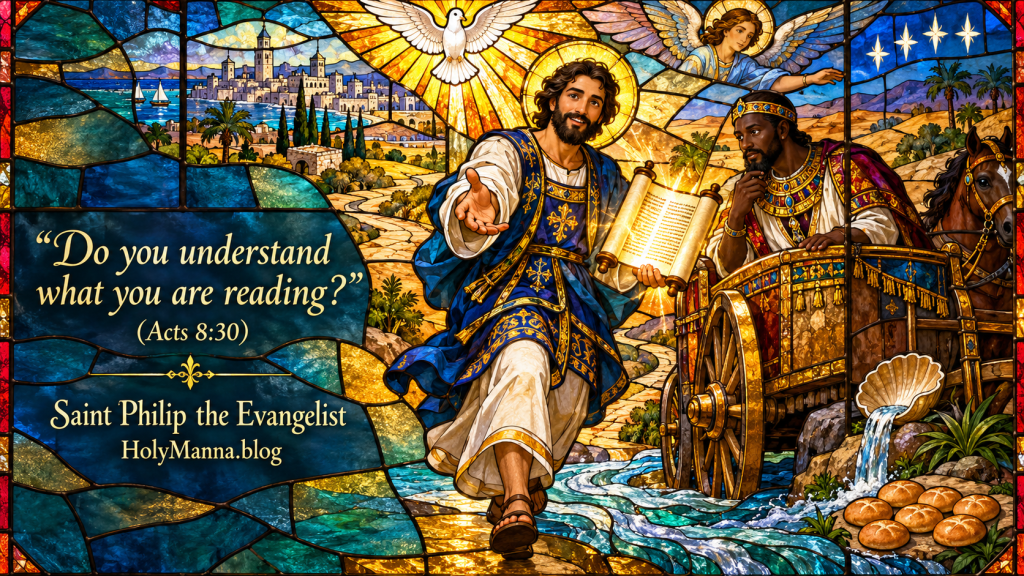
Then came the encounter that made Philip famous for all time. “But an angel of the Lord said to Philip, ‘Rise and go toward the south to the road that goes down from Jerusalem to Gaza.’ This is a desert road” (Acts 8:26). Philip was in the middle of a thriving revival, and God sent him to an empty road. He went anyway. There he found a chariot carrying an Ethiopian eunuch, the treasurer of the Candace, queen of the Ethiopians, a God-fearing man returning home from worship in Jerusalem, reading the prophet Isaiah aloud. The Spirit told Philip to go up and join the chariot, and Philip ran to it. His first recorded words, the only verified quotation of this saint that exists, form one of the great questions of Scripture: “Do you understand what you are reading?” (Acts 8:30). The official’s answer should echo in every Catholic heart: “How can I, unless some one guides me?” (Acts 8:31).
The man was reading the passage about the Suffering Servant: “As a sheep led to the slaughter or a lamb before its shearer is dumb, so he opens not his mouth” (Acts 8:32, quoting Isaiah 53). And Luke records that “Philip opened his mouth, and beginning with this scripture he told him the good news of Jesus” (Acts 8:35). This scene is a living picture of how the Church teaches the Bible must be read. Scripture is not a private puzzle; it is a book given to the Church, read in the Church, and interpreted with the Church. The Catechism instructs the faithful to “read the Scripture within ‘the living Tradition of the whole Church’” (CCC 113), and it teaches that the task of authentic interpretation “has been entrusted to the living teaching office of the Church alone” (CCC 85). The eunuch had the scroll, the devotion, and the desire, but he needed a guide sent by God, and God sent him one. When they came to water, the official asked what prevented him from being baptized, and Philip baptized him on the spot. An ancient reading of this passage, found in the Latin Vulgate and later manuscripts as Acts 8:37 though absent from the earliest Greek manuscripts, preserves the exchange in which Philip says, “If you believe with all your heart, you may,” and the eunuch confesses, “I believe that Jesus Christ is the Son of God.” Then came one of the strangest miracles in the New Testament: “And when they came up out of the water, the Spirit of the Lord caught up Philip; and the eunuch saw him no more, and went on his way rejoicing. But Philip was found at Azotus, and passing on he preached the gospel to all the towns till he came to Caesarea” (Acts 8:39 to 40). The Holy Spirit physically carried Philip away, some 20 miles up the coast, and the deacon simply kept preaching, town after town, until he reached Caesarea.
A Long Obedience in Caesarea
Philip was not a martyr, and the Church commemorates him as a deacon and evangelist rather than with the palm of martyrdom. But his life was anything but easy, and his hardships deserve to be named honestly. He lived through the first persecution of the Church and watched his brother deacon Stephen die under a hail of stones. He was driven from Jerusalem as a religious refugee, leaving behind the community he had been ordained to serve. He preached in Samaria, among a people hostile to his own, with no guarantee of welcome. He obeyed an angel’s command to abandon a flourishing mission for a deserted road, the kind of obedience that looks like failure until God reveals the plan. He then spent roughly 2 decades in Caesarea, the Roman provincial capital, a pagan port city bristling with imperial power, raising 4 daughters in the faith and keeping the Gospel alive far from the centers of Church life. There is a quiet heroism in those hidden years that Scripture honors with a single, luminous snapshot.
That snapshot comes in Acts 21, when Saint Paul traveled to Jerusalem for the last time before his arrest. Luke, who was traveling with Paul, writes: “On the morrow we departed and came to Caesarea; and we entered the house of Philip the evangelist, who was one of the seven, and stayed with him. And he had four unmarried daughters, who prophesied” (Acts 21:8 to 9). Consider the weight of that scene. The man sleeping under Philip’s roof was Saul of Tarsus, the very persecutor whose campaign of terror had scattered Philip from Jerusalem some 20 years earlier. The refugee now hosted his former persecutor as a brother and fellow apostle of Jesus Christ. If anyone had a right to old resentment, it was Philip; instead, Scripture shows only hospitality. It was in Philip’s house, during that same visit, that the prophet Agabus bound his own hands and feet with Paul’s belt and prophesied Paul’s coming arrest in Jerusalem. Philip’s home had become a place where the Holy Spirit spoke freely, through guests and through his own daughters, women whom the early Church would remember and honor for generations.
After Acts 21, Scripture falls silent about Philip, and the historical record offers no documented account of his death. The current Roman Martyrology says simply that he evangelized city after city “up to Caesarea, where he is believed to have his days finished.” The Church asserts no martyrdom and no dramatic ending, only a long, faithful life poured out in service and proclamation until God called him home.
Two Philips, Three Tombs
No formally documented miracles are attributed to Philip the Evangelist after his death, and integrity requires saying so rather than inventing wonders he never worked. What the centuries did produce is a rich, tangled web of traditions about his burial and his legacy, and those traditions are worth telling carefully, with the historical record and the pious story clearly separated.
The oldest Roman tradition placed his death and burial at Caesarea. The traditional Roman Martyrology, which commemorated him on June 6th before the 2004 revision moved his commemoration to October 11th, read: “At Caesarea, in Palestine, the birthday of blessed Philip, one of the first seven deacons. Near him are buried three of his daughters, virgins and prophetesses.” In the Church’s vocabulary, a saint’s “birthday” means the day of his birth into eternal life. Supporting this Caesarea tradition, Saint Jerome’s account of the pilgrimage of Saint Paula in the late 4th century reports that pilgrims at Caesarea were shown the house of Philip and the chambers of his 4 virgin daughters. This detail rests on Jerome’s testimony about what pilgrims were shown, which demonstrates that the memory of Philip’s household was alive and venerated at Caesarea within a few centuries of his death, though the authenticity of the sites themselves cannot be verified.
A second tradition, preserved in the Greek East, holds that Philip later became bishop of Tralles in Lydia, in what is now western Turkey, and died there in old age. This tradition is late, and it cannot be verified.
The third and most famous tradition centers on Hierapolis in Phrygia, the modern Pamukkale in Turkey, and here the ancient confusion of the two Philips comes fully into view. Around the years 189 to 198, Polycrates, bishop of Ephesus, wrote to Pope Victor that Philip, one of the twelve apostles, lay buried at Hierapolis with 2 of his aged virgin daughters, while a third daughter rested at Ephesus. Yet a Roman priest named Proclus, quoted by the early Church historian Eusebius, spoke instead of 4 prophetesses: “After him there were four prophetesses, the daughters of Philip, in Hierapolis in Asia; their tomb is there and that of their father.” Four prophesying virgin daughters is precisely the description Scripture gives of the Evangelist’s family, not the Apostle’s. Eusebius also records that Papias, the early 2nd-century bishop of Hierapolis, personally knew the daughters of Philip and learned accounts of the apostolic age from them. The Catholic Encyclopedia concludes that a confusion of the two Philips evidently took place, that it is difficult to decide which Philip was buried at Hierapolis, and that many modern historians believe it was the deacon. A great martyrium, an octagonal pilgrimage church, was built over the venerated tomb at Hierapolis in the early 5th century, and its ruins still crown the hillside today; the shrine has traditionally been assigned to the Apostle, but the possibility that it honors the Evangelist, or that both men left their mark on the city, remains an open question. Whichever Philip lies there, the tomb at Hierapolis cannot be verified as the Evangelist’s, and this post asserts nothing more than the sources allow.
What can be verified is the breadth of his veneration. The Latin Church commemorates him on October 11th in the Roman Martyrology, and Vatican News lists him among the saints of that day, though his feast does not appear on the General Roman Calendar. The Eastern Orthodox Church venerates him on the same date of October 11th, counts him among the Seventy Apostles, and honors him with the title of Protodeacon, with an additional commemoration on January 4th among the Seventy. His cultural footprint runs deeper still. Tradition holds that the Ethiopian official he baptized returned home and became the first herald of the Gospel in his own land, making Philip’s roadside catechesis the remote seed of Ethiopian Christianity, one of the most ancient Christian cultures on earth; this tradition, attested by early Church writers, cannot be verified in its details. Artists have returned to the Gaza road again and again, most famously Rembrandt, whose painting of the baptism of the eunuch dates to 1626. And in the modern Church, Philip has taken on fresh relevance: when the Second Vatican Council restored the permanent diaconate, the Church pointed back to the ancient order of deacons, for “since the Second Vatican Council the Latin Church has restored the diaconate ‘as a proper and permanent rank of the hierarchy’” (CCC 1571), and permanent deacons across the world now look to Philip, alongside Stephen and Lawrence, as a scriptural model of their vocation.
Lessons From a Man Who Ran Toward the Chariot
Philip’s life asks something uncomfortable of every believer, because his credentials were so ordinary. He held no apostolic office. He was chosen to distribute food. And yet the Holy Spirit made him the first missionary of the Church, because he possessed the one qualification God actually requires: availability. When the community needed servers, he served. When persecution scattered him, he preached. When an angel said to leave the revival for a desert road, he went. When the Spirit said to approach the chariot, Luke says he ran. How often does God’s prompting come, in prayer, in an inconvenient request, in a stranger’s question about the faith, and find hesitation instead of running feet?
Philip also models what evangelization actually looks like, and it looks nothing like a lecture. He began with a question, not a sermon. He listened to where the Ethiopian already was, reading Isaiah, hungry and confused, and he started there, for “beginning with this scripture he told him the good news of Jesus” (Acts 8:35). The Catechism teaches that “from this loving knowledge of Christ springs the desire to proclaim him, to ‘evangelize’, and to lead others to the ‘yes’ of faith in Jesus Christ” (CCC 429). Evangelization begins in love of Christ and moves at the pace of a real conversation. A coworker’s question about why Catholics go to Mass, a friend’s curiosity about a Bible verse, a family member picking at an old wound with the Church: each is a chariot on a desert road. The Philip option is to draw near, ask a genuine question, listen, and then speak of Jesus from the Scriptures and the teaching of the Church, not from private opinion.
The eunuch’s side of the story carries its own lesson. “How can I, unless some one guides me?” is the humble cry of every honest reader of Scripture, and the Church is the guide God has provided, for Scripture is to be read “within ‘the living Tradition of the whole Church’” (CCC 113). A practical resolution in Philip’s honor: read Acts 6, Acts 8, and Acts 21 slowly this week, with a Catholic commentary or the footnotes of a Catholic Bible, and let the Church guide the reading the way Philip guided the eunuch. And for those whose lives feel hidden, 20 years of ordinary fidelity in Caesarea, raising children in the faith, opening the home, forgiving old persecutors, Philip’s long obedience whispers that none of it is wasted. Who in ordinary daily life, at work, at home, on the road, might be waiting for someone to simply draw near and ask a question? And what would it cost to run toward them instead of away?
Engage With Us!
Saint Philip the Evangelist went from serving tables to baptizing a nation’s first Christian, all because he said yes to every small prompting of the Holy Spirit. His story belongs to every believer who has ever felt too ordinary to matter in God’s plan. Share your thoughts and reflections in the comments below; this community grows the same way the early Church did, one honest conversation at a time.
- Philip was chosen to serve before he was sent to preach. Where is God asking for humble, hidden service right now, and is that service being embraced or resented?
- The persecution that scattered Philip became the occasion of his greatest mission. Has a painful disruption in life ever turned out to be God’s redirection toward something greater?
- Philip left a thriving ministry in Samaria for an empty desert road simply because God said go. What would need to change to obey God that quickly and that completely?
- The Ethiopian asked, “How can I, unless some one guides me?” Who has been a Philip in your faith journey, and to whom could you be a Philip this month?
- Philip welcomed Paul, the man whose persecution had driven him from his home. Is there someone whom God is calling you to forgive and welcome to your table?
Saint Philip ran toward the chariot, and heaven has never forgotten it. Run toward the people God places on the road this week. Serve first, speak of Jesus always, and do everything, every meal served, every question answered, every stranger welcomed, with the love and mercy that Jesus taught us.
Saint Philip the Evangelist, pray for us!
Follow us on YouTube, TikTok, Instagram and Facebook for more insights and reflections on living a faith-filled life.


Leave a Reply