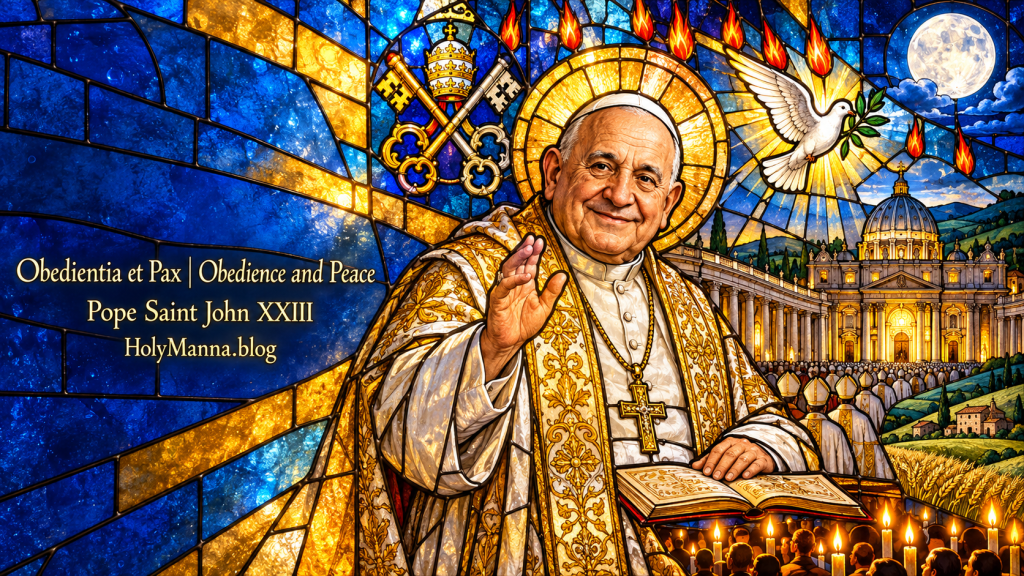
The Good Pope
On the night of October 11th, 1962, something happened in Saint Peter’s Square that no pope had ever done before. Half a million people had gathered with torches and candles to celebrate the opening of the Second Vatican Council, and an elderly, round faced pope appeared at the window of the Apostolic Palace to greet them. He had no prepared text. He pointed up at the sky and marveled that even the moon seemed to have hurried out to watch. Then, in words that Italy has never forgotten, he told the parents in the crowd to go home and find their little ones: “Give your children a caress and say: This is the caress of the Pope.” That spontaneous address, preserved at the Vatican and known forever as the Moonlight Speech, captures why the world still calls him il Papa buono, the Good Pope.
Pope Saint John XXIII, born Angelo Giuseppe Roncalli, reigned for less than 5 years, from 1958 to 1963, yet he changed the course of modern Church history by convoking the Second Vatican Council, the 21st ecumenical council of the Catholic Church. He guided the world back from the edge of nuclear war during the Cuban Missile Crisis, gave the Church the great peace encyclical Pacem in Terris, and showed a skeptical century that the papacy is, as the Church teaches, the perpetual and visible source and foundation of the unity of the bishops and of the whole company of the faithful (CCC 882). He holds a formally documented patronage: in 2017 the Congregation for Divine Worship declared him heavenly patron of the Italian Army, recalling his own humble service as a military chaplain and stretcher bearer. The Church celebrates his feast on October 11th, not the day of his death, but the anniversary of the day he opened the Council that defined his life.
A Boy From Sotto il Monte
Angelo Giuseppe Roncalli was born on November 25th, 1881, in Sotto il Monte, a small farming village in the foothills near Bergamo in Lombardy, northern Italy. His parents, Giovanni Battista Roncalli and Marianna Mazzola, were sharecroppers who worked land they did not own, and Angelo was the fourth child in a very large family; most sources count 14 children in all, while a few count 13, a small discrepancy worth noting honestly. The family was poor in money and rich in faith. Angelo was baptized on the very day of his birth, and his religious formation was entrusted to his godfather, his great-uncle Zaverio, a man of deep piety who taught the boy to love the mystery of God and the rhythms of Catholic life. Decades later, the pope would still speak of his family’s simple faith as the foundation of everything he became.
There was no thunderbolt conversion in Angelo’s life, and that is precisely what makes him so relatable. His story is one of steady deepening, the kind of quiet growth the Church holds out to every single baptized person, since all the faithful of Christ of whatever rank or status are called to the fullness of the Christian life and to the perfection of charity (CCC 2013). He entered the minor seminary of Bergamo in 1892 at only 11 years old. In 1896, still a teenager, he was received into the Secular Franciscans, binding himself to the spirit of the Poverello. At 14 he began keeping a spiritual journal of resolutions, examinations of conscience, and prayers, a practice he continued until his death as pope. That journal, published after his death as Journal of a Soul, is one of the great spiritual documents of the 20th century, and it shows a young man learning that sanctity is not imitation of someone else’s path. As he wrote while still in formation, “I am not St. Aloysius, nor must I seek holiness in his particular way.” Holiness, he discovered, had to be lived in his own nature, his own character, and his own circumstances.
A scholarship brought him to the Pontifical Roman Seminary in 1901, interrupted by a year of mandatory military service in the Italian infantry. He was ordained a priest in Rome on August 10th, 1904, at the age of 22, and celebrated Mass the next morning in the crypt of Saint Peter’s Basilica, near the bones of the first pope. Soon afterward he met Pope Saint Pius X. Back home, he became secretary to the saintly Bishop Giacomo Radini-Tedeschi of Bergamo, a tireless social reformer, and taught Church history in the seminary. In the diocesan archives he discovered the records of Saint Charles Borromeo’s 1575 apostolic visitation of Bergamo, a scholarly project he would labor over for decades. His great friends among the saints in these formative years were Saint Charles Borromeo and Saint Francis de Sales, bishops who combined intellectual seriousness with pastoral tenderness. Looking at them, young Father Roncalli was quietly learning how to be a shepherd.
Obedience and Peace
When Italy entered World War I, Father Roncalli was drafted into the Royal Italian Army, where he served as a sergeant in the medical corps, carrying wounded and dying young men off the battlefield as a stretcher bearer, and later ministering to the troops as a chaplain. He never forgot what war does to the bodies and souls of the young, and that memory shaped everything he would later say about peace. After the war, Pope Benedict XV called him to Rome in 1921 to direct the Italian branch of the Society for the Propagation of the Faith, the Church’s great missionary engine. Then, in 1925, Pope Pius XI consecrated him a bishop and sent him as Apostolic Visitor to Bulgaria, an Orthodox country with a small and scattered Catholic flock. For his episcopal motto he chose 2 words that became the key to his whole life: Obedientia et Pax, Obedience and Peace. On the eve of his episcopal ordination he noted that those words were, in a way, his story and his life, a remark Pope Francis himself recalled on the 50th anniversary of his death.
Bulgaria led to a decade in Istanbul as Apostolic Delegate to Turkey and Greece beginning in 1935, and it was there, during World War II, that Archbishop Roncalli performed some of the most heroic work of his life. Using his diplomatic position, his contacts, and the tools of nunciature paperwork, he helped Jewish refugees fleeing Nazi persecution obtain transit papers and immigration certificates toward safety. The fact of this rescue work is well documented by historians and honored by Jewish organizations, though scholars still debate the precise numbers of those he helped save. He did not consider it extraordinary. He considered it obvious, the plain demand of the Gospel in which the Lord says, “I was a stranger and you welcomed me” (Matthew 25:35). In December 1944, Pope Pius XII gave him one of the most delicate posts in the Church, Apostolic Nuncio to newly liberated France, where he healed wounds between the Church and a nation torn by occupation and collaboration. In January 1953 he was created a cardinal and named Patriarch of Venice, and he assumed, at 71 years old, that he had received his final assignment. He was wrong.
On October 28th, 1958, following the death of Pius XII, the conclave elected the 76 year old Roncalli, reportedly on the 11th ballot; the ballots themselves are secret, so that detail rests on reporting rather than records. Many observers expected a short, quiet, caretaker papacy. Instead, the new pope, who took the name John after his father and after the beloved Baptist and Evangelist, immediately began to shepherd in a new way. On December 26th, 1958, he walked into Rome’s Regina Coeli prison to be with the inmates, telling them, in words reported around the world, “You could not come to me, so I came to you.” He visited sick children at the Bambino Gesù hospital. He slipped out of the Vatican to see ordinary Romans. He was living what the Lord commanded Peter: “Feed my sheep” (John 21:17).
Then came the thunderclap. On January 25th, 1959, the feast of the Conversion of Saint Paul, at the Basilica of Saint Paul Outside the Walls, Pope John announced to a stunned group of cardinals his intention to convoke an ecumenical council, the first since Vatican I closed in 1870. He opened the Second Vatican Council on October 11th, 1962, before roughly 2,500 bishops, the largest council in the history of the Church. In his opening address, Gaudet Mater Ecclesia, he gently rebuked the pessimists around him, those prophets of doom who could see nothing in the modern world but ruin, and he set the Council’s pastoral tone by declaring that the Church today prefers “the medicine of mercy rather than that of severity.” Weeks later he added the name of Saint Joseph to the Roman Canon of the Mass, a quiet devotional landmark.
That same October, the Cuban Missile Crisis brought the world closer to nuclear annihilation than it has ever been. On October 25th, 1962, Pope John broadcast a radio appeal begging the leaders of the great powers to hear the cry of humanity and choose negotiation, an appeal published even in the Soviet press and credited by many on both sides with helping to open a path back from the brink. Out of that experience came his final gift, the encyclical Pacem in Terris of April 11th, 1963, the first encyclical ever addressed not only to Catholics but to all people of good will. In it he taught that real peace among nations rests “not in equality of arms, but in mutual trust alone” (Pacem in Terris 113), a conviction the Church still echoes when the Catechism teaches that peace is not merely the absence of war and cannot be reduced to maintaining a balance of power between adversaries (CCC 2304).
Here honesty matters, because honesty was his own virtue. The historical record attributes no miracles to John XXIII during his earthly life, no healings at his hands, no marvels of nature, and the Church has never claimed any. His wonder was of another kind, the steady miracle of heroic charity: a peasant’s son who carried the wounded, rescued the persecuted, reconciled the divided, embraced prisoners, and made hundreds of millions of people, Catholic or not, feel that God was near. The Church formally recognized that his virtues were lived to a heroic degree, which is exactly what the process of canonization examines when the Church solemnly proclaims that a saint practiced heroic virtue and lived in fidelity to God’s grace (CCC 828).
The Hidden Crosses of a Smiling Pope
John XXIII was not a martyr, and his life contained no dramatic persecutions, yet his road was full of crosses that will feel familiar to anyone who has ever felt overlooked, lonely, or stuck. He was born into real poverty, the kind where a large family shares a small table and every harvest matters. In the trenches of World War I he carried shattered young bodies and sat with dying soldiers, an experience that marked his soul permanently. Then came what felt like exile. His 10 years in Bulgaria and nearly 10 more in Turkey were years on the far margins of Church life, often lonely, often misunderstood, with little visible fruit, while classmates and contemporaries advanced to prominent posts back home. His journal from those decades shows a man wrestling honestly with obscurity, monotony, and the temptation to measure himself by career instead of by fidelity, and answering that temptation again and again with his motto of obedience and peace. He chose to believe that God had placed him exactly where God wanted him, and he kept working, praying, and loving the people in front of him.
In France after the war he inherited a diplomatic minefield, pressed between a new government demanding the removal of bishops accused of collaboration and a Church desperate for healing, and he navigated it with patience and tact that cost him dearly in private. Even his election as pope carried its own hidden weight; he was chosen at 76, widely dismissed as a transitional figure, and he knew it. When he announced the Council, some of the most powerful men in the Curia thought the project naive or impossible, and he bore years of quiet resistance with his characteristic good humor, pressing forward because he was convinced the inspiration had come from the Holy Spirit.
His final hardship was the one that revealed his sanctity most clearly. In the autumn of 1962, just as the Council he had dreamed of was beginning, John XXIII was diagnosed with stomach cancer, the same disease that had taken members of his own family. He told almost no one. Through the Council’s entire first session, as he greeted bishops and charmed the world, he was dying, and he knew it. He continued working into the spring, signing Pacem in Terris in April 1963 as a kind of last testament to the human family. His final agony, in the first days of June 1963, became a global vigil; Saint Peter’s Square filled day and night with people of every nation and belief praying for him, a scene Pope Francis later recalled vividly. Those at his bedside reported that in his last days his heart kept returning to Our Lord’s own prayer, “that they may all be one” (John 17:21), and that he offered his sufferings for the Council and for the unity of Christians. He died in peace on the evening of June 3rd, 1963, the Monday after Pentecost, at 81 years old. He had lived what the Church teaches about Christian suffering, that by uniting our trials to the Passion of Christ, suffering itself is transformed and becomes a participation in the saving work of Jesus (CCC 1521). The world grieved as it rarely grieves for anyone; even the official press of the Soviet Union, the Church’s sworn ideological enemy, honored his labors for peace. Months earlier, Time magazine had named him its Man of the Year for 1962, the first pope ever so recognized, and in May 1963 he received the Balzan Peace Prize, which he accepted as a tribute to the cause of peace rather than to himself.
The Miracle in Naples
Devotion to Pope John began the moment he died, and the Church moved quickly; Pope Paul VI opened his cause for canonization on November 18th, 1965, during the final period of the very Council John had convoked, and Pope John Paul II declared him Venerable in 1999 after the Church formally recognized his heroic virtue. The faithful ask the saints to intercede because, as the Church teaches, the saints in heaven do not cease to intercede with the Father for us, and their fraternal concern greatly helps our weakness (CCC 956). In Naples, one young religious sister staked her life on exactly that.
Sister Caterina Capitani, a Daughter of Charity of Saint Vincent de Paul, began suffering devastating gastric hemorrhages in 1963 while serving at a children’s hospital. Surgeons eventually removed most of her stomach, but her condition kept collapsing; by May 1966 a perforating fistula had opened in her abdomen, peritonitis set in, and the 23 year old sister was dying. She had received the last rites. Her community prayed insistently to Pope John, who had died 3 years earlier, and a relic of his was placed on her body. On May 25th, 1966, according to her sworn testimony and that of the sisters who cared for her, Caterina suddenly woke from her agony, felt a hand pressed on her wound, and heard a man’s voice calling her name. Turning, she saw Pope John standing by her bed, and he told her that she was healed and should have the doctors examine her. The pain was gone. The wound was closed. She rose, ate a full meal that evening, and lived a normal religious life for another 44 years, dying in 2010. The Vatican’s medical commission studied the case for decades and concluded that the cure had no scientific explanation, and the Church formally approved it as the miracle for his beatification. This is not an unverifiable pious tale; it is the Church’s own canonically investigated and approved miracle. Pope John Paul II beatified John XXIII on September 3rd, 2000, in Saint Peter’s Square during the Great Jubilee; a stray news report once misdated the ceremony to 2001, but the Vatican’s records are clear that it took place in 2000, with Sister Caterina herself present.
In January 2001 his body was exhumed and found remarkably intact, a discovery that electrified the faithful. Here again honesty is owed to the reader: Vatican officials attributed the preservation to the embalming and the sealed triple coffin, and the Church has never declared it miraculous. Even so, the Church placed his body, visible under glass, beneath the altar of Saint Jerome in Saint Peter’s Basilica, where millions of pilgrims have since prayed before the Good Pope’s gentle face. For his canonization, something remarkable happened. On July 5th, 2013, Pope Francis, with the unanimous support of a consistory of cardinals, waived the customary requirement of a second approved miracle, judging that John’s heroic life and the fruits of the Council sufficed, and on Divine Mercy Sunday, April 27th, 2014, he canonized John XXIII together with John Paul II before an immense crowd, with Pope Emeritus Benedict XVI concelebrating; the faithful called it the day of 4 popes. Alongside the approved miracle, countless private reports of graces and healings attributed to his intercession have circulated among the faithful since 1963; these individual stories have not been formally investigated by the Church and cannot be verified.
His cultural footprint is enormous. His home village officially renamed itself Sotto il Monte Giovanni XXIII in his honor, and it remains a beloved pilgrimage destination, where pilgrims visit his humble birthplace and the Ca’ Maitino house museum filled with his belongings. In 2018 his body was carried from Saint Peter’s back to Bergamo and Sotto il Monte for an extraordinary pilgrimage, and hundreds of thousands came to venerate him in the land of his birth. In 2017 the Congregation for Divine Worship issued a formal bull naming him heavenly patron of the Italian Army, presented to the Army’s leadership that September, an honor recalling the sergeant stretcher bearer of World War I. Hospitals, schools, universities, and parishes across the world bear his name, including the major hospital of his own Bergamo, and an American peace award inspired by Pacem in Terris has been conferred on champions of human dignity since 1964. More quietly, 2 beloved anecdotes still travel wherever his name is spoken: the story that, asked how many people worked in the Vatican, he replied that about half of them did, and the story that he would wake at night resolving to bring a problem to the pope, then remember that he was the pope. Both are told everywhere as classic examples of his humor and humility, and both are stories whose original source cannot be verified.
Holiness in Ordinary Clothes
The life of John XXIII dismantles one of the biggest lies the modern world tells about holiness, the lie that saints are born different from the rest of us. Angelo Roncalli was a farm kid from a crowded house who spent decades in jobs nobody envied, and he became a saint not by escaping the ordinary but by filling it with love. For nearly 40 years he served in postings that looked like dead ends, and instead of growing bitter he grew holy, trusting that obedience to God’s placement of his life would produce peace. That is a word for you if you are in a season that feels small, a job that feels invisible, a vocation that feels slower than everyone else’s. Where in your life right now does God seem to have you waiting, and can you choose, like Angelo, to believe He has you there on purpose?
His motto offers a practical rule of life that fits on a sticky note: obedience and peace. Obedience here is not weakness; it is the daring trust that God’s will, discovered through prayer, the duties of your state in life, and the teaching of His Church, is a safer guide than your own anxiety. The Catechism, quoting Saint Augustine, defines peace as “the tranquillity of order” (CCC 2304), and John’s serenity flowed from exactly that interior order. He also shows that joy and orthodoxy are friends. He was no doctrinal innovator; he was a man soaked in Scripture, the Fathers, and the Church’s tradition, and precisely because he was so rooted, he could face the modern world with hope instead of panic, preferring mercy as the Church’s medicine without ever denying her teaching. In an age of online outrage, including Catholic outrage, that is a deeply countercultural witness. When you talk about the faith, do people hear the confidence of a son or daughter of God, or do they hear a prophet of doom?
There are concrete ways to weave his example into daily life. Start a simple spiritual journal, even a few honest lines each night, as he did from age 14 until his death. Perform works of mercy with his directness, since the works of mercy are charitable actions by which we come to the aid of our neighbor in his spiritual and bodily necessities (CCC 2447); he visited prisoners and sick children within weeks of becoming pope, and you can visit, call, or feed someone this very week. Pray daily for peace, in your home, your parish, and the world, remembering that peace is the work of justice and the effect of charity (CCC 2304). Caress your children, literally; bless them at bedtime the way Pope John asked the parents of Rome to do. And when illness, aging, or failure comes, offer it to Jesus as John offered his final months, confident that nothing surrendered to God is ever wasted. What is one hidden suffering you could begin offering to God today for someone else’s good?
Engage With Us!
Pope Saint John XXIII spent his whole life making people feel that God was close to them, and this little corner of the internet exists for the same reason, so please share your thoughts and reflections in the comments below. Your story might be exactly the encouragement another reader needs today. To get the conversation started, here are a few questions to pray with.
- John XXIII spent decades in assignments that felt like exile before God revealed His larger plan; where might God be preparing you in hiddenness right now?
- His motto was Obedience and Peace; which obedience in your life, if you finally embraced it, would bring you the most peace?
- He chose the medicine of mercy over severity; is there someone in your life who needs mercy from you more than they need correction?
- He risked his career and comfort to help persecuted strangers during the war; who is the stranger that Christ is asking you to welcome this season?
- If the Pope’s caress could reach the children of Rome through their parents’ hands, whose hands will carry God’s tenderness into your home tonight?
The Good Pope proved that sanctity does not require extraordinary circumstances, only extraordinary love poured into ordinary days. So go live your faith boldly this week; bless your children, forgive quickly, work for peace, and trust the God who raises farm boys to the Chair of Peter. Do everything, big and small, with the love and mercy that Jesus taught us, and let your life be somebody’s caress from God.
Pope Saint John XXIII, pray for us!
Follow us on YouTube, TikTok, Instagram and Facebook for more insights and reflections on living a faith-filled life.


Leave a Reply