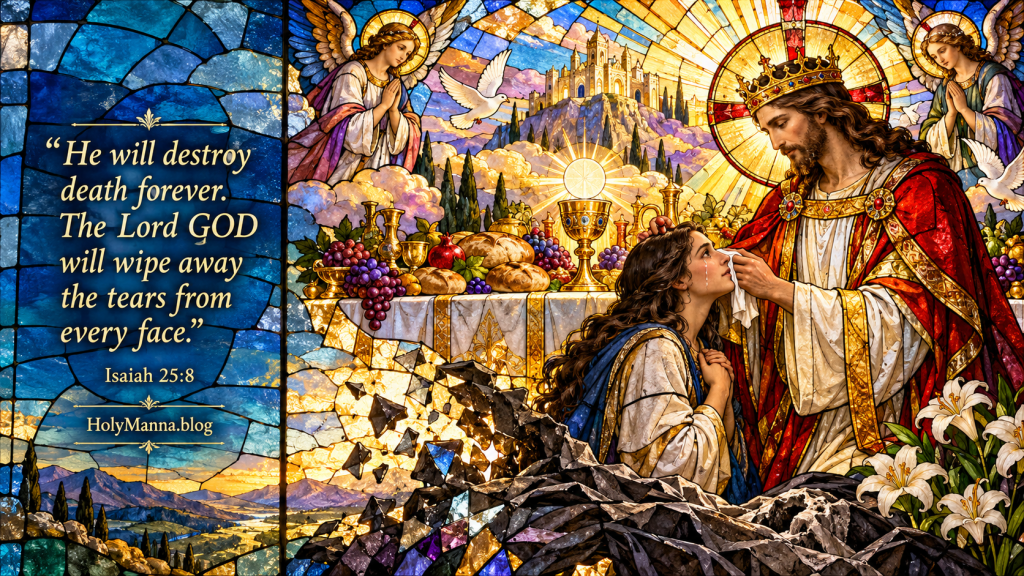
Twenty-eighth Sunday in Ordinary Time – Lectionary: 142
The Table Is Already Set
Imagine receiving an invitation so generous that it feels almost suspicious, a feast where the host has spared no expense, and your name is on the guest list for no reason you can explain. That is the situation every soul finds itself in this Sunday.
On this Twenty-eighth Sunday in Ordinary Time, the Church lays out a single golden thread running through every reading: God has prepared a feast, He freely invites everyone to it, and the only fitting response is to come, to trust the Host completely, and to arrive clothed in love. The prophet Isaiah, writing in an age when Judah lived under the shadow of empires and the constant grief of war, dares to promise a banquet on God’s holy mountain where death itself is destroyed and every tear is wiped away. Psalm 23, the beloved song of the shepherd King David, shows that this is no distant dream, for the Shepherd is already spreading the table, already filling the cup. Saint Paul, writing from a Roman prison cell, reveals what life looks like for someone who has learned to live at that table, content in hunger and abundance alike because Christ Himself is his strength. Then Jesus, teaching in the Temple during the final week before His Passion, tells the chief priests a parable that turns the banquet into a wedding feast for the King’s Son, and adds a sobering twist about a guest without a wedding garment.
In the ancient world, a royal invitation was an honor no sane person refused. Heaven’s invitation is greater still. The feast is ready. The question this Sunday asks is simple and searching: will you come, and what will you be wearing when you arrive?
First Reading — Isaiah 25:6-10a
The Mountain Where Death Dies
This breathtaking oracle comes from a section of Isaiah that scholars often call the Isaiah Apocalypse, chapters 24 through 27, where the prophet’s vision stretches beyond the politics of his day toward the end of history itself. Isaiah ministered in Judah during the eighth century before Christ, an age of terror, when the Assyrian war machine swallowed nations whole and Jerusalem lived under constant threat of siege, famine, and exile. Into that darkness the prophet speaks of a feast. The mountain is Zion, the hill of God’s Temple, but the guest list explodes beyond Israel to include all peoples and all nations. In the ancient Near East, a king sealed covenants and celebrated victories with lavish banquets, and Israel remembered how the elders ate and drank in God’s presence on Sinai, as Exodus 24 recounts. Isaiah takes that memory and universalizes it. This reading anchors the day’s central theme: the feast is God’s idea, God’s expense, and God’s gift, prepared before anyone deserves it.
Isaiah 25:6-10a
On this mountain the LORD of hosts
will provide for all peoples
a feast of rich food and choice wines,
juicy, rich food and pure, choice wines.
On this mountain he will destroy
the veil that veils all peoples,
the web that is woven over all nations;
he will destroy death forever.
The Lord GOD will wipe away
the tears from every face;
the reproach of his people he will remove
from the whole earth; for the LORD has spoken.
On that day it will be said:
“Behold our God, to whom we looked to save us!
This is the LORD for whom we looked;
let us rejoice and be glad that he has saved us!”
For the hand of the LORD will rest on this mountain.
Detailed Exegesis
Verse 6
On this mountain the LORD of hosts will provide for all peoples a feast of rich food and choice wines, juicy, rich food and pure, choice wines.
The Hebrew describes fat things full of marrow and wines aged on the lees, the costliest fare an ancient table could offer. This is royal food, the food of kings, yet it is set before all peoples without distinction. Notice who does the providing: the LORD of hosts Himself. Salvation is a banquet God throws, not a wage anyone earns. The Church has always heard in this verse a prophecy of the Eucharist, the rich food of Christ’s own Body and the choice wine of His Blood, and beyond it the eternal banquet of heaven.
Verse 7
On this mountain he will destroy the veil that veils all peoples, the web that is woven over all nations;
The veil here is a funeral image, the shroud laid over the face of the dead, and the web is the winding sheet wrapped around a corpse. Every nation, the prophet says, lives draped in mourning cloth, because every nation buries its dead. God promises to tear that shroud away. There is also a deeper resonance: the veil of spiritual blindness that keeps the nations from seeing God, which Saint Paul echoes in 2 Corinthians 3, is removed in Christ.
Verse 8
he will destroy death forever. The Lord GOD will wipe away the tears from every face; the reproach of his people he will remove from the whole earth; for the LORD has spoken.
This is one of the most astonishing sentences in the Old Testament. Death, humanity’s final and undefeated enemy, will itself be destroyed, literally swallowed up, in a stunning reversal of the grave that swallows everyone. Saint Paul quotes this very verse in 1 Corinthians 15:54 and declares it fulfilled in the Resurrection of Jesus. The tenderness of the image that follows deserves a long pause: God does not delegate the wiping of tears to an angel. He does it Himself, face by face, as a mother does for a child. Revelation 21:4 takes up this promise word for word.
Verse 9
On that day it will be said: “Behold our God, to whom we looked to save us! This is the LORD for whom we looked; let us rejoice and be glad that he has saved us!”
Here is the cry of a people whose long waiting is finally over. The verse repeats the word looked twice, because hope deferred is the hardest discipline of faith. On that day, trust will be vindicated in sight, and the proper response is not a quiet nod but rejoicing. Every Mass anticipates this cry, when the priest holds up the Lamb of God and the faithful behold the One for whom the world has waited.
Verse 10a
For the hand of the LORD will rest on this mountain.
The hand of the LORD is a biblical expression for His power and protection. For it to rest on the mountain means His presence will remain there permanently, not as a passing visitation but as a settled dwelling. The feast never ends because the Host never leaves.
Teachings
The Catechism gathers Isaiah’s promise into its teaching on the new creation. CCC 1044 declares: In this new universe, the heavenly Jerusalem, God will have his dwelling among men. “He will wipe away every tear from their eyes, and death shall be no more, neither shall there be mourning nor crying nor pain any more, for the former things have passed away.” The Church also teaches that the Eucharist is the real foretaste of Isaiah’s banquet. CCC 1402 preserves the ancient prayer of Saint Thomas Aquinas, the Angelic Doctor: O sacred banquet in which Christ is received as food, the memory of his Passion is renewed, the soul is filled with grace and a pledge of the life to come is given to us. Every Communion is a down payment on the mountain feast. History bears witness that the Church has clung to this hope in her darkest hours, from the martyrs of the Roman arenas who went to their deaths speaking of the banquet awaiting them, to the countless faithful who have had Revelation 21:4, the fulfillment of Isaiah’s promise, read at the funerals of those they loved.
Reflection
Everyone carries grief of some kind, a face they miss at the table, a loss that still stings years later. Isaiah insists that grief does not get the last word, God does. A concrete way to live this reading is to bring one specific sorrow to Mass this Sunday and consciously place it on the altar during the offertory, trusting the God who has promised to destroy death forever. Another is to notice the words of the liturgy with fresh ears, especially the invitation to the Supper of the Lamb, which is Isaiah’s feast breaking into the present moment. Consider also visiting a grieving friend this week, becoming the hand that wipes away tears until God does it perfectly. Where in your life are you still wearing the veil of mourning, and have you let God touch that place? When you receive the Eucharist, do you taste it as a foretaste of the feast that never ends?
Responsorial Psalm — Psalm 23:1-6
The Shepherd Who Becomes the Host
No psalm is more beloved than this one, and few are more misunderstood as merely a comfort for funerals. David composed it out of his own youth spent guarding sheep in the hills around Bethlehem, where a shepherd’s competence was literally a matter of life and death for the flock. The psalm moves through two images that fit this Sunday perfectly: the Lord as shepherd in the first four verses, and the Lord as banquet host in the last two. The early Church treasured this psalm so deeply that catechumens preparing for Baptism memorized it, and the Fathers read it as a map of the sacraments of initiation. Saint Ambrose, instructing the newly baptized in his work On the Mysteries, pointed them to this very psalm to explain what had just happened to them. Between Isaiah’s promised feast and the Gospel’s wedding hall, the psalm shows the table already being spread in the present tense.
Psalm 23:1-6
R. (6cd) I shall live in the house of the Lord all the days of my life.
The LORD is my shepherd; I shall not want.
In verdant pastures he gives me repose;
beside restful waters he leads me;
he refreshes my soul.
R. I shall live in the house of the Lord all the days of my life.
He guides me in right paths
for his name’s sake.
Even though I walk in the dark valley
I fear no evil; for you are at my side
with your rod and your staff
that give me courage.
R. I shall live in the house of the Lord all the days of my life.
You spread the table before me
in the sight of my foes;
you anoint my head with oil;
my cup overflows.
R. I shall live in the house of the Lord all the days of my life.
Only goodness and kindness follow me
all the days of my life;
and I shall dwell in the house of the LORD
for years to come.
R. I shall live in the house of the Lord all the days of my life.
Detailed Exegesis
Verse 1
The LORD is my shepherd; I shall not want.
Everything flows from this opening confession. In the ancient world, kings called themselves shepherds of their people, usually while fleecing them. David declares that the LORD Himself, not any earthly power, is his shepherd, and the immediate consequence is the end of wanting. Saint Augustine, in his Expositions on the Psalms, hears the whole Church speaking these words to Christ and asks what anyone could lack who possesses the One who has everything. Jesus claims this title for Himself in John 10, calling Himself the Good Shepherd who lays down His life for the sheep.
Verse 2
In verdant pastures he gives me repose; beside restful waters he leads me;
In the dry hill country of Judah, green pasture and calm water were never accidents; they were the fruit of a shepherd who knew the land and planned the route. The Fathers saw the pastures as the nourishing Word of God and the restful waters as Baptism. Saint Augustine writes of this verse: By the water of baptism, whereby they are refreshed who have lost health and strength, hath He brought me up. Saint Cyril of Alexandria teaches the same, saying in his commentary on the psalms that Christ establishes His people by the water of rest, that is to say, by Baptism.
Verse 3
he refreshes my soul. He guides me in right paths for his name’s sake.
The Hebrew says God restores or brings back the soul, the language of a shepherd retrieving a wandering sheep. Guidance in right paths is moral as well as geographic, and the motive is striking: for His name’s sake. God’s own honor is bound up with the welfare of His flock, which means His faithfulness does not depend on the sheep’s performance.
Verse 4
Even though I walk in the dark valley I fear no evil; for you are at my side with your rod and your staff that give me courage.
Here the psalm shifts from talking about God to talking directly to Him, precisely at the darkest point. That grammatical turn is the whole spiritual life in miniature: trouble turns description into prayer. The rod drove off predators and the staff rescued sheep from crevices; discipline and rescue are both mercies. The verse does not promise a detour around the valley, only an unshakable Companion within it.
Verse 5
You spread the table before me in the sight of my foes; you anoint my head with oil; my cup overflows.
The shepherd becomes the host. In the East, a host anointed an honored guest with fragrant oil and kept the cup full as a sign of welcome without limit. The Fathers read this verse sacramentally: the spread table is the Eucharist, the anointing is Confirmation, the overflowing cup is the chalice of salvation. The feast happens in the sight of foes, because God’s hospitality does not wait for a world without enemies.
Verse 6
Only goodness and kindness follow me all the days of my life; and I shall dwell in the house of the LORD for years to come.
The word translated follow really means pursue. All through the psalm the sheep has been led from ahead; now goodness and covenant love chase it from behind. David’s story ends not in a pasture but in a house, God’s own house, which is why the refrain of this Sunday’s liturgy sings of dwelling there all the days of life.
Teachings
The Church sees herself in this psalm. CCC 754 teaches: The Church is, accordingly, a sheepfold, the sole and necessary gateway to which is Christ. It is also the flock of which God himself foretold that he would be the shepherd, and whose sheep, even though governed by human shepherds, are unfailingly nourished and led by Christ himself, the Good Shepherd and Prince of Shepherds, who gave his life for his sheep. The mystagogical reading of the Fathers deserves to be recovered by every modern Catholic. Saint Ambrose, catechizing the newly baptized of Milan in the fourth century, urged them with the words: Hear what sacrament you have received, hear David who is speaking to you. For Ambrose, Augustine, Athanasius, and Cyril of Alexandria alike, this psalm narrates the journey from the font to the altar. A person who has been baptized, confirmed, and fed at the Eucharistic table has already lived every verse.
Reflection
Most anxiety comes down to a single suspicion, that no one is actually leading, that life is a valley with no shepherd in it. This psalm trains the heart in the opposite conviction. A practical way to pray it is to walk through one verse each day of the week, asking where that verse has already come true in life, the restful waters of Baptism, the anointing of Confirmation, the table of last Sunday’s Mass. Another concrete step is to memorize the psalm, as the ancient catechumens did, so that it rises automatically in dark valleys, hospital waiting rooms, and sleepless nights. Try also to be a shepherd to someone this week, checking on a person who has wandered from the flock. When you walk through a dark valley, do you speak about God or to Him? What would change in your week if you truly believed that goodness and kindness were pursuing you?
Second Reading — Philippians 4:12-14, 19-20
The Secret Learned in a Prison Cell
Picture a man in chains, awaiting a trial that could end in his execution, writing the most joyful letter of his life. That is the setting of Philippians, which Saint Paul composed from imprisonment, most likely in Rome in the early sixties of the first century. The church at Philippi, the first community Paul founded on European soil, held a unique place in his heart. It was the only church from which he accepted financial support, and this passage is part of his thank you note for a gift the Philippians sent him through their messenger Epaphroditus. Yet Paul does something remarkable with his gratitude. He thanks them warmly while testifying that his contentment never depended on the gift, because he has learned a secret that money cannot buy. This reading shows what a life looks like when it is lived at the table the Shepherd spreads: trusting, steady, and free, whether the plate is full or empty. It is the lived answer to Isaiah’s promise and the Psalm’s confidence.
Philippians 4:12-14, 19-20
Brothers and sisters:
I know how to live in humble circumstances;
I know also how to live with abundance.
In every circumstance and in all things
I have learned the secret of being well fed and of going hungry,
of living in abundance and of being in need.
I can do all things in him who strengthens me.
Still, it was kind of you to share in my distress.My God will fully supply whatever you need,
in accord with his glorious riches in Christ Jesus.
To our God and Father, glory forever and ever. Amen.
Detailed Exegesis
Verse 12
I know how to live in humble circumstances; I know also how to live with abundance. In every circumstance and in all things I have learned the secret of being well fed and of going hungry, of living in abundance and of being in need.
Paul’s resume of hardship, spelled out in 2 Corinthians 11, included shipwrecks, beatings, hunger, and cold, but he had also known seasons of plenty. The striking word here is secret. The Greek term Paul uses was the language of initiation into hidden knowledge, and he baptizes it deliberately. The secret of contentment is not a technique or a temperament; it is a Person, learned slowly through both feast and famine. Notice too that abundance requires as much grace as poverty, since prosperity has shipwrecked more souls than hunger ever did.
Verse 13
I can do all things in him who strengthens me.
This verse may be the most quoted and most misused line in the whole letter. Ripped from its context, it becomes a slogan for athletic trophies and personal ambition. In context, it is a prisoner’s confession that Christ supplies the strength to endure anything, hunger or plenty, chains or freedom. Paul is not claiming superpowers; he is renouncing self-sufficiency. The Stoic philosophers of his day prized a contentment achieved through inner detachment and willpower. Paul’s contentment comes from the opposite direction, total dependence on Another who lives in him.
Verse 14
Still, it was kind of you to share in my distress.
Having insisted that he needed nothing, Paul immediately honors the gift anyway. Grace does not make generosity pointless; it makes generosity beautiful. The Greek says the Philippians entered into fellowship with his affliction, a far richer idea than writing a check. Christian giving is communion, a real sharing in another person’s burden, and Paul receives it as such.
Verse 19
My God will fully supply whatever you need, in accord with his glorious riches in Christ Jesus.
Paul cannot repay the Philippians from a prison cell, so he hands the debt to his God, and the phrase my God carries the warmth of long personal acquaintance. The measure of the repayment is staggering: not out of God’s riches, as a billionaire tosses a coin, but in accord with them, on the scale of them. This is Isaiah’s banquet logic again, a God who provides rich food and choice wines because lavishness is simply His character.
Verse 20
To our God and Father, glory forever and ever. Amen.
The passage ends where all Christian reasoning ends, in doxology. Gratitude, contentment, and generosity all resolve into praise. The word Amen, so be it, invites every reader to co-sign the sentence.
Teachings
The Catechism grounds Paul’s confidence in the doctrine of divine providence. CCC 301 teaches: With creation, God does not abandon his creatures to themselves. He not only gives them being and existence, but also, and at every moment, upholds and sustains them in being, enables them to act and brings them to their final end. And CCC 2547 draws the practical conclusion: Abandonment to the providence of the Father in heaven frees us from anxiety about tomorrow. Trust in God is a preparation for the blessedness of the poor. They shall see God. The saints have lived this secret in every century. Saint Teresa of Ávila, Doctor of the Church, carried a handwritten prayer in her breviary that distills this entire reading: Let nothing disturb you, let nothing frighten you, all things are passing away: God never changes. Patience obtains all things. Whoever has God lacks nothing; God alone suffices. Those words echo Psalm 23 exactly, for the one whose shepherd is the LORD shall not want.
Reflection
Modern life runs on the engine of discontent, with every advertisement whispering that the next purchase will finally be enough. Paul’s secret is a quiet rebellion against that whole economy. A concrete practice is to begin each day this week by praying verse 13 slowly, replacing ambition with dependence, asking Christ for strength for whatever the day actually holds rather than the day imagined. Another is to perform an inventory of abundance, writing down ten gifts already possessed, since contentment grows in the soil of gratitude. A third is to imitate the Philippians by sharing concretely in someone’s distress, perhaps supporting a missionary, a seminarian, or a struggling family, remembering that such giving is communion and not charity at arm’s length. Which season tests your trust in God more, scarcity or abundance? If Christ truly strengthens you for all things, what is the one circumstance you have been excluding from that promise?
Holy Gospel — Matthew 22:1-14
An Invitation Too Important to Refuse
Jesus tells this parable in the Temple itself, during the tense final week before His Passion, speaking directly to the chief priests and elders who are already plotting His death. It is the third in a trilogy of judgment parables, after the two sons and the wicked tenants, and it is the boldest. In the ancient world, invitations to a great feast came in two waves: a first notice well in advance, then a second summons on the day itself, meaning the food was ready. To refuse a king’s second summons to his own son’s wedding was not a scheduling conflict; it was an act of contempt bordering on rebellion. Jesus wraps the entire history of salvation inside this social custom: the prophets sent and rejected, the apostles sent and persecuted, Israel’s leadership refusing the Messiah, and the Gentiles streaming into the hall. Then comes the twist of the wedding garment, which turns the parable from a story about them into a question for everyone. Here Isaiah’s banquet, the Psalm’s table, and Paul’s contentment all converge, along with a warning that the free invitation still demands a fitting response.
Matthew 22:1-14
Jesus again in reply spoke to the chief priests and elders of the people
in parables, saying,
“The kingdom of heaven may be likened to a king
who gave a wedding feast for his son.
He dispatched his servants
to summon the invited guests to the feast,
but they refused to come.
A second time he sent other servants, saying,
‘Tell those invited: “Behold, I have prepared my banquet,
my calves and fattened cattle are killed,
and everything is ready; come to the feast.”‘
Some ignored the invitation and went away,
one to his farm, another to his business.
The rest laid hold of his servants,
mistreated them, and killed them.
The king was enraged and sent his troops,
destroyed those murderers, and burned their city.
Then he said to his servants, ‘The feast is ready,
but those who were invited were not worthy to come.
Go out, therefore, into the main roads
and invite to the feast whomever you find.’
The servants went out into the streets
and gathered all they found, bad and good alike,
and the hall was filled with guests.
But when the king came in to meet the guests,
he saw a man there not dressed in a wedding garment.
The king said to him, ‘My friend, how is it
that you came in here without a wedding garment?’
But he was reduced to silence.
Then the king said to his attendants, ‘Bind his hands and feet,
and cast him into the darkness outside,
where there will be wailing and grinding of teeth.’
Many are invited, but few are chosen.”
Detailed Exegesis
Verse 1
Jesus again in reply spoke to the chief priests and elders of the people in parables, saying,
The word again signals that Jesus is pressing the same confrontation forward. He answers His enemies not with argument but with story, because a parable slips past defenses and forces listeners to judge themselves.
Verse 2
“The kingdom of heaven may be likened to a king who gave a wedding feast for his son.”
The king is the Father, the son is Christ, and the feast is the messianic banquet Isaiah foresaw. Scripture consistently presents salvation as a marriage, with God as Bridegroom and His people as bride, culminating in the wedding feast of the Lamb in Revelation 19.
Verse 3
He dispatched his servants to summon the invited guests to the feast, but they refused to come.
The invited guests had already accepted the first invitation; this is the summons on the day itself. The refusal pictures Israel’s long resistance to the prophets, and the quiet tragedy of every soul that says yes to God in theory and no in practice.
Verse 4
A second time he sent other servants, saying, ‘Tell those invited: “Behold, I have prepared my banquet, my calves and fattened cattle are killed, and everything is ready; come to the feast.”‘
The king responds to insult with patience and an even more detailed appeal. Everything is ready is the Gospel in three words; grace always arrives as a finished preparation, never as a demand that guests cook their own meal.
Verse 5
Some ignored the invitation and went away, one to his farm, another to his business.
The first rejections are not hostile, merely preoccupied. Farm and business are good things that become idols the moment they outrank the King. Indifference, not hatred, is the most common way people miss the feast.
Verse 6
The rest laid hold of his servants, mistreated them, and killed them.
Indifference hardens into violence. Jesus is describing the fate of the prophets before Him and prophesying the fate of the apostles and martyrs after Him.
Verse 7
The king was enraged and sent his troops, destroyed those murderers, and burned their city.
The early Church Fathers consistently heard in this verse a foreshadowing of the destruction of Jerusalem by Roman armies in the year 70, roughly forty years after this parable was spoken. Grace refused does not simply evaporate; it leaves history changed.
Verse 8
Then he said to his servants, ‘The feast is ready, but those who were invited were not worthy to come.’
Unworthiness here is not failed background checks but refused invitations. The only disqualification from this feast is declining it.
Verse 9
‘Go out, therefore, into the main roads and invite to the feast whomever you find.’
The invitation explodes outward to the crossroads where anyone might be found, fulfilling Isaiah’s promise of a feast for all peoples and prefiguring the mission to the Gentiles and to every generation since.
Verse 10
The servants went out into the streets and gathered all they found, bad and good alike, and the hall was filled with guests.
Bad and good alike is a perfect portrait of the Church on earth, a net full of every kind of fish, a field of wheat and weeds together. No one is invited because of merit, which is precisely why the hall fills.
Verse 11
But when the king came in to meet the guests, he saw a man there not dressed in a wedding garment.
Tradition holds that hosts of great feasts could provide garments for guests gathered on short notice, which makes this man’s state a refusal rather than a misfortune. The king personally inspects, because the supreme Judge sees what servants cannot, the interior of every guest.
Verse 12
The king said to him, ‘My friend, how is it that you came in here without a wedding garment?’ But he was reduced to silence.
Even now the king speaks with tenderness, calling him friend and inviting an explanation. The silence is the verdict; before the One who reads hearts, no excuse survives. Saint John Chrysostom observes that the man condemned himself by having nothing to say.
Verse 13
Then the king said to his attendants, ‘Bind his hands and feet, and cast him into the darkness outside, where there will be wailing and grinding of teeth.’
The darkness outside is Matthew’s sober image for hell, the self-chosen exclusion from the lit and laughing hall. The feast is free, but it is not trivial, and presuming on grace is the final way of refusing it.
Verse 14
Many are invited, but few are chosen.
The invitation is universal; the choosing involves the response. God excludes no one from the call, but the called can exclude themselves, either by staying away or by entering unchanged.
Teachings
The Fathers are united on the meaning of the garment. Saint Gregory the Great asks in his Homily 38 on the Gospels: What do we think is meant by the wedding garment, dearly beloved? For if we say it is Baptism or faith, is there anyone who has entered this marriage feast without them? What then must we understand by the wedding garment but love? Pope Benedict XVI, preaching on this parable in 2011, quoted Gregory again: Therefore each one of you in the Church who has faith in God has already taken part in the wedding feast, but cannot claim to wear the wedding garment unless he jealously guards the grace of love. Saint Augustine, in Sermon 90, reaches the same conclusion through Saint Paul: What is that wedding garment, then? This is the wedding garment: “The goal of this command is charity,” says the apostle, “which comes from a pure heart and a good conscience and a sincere faith.” Saint John Chrysostom, in his Homily 69 on Matthew, adds the moral edge: For the garment is life and practice, teaching that to be called and cleansed was pure grace, yet keeping the garment clean belongs to the diligence of the called. The Catechism confirms it in CCC 546: Through his parables he invites people to the feast of the kingdom, but he also asks for a radical choice: to gain the kingdom, one must give everything. Words are not enough; deeds are required.
Reflection
The parable leaves no neutral ground, since everyone in it is either refusing, attacking, attending, or being inspected. Begin with an honest look at the farm and the business, the legitimate goods that most often crowd out Sunday Mass, daily prayer, and the voice of God. A concrete step is to treat this Sunday’s Mass as a royal summons, arriving early, dressing the soul through a good Confession if mortal sin has stained the garment, and receiving Communion with the deliberate intention of putting on charity. Another is to become one of the servants at the crossroads, personally inviting one person back to Mass this month, since the hall still has room. Which invitation from God have you been politely ignoring, and what farm or business stands behind the excuse? If the King inspected the garment of your charity today, what would He find?
Save a Seat at the Feast
Step back and look at what this Sunday has laid on the table. Isaiah stood in an age of war and promised a mountain where God Himself would serve rich food and choice wines, destroy death forever, and wipe the tears from every face. David sang of a Shepherd who leads His sheep through dark valleys only to seat them at a spread table with an overflowing cup. Paul, writing in chains, revealed the secret of a heart so at home at that table that neither hunger nor abundance could shake it, because Christ Himself was his strength. Then Jesus pulled back the curtain entirely: the feast is a wedding, the Bridegroom is the Son, the invitation has gone out to the crossroads of the world, and the hall is filling with the bad and good alike.
The whole story of salvation turns out to be an invitation that keeps arriving. It arrived through the prophets, through the apostles, through the martyrs, and it arrives still, every time the church bells ring on Sunday morning. The feast is not a metaphor waiting in the distant future. It stands on the altar at every Mass, where the Lamb is already served and heaven already touches earth.
So come. Come hungry, come wounded, come from the farm and the business and the crossroads. Come wearing charity, the garment woven from love of God and love of neighbor, and if that garment has been stained, let the mercy of Confession wash it white again. The King has done everything else. The calves are killed, the wine is poured, the tears are about to be wiped away, and there is a seat with your name on it. The only thing the King will not do is come in your place.
Engage With Us!
The conversation does not end when the post does. Share your reflections in the comments below, because hearing how God’s Word lands in another person’s life is one of the quiet joys of walking this road together, and your insight may be exactly what another reader needs today.
Here are some questions to spark your reflection:
- In Isaiah 25:6-10a, God promises to destroy death forever and wipe the tears from every face. What grief or loss are you being invited to place into His hands this week, trusting that His feast will outlast every funeral?
- In Psalm 23:1-6, the Shepherd leads His sheep through the dark valley to a spread table. Looking back on your own dark valleys, where can you now recognize that the Shepherd was at your side the whole time?
- In Philippians 4:12-14, 19-20, Paul reveals that he learned the secret of contentment in both hunger and abundance. Which circumstance in your life right now most needs the words “I can do all things in him who strengthens me”?
- In Matthew 22:1-14, the king finds a guest without a wedding garment, which the Church Fathers teach is charity. What is one concrete act of love you can perform this week to keep your wedding garment ready for the feast?
- Taking all the readings together, God prepares the banquet, extends the invitation, and supplies every need. What is the one thing holding you back from accepting His invitation more fully, and what would it take to let it go?
Keep walking forward in faith, one honest step at a time. The King has prepared the feast, the Shepherd knows the way, and grace will supply whatever is lacking. Go out into the week ahead and do everything, the small things and the hard things alike, with the love and mercy Jesus taught us.
Sacred Heart of Jesus, we trust in You!
Immaculate Heart of Mary, pray for us!
Saint Michael the Archangel, defend us in battle!
Follow us on YouTube, TikTok, Instagram and Facebook for more insights and reflections on living a faith-filled life.


Leave a Reply