A Roman Heart at the Edge of the World
Every year on October 10th, the Church remembers Saint Paulinus of York, a Roman monk who crossed the known world to bring the Gospel to a people who had never heard it, and who lived to see an entire kingdom wade into cold northern rivers to be baptized. Paulinus belongs to the remarkable generation of missionaries sent out by Pope Saint Gregory the Great at the turn of the 7th century to plant the Catholic faith in Anglo-Saxon England. He became the first Bishop of York, the apostle of Northumbria, the man who converted King Edwin and baptized thousands in the rivers Glen, Swale, and Trent. He also became something the modern world rarely celebrates: a missionary who watched his life’s work seemingly collapse overnight, and who kept serving God anyway, quietly, faithfully, in a smaller place, until the day he died.
His story is told almost entirely by Saint Bede the Venerable in his Ecclesiastical History of the English People, written within a century of the events and drawing on eyewitness memory, which makes Paulinus one of the best documented saints of his age. His witness speaks to anyone who has ever labored for something good, lost it, and wondered whether it mattered. The Church teaches that it always matters, because the Church “is missionary by her very nature” and exists to carry salvation to all people (CCC 850). Paulinus staked his whole life on that truth.
From Saint Andrew’s Monastery to the Mission Fields of Kent
Paulinus was born in Italy, almost certainly in Rome, sometime in the later 6th century. Some later sources offer the year 584 for his birth, but no early source records it, and that date cannot be verified. What is documented is where his story truly begins: the monastery of Saint Andrew on the Caelian Hill in Rome, the same monastery from which Pope Saint Gregory the Great had drawn Saint Augustine of Canterbury and the first missionaries to England in 596. Paulinus was formed there as a monk, shaped by the discipline of prayer, obedience, and community life that would steady him for everything to come.
In 601, Pope Gregory sent a second wave of reinforcements to the struggling English mission. Paulinus traveled with Saint Mellitus, Saint Justus, and others, carrying letters, sacred vessels, books, and relics, as well as the pallium for Augustine. These men left the civilized heart of Christendom for a cold, fragmented island of warring pagan kingdoms, with no guarantee they would ever return. The Catechism teaches that missionary endeavor “requires patience” and begins with the proclamation of the Gospel to peoples and groups who do not yet believe in Christ (CCC 854). Paulinus would need that patience more than almost anyone.
He then spent roughly 24 years laboring in Kent, the one corner of England where the faith had taken root under King Æthelberht. For nearly a quarter of a century, Paulinus did hidden, unglamorous work: teaching, baptizing, building up a young church, learning the language and the ways of the Anglo-Saxon people. Some scholars suggest he may have taken part in an early attempt to evangelize East Anglia before 616, possibly at the court of King Rædwald, but this cannot be established with certainty. The documented record simply shows a man waiting on God’s timing for over two decades. His conversion story is not a dramatic turn from sin but something quieter and just as demanding: a long obedience in the same direction, the slow formation of a soul God was preparing for an extraordinary assignment.
That assignment came in 625. King Edwin of Northumbria, the most powerful pagan ruler in Britain, sought to marry Æthelburh, the Christian sister of King Eadbald of Kent. The Kentish court answered that a Christian princess could not be given to a pagan unless she were free to practice her faith, and Edwin agreed, even hinting he might consider the new religion himself. On July 21st, 625, Paulinus was consecrated a bishop by Saint Justus, Archbishop of Canterbury, and sent with her as her chaplain, with a far larger hope burning in his heart: the conversion of the entire Northumbrian people. Modern historians note some difficulty in Bede’s chronology here, since surviving papal letters imply King Eadbald had only recently become a Christian at the time of the marriage negotiations; the traditional dates are given as Bede records them, with that question acknowledged.
A Hand on the King’s Head
Bede preserves a vivid eyewitness description of Paulinus, passed down from an old man whom the bishop had baptized in the River Trent in the presence of King Edwin. He was, Bede writes, “a tall man with a slight stoop, who had black hair, a thin face and a narrow, aquiline nose, his presence being venerable and awe-inspiring.” This was the figure who stood in Edwin’s hall, year after year, preaching Christ to a king who listened politely and did nothing.
The first crack in Edwin’s resistance came at Pentecost in 626, and it came through violence. An assassin sent by the king of Wessex attacked Edwin with a poisoned dagger, and one of the king’s own men, the thegn Lilla, threw his body between the blade and his lord, dying so that Edwin might live. That same night, Queen Æthelburh safely gave birth to a daughter, Eanflæd. Bede records that when the pagan king thanked his gods for the child, Paulinus countered that it was Christ, in answer to his own prayers, who had given the queen a safe and painless delivery. Struck by the events of that night, Edwin promised that if Christ would grant him victory over Wessex and preserve his life, he would renounce his idols and serve Christ. As a pledge, he gave his infant daughter to Paulinus, and at Pentecost Eanflæd was baptized with 11 others of the household, the first of the Northumbrian nation to be reborn in the waters of baptism.
Edwin won his war, yet still he hesitated, sitting alone for long hours, weighing everything. Then Bede tells of the moment that broke the stalemate. Long before, as a hunted exile at a foreign court, Edwin had received a mysterious vision in the night: a stranger who promised him deliverance, future kingship, and a better teaching than his people had known, and who laid a hand upon his head, telling him to remember that sign when it came again. Now, as the king sat brooding, Paulinus came to him, laid his right hand upon his head, and asked whether he recognized that sign. The king, trembling, would have fallen at his feet, but Bede records that Paulinus raised him up and spoke to him as a friend: “God has helped you to escape from the hands of your enemies, and it is through His bounty that you have received the kingdom that you desired.” He then urged Edwin to fulfill his promise. A later tradition, found in an early life of Pope Gregory written at Whitby, holds that Paulinus himself was the mysterious stranger in the original vision. Bede does not say this, and that detail cannot be verified.
Edwin summoned his council, and here occurs one of the most famous scenes in all of English history. Bede recounts that one of the king’s counselors, whose name is not recorded, compared the life of man to a sparrow flying out of the winter storm, through the warm, firelit hall, and back out into the dark, saying that of what came before and after, man knows nothing, and that if this new teaching brought any more certain knowledge, it deserved to be followed. It must be said plainly, because the internet so often gets this wrong, that these words belong to the anonymous counselor, not to Paulinus, though Paulinus stood in that hall and it was his preaching that provoked them. Even Coifi, the king’s own pagan high priest, declared the old religion useless, listened to Paulinus expound the Gospel, then rode to the great temple at Goodmanham, hurled a spear into it, and ordered it burned.
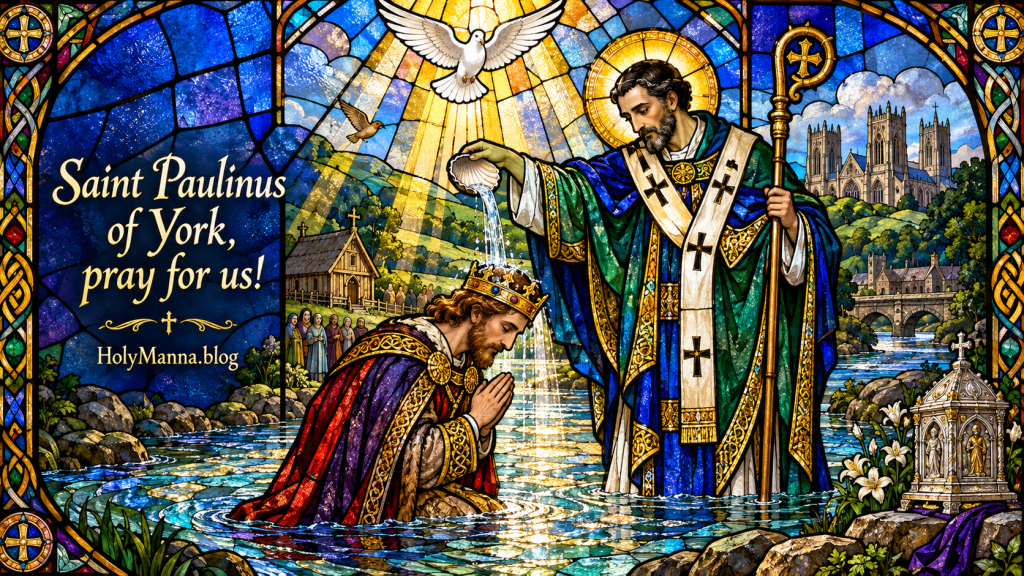
On Easter Day, April 12th, 627, Paulinus baptized King Edwin at York in a small wooden church of Saint Peter, hurriedly built for the occasion on the spot where York Minster stands today. With the king came his nobles and a great number of his people, among them a girl of 13, the king’s great-niece, who would become the mighty abbess Saint Hilda of Whitby. The Catechism teaches that “Baptism is the basis of the whole Christian life, the gateway to life in the Spirit, and the door which gives access to the other sacraments” (CCC 1213), and through Paulinus that door swung open for an entire people.
What followed was one of the most astonishing harvests in the history of evangelization. Bede records that Paulinus, with the king’s support, preached throughout the vast Northumbrian realm. At the royal estate of Yeavering in the Cheviot hills, he spent 36 consecutive days catechizing the crowds who streamed to him and baptizing them from morning until evening in the River Glen. He did the same in the River Swale near Catterick, and an eyewitness remembered him baptizing multitudes in the River Trent while King Edwin looked on. He carried the mission south into the province of Lindsey, converted Blæcca, the chief officer of Lincoln, and built a stone church in that city around 628, where he later consecrated Honorius as Archbishop of Canterbury. He established his episcopal seat at York and began building a larger stone church around the little wooden chapel of the king’s baptism. The mother church of northern England traces back to this thin, stooped Roman monk standing waist-deep in a river, baptizing farmers and nobles alike.
It should be said honestly that Bede records no healing miracles or wonders of nature worked by Paulinus during his life. The miracle of his ministry is of another kind, the kind the Church prizes most: the conversion of hardened hearts, the grace of faith poured out on thousands, and the sacraments faithfully given. The Catechism teaches that “the Church on earth is endowed already with a sanctity that is real though imperfect” and that God’s grace works through his ministers (CCC 825), and in Paulinus that grace worked on the scale of a nation.
When the Kingdom Fell
For 6 years, Northumbria flowered. Then, in October of 633, the whole structure collapsed in a single day. King Edwin was defeated and killed at the Battle of Hatfield Chase by the pagan King Penda of Mercia and his ally Cadwallon. Some sources date the battle to 632 rather than 633; the traditional date is used here with that conflict noted. What followed was not merely a change of rulers but a savage attempt to exterminate the young church; the land was ravaged, Christians were slaughtered, and the pagan forces set out to undo everything Paulinus had built.
Here Paulinus faced the hardest decision of his life. The widowed Queen Æthelburh and her small children, including the baptized princess Eanflæd, were in mortal danger. Paulinus took them, along with precious treasures of the church, and brought them safely by sea back to Kent. With the king dead and the land in flames, the organized mission in the north was, for the moment, impossible. He did not abandon the flock to nothing: he left behind his deacon, James, a man Bede praises warmly, who remained in the north for decades, teaching and baptizing amid the ruins and keeping the faith alive until better days.
Was Paulinus right to withdraw? Writers have debated it for centuries. Catholic tradition, following Bede, has held that he had no real choice, that his first duty of protection lay with the queen and her children, and that he was the best judge of what was possible in that catastrophe. The Church understands prudence as “the virtue that disposes practical reason to discern our true good in every circumstance and to choose the right means of achieving it” (CCC 1806), and Paulinus’s withdrawal was an act of that virtue, not of cowardice. Still, one can hardly imagine his grief. He had given 8 years to Northumbria and watched tens of thousands enter the Church, and now he sailed south with a widow and orphans, leaving behind burned churches and scattered converts.
In Kent he found the See of Rochester vacant, and rather than claim any dignity for himself, he quietly took up that small diocese and shepherded it for the remaining 11 years of his life. In 634, in a detail heavy with bittersweet irony, the pallium arrived from Pope Honorius I, naming Paulinus Archbishop of York. The Pope had sent it before news of the disaster reached Rome, and by the time it arrived, Paulinus had already left the see it honored. Because of this, historians still dispute whether he should be counted the first Archbishop of York or only its first bishop. Paulinus himself seems never to have grasped at the title. He was not a martyr, and his hardships were of the slower kind: exile, loss, the apparent ruin of his life’s work, and the humility of finishing his days in a small diocese far from the mission fields of his glory. He bore all of it without recorded complaint, and he served Rochester faithfully until God called him home on October 10th, 644.
And here is the consolation Paulinus may never have fully seen in this life: the work did not die. James the Deacon kept the embers glowing. Within a few years, Saint Oswald restored Christian kingship in Northumbria and brought Saint Aidan from Iona. Eanflæd, the first Northumbrian ever baptized, Paulinus’s own godchild in the faith, grew up to become Queen of Northumbria and a force for the Church. Hilda, baptized by Paulinus at 13, became the great abbess of Whitby. As Scripture says, “I planted, Apollos watered, but God gave the growth” (1 Corinthians 3:6 to 7). Paulinus planted an entire forest, and God grew it after he was gone.
A Silver Shrine by the Medway
Bede records that Paulinus was buried “in the sacristy of the church of the Blessed Apostle Andrew” at Rochester, the cathedral founded by King Æthelberht. Almost immediately, the faithful of Kent began to venerate him as a saint, and his tomb became a place of prayer. His cult is ancient and pre-dates formal canonization processes; he is honored as a saint of the pre-Congregation era, his holiness recognized by the universal and uninterrupted veneration of the Church.
After the Norman Conquest, Rochester Cathedral was rebuilt, and the relics of Paulinus were solemnly translated into the new church and enclosed in a shrine of silver. Here the sources preserve a small conflict that is flagged honestly: the Catholic Encyclopedia attributes the translation to Archbishop Lanfranc of Canterbury, while the life of Bishop Gundulf of Rochester and the cathedral’s own records credit Gundulf, who completed the new choir around 1087 and raised the relics into the silver shrine he had made. Both great churchmen were deeply involved in rebuilding Rochester, and the silver shrine itself is well attested either way. That shrine became a true place of pilgrimage. For centuries, pilgrims traveled to Rochester to pray at the shrine of Saint Paulinus, which stood in the place of highest honor beside the high altar, paired with the shrine of Saint Ithamar, the first Anglo-Saxon ever raised to the episcopate and Paulinus’s successor at Rochester. In the late 12th century, after the eastern arm of the cathedral was rebuilt, the relics were translated again to new shrine tombs flanking the high altar, mirroring the arrangement of the great shrines at Canterbury.
Unlike some early English saints, no early collection of posthumous healing miracles attributed specifically to Paulinus survives, and that is stated plainly rather than embellished. His posthumous glory took a different and arguably greater form: the centuries of pilgrimage to his shrine, the churches across Yorkshire, Northumberland, Lincolnshire, and Kent that trace their origins or their dedications to him, and the two mighty cathedrals, York Minster and Rochester, that stand upon his labors. A local tradition in Yorkshire holds that Paulinus also baptized converts at Brafferton on the River Swale, and that the church there was placed on the riverbank to commemorate it; this is a tradition and cannot be verified. The silver shrine at Rochester endured until the Reformation, when it was destroyed and its treasure seized, yet the destruction of a shrine cannot destroy a saint. His feast on October 10th is still kept, with particular devotion in the north of England and in the monasteries there, and every Catholic in the English-speaking world stands, in some real sense, downstream of the rivers where Paulinus baptized.
The Catechism teaches that “the Church is apostolic because she is founded on the apostles” and that she continues to be taught, sanctified, and guided by the apostles through their successors, the bishops (CCC 857, CCC 862). Paulinus was one of those successors in the most literal, physical sense: a bishop in the direct line of the apostolic mission, sent by a pope, consecrating other bishops, handing on what he had received. When the Church canonizes or venerates such saints, she “recognizes the power of the Spirit of holiness within her and sustains the hope of believers by proposing the saints as models and intercessors” (CCC 828).
Planting Seeds You May Never See Bloom
What does a 7th-century Roman missionary have to say to a 21st-century believer scrolling on a phone? More than almost anyone, because Paulinus’s life answers the question so many people quietly carry. What happens when the thing you gave everything to falls apart?
Think first about his 24 hidden years in Kent. Nearly a quarter century of faithful, unspectacular service before God handed him his great assignment. This generation is trained to expect results in a quarter, not a quarter century. Paulinus teaches that God often spends decades preparing a soul for a work that will take only a few years to accomplish, and that the preparation is not wasted time but holy time. Where in your life might God be asking you to be faithful in obscurity right now, without any visible payoff?
Think next about how Paulinus evangelized. He did not argue Edwin into the Kingdom in an afternoon; he moved into the king’s world, stayed for years, prayed, preached, and waited for grace to do what pressure never could. He was present at the moment of crisis, after the assassination attempt and the birth of Eanflæd, and he was bold when boldness was needed, laying his hand on the king’s head. The Catechism reminds the faithful that the lay vocation is “to seek the kingdom of God by engaging in temporal affairs and directing them according to God’s will” (CCC 898), and that every disciple has the duty of spreading the faith according to his or her state in life (CCC 900). Most people will never baptize a king, but everyone knows an Edwin: a friend, a sibling, a coworker who watches, hesitates, and needs both patient presence and one well-timed moment of courage. Who is the Edwin in your life, and have you been praying for that person by name?
Then there is the hardest lesson, the one bought at Hatfield Chase. Paulinus watched his life’s work apparently destroyed, and he responded not with despair but with duty: protect the vulnerable, preserve what could be preserved, leave a faithful man behind, and keep serving in the smaller place God provided. He finished his race in little Rochester, and from heaven he watched God raise up Oswald, Aidan, Hilda, and Eanflæd from the seeds he had planted. The Catechism defines hope as the virtue “by which we desire the kingdom of heaven and eternal life as our happiness, placing our trust in Christ’s promises and relying not on our own strength, but on the help of the grace of the Holy Spirit” (CCC 1817). That is precisely the virtue Paulinus lived in his last 11 years. When a career ends, a ministry closes, a parish shrinks, or a dream dies, the disciple’s question is not was it all wasted? but what is God asking now, in this smaller field? God wastes nothing offered to Him. When something you built for God has crumbled, can you trust that He is still growing what you planted, even where you cannot see it?
Practically, this week, consider 3 things in the spirit of Saint Paulinus. Recommit to one hidden, faithful practice, such as daily prayer or a weekly holy hour, and hold it for the long haul. Choose one person who is curious but hesitant about the faith, and commit to praying for that person daily while simply being present without pressure. And if some good work in your life has collapsed, bring it to Jesus in the Blessed Sacrament, hand Him the ruins, and ask Him to show you your Rochester, the next faithful assignment, however small it looks.
Engage With Us!
The conversation does not end here, and your story matters in it. Share your thoughts and reflections on Saint Paulinus of York in the comments below; your experience of planting, losing, and trusting God with the growth may be exactly what another reader needs to hear today. To spark that conversation, here are a few questions to pray with:
- Saint Paulinus served faithfully for 24 years before his great mission began. Where is God asking you to be patient and faithful in hidden work right now?
- Paulinus evangelized King Edwin through years of presence, prayer, and one bold moment. Who in your life needs your patient witness, and what would holy boldness look like with them?
- When Northumbria fell, Paulinus protected the vulnerable and accepted a smaller mission at Rochester. How do you respond when something you built for God falls apart?
- Thousands entered the Church through baptisms in cold northern rivers. What does your own baptism mean to you today, and how are you living out its graces?
- James the Deacon stayed behind to keep the faith alive in the ruins. Who kept the faith alive for you in a hard season, and whom might God be calling you to do that for?
Saint Paulinus planted a forest he never saw grown, and heaven is full of the fruit. You are called to the same quiet heroism: to be faithful in obscurity, bold in the decisive moment, and hopeful in the ruins. So go into this week and do everything, the hidden things and the hard things alike, with the love and mercy that Jesus taught us, trusting that the God who grew a Church from rivers in Northumbria is growing something eternal from your faithfulness too.
Saint Paulinus of York, pray for us!
Follow us on YouTube, TikTok, Instagram and Facebook for more insights and reflections on living a faith-filled life.


Leave a Reply