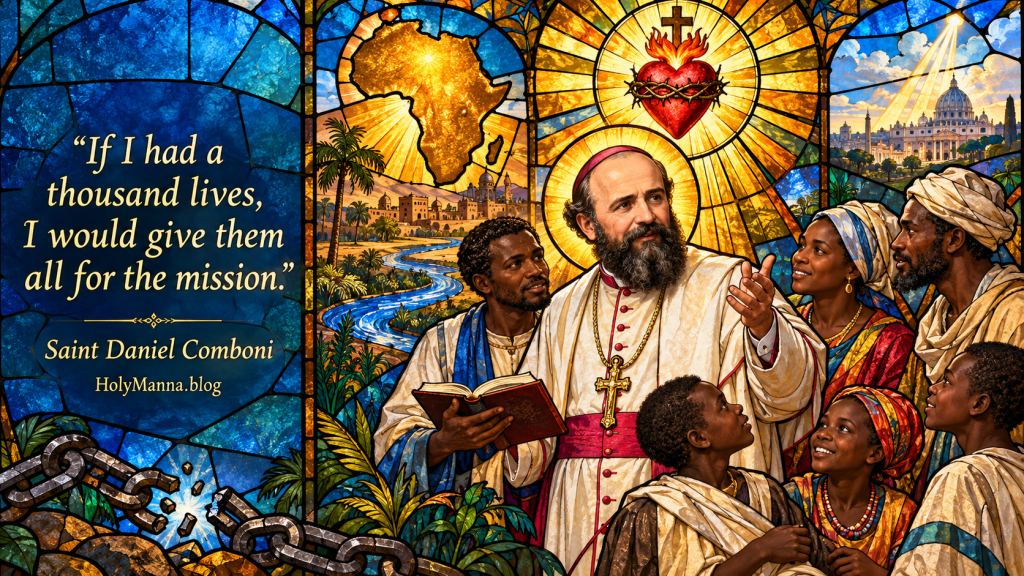
Africa or Death
On October 10th, the Church celebrates Saint Daniel Comboni, a man who proves that God delights in choosing the small to accomplish the immense. Born in 1831 to poor gardeners on the shore of Lake Garda in northern Italy, Daniel Comboni became the first Catholic Bishop of Central Africa, the founder of two missionary institutes that now serve on four continents, and one of the most daring evangelizers the Church has ever produced. At a time when much of Europe looked at Africa and saw only territory to exploit, Comboni looked at Africa and saw beloved sons and daughters of God, people for whom Christ had died, people fully capable of becoming saints, scholars, priests, and apostles themselves. His famous missionary vision was captured in four words that still sound revolutionary today: “Save Africa with Africa.”
Comboni poured out his life fighting the slave trade, burying his closest friends, crossing deserts, begging funds from kings and peasants alike, and enduring slander from people who should have supported him. He died exhausted in Khartoum at only 50 years old, whispering a promise that history has proven true: “I am dying, but my work will not die.” Pope Saint John Paul II beatified him on March 17th, 1996 and canonized him on October 5th, 2003. When the Church canonizes a saint, she is not merely handing out an honor; as The Catechism teaches, “by canonizing some of the faithful, i.e., by solemnly proclaiming that they practiced heroic virtue and lived in fidelity to God’s grace, the Church recognizes the power of the Spirit of holiness within her and sustains the hope of believers by proposing the saints to them as models and intercessors” (CCC 828). Saint Daniel Comboni is exactly that kind of model: a man whose heart burned so fiercely for souls that not even death could put the fire out.
From a Lemon Grove to the Banks of the Nile
Daniel Comboni was born on March 15th, 1831 in Limone sul Garda, a small fishing and farming village clinging to the cliffs above Lake Garda in the province of Brescia, Italy. His parents, Luigi Comboni and Domenica Pace, worked as gardeners for a wealthy local landowner, tending the lemon groves that gave the village its character. The family lived in the custodian’s dwelling of a lemon house, and because that corner of Italy still sat under Austrian rule in 1831, the future apostle of Africa was actually born an Austrian subject. The Combonis were materially poor but spiritually rich, and their faith had been tested by sorrow in a way most modern readers can barely imagine. Daniel was the fourth of eight children, and he was the only one who survived into adulthood; six of his brothers and sisters died in infancy. Luigi and Domenica clung to their one surviving boy with a love that was tender, protective, and deeply Christian.
It was poverty, strangely enough, that God used to open the door of Daniel’s vocation. His parents could not afford his education, so young Daniel was sent away to Verona to study at the institute founded by Father Nicola Mazza, a priest who ran a school for poor and gifted boys. There, Daniel completed his studies in philosophy and theology, and there his heart caught fire. Missionaries returning from Central Africa visited the institute and told stories of peoples who had never heard the name of Jesus, and of the horrors of the slave trade that was devouring the continent. Something in the teenage boy from Limone answered that call with his whole being. On January 6th, 1849, the feast of the Epiphany, the seventeen year old Daniel knelt in the presence of Don Mazza and vowed to consecrate his life to the missions of Central Africa. It was a promise he would keep until his last breath.
Daniel was ordained a priest on December 31st, 1854 by Blessed John Nepomucene Tschiderer, the Bishop of Trent, in the very year that Blessed Pope Pius IX proclaimed the dogma of the Immaculate Conception. Three years later, in 1857, the moment arrived. Father Daniel Comboni set out for Africa with five other missionaries from the Mazza Institute. The hardest goodbye was to his mother. Domenica, who had already buried seven children, gave her only son to God with words that deserve to be remembered among the great acts of faith by Christian mothers: “Go, Daniel, and may the Lord bless you.” Her surrender echoes the generosity that The Catechism describes when it teaches that “parents should respect and encourage their children’s vocations” and remember that “the first calling of the Christian is to follow Jesus” (CCC 2253). After roughly four months of grueling travel by sea, river, and desert, the little band of missionaries reached Khartoum, the capital of Sudan, in January of 1858. Daniel Comboni was 26 years old, and the mission that would define his life, and eventually take it, had begun.
A Flash of Lightning at the Tomb of Saint Peter
Comboni’s first encounter with Africa nearly destroyed him, and it is important to be honest about that, because his greatness is not the greatness of a man for whom everything went smoothly. The climate was brutal, disease was everywhere, and the mission stations were surrounded by the misery produced by the slave trade. From the mission of Holy Cross along the Nile, the young priest wrote home to his parents words that reveal the steel underneath his gentleness: “We will have to labour hard, to sweat, to die: but the thought that one sweats and dies for love of Jesus Christ and the salvation of the most abandoned souls in the world, is far too sweet for us to desist from this great enterprise.” The dying began quickly. By the end of 1859, three of his five companions were dead, and Comboni himself was so ravaged by malaria that he was forced back to Italy. Kneeling at the deathbed of one of his brother missionaries, he did not waver; instead he sealed his resolve in a cry that became the battle standard of his whole life: “O Nigrizia o morte!”, which means “Either Africa, or death!”
God honored that cry in a moment that Comboni himself described with precision. On September 15th, 1864, while he was praying at the tomb of Saint Peter in the Vatican Basilica during the celebrations surrounding the beatification of Margaret Mary Alacoque, an idea struck him, in his own words, “like a flash of lightning.” Within hours he had begun writing his Plan for the Regeneration of Africa, and three days later he presented it to Cardinal Barnabò, the Prefect of Propaganda Fide, and to Blessed Pope Pius IX. The Plan was decades ahead of its time. While colonial Europe treated Africans as problems to be managed or property to be sold, Comboni proposed founding seminaries, schools, trades institutes, and Christian communities in which Africans themselves would be formed as catechists, teachers, religious, and priests, so that Africa would be evangelized principally by Africans. He compressed the whole vision into the motto “Save Africa with Africa.” This is precisely the missionary logic the Church professes, for The Catechism teaches that “the Church, in obedience to the command of her founder and because it is demanded by her own essential universality, strives to preach the Gospel to all men” (CCC 849), and that the Gospel takes root when local churches raise up their own apostles.
Comboni then did something almost unheard of for a poor priest with no institutional backing: he crisscrossed Europe, from Italy to France, Spain, England, Germany, and Austria, begging spiritual and material support from kings, bishops, nobles, and simple laborers alike, anyone who would listen to him speak about Christ and Africa. In 1867 he founded the missionary institute now known as the Comboni Missionaries of the Heart of Jesus, and in 1872 he founded the Comboni Missionary Sisters, becoming the first missionary leader to bring consecrated women into the heart of the Central African mission, where they served shoulder to shoulder with the priests and brothers. At the First Vatican Council, where he served as theologian to the Bishop of Verona, he persuaded 70 bishops to sign the petition Postulatum pro Nigris Africæ Centralis, pleading with the universal Church to take up the evangelization of Central Africa. In 1872 Pius IX entrusted the immense Vicariate of Central Africa to him as Pro-Vicar, and on July 2nd, 1877 he was named Vicar Apostolic and consecrated a bishop one month later, the first bishop of Central Africa.
No physical miracles such as healings are historically documented from Comboni’s lifetime, and honesty requires saying so plainly; his was a different kind of wonder. The documented marvels of his life were moral ones: ransoming and educating people enslaved by traffickers, opening schools and missions at El Obeid, Delen, and beyond, and pouring out a love his people could feel. When he returned to Khartoum in 1873 to take up the leadership of the mission, he preached a homily that his spiritual sons and daughters still treasure, telling the faithful: “I make common cause with each one of you, and the happiest day of my life will be the one on which I will be able to give my life for you” (Writings 3158 to 3159). A shepherd who talks like that is simply echoing his Master, who said in The Gospel of John, “I am the good shepherd. The good shepherd lays down his life for the sheep” (Jn 10:11).
The Cross That Never Left Him
Saint Daniel Comboni was not a martyr in the strict sense; no executioner took his life. Yet his fifty years were one long martyrdom of labor, loss, and misunderstanding, the slow daily martyrdom that the Church’s spiritual tradition calls white martyrdom, in which a person gives his life not in a single moment but second by second. The Catechism describes the law that governed Comboni’s whole existence: “The way of perfection passes by way of the Cross. There is no holiness without renunciation and spiritual battle” (CCC 2015). Comboni knew that law intimately, and he embraced it, writing that the works of God are born and grow at the foot of Calvary, a conviction quoted to this day in the Church’s own liturgical texts for his memorial.
It is worth considering what he actually endured. He buried companion after companion, young men and women who had followed him to Africa and died of fever within months or years of arriving. He battled malaria repeatedly in his own body. He stood face to face with the slave trade, one of the great organized evils of his century, and fought it with every tool he had: ransoming captives, sheltering and educating the freed, and pleading with the powers of Europe to act. The Church would later condemn that evil in words that read like a summary of Comboni’s lifelong battle, teaching that the seventh commandment forbids acts or enterprises that “lead to the enslavement of human beings, to their being bought, sold and exchanged like merchandise, in disregard for their personal dignity” (CCC 2414). He likewise lived decades ahead of the principle that “every form of social or cultural discrimination in fundamental personal rights on the grounds of sex, race, color, social conditions, language, or religion must be curbed and eradicated as incompatible with God’s design” (CCC 1935).
The hardships were not only physical. Comboni was mocked in Europe as a dreamer whose plan was foolhardy, even crazy. He faced chronic shortages of money and personnel. When he returned to Khartoum in 1878 to a triumphant welcome, he walked straight into one of the worst famines in Sudan’s history, followed by epidemics that cut down his missionaries and his people in waves. And in the final stretch of his life came perhaps the bitterest cross of all: a campaign of calumnies and false accusations, wounds inflicted not by strangers but by voices within the world that should have defended him. He bore it without abandoning his post. In October of 1881, days after administering 14 baptisms, he was seized by fever. On October 10th, 1881, at only 50 years of age, Bishop Daniel Comboni died in Khartoum, among the people he had chosen over every comfort, every honor, and every safety Europe could have offered him. His last recorded words were not a complaint but a prophecy: “I am dying, but my work will not die.” He had told his people years earlier that the happiest day of his life would be the day he could give his life for them. On October 10th, that day arrived.
A Work That Did Not Die
The first test of Comboni’s dying prophecy came almost immediately, and it came in the form of catastrophe. Within months of his death, the Mahdist uprising swept across Sudan. Missions were destroyed, missionaries were captured or driven out, and to human eyes the work of thirty years lay in ruins. Comboni had been buried in the mission garden in Khartoum the day after his death, and when missionaries were finally able to return years later, they could recover only a few bone fragments, which were placed in an urn in the church at Aswan in Egypt. The Church’s own liturgical texts for his memorial state it plainly: his bones were scattered. There is something profoundly fitting in that; like the grain of wheat in The Gospel of John that must fall to the ground and die to bear much fruit (Jn 12:24), Comboni was sown into the very soil of the continent he loved. One treasured relic does survive: the white cassock he was wearing at the hour of his death, stained with the sweat of his final labors, is venerated at the Mother House of the Comboni Missionary Sisters in Verona and has been carried on pilgrimage among Comboni communities.
And the work did not die. The institutes he founded rebuilt, returned, and multiplied, and today Comboni priests, brothers, sisters, secular missionaries, and lay missionaries serve in more than 40 countries across Africa, Europe, Asia, and the Americas. The Church in Sudan and South Sudan, which endured persecution and war through the twentieth century, traces its lineage directly to his sacrifice. His birthplace at Limone sul Garda is preserved and welcomes pilgrims, and the faithful across Africa celebrate his feast with particular devotion. The Catechism explains why the saints remain so powerfully active after death: “being more closely united to Christ, those who dwell in heaven fix the whole Church more firmly in holiness” and “they do not cease to intercede with the Father for us” (CCC 956). Comboni’s intercession has been confirmed by the Church in two formally recognized miracles.
The first opened the way to his beatification. On December 25th, 1970, in Brazil, an Afro-Brazilian girl named Maria José de Oliveira Paixão was healed after a stomach operation for an infection that had been growing steadily worse. After rigorous medical and theological examination, the Church recognized this healing in 1995 as a miracle worked through Comboni’s intercession, and Pope John Paul II beatified him in Saint Peter’s Basilica on March 17th, 1996.
The second miracle is one of the most beautiful in the modern history of canonizations, because God worked it for a devout Muslim mother in Comboni’s own Khartoum. On November 11th, 1997, a 38 year old woman named Lubna Abdel Aziz was admitted to Saint Mary’s Hospital, run by the Comboni Sisters, to deliver her fifth child by caesarean section. The baby was born safely, but the mother began to hemorrhage uncontrollably, and two operations failed to stop the bleeding. The doctors concluded that nothing more could be done. Sister Bianca Benatelli, who led the maternity ward, asked Lubna and her husband for permission to pray to Comboni, the one Christian figure she could propose to a practicing Muslim family, since his holiness was already famous among the people of Sudan. The family agreed, and the sisters began storming heaven together. According to the sister’s testimony gathered in the process, an image of Comboni was placed near the dying woman’s pillow, and her husband begged the sisters to pray to their God so that the mother of his child would not be lost; those tender details rest on the sister’s account and cannot be independently verified. What the Church did verify, with the medical findings of two Muslim doctors included in the official acts, is this: the woman the physicians expected to die before morning was found the next day alive and recovering, and her healing had no natural explanation. The Church formally recognized the miracle, and on October 5th, 2003, Pope John Paul II canonized Daniel Comboni in Rome, together with the missionary founders Arnold Janssen and Josef Freinademetz. The son of Limone’s gardeners, whose plan had once been called crazy, was raised to the altars of the universal Church, and in 2023 Pope Francis held him up to the whole world at a General Audience as a model of apostolic zeal, an apostle of Africa whose energy flowed from the joy of the Gospel.
What a Burning Heart Can Teach a Busy World
It would be easy to admire Saint Daniel Comboni from a safe distance, as a heroic figure from another century whose life has nothing to do with mortgages, commutes, and group chats. That would be a mistake, because the engine of his life is available to every baptized person. The Catechism insists that “all Christians in any state or walk of life are called to the fullness of Christian life and to the perfection of charity” (CCC 2013). Comboni did not become a saint because he went to Africa; he went to Africa because he had already decided, kneeling before Don Mazza at seventeen, that his life belonged entirely to Jesus Christ. The location was Sudan; the decision could be made anywhere, including wherever you are reading this.
Start with how Comboni saw people. Where his contemporaries saw a continent of strangers, he saw family, and he made common cause with them. Who are the people you have quietly decided are someone else’s problem, and what would it cost you to make common cause with them this week? His motto, “Save Africa with Africa,” carries a lesson for anyone who serves others: real charity does not do things to people or merely for people, it believes in people, equips them, and trusts them to become protagonists of their own story. Parents can live this with their children, managers with their teams, catechists with their students, friends with a struggling friend.
Then there is his relationship with the Cross. Comboni was convinced that the works of God are born and grow at the foot of Calvary, and he treated every setback, every funeral, every slander as soil rather than as a verdict. When your plans collapse, do you conclude that God has abandoned the work, or do you ask what He is planting? A practical way to imitate him is to name one hardship currently sitting in your life and consciously offer it for someone else’s salvation, the way Comboni offered his fevers and his griefs for the people of Africa. Another is perseverance in small daily fidelity: he answered letters, begged donations, taught children, and crossed deserts one day at a time for decades. Holiness rarely looks dramatic from the inside; it looks like not quitting. Finally, imitate his boldness in prayer. He asked Blessed Pope Pius IX for a continent, and he asked bishops at an ecumenical council to sign their names to his dream. When was the last time you asked God for something so large that only He could supply it?
Engage With Us!
Saint Daniel Comboni gave everything, held nothing back, and trusted God with the harvest. Now the conversation turns to you. Share your thoughts and reflections in the comments below; your witness might be exactly the encouragement another reader needs today. Here are some questions to pray with and respond to:
- Comboni’s mother said, “Go, Daniel, and may the Lord bless you,” releasing her only surviving child to God. Is there something or someone you are being invited to entrust to the Lord with that same open hand?
- Comboni cried “Either Africa, or death!” after burying his friends. What mission or commitment in your own life needs that kind of renewed, wholehearted resolve?
- His plan was to “Save Africa with Africa,” trusting others to become protagonists rather than projects. Who in your life needs you to believe in them, equip them, and step back?
- God healed a Muslim mother through Comboni’s intercession because a religious sister dared to pray boldly. Where could you bring intercessory prayer into a situation that looks medically, financially, or relationally hopeless?
- Comboni said the happiest day of his life would be the day he could give his life for his people. What would it look like for you to give your life away, a little more generously, starting tomorrow morning?
The story of Saint Daniel Comboni proves that one surrendered heart can outlast empires, famines, and even the scattering of its own bones. You do not need a continent to begin; you need only the next person God places in front of you. Go into this feast day resolved to love without calculation, to persevere at the foot of whatever Calvary you are standing on, and to do everything, great or small, with the love and mercy that Jesus taught us. His work did not die, and if you hand your life to the same Lord, neither will yours.
Saint Daniel Comboni, pray for us!
Follow us on YouTube, TikTok, Instagram and Facebook for more insights and reflections on living a faith-filled life.


Leave a Reply