Saturday of the Twenty-seventh Week in Ordinary Time – Lectionary: 466
The Promise That Found Its Moment
Some promises take centuries to keep, and the readings for Saturday, October 10th, tell the story of the longest kept promise in history. The central theme uniting this Saturday of the Twenty-seventh Week in Ordinary Time is covenant belonging: God remembers His promise to Abraham forever, fulfills it in Jesus Christ, and opens it to everyone who hears His word and keeps it.
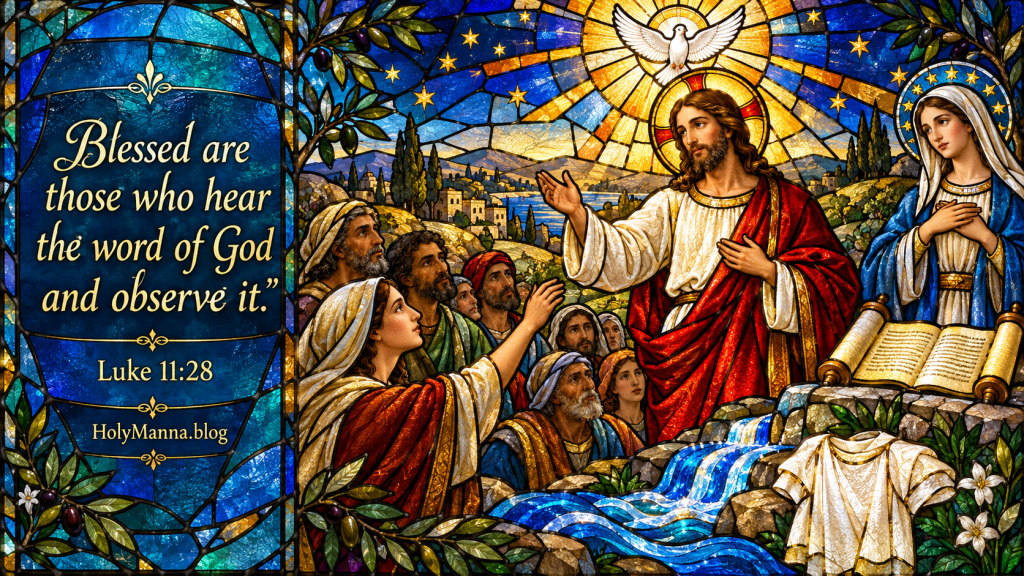
In the First Reading from Galatians 3, Saint Paul explains to a community in crisis that the Law of Moses was never the destination. It was the trusted guardian walking God’s people toward Christ, and now that faith has come, believers are no longer minors under supervision but children of God, clothed with Christ in Baptism and heirs of the promise made to Abraham roughly two thousand years before Paul picked up his pen. The Responsorial Psalm, Psalm 105, is Israel’s family memory set to music, a song King David’s own liturgy used when the Ark of the Covenant entered Jerusalem, insisting that “The Lord remembers his covenant for ever.” Then, in The Gospel of Luke, a woman in the crowd shouts a blessing over the Mother of Jesus, and the Lord answers with the beatitude that defines His family: blessed are those who hear the word of God and observe it.
The Church has long honored the Blessed Virgin Mary on Saturdays, and in October, the month of the Holy Rosary, that custom shines brighter. Mary stands quietly behind all three readings as the first believer, the daughter of Abraham who heard the promise and said yes. These readings invite every reader to take a place in that same family.
First Reading — Galatians 3:22-29
When the Guardian Steps Aside
Around the year 49, Saint Paul received alarming news. The churches he had founded in Galatia, in the heart of modern-day Turkey, were being told by outside agitators that faith in Christ was not enough, and that Gentile converts needed circumcision and the full Mosaic Law to truly belong to God’s people. Paul’s answer draws on a figure every Galatian household knew: the paidagogos, the trusted slave who escorted a boy to school, corrected his behavior, and guarded him until he came of age. The NABRE translates this word as disciplinarian. The guardian was good and necessary, but no one stayed under him forever. This reading fits the day’s theme perfectly, because it explains how the ancient promise God made to Abraham finally reached its moment in Christ.
Galatians 3:22-29
Brothers and sisters:
Scripture confined all things under the power of sin,
that through faith in Jesus Christ
the promise might be given to those who believe.Before faith came, we were held in custody under law,
confined for the faith that was to be revealed.
Consequently, the law was our disciplinarian for Christ,
that we might be justified by faith.
But now that faith has come, we are no longer under a disciplinarian.
For through faith you are all children of God in Christ Jesus.
For all of you who were baptized into Christ
have clothed yourselves with Christ.
There is neither Jew nor Greek,
there is neither slave nor free person,
there is not male and female;
for you are all one in Christ Jesus.
And if you belong to Christ, then you are Abraham’s descendants,
heirs according to the promise.
Detailed Exegesis
Verse 22: “Scripture confined all things under the power of sin, that through faith in Jesus Christ the promise might be given to those who believe.” Paul begins with a diagnosis. Scripture, speaking with God’s own authority, declared the whole human race imprisoned by sin, not to crush anyone but to make the cure unmistakable. If everyone is locked in, then no one escapes by personal achievement. The promise, the blessing sworn to Abraham in Genesis 12 and Genesis 15, comes as pure gift to those who believe.
Verse 23: “Before faith came, we were held in custody under law, confined for the faith that was to be revealed.” The image here is protective custody rather than punishment. Israel was guarded by the Law the way a city is guarded by walls, kept safe and set apart until the appointed hour. Notice that faith is something that came, meaning it arrived in history. Faith has a birthday, because faith has a face, Jesus Christ.
Verse 24: “Consequently, the law was our disciplinarian for Christ, that we might be justified by faith.” The Law was never the teacher; it was the escort walking God’s people to the teacher. It restrained evil, trained the conscience, and revealed sin for what it was, but it could not give the life it demanded. Justification, meaning a right relationship with God, comes by faith as a gift, not as a wage.
Verse 25: “But now that faith has come, we are no longer under a disciplinarian.” When a son came of age in the ancient world, the guardian’s job honorably ended. Paul announces that humanity has come of age in Christ. The Law’s moral truth remains forever, but its role as warden is finished, because the One it pointed toward has arrived.
Verse 26: “For through faith you are all children of God in Christ Jesus.” Here the household image turns breathtaking. The ward has not merely been released; he has been adopted. Through faith and in Christ, believers are no longer minors under supervision but sons and daughters in the Father’s house, sharing by grace what Christ possesses by nature.
Verse 27: “For all of you who were baptized into Christ have clothed yourselves with Christ.” Paul now names the moment adoption happens: Baptism. The clothing image likely echoes the early practice behind the white baptismal garment, which the Church still gives today. CCC 1243 teaches that the white garment “symbolizes that the person baptized has ‘put on Christ,’ has risen with Christ.” The baptized do not simply admire Christ from a distance; they wear Him as their deepest identity.
Verse 28: “There is neither Jew nor Greek, there is neither slave nor free person, there is not male and female; for you are all one in Christ Jesus.” Paul names the three great dividing lines of the ancient world, ethnicity, legal status, and sex, and declares that none of them determines standing before God. Many scholars believe these words come from an early baptismal proclamation. Grace does not erase real differences or vocations, but it dissolves every claim of superiority within God’s family.
Verse 29: “And if you belong to Christ, then you are Abraham’s descendants, heirs according to the promise.” The argument lands where it began. Belonging to Christ makes a believer a true child of Abraham, not by bloodline but by faith, and therefore an heir of everything God swore to him. The promise that waited two thousand years now has the believer’s name on it.
Teachings
Saint John Chrysostom, Doctor of the Church, preached on this very passage in his Commentary on Galatians and refused to let anyone pit the Law against grace. He wrote, “The Law then, as it was our tutor, and we were kept shut up under it, is not the adversary but the fellow-worker of grace.” Then he offered one of his most memorable images: “If a candle which gave light by night, kept us, when it became day, from the sun, it would not only not benefit, it would injure us.” The Law was the candle; Christ is the sunrise. The Catechism teaches the same truth in CCC 708: “God gave the Law as a ‘pedagogue’ to lead his people towards Christ.” On what Baptism actually accomplishes, CCC 1265 declares, “Baptism not only purifies from all sins, but also makes the neophyte ‘a new creature,’ an adopted son of God, who has become a ‘partaker of the divine nature,’ member of Christ and co-heir with him, and a temple of the Holy Spirit.” And on verse 28, CCC 791 affirms that “the unity of the Mystical Body triumphs over all human divisions.” The Church settled this exact controversy at the Council of Jerusalem, recorded in Acts 15, when the Apostles declared that Gentiles are saved through the grace of the Lord Jesus. Paul’s letter and that council together protected the Gospel of grace for every generation since.
Reflection
This reading asks you to check which story you are living in. It is painfully easy to treat the faith like a probation program, keeping rules to avoid trouble while never feeling at home with God. Paul insists that you were baptized into a family, not sentenced to a system. Try something concrete this week: find out the date of your Baptism, write it down, and celebrate it every year like the birthday it truly is. Then look around your parish on Sunday and notice how many dividing lines, culture, income, language, and age, dissolve at the same altar rail. Treat one person outside your usual circle like the sibling in Christ they actually are. Does your faith feel more like a rulebook to survive or a family to belong to? What would change in your daily decisions if you woke up each morning remembering that you are clothed with Christ? Is there a dividing line you still let stand between yourself and another member of God’s family?
Responsorial Psalm — Psalm 105:2-8a
The Song That Refuses to Forget
Psalm 105 belongs to the family of historical psalms, songs Israel composed to keep its memory of God’s saving deeds alive from one generation to the next. Its opening verses carry a remarkable pedigree: 1 Chronicles 16 records that when King David brought the Ark of the Covenant into Jerusalem, the liturgy he appointed for that day included these very lines. For roughly three thousand years, believers have sung this psalm to answer a simple danger, the danger of forgetting. The refrain the Church places on every lip today, “The Lord remembers his covenant for ever,” is the hinge between the First Reading and the Gospel, because the promise Paul says is fulfilled in Christ is the same covenant this psalm insists God never forgets.
Psalm 105:2-8a
R. (8a) The Lord remembers his covenant for ever.
or:
R. Alleluia.
Sing to him, sing his praise,
proclaim all his wondrous deeds.
Glory in his holy name;
rejoice, O hearts that seek the LORD!
R. The Lord remembers his covenant for ever.
or:
R. Alleluia.
Look to the LORD in his strength;
seek to serve him constantly.
Recall the wondrous deeds that he has wrought,
his portents, and the judgments he has uttered.
R. The Lord remembers his covenant for ever.
or:
R. Alleluia.
You descendants of Abraham, his servants,
sons of Jacob, his chosen ones!
He, the LORD, is our God;
throughout the earth his judgments prevail.
R. The Lord remembers his covenant for ever.
or:
R. Alleluia.
Detailed Exegesis
Verse 2: “Sing to him, sing his praise, proclaim all his wondrous deeds.” The psalm opens with commands, and every one of them is loud. Biblical praise is never private trivia; it is proclamation, telling the story of what God has done out where others can hear it. Gratitude that stays silent eventually starves, while gratitude spoken aloud becomes evangelization.
Verse 3: “Glory in his holy name; rejoice, O hearts that seek the LORD!” To glory in God’s name means to boast in who God is rather than in personal accomplishment, which answers Galatians beautifully, since no one under grace boasts in human achievement. Notice also that joy is promised to hearts that seek, not only to hearts that have fully found. The search itself, done in faith, already carries rejoicing.
Verse 4: “Look to the LORD in his strength; seek to serve him constantly.” The psalmist points attention away from personal resources and toward God’s strength, the same movement Paul makes when he says justification cannot be earned. The word constantly matters here. Covenant faithfulness is not an occasional mood but a steady direction, renewed each morning.
Verse 5: “Recall the wondrous deeds that he has wrought, his portents, and the judgments he has uttered.” Here stands the psalm’s beating heart, the command to remember. In Hebrew thought, this kind of remembering, the zikkaron, is far more than nostalgia. It is a liturgical act that makes God’s past deeds present and effective for the worshiper today, the very concept that blossoms into the Church’s understanding of the Mass.
Verse 6: “You descendants of Abraham, his servants, sons of Jacob, his chosen ones!” The psalmist names his audience, and Saint Paul would smile at the address. According to Galatians 3:29, everyone who belongs to Christ is now included among Abraham’s descendants. A Christian praying this verse at Mass today is not reading someone else’s mail; this summons is addressed to the baptized by name.
Verse 7: “He, the LORD, is our God; throughout the earth his judgments prevail.” The psalm makes a double claim that only Israel dared to make: the God who is intimately ours also rules the entire earth. The covenant is personal without being small. What God decides stands everywhere, which is exactly why a promise He made can never quietly expire.
Verse 8a: “The Lord remembers his covenant for ever.” The refrain gathers everything into one sentence. Human beings forget promises, anniversaries, and even the people who love them, but God’s memory is His faithfulness. The covenant with Abraham was not filed away; it was kept, guarded, and finally fulfilled when the promised descendant arrived.
Teachings
The Church sees in this psalm’s command to remember the deep roots of her own worship. The Catechism teaches in CCC 1363, “In the sense of Sacred Scripture the memorial is not merely the recollection of past events but the proclamation of the mighty works wrought by God for men. In the liturgical celebration of these events, they become in a certain way present and real.” That is precisely what Psalm 105 was doing for Israel at the Passover and what the Eucharist does in its fullness for the Church, since Jesus commanded His Apostles to do this in memory of Him. Every Mass is this psalm kept perfectly, the wondrous deeds of God not merely recalled but made present on the altar. The historical setting deepens the point. When David placed the Ark in Jerusalem, 1 Chronicles 16 shows the king appointing singers so that remembering would never depend on individual effort but would be built into the community’s public prayer. The Church inherited that wisdom, which is why the liturgy repeats the same psalms, feasts, and seasons year after year. Repetition is not boredom; it is how a family keeps its memory, and how a people stays certain that the God who acted before will act again.
Reflection
Forgetfulness is the quiet enemy of faith, and the cure the psalm prescribes is deliberate remembering. Try keeping a simple record of answered prayers in a notebook or in a notes app, one line per blessing, and read it whenever God feels distant. Make a habit of naming one of God’s wondrous deeds aloud at the dinner table or in a text to a friend, because proclaimed gratitude strengthens everyone who hears it. Above all, bring this psalm to Mass, where remembering becomes reality. When was the last time you recalled, specifically and by name, something God has done in your life? Who in your circle needs to hear you proclaim His wondrous deeds this week? Do you approach the Eucharist as a routine or as the living memorial where God’s saving deeds become present for you?
Holy Gospel — Luke 11:27-28
The Compliment Jesus Would Not Leave Alone
This tiny Gospel, only two verses long, arrives at a tense moment in The Gospel of Luke. Jesus has just cast out a demon and endured the accusation that He works by the power of Beelzebul, and in the middle of His reply a woman’s voice rises above the crowd. Her words follow a warm Jewish custom of the time, praising a man by blessing the mother who bore and nursed him. Jesus answers with the Greek word menoun, which the NABRE renders as rather, a word that does not reject her praise but lifts it higher, as if to say yes, and even more than that. Read carelessly, the exchange sounds like a slight against His Mother. Read with the Church, it is the moment Jesus reveals the true source of Mary’s blessedness and opens that same blessedness to everyone, which is why this passage completes the day’s theme of covenant belonging.
Luke 11:27-28
While Jesus was speaking,
a woman from the crowd called out and said to him,
“Blessed is the womb that carried you
and the breasts at which you nursed.”
He replied, “Rather, blessed are those
who hear the word of God and observe it.”
Detailed Exegesis
Verse 27: “While Jesus was speaking, a woman from the crowd called out and said to him, ‘Blessed is the womb that carried you and the breasts at which you nursed.’” This anonymous woman is the first voice in the Gospel to bless the Mother of Jesus publicly, and her instinct is sound. Her cry unknowingly echoes Elizabeth’s greeting in Luke 1:42 and Mary’s own prophecy in Luke 1:48 that all generations would call her blessed. In a culture where a woman’s honor was bound to her children, this was the highest compliment available: so remarkable a teacher must have a remarkable mother. The woman speaks better than she knows, yet her praise stops at biology, at womb and breast, at the physical bond alone.
Verse 28: “He replied, ‘Rather, blessed are those who hear the word of God and observe it.’” Jesus does not deny the woman’s blessing; He completes it. If blessedness came only through physical motherhood, it would belong to one woman in history and be closed to everyone else forever. By grounding blessedness in hearing and keeping God’s word, Jesus names the very thing Mary did first and did perfectly. She heard the word at the Annunciation and answered in Luke 1:38, “May it be done to me according to your word,” and Luke 2:19 says she kept all these things in her heart. The beatitude does not demote Mary; it explains her, and then it flings the door open so that every listener in that crowd, and every reader today, can share her blessedness.
Teachings
Saint Augustine, Doctor of the Church, wrote the definitive commentary on this scene around the year 401 in his treatise Of Holy Virginity. He taught, “Therefore Mary is more blessed in receiving the faith of Christ, than in conceiving the flesh of Christ.” He pressed the point further: “Thus also her nearness as a Mother would have been of no profit to Mary, had she not borne Christ in her heart after a more blessed manner than in her flesh.” Far from diminishing Our Lady, Augustine exalts her twice over, blessed in body as the Mother of God and more blessed still in the faith that welcomed Him. The Second Vatican Council made this reading official in Lumen Gentium 58, teaching that Jesus “declared blessed those who heard and kept the word of God, as she was faithfully doing.” The Catechism gathers it all together in CCC 149: “Throughout her life and until her last ordeal when Jesus her son died on the cross, Mary’s faith never wavered. She never ceased to believe in the fulfillment of God’s word. And so the Church venerates in Mary the purest realization of faith.” It is fitting that this Gospel falls on a Saturday, the day the Church has long dedicated to Our Lady by cherished tradition, and in October, the month of the Holy Rosary, when Catholics ponder the word of God through her eyes decade by decade.
Reflection
Jesus hands you the family resemblance test in a single sentence: hear the word of God and observe it. Hearing comes first, so give the word a real place in your schedule. Read the daily Mass readings each morning, even five minutes’ worth, or pray one decade of the Rosary while genuinely pondering its mystery the way Mary pondered. Then comes the harder half, observing it. Pick one thing you hear in Scripture this week and do it the same day, whether that means forgiving a specific person, telling the truth in an uncomfortable conversation, or giving quietly to someone in need. Blessedness, by the Lord’s own definition, is not reserved for the extraordinary; it is offered to the obedient. When God’s word is read at Mass, are you truly hearing it or merely letting it pass by? What is one word from today’s readings that you can observe, concretely, before this day ends? How could imitating Mary’s habit of pondering God’s word in her heart change the pace and noise of your week?
Welcome Home to the Promise
Step back and watch the whole story come together. Long before Sinai, God made a promise to an old man named Abraham, swearing that through his descendants every family on earth would be blessed. The psalmist spent centuries singing that “The Lord remembers his covenant for ever,” and he was right. Saint Paul announces the moment the promise came true: faith arrived in the person of Jesus Christ, the guardian stepped aside, and through Baptism believers were adopted as children of God, clothed with Christ, and written into Abraham’s inheritance. Then Jesus Himself, answering a shout from the crowd, explained what life inside that family looks like. Blessed are those who hear the word of God and observe it, exactly as His Mother did first and best.
That is the invitation sitting quietly inside this ordinary October Saturday. The faith is not a performance review to survive or a museum to visit; it is a home to live in, with a Father who never forgets, an inheritance already signed, and a Mother who shows everyone how it is done. So take the next step. Dig up your baptismal date and celebrate it. Open the daily readings tomorrow and let one verse follow you around all day until you obey it. Pray a decade of the Rosary with Mary, the first hearer and keeper of the word. The God who remembered His covenant through two thousand years of waiting has certainly not forgotten anyone reading these words today. The promise found its moment, and the moment is now.
Engage With Us!
The conversation does not end here, and your voice is part of it. Share your reflections in the comments below, because what God is doing in your life may be exactly the encouragement another reader needs today. To get the discussion started, here are some questions drawn from today’s readings:
- In Galatians 3:22-29, Saint Paul says the baptized have clothed themselves with Christ and become heirs of the promise. How does knowing you are an adopted child of God, rather than a servant earning approval, change the way you pray and make decisions?
- In Psalm 105:2-8a, the psalmist commands God’s people to recall His wondrous deeds and proclaims that the Lord remembers His covenant forever. What is one specific deed God has done in your life that you can proclaim to someone this week?
- In Luke 11:27-28, Jesus declares that true blessedness belongs to those who hear the word of God and observe it. Which half is harder for you right now, the hearing or the observing, and what is one practical step you can take to grow in it?
- Taking all the readings together, God remembers His covenant and invites everyone into His family through faith. Where in your life is God inviting you to stop living like an outsider and start living like an heir?
Keep walking forward in faith, one heard and obeyed word at a time. Live this day, and every day, with the love and mercy Jesus taught us, and trust that the God who remembers His covenant forever remembers you by name.
Sacred Heart of Jesus, we trust in You!
Immaculate Heart of Mary, pray for us!
Saint Michael the Archangel, defend us in battle!
Follow us on YouTube, TikTok, Instagram and Facebook for more insights and reflections on living a faith-filled life.


Leave a Reply