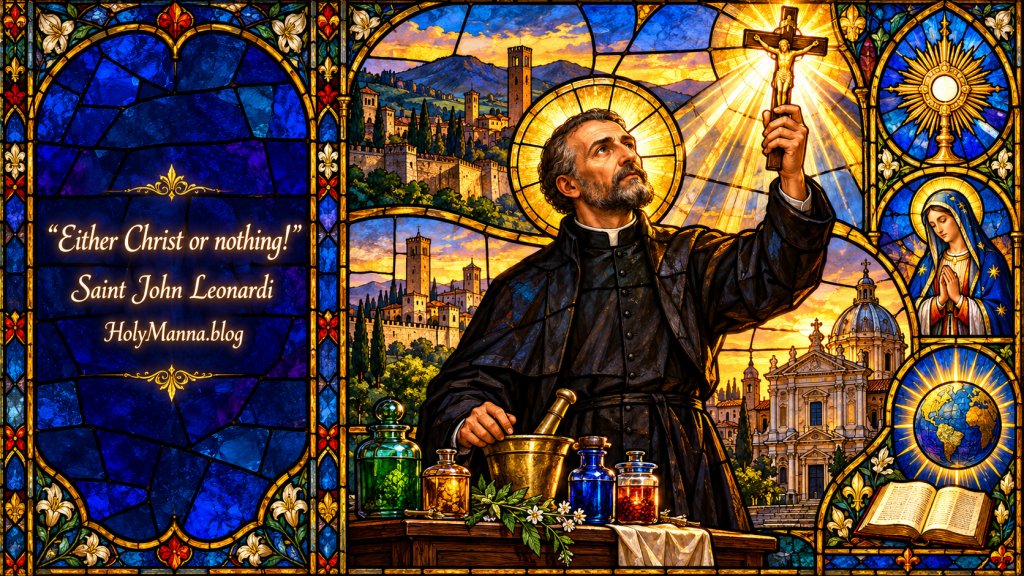
The Pharmacist Who Prescribed Christ
Every age thinks its problems are unprecedented, and every age discovers that God has already sent someone to meet them. The late 1500s were a time of fracture. The Protestant Reformation had split Western Christendom, scandal had wounded the credibility of the clergy, and ordinary Catholics often did not know the basics of the faith they professed. Into that wounded world stepped a quiet apothecary’s apprentice from a small town near Lucca, Italy, a man who spent 10 years learning to measure out medicines before he ever measured out a homily. His name was John Leonardi, and he became convinced that humanity’s deepest sickness was not political or economic but spiritual, and that there was exactly one remedy for it. Pope Benedict XVI, reflecting on his life 400 years after his death, said that Saint John Leonardi summed up that remedy in a single expression: “Christ first of all”, Christ at the center of the heart, at the center of history and of the cosmos.
The Church celebrates Saint John Leonardi on October 9th with an Optional Memorial, honoring him as a priest, a founder, and a reformer who helped rebuild the Church from the inside out during the Counter-Reformation. He founded the Order of Clerics Regular of the Mother of God, formed the Confraternity of Christian Doctrine to teach children the faith, wrote a catechism that stayed in use for nearly 300 years, and helped plant the seed that would grow into the Vatican’s great missionary congregation, Propaganda Fide. He is the patron saint of pharmacists, a patronage formally given to him on August 8, 2006, and a nod to the trade he learned as a young man and never really left behind. He simply changed what he was dispensing.
The Apothecary’s Apprentice of Diecimo
John Leonardi was born in 1541 in Diecimo, a village in the territory of the old Republic of Lucca in what is now Tuscany, Italy. He was the youngest of 7 children in a hard-working family of modest means, and the sources describe a childhood shaped by the steady rhythm of faith lived at home. Some accounts call the family working class and others middle class; what is certain is that they were people of honest labor who took their religion seriously. The young John was known for being prayerful, and early accounts note that he sought out solitude for meditation even as a boy. He also made regular visits to a workshop in his hometown that prepared and sold essences and medicines, and something about that work of healing clearly captured his imagination.
When John was 17, his father enrolled him in a formal apothecary’s course in Lucca, intending to set his son up as a pharmacist, or an apothecary as the trade was then called. John applied himself to it for about 10 years, alert and diligent, until he earned the official recognition of the Republic of Lucca that would have authorized him to open his own shop. He had arrived. He had a profession, a license, and a future. And it was precisely at that moment of security that he began asking whether the time had come to pursue a plan he had carried in his heart all along. After mature reflection, he walked away from the shop, took up theological studies, and was ordained a priest. According to the Vatican’s account, he celebrated his first Mass on the feast of the Epiphany in 1572; some Catholic sources give his ordination date as December 22, 1572, so the exact timing is recorded differently across sources, though all agree on the year.
Here is the detail that makes his story so compelling. He never stopped thinking like a pharmacist. Benedict XVI observed that John retained his interest in medicine because he came to see his old profession as a parable of his new one. Through a holy life, a priest could pass on to men and women what John called “the medicine of God”, which is the Crucified and Risen Jesus Christ, the “measure of all things”. The Catechism teaches the same truth about where catechesis must always point: “At the heart of catechesis we find, in essence, a Person, the Person of Jesus of Nazareth” (CCC 426). John Leonardi grasped that centuries before the Catechism was compiled. He liked to repeat, again and again, “It is necessary to start afresh from Christ.”
Dispensing the Medicine of God
Newly ordained, Father John threw himself into the hardest ministry available. He worked in the hospitals and prisons of Lucca, among the sick and the forgotten, and he dedicated himself to the Christian formation of young people in his parish. His example proved magnetic. A group of young laymen began assisting him in his work, and several of them would later become priests themselves. This is worth pausing on, because it reveals something true about evangelization in every century. John did not recruit with programs or slogans. He simply did the work with visible love, and others wanted in. The Catechism describes this dynamic when it teaches that the laity and clergy alike are called to be witnesses, since “the witness of a Christian life and good works done in a supernatural spirit have great power to draw men to the faith and to God” (CCC 2044).
On September 1, 1574, in the little church of Santa Maria della Rosa in Lucca, John gathered his young companions and founded what he called the Congregation of Reformed Priests of the Blessed Virgin, later known as the Order of Clerics Regular of the Mother of God. He placed the community under the patronage of Our Lady because of his deep personal devotion to her; Benedict XVI said that Mary was for John “a teacher, sister and mother”, and that he experienced her constant protection. When John took his religious name, he chose to be called Giovanni of the Mother of God. His instructions to his disciples sounded exactly like a man trained to measure doses with precision. He told them to keep “before their eyes and minds only the honour, service and glory of Jesus Christ Crucified”, and he added, with an apothecary’s exactness, “lift up your hearts a little higher to God and with him measure all things.”
The community’s mission matched the needs of the hour: preaching, teaching, promoting frequent reception of the Holy Eucharist, and spreading the Forty Hours devotion of Eucharistic adoration. At a time when many Catholics received Communion rarely, John pushed the faithful toward the altar, anticipating what the Church would later state so plainly, that the Eucharist is “the source and summit of the Christian life” (CCC 1324). In 1574 he published a compendium of Christian doctrine in Lucca, a catechism so clear and useful that it remained in use until the 19th century. Think about that for a moment. A book written by a former pharmacist’s apprentice taught the faith to Italian children for close to 300 years. In 1579 he formed the Confraternity of Christian Doctrine, organizing and training lay catechists to teach the faith systematically, decades before such structures were common. The congregation received the approval of the bishop of Lucca in 1583 with the blessing of Pope Gregory XIII, and Pope Clement VIII confirmed it on October 13, 1595.
Rome noticed the man’s gifts. Clement VIII entrusted John with the delicate task of reforming the monks of Vallombrosa and Monte Vergine, and the New Catholic Encyclopedia records that he helped inaugurate 4 additional religious orders and reformed several others. In 1601 he established his community in Rome at Santa Maria in Portico, and in 1603 his order’s first general chapter elected him superior general for life. That same period produced what may be his most far-reaching work. Together with Monsignor Juan Bautista Vives and the Jesuit Martín de Funes, John planned and helped found a seminary for the training of missionary priests, a project that contributed directly to the creation of the Holy See’s Congregation for the Propagation of the Faith, Propaganda Fide, formally erected in 1622 after his death. Benedict XVI noted that this institution has forged thousands of priests down the centuries, many of them martyrs. The man exiled from one small Italian republic helped build the engine that would carry the Gospel to every continent.
As for miracles during his lifetime, the historical record is honest and modest. Catholic sources attest that John was venerated for his miracles and his religious fervor, and the faithful who knew him regarded him as a holy man through whom God worked. However, detailed narratives of specific miracles performed during his life are not preserved in the commonly accessible sources, and this post will not invent what history did not record. His contemporaries did not need wonder stories to recognize sanctity in him. They saw it in the hospitals, the prisons, the classrooms, and the confessional.
Exiled by His Own City, Befriended by a Saint
If anyone imagines that doing God’s work earns a person an easy life, Saint John Leonardi’s story is the correction. His zeal for reform and his founding of a new religious community provoked fierce political opposition in Lucca. The governing class of the fiercely independent republic suspected his motives, with some believing he had founded his community for his own glorification, and others opposing his vigorous defense of Catholic doctrine for political reasons. The result was brutal for a man who loved his homeland. John spent practically the rest of his life banished from Lucca, admitted back only now and again by special decree of the Senate, and those decrees were granted unwillingly, extracted under pressure from the popes themselves. He was offered churches elsewhere many times, but hoping for reconciliation with his city’s government, he thought it better to refuse them. The reconciliation never fully came.
Exile could have made him bitter. Instead, it made him Roman. In Rome, John found encouragement and help from Saint Philip Neri, the joyful founder of the Oratory, who became his friend and supporter and, by some accounts, his spiritual director. There is a charming story attached to this friendship, retold by Catholic sources including Franciscan Media. When Philip Neri handed over his lodgings to John, he handed over something else along with the rooms: the care of his beloved cat. The image of two future saints negotiating custody of a cat is a gift to anyone who thinks holiness must be grim. This detail comes from the traditional accounts of the two saints’ friendship, and while it is lovingly retold in Catholic sources, it cannot be independently verified from contemporary documents.
John’s greatest trial, though, was watching the Church he loved suffer from the failures of her own members, and his response to that trial is the reason the Church still holds him up as a model. In May 1605 he sent the newly elected Pope Paul V a formal Petition laying out the criteria for an authentic renewal of the Church, and his words have lost none of their edge. He wrote that “any one who wishes to carry out a serious religious and moral reform must first of all, like a good doctor, make an attentive diagnosis of the evils besetting the Church, thereby to be able to prescribe the most appropriate remedy for each one of them.” He insisted that those who aspire to reform must seek “especially and above all things, the glory of God”, and must shine out “for their integrity of life and the excellence of their morals so that, rather than constraining people, they gently draw them to reform.” And then came the line that took real courage to write to a pope: the renewal of the Church “must be started by those in charge and extended to their subjects.”
Notice what John did not do. He did not leave. He lived in the same era as the Protestant reformers, and he saw the same scandals they saw. Benedict XVI drew out the difference beautifully. John knew that the Church is holy but frail, rooted in history, a field where wheat and weeds grow side by side, as the Lord teaches in The Gospel of Matthew, Mt 13:24 to 30. The pope said of him that “to combat the weeds he chose to be good wheat”, deciding to love Christ in the Church and to help make her, more and more, a transparent sign of Christ. He realized that every reform should be made within the Church and never against the Church. The Catechism teaches this same realism about the Church’s nature, that she is “the holy People of God” whose members are called saints (CCC 823), and yet she clasps sinners to her bosom and is “at once holy and always in need of purification” (CCC 827). John was not martyred, but he endured the long white martyrdom of exile, suspicion, and labor without earthly reward, and he endured it without ever losing either his honesty about the Church’s wounds or his love for her.
His death was of a piece with his life. In the autumn of 1609, an epidemic swept through the Campitelli quarter of Rome, and John, the old apothecary’s apprentice, went out to care for the stricken, nursing his own brethren through the illness. He caught the disease himself; the Vatican identifies it as influenza, while some sources describe it as plague. He died in Rome on October 9, 1609, at the age of 68. Most sources, including the Vatican, give October 9th as the date of his death, though at least one devotional source records October 8th. A man who had spent his whole life dispensing medicine to others died because he would not stop doing it.
Four Centuries of Quiet Fruitfulness
John Leonardi was buried at Santa Maria in Portico in Rome, and veneration began quickly. He was soon honored as a holy man and remembered as a worker of miracles; as with his lifetime, specific documented miracle narratives from the period after his death are not detailed in the commonly accessible sources, and the Church’s formal processes, which require rigorously examined miracles for beatification and canonization, conducted their work across the following centuries. The Catechism explains what such canonizations mean, that “by canonizing some of the faithful, i.e., by solemnly proclaiming that they practiced heroic virtue and lived in fidelity to God’s grace, the Church recognizes the power of the Spirit of holiness within her and sustains the hope of believers by proposing the saints to them as models and intercessors” (CCC 828). For John, that recognition unfolded slowly and surely. He was declared Venerable in 1701, beatified by Blessed Pope Pius IX on November 10, 1861, and canonized by Pope Pius XI on April 17, 1938, at Saint Peter’s Basilica.
In 1662 his remains were transferred to the newly built church of Santa Maria in Campitelli, also called Santa Maria in Portico in Campitelli, in the heart of Rome, the mother church of his order. His relics rest enshrined under an altar there to this day, and the church remains a place of prayer and pilgrimage for those who seek his intercession, staffed by the sons of the order he founded. The faithful who visit can pray at the tomb of a man who died a few streets away, serving the sick of that very neighborhood. Pilgrims and devotees marked the 400th anniversary of his death in 2009 with celebrations in Rome, and Pope Benedict XVI dedicated an entire General Audience to him on October 7, 2009, holding him up as an example for all priests during the Year for Priests and calling him a luminous priestly figure.
His cultural footprint is quieter than that of some saints, and deliberately so. His order, whose members are sometimes called the Leonardini, remained small by the founder’s own design, with accounts noting that it never held more than a handful of churches, concentrated in places like Lucca, Rome, Genoa, Milan, and Naples. In Lucca, the order’s school went on to form generations of the city’s leading citizens, a sweet irony for a man the city exiled. His influence traveled farthest through two channels that bear no statue of him: the catechism he wrote, which formed Italian Catholics for nearly 3 centuries, and Propaganda Fide, whose missionary college, the Pontifical Urban College, still trains priests from mission territories around the world. On August 8, 2006, the Church named him Patron of Pharmacists, and pharmacists who take their vocation seriously could hardly ask for a better intercessor, a man who understood both the dignity of healing the body and its ordering toward the healing of the soul. The Catechism teaches that the saints in heaven “do not cease to intercede with the Father for us” and that “their intercession is their most exalted service to God’s plan” (CCC 956), so the pharmacist counting out doses on a late shift has a friend in high places who once did the same.
The Prescription Still Works
So what does a 16th century apothecary turned priest have to say to someone scrolling through this post in the 21st century? More than might be expected, because Benedict XVI made the connection explicitly. He observed that John lived at the cultural threshold where the modern world began, when faith and reason started to be pulled apart and humanity began experimenting with living as though God did not exist. The pope called this the crisis of modern thought, one that often leads to relativism, and he said John Leonardi perceived the real medicine for these spiritual evils: “Christ first of all”. John put it even more starkly: “Either Christ or nothing!” That was his recipe for every type of spiritual and social reform, and it remains the Church’s recipe, for the Catechism opens by declaring that God “calls man to seek him, to know him, to love him with all his strength” (CCC 1), and it insists that every member of the faithful, not just priests and religious, is called to holiness, since “all Christians in any state or walk of life are called to the fullness of Christian life and to the perfection of charity” (CCC 2013).
John’s life suggests some very practical applications. First, there is his career. He walked away from a secure license and a profitable shop, yet he did not discard his training; God repurposed it. The 10 years behind the apothecary’s counter became the lens through which he understood his entire priesthood. Whatever skills a person has built, in sales, in nursing, in teaching, in code, in a kitchen, God does not waste them. What profession or skill do you have that God might be inviting you to place at the service of the Gospel? Second, there is his approach to a Church in crisis. John saw corruption and mediocrity up close, and he chose to be good wheat among the weeds rather than torch the field. In an age when scandal tempts so many to walk away, his witness asks a pointed question. When you see weakness in the Church, do you respond by becoming holier yourself, or by becoming more cynical? Third, there is his insistence that reform starts with the reformer. He told a pope that renewal must begin with those in charge, but the principle scales down to every household and every heart, and it echoes the Lord’s own teaching about removing the beam from one’s own eye in The Gospel of Matthew, Mt 7:3 to 5. The Catechism likewise teaches that interior conversion is the root of all renewal, for without it, “penances remain sterile and false”, while “interior conversion urges expression in visible signs, gestures and works of penance” (CCC 1430).
Weaving his lessons into daily life can be simple. Start the morning by consciously putting Christ first, before the phone, even for 2 minutes. Learn the faith well enough to hand it on, the way John wrote his little compendium, perhaps by reading one paragraph of the Catechism a day. Visit the Blessed Sacrament, since John spent his life promoting Eucharistic adoration and frequent Communion. Serve someone sick or isolated, remembering that John caught his final illness precisely because he refused to keep a safe distance from suffering people. And when discouragement about the state of the world or the Church creeps in, repeat his prescription slowly: “It is necessary to start afresh from Christ.” What would starting afresh from Christ look like in your life this week?
Engage With Us!
Saint John Leonardi spent his life dispensing the medicine of God, and his story raises questions worth sitting with. Share your thoughts and reflections in the comments below; this community grows stronger when readers bring their own experiences of faith into the conversation. Here are some questions to get the discussion started.
- John Leonardi walked away from a secure career at the exact moment it finally paid off. What security might God be asking you to hold more loosely right now?
- John saw real corruption in the Church and chose to become good wheat rather than walk away. What helps you stay rooted in the Church when her human weaknesses are on display?
- He told Pope Paul V that reform must begin with those in charge. Where in your own life, your family, your workplace, or your parish does reform need to begin with you?
- John treated Jesus Christ as the medicine every human being needs most. When has an encounter with Christ, in prayer, in the sacraments, or through another person, actually healed something in you?
- As the patron of pharmacists, John shows that ordinary professions can become holy missions. How could your daily work become a channel of God’s love for the people around you?
Saint John Leonardi never saw most of the fruit of his labor. The missionary congregation he helped dream into being was founded after his death, his order grew after he was gone, and his hometown never fully welcomed him back. He simply stayed faithful, measured all things with God, and kept dispensing the one remedy that never fails. You are invited to do the same. Live your faith boldly this week, put Christ first in the small decisions and the large ones, and do everything with the love and mercy that Jesus taught us.
Saint John Leonardi, pray for us!
Follow us on YouTube, TikTok, Instagram and Facebook for more insights and reflections on living a faith-filled life.


Leave a comment