A Kindly Light for a Doubting Age
Every October 9th, the Church celebrates a saint who knows exactly what it feels like to be a modern believer. Saint John Henry Newman, Priest, Cardinal, Founder of the English Oratory, and Doctor of the Church, lived through an age of skepticism, scandal, and shifting loyalties that looks remarkably like the world of today, and he answered it not with slogans but with holiness and with one of the finest minds the Church has ever received. He was the most famous religious figure in Victorian England, an Oxford legend whose conversion to Catholicism in 1845 shocked an empire, and whose writings, more than 40 books and roughly 20,000 surviving letters, still shape how the Church thinks about faith, conscience, education, and the development of doctrine. Pope Benedict XVI beatified him on September 19th, 2010. Pope Francis canonized him on October 13th, 2019. Then, on November 1st, 2025, at the close of the Jubilee of the World of Education, Pope Leo XIV declared him the 38th Doctor of the Church and named him, together with Saint Thomas Aquinas, co-Patron of the Church’s educational mission, a patronage he holds to this day. Just months later, by a decree dated November 9th, 2025, Pope Leo inscribed his Optional Memorial on October 9th into the General Roman Calendar, so that the whole Church now celebrates him together. The date is no accident; it marks the day in 1845 when Newman finally came home. The Church teaches that “by canonizing some of the faithful… the Church recognizes the power of the Spirit of holiness within her” (CCC 828), and in Newman that power took the form of a kindly light for everyone who has ever wrestled with doubt.
The Making of a Mind
John Henry Newman was born in London on February 21st, 1801, the eldest of six children of John Newman, a banker, and Jemima Fourdrinier, who came from a family of French Huguenot descent. His was an ordinary, respectable Church of England household, warm but not especially devout, and the young Newman absorbed the Bible early while holding religion at a comfortable distance. That distance collapsed in the autumn of 1816, when the 15 year old, left at his school in Ealing during an illness and a family financial crisis, came under the influence of a devout schoolmaster, Reverend Walter Mayers, and the writings of the Evangelical Thomas Scott. What happened in those months was a genuine conversion of heart. Decades later, in Apologia Pro Vita Sua, Newman wrote that he was more certain of that inward change “than that I have hands and feet.” From that point forward, the reality of God was the central fact of his life; he described resting in the thought of “two and two only absolute and luminously self-evident beings, myself and my Creator.”
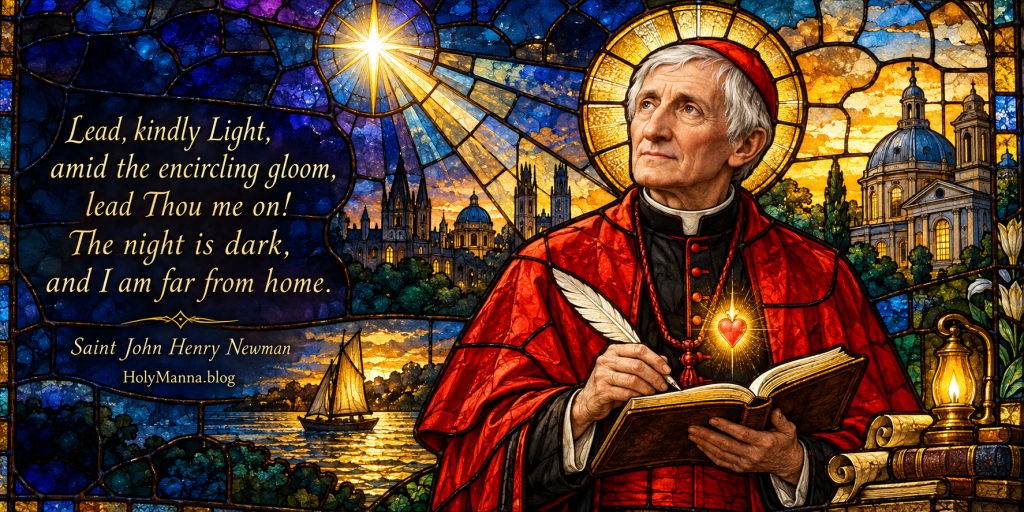
The brilliant boy went up to Trinity College, Oxford, in 1817, and in 1822 won a coveted fellowship at Oriel College, then the most intellectually formidable college in the university. He was ordained an Anglican deacon in 1824 and a priest in 1825, and in 1828 became Vicar of the University Church of St. Mary the Virgin, where his afternoon sermons, later published as Parochial and Plain Sermons, made him the most spellbinding preacher in Oxford. A Mediterranean journey in 1832 and 1833 changed everything. Newman fell desperately ill with fever in Sicily and nearly died, yet he insisted to his servant, “I have a work to do in England.” Becalmed for a week on an orange boat in June 1833, homesick and spent, he wrote the poem The Pillar of the Cloud, which the world knows as the hymn Lead, Kindly Light: “Lead, kindly Light, amid the encircling gloom, lead Thou me on! The night is dark, and I am far from home.” He reached England just in time to hear John Keble preach the Assize Sermon on July 14th, 1833, the moment Newman always counted as the birth of the Oxford Movement, the great campaign to recover the Catholic heritage of the Church of England through the Tracts for the Times.
It was that very search for the Church’s ancient roots that undid his Anglicanism. Studying the Arian and Monophysite controversies of the early centuries, Newman was haunted by the recognition that the position of the Church of England mirrored the position of the ancient heretical parties, while Rome stood where Rome had always stood. His conclusion became one of his most famous lines: “To be deep in history is to cease to be a Protestant” (An Essay on the Development of Christian Doctrine). In 1841 he published Tract 90, arguing that the Church of England’s Thirty-Nine Articles could be read in a Catholic sense; the Oxford authorities condemned it, bishop after bishop denounced him, and Newman withdrew to the village of Littlemore, where he spent 4 years in prayer, fasting, and study, testing his conscience inch by inch. There he wrote the Essay on the Development of Christian Doctrine, showing how the Church’s teaching grows organically from the apostolic deposit without ever contradicting it, an insight the Church herself echoes when she teaches that “there is a growth in the understanding of the realities and the words of the heritage of faith” (CCC 94). On the rainy night of October 9th, 1845, Newman knelt before Blessed Dominic Barberi, a humble Italian Passionist missionary, and was received into the Catholic Church. It is the very step he had described in his own developing convictions, and it is why he could write, in the same essay, “to live is to change, and to be perfect is to have changed often.”
Heart Speaks to Heart
Why should anyone remember Newman, and why should anyone imitate him? Because he shows what holiness looks like when it wears tweed instead of armor. Newman was never a wonder-worker in his lifetime; no miracles are recorded or claimed from his living hands, and the Church verified his miracles only after his death. His sanctity during life was the quieter, harder kind: heroic fidelity to conscience, tireless pastoral love, and patient endurance of humiliation. The Church teaches that conscience is “man’s most secret core and his sanctuary” where “he is alone with God” (CCC 1776), and Newman is perhaps the modern Church’s greatest witness to that truth, because obeying his conscience cost him nearly everything he loved.
After his reception, he traveled to Rome and was ordained a Catholic priest in 1847, and in 1848 he founded the first English house of the Oratory of St. Philip Neri, which soon settled in Birmingham, a gritty industrial city far from Oxford’s spires. There the former Oxford celebrity became a parish priest to factory workers and the poor. When cholera swept through the Black Country in 1849, Newman and his Oratorians went into Bilston to tend the sick and dying at real risk to their own lives. He heard confessions, visited prisons and deathbeds, founded the Oratory School for boys, and answered thousands upon thousands of letters from strangers struggling with faith, each one treated as a soul worth his full attention. His cardinal’s motto, chosen decades later, had already been his pastoral method all along: Cor ad cor loquitur, “Heart speaks to heart,” a phrase he drew from Saint Francis de Sales.
His mind served the same mission as his heart. From 1854 to 1858 he served as founding Rector of the Catholic University of Ireland in Dublin, and the lectures he wrote for it became The Idea of a University, still the most influential Catholic vision of education ever written, which is precisely why Pope Leo XIV attached his patronage to the Church’s educational mission. In 1870 he published An Essay in Aid of a Grammar of Assent, defending the reasonableness of faith for ordinary believers who will never master formal proofs. And in his Meditations and Devotions he left the lines that Pope Leo XIV quoted to the world at his proclamation as Doctor of the Church: “God has created me to do Him some definite service; He has committed some work to me which He has not committed to another.” For a generation drowning in questions about purpose and identity, Newman’s whole life is the answer: every single person is called by name, for a mission no one else can fulfill.
Losing Everything but God
Newman was never martyred, but his road was a long white martyrdom of loss, suspicion, and public humiliation, endured without bitterness. His conversion in 1845 cost him his Oxford fellowship, his pulpit, his income, his social standing, and most of his friends; some family relationships never recovered, and England’s establishment treated converts to Rome as traitors. The Catholic world he entered did not entirely trust him either. For decades he was viewed with suspicion by some in Rome and in the English Catholic hierarchy, his projects were quietly undermined, his orthodoxy was whispered against, and he described those middle years as a time of deep interior desolation. He bore it all with the patience he had preached, writing in Apologia Pro Vita Sua the sentence the Church would one day place in her own Catechism: “Ten thousand difficulties do not make one doubt” (CCC 157). Faith, he insisted, is certain because it rests on the Word of God, even when the believer is walking through fog one step at a time.
Two public trials tested him most. In 1851 and 1852, after Newman publicly exposed the scandalous past of Giacinto Achilli, an ex-Dominican apostate then touring England to inflame anti-Catholic feeling, Achilli sued him for libel. Despite overwhelming evidence, including witnesses brought from Italy, a hostile jury convicted Newman, and he was fined; even much of the English press admitted the verdict was a disgrace, and Catholics around the world paid his enormous legal costs. Then in 1864 the novelist Charles Kingsley publicly sneered that truth had never been a virtue with Father Newman or with the Roman clergy generally. Newman’s answer, written at white heat in a matter of weeks, was Apologia Pro Vita Sua, the spiritual autobiography that laid his whole soul open to a suspicious nation. It did more than clear his name; it won back England’s respect and became one of the great conversion accounts of Christian history, standing beside The Confessions of Saint Augustine. Vindication finally arrived in 1879, when Pope Leo XIII, in one of the first acts of his pontificate, created the 78 year old priest a Cardinal, a nearly unheard of honor for a man who was never a bishop. In 1875 Newman had already given the Church his classic Letter to the Duke of Norfolk, defending Catholic loyalty and rightly formed conscience, where he wrote the line the Catechism quotes to this day, that conscience is “the aboriginal Vicar of Christ” (CCC 1778), and added, with his famous wit, “I shall drink to the Pope, if you please, still, to Conscience first, and to the Pope afterwards.” Properly understood, that is not rebellion; it is the teaching that conscience, formed by the truth, is the first echo of God’s voice that leads a soul to the Pope and to the Church. He died peacefully at the Birmingham Oratory on August 11th, 1890, and some 15,000 people lined the streets of Birmingham for the funeral of the convert England had once despised. His memorial tablet carries the epitaph he chose: Ex umbris et imaginibus in veritatem, “Out of shadows and images into truth.”
A Spine Made Straight and the Scent of Roses
Heaven confirmed what Birmingham already believed. The first miracle accepted by the Church came through Jack Sullivan, a married court magistrate from Marshfield, Massachusetts, who was studying for the permanent diaconate when a severe spinal condition left him in crushing pain, his vertebrae squeezing his spinal cord and his formation in jeopardy. After seeing a program about Newman, he prayed simply for the ability to return to his studies, and received relief long enough to continue; when the condition collapsed again and surgery in August 2001 left the lining of his spinal cord badly torn, he prayed once more, asking Cardinal Newman to help him walk. On August 15th, 2001, the Solemnity of the Assumption, Sullivan felt an intense heat and a surge of joy, stood up, and walked, free of pain, completely and permanently. Doctors could offer no medical explanation. Pope Benedict XVI formally recognized the healing as a miracle on July 3rd, 2009, and Sullivan, by then an ordained deacon, proclaimed the Gospel at Newman’s beatification at Cofton Park, Birmingham, on September 19th, 2010, with Pope Benedict personally presiding, an honor the Pope reserved for no other beatification of his pontificate.
The canonization miracle belongs to Melissa Villalobos, a young mother in Chicago who had grown devoted to Newman through two small holy cards her husband brought home. In May of 2013, pregnant and already raising four small children, she began hemorrhaging from a subchorionic hematoma, a blood clot in the fetal membrane that scans showed to be two and a half times the size of her unborn baby. Doctors warned that miscarriage was likely and that nothing could be done beyond bed rest. One morning, bleeding heavily on her bathroom floor while her husband was away on a flight and her children waited downstairs, she cried out, “Please, Cardinal Newman, make the bleeding stop.” The bleeding stopped at that instant. She has testified that the bathroom filled with the scent of roses at that moment; that detail is her personal account rather than a medical finding, and it cannot be verified. What the doctors did verify stunned them: the ultrasound that same afternoon showed the tear in the placenta had vanished, the bleeding never returned, and her daughter Gemma was born full term on December 27th, 2013, weighing 8 pounds 8 ounces. After more than 5 years of investigation, Pope Francis approved the miracle on February 13th, 2019, and canonized Newman in St. Peter’s Square on October 13th, 2019.
One more remarkable fact surrounds his relics. When his grave at Rednal was opened in 2008 in preparation for the beatification, no bodily remains were found; the wooden coffin and the body had completely decomposed in the damp soil. The Church acknowledged this plainly, and devotees have often seen in it a quiet poetry for a man whose epitaph pointed beyond shadows and images to truth. Surviving relics, including locks of hair and items he used, are venerated at the Birmingham Oratory, which houses his shrine and remains the heart of his devotion. Pilgrims also seek out Littlemore, the simple college outside Oxford where he was received into the Church, preserved today as a place of prayer, and the University Church in Oxford where he once preached. His cultural reach is enormous. His poem The Dream of Gerontius, set to music by Edward Elgar, gave the Church the beloved hymns Praise to the Holiest in the Height and Firmly I Believe and Truly, and Catholic campus ministries at secular universities around the world bear his name as Newman Centers. His witness even touched the English crown; the then Prince Charles attended the canonization in 2019, and just one week before Newman was proclaimed a Doctor of the Church, King Charles III prayed alongside Pope Leo XIV in the Sistine Chapel, a scene of Catholic and Anglican friendship that Newman’s own costly journey helped make possible.
Walking by One Step at a Time
Newman’s life speaks with uncomfortable precision to anyone in their twenties, thirties, or forties today. He knew what it was to build an identity, a career, and a reputation, and then to discover that the truth was asking for all of it. He did not receive certainty in a single blinding flash; he followed the kindly light one step at a time, praying in his famous hymn, “I do not ask to see the distant scene; one step enough for me.” That is a spirituality built for real life, for the person discerning a vocation, weighing a career change, or inching back toward the Church after years away. The Catechism teaches that “the way of perfection passes by way of the Cross” and that there is no holiness without renunciation and spiritual battle (CCC 2015), and Newman’s renunciations were concrete: friendships, status, security, and the good opinion of his nation. What is the one step God is asking of you right now, the step you already see clearly but keep postponing?
He also teaches the right use of conscience in an age that constantly misuses the word. For Newman, conscience was never a license to believe whatever feels comfortable; it was the stern, demanding voice of God within, which must be formed, obeyed, and followed even uphill, and which led him into the Church, not away from her (CCC 1776 to 1778). Anyone tempted to treat faith as a private preference can learn from a man who let truth cost him everything. And he teaches that the intellect is not the enemy of faith. Newman read himself into the Catholic Church through the Church Fathers, and he spent his Catholic decades showing that rigorous thinking and childlike trust belong together. In practical terms, his example invites a few concrete habits: read 10 minutes of the Church Fathers or the Catechism alongside Scripture each day; write letters, or their modern equivalents, that treat each person as a soul rather than a contact; pray the Lead, Kindly Light hymn slowly in moments of confusion; and recall each morning that God has committed some work to each person that He has committed to no one else. When doubts or difficulties come, are they treated as conversation partners on the road to deeper faith, or as excuses to stop walking? Newman would gently insist that ten thousand difficulties do not add up to a single doubt, and that the God who led him from London to Oxford to Littlemore to Rome is still leading souls home today.
Engage With Us!
Newman believed that heart speaks to heart, and this corner of HolyManna exists for exactly that. Share your thoughts, your questions, and your own story in the comments below; someone walking a step behind you may need to read it. To spark the conversation, here are a few questions for reflection and discussion.
- Saint John Henry Newman followed the truth even when it cost him his career, his friendships, and his reputation. What truth might God be asking you to follow at a real cost right now?
- Newman prayed for light enough for one step rather than the whole path. Where in your life are you demanding to see the distant scene instead of taking the next faithful step?
- His motto was “Heart speaks to heart.” Who in your life needs a patient, personal word of faith from you this week rather than an argument?
- Newman spent years forming his conscience through prayer, study, and honest self-examination. What is one concrete practice you could adopt this month to form yours?
- God has created you to do Him some definite service that He has committed to no one else. What might that definite service look like in this season of your life?
Wherever this finds you, whether firmly rooted in the faith, quietly wrestling like Newman at Littlemore, or just beginning to notice the kindly light, keep walking. Take the one step in front of you, trust the God who calls each soul by name, and do everything, the studying and the parenting and the working and the waiting, with the love and mercy that Jesus taught us.
Saint John Henry Newman, pray for us!
Follow us on YouTube, TikTok, Instagram and Facebook for more insights and reflections on living a faith-filled life.


Leave a comment