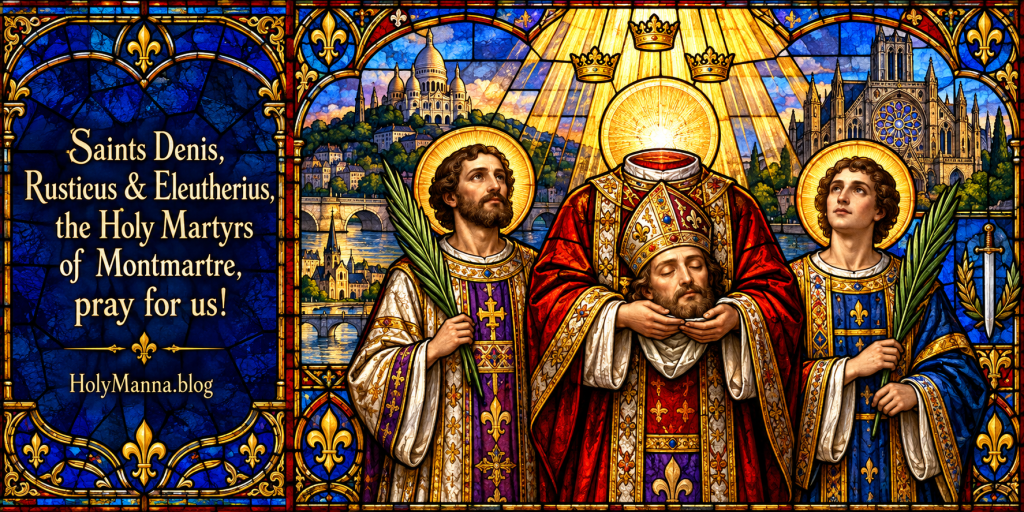
The Martyrs of Montmartre
Every October 9th, the Church lifts up a bishop who walked into one of the most pagan cities of the Roman world with nothing but the Gospel and two companions, and changed the course of a nation. Saint Denis, known in Latin as Dionysius, is venerated as the first Bishop of Paris and as one of the most beloved martyrs of the early Church in the West. He did not arrive with armies or influence. He arrived with a priest named Rusticus and a deacon named Eleutherius, and together the three of them planted the faith in soil that would one day produce Saint Genevieve, Saint Louis, Saint Joan of Arc, Saint Vincent de Paul, and Saint Thérèse of Lisieux. When Catholics speak of France as the eldest daughter of the Church, the story begins, humanly speaking, with Denis.
Saint Denis is the patron saint of France and of the city of Paris, and he is counted among the Fourteen Holy Helpers, that group of saints whose intercession Christians have sought with special confidence since the Middle Ages. He is invoked against headaches and migraines, a patronage that flows with a certain holy irony from the manner of his death, and he is also invoked against frenzy, strife, and diabolical possession. His two companions, Saint Rusticus and Saint Eleutherius, share his feast and his glory, a beautiful reminder that the Church’s mission has never been a solo project. The Catechism of the Catholic Church teaches that “the whole Church is apostolic, in that she remains, through the successors of St. Peter and the other apostles, in communion of faith and life with her origin” (CCC 863). Denis, Rusticus, and Eleutherius are living proof of that apostolic chain, three links connecting the streets of modern Paris all the way back to the apostles themselves.
From Italy to the Island in the Seine
Here is where honesty matters, and Saint Denis deserves honesty. The documented facts of his early life are few. The Catholic Encyclopedia records that he was born in Italy, and that nothing is definitely known of the time or place of his birth, his family, or his upbringing. What history does preserve is far more important than a birth certificate. It preserves his mission.
The most reliable early witness is Saint Gregory of Tours, the great 6th-century bishop and historian of the Franks. In his History of the Franks, Book 1, Chapter 30, Gregory records that in the consulship of Decius and Gratus, which corresponds to the year 250, seven bishops were sent out to evangelize the cities of Gaul. Among them were Gatianus to Tours, Trophimus to Arles, Paul to Narbonne, Saturninus to Toulouse, Austremonius to Clermont, Martial to Limoges, and Dionysius to Paris. Catholic tradition holds that it was Pope Fabian, who governed the Church from 236 to 250 and who was himself martyred under the Emperor Decius, who sent these missionary bishops north. The timing tells you everything about the kind of man Denis was. The persecution of Decius had just torn through the Church of Gaul and nearly wiped out the small Christian community there. Rome was not sending these seven men into a promising mission field. Rome was sending them into the wreckage, to rebuild what persecution had burned down, knowing full well the persecutors were still in power.
That one fact is the best evidence available about Denis’s formation and character. The Catholic Encyclopedia observes that his selection for so difficult a mission proves that, while still young, he was already distinguished for his virtuous life, his knowledge of sacred things, and his firm faith. A man does not get handed the hardest assignment in the Western Church by accident.
Denis did not travel alone. With him came his inseparable companions, the priest Rusticus and the deacon Eleutherius. The three men made their way to Lutetia, the Roman city that would become Paris, and settled on the island in the Seine that Parisians today call the Île de la Cité, the same island where Notre-Dame Cathedral now stands. Readers should picture the scene honestly. A walled Roman garrison town, temples to the Roman gods, a population devoted to its idols, and three foreigners setting up a church on a river island in the middle of it all.
One note of scholarly honesty is owed here. The names Rusticus and Eleutherius appear joined to Denis in the ancient Martyrology of Jerome, the oldest surviving martyrology of the Western Church, which lists all three on October 9th. Later writers identify Rusticus as his priest and Eleutherius as his deacon. Some modern scholars caution that the two companions are known to history almost entirely through that listing and the later accounts of the martyrdom. The Church, for her part, has venerated the three together from her earliest surviving records, and this post follows the Church’s constant liturgical memory.
Planting a Church in Pagan Soil
What did Denis actually do in Paris? The earliest account of his labors, a document called the Passio SS. Dionysii, Rustici et Eleutherii, written at the end of the 6th century or the beginning of the 7th, records that on the island in the Seine Denis built a church and provided for the regular celebration of the Divine service. That short line deserves a long pause. Before anything else, Denis gave Paris the Mass. His strategy for converting a pagan city was not primarily argument or spectacle. It was the steady, faithful offering of the Eucharist and the preaching of Jesus Christ crucified and risen. The Catechism teaches that the Eucharist is “the source and summit of the Christian life” (CCC 1324), and Denis built his entire mission on that truth seventeen centuries before the Second Vatican Council put it in those words.
And it worked. The sources agree that Denis was remarkably effective. Conversions multiplied. Alban Butler, in his Lives of the Saints, writes of him, “Of all the Roman missionaries sent into Gaul, St. Dionysius carried the faith the furthest into the country, fixing his see at Paris”, and notes that by him and by his disciples other sees, such as Chartres, Senlis, and Meaux, were erected. In other words, Denis did not just plant one parish. He planted a network of churches whose descendants still celebrate Mass today.
Are there verified miracles from his lifetime? Here the record calls for the same honesty. The earliest documents do not preserve specific, verifiable miracle accounts from his years of ministry; later tellings embellished his story generously, and those embellishments are treated in their proper place below. But the sober historical record preserves something that the saints themselves would call the greater miracle. A devastated, persecuted, nearly extinguished Christian community was rebuilt, and a pagan city began to turn to Christ, through the preaching of one bishop, one priest, and one deacon. The conversion of hearts is the miracle Scripture prizes most. As Jesus says in The Gospel of Luke, “there will be more joy in heaven over one sinner who repents than over ninety-nine righteous people who have no need of repentance” (Lk 15:7). By that measure, the ministry of Denis, Rusticus, and Eleutherius was miraculous many times over.
Why should the modern reader remember and emulate this man? Because Denis shows what the Catechism means when it teaches that “the disciple of Christ must not only keep the faith and live on it, but also profess it, confidently bear witness to it, and spread it” (CCC 1816). He was a man sent into a culture that had no room for Christ, and instead of softening the message to fit the culture, he let the message transform the culture. Anyone who has ever felt like the only believer in the office, the classroom, or the group chat has a patron in Saint Denis.
The Hill of Martyrs
Success drew blood. The Passio records that the growing number of conversions aroused the envy, anger, and hatred of the pagan priests, who stirred up the Roman authorities against the three missionaries. Denis, Rusticus, and Eleutherius were seized and imprisoned. They were tortured. And when torture failed to break their faith, they were condemned to death by beheading.
Saint Gregory of Tours records the martyrdom with a historian’s restraint: “the blessed Dionysius, bishop of Paris, after suffering diverse pains in Christ’s name, ended the present life by the threatening sword” (History of the Franks, Book 1, Chapter 30). Diverse pains. Gregory does not catalogue them, and the reader does not need him to. The phrase is enough to show that the three men were given every opportunity and every incentive to renounce Christ, and that they refused, together, to the end.
A word about the date, because sources genuinely differ and readers deserve to know it. Gregory’s account places the mission under Decius around 250 to 251. The New Catholic Encyclopedia considers the best hypothesis to be that Denis was beheaded in the persecution of the Emperor Valerian in 258, the same persecution that claimed Pope Saint Sixtus II and Saint Lawrence in Rome and Saint Cyprian in Carthage. The older Catholic Encyclopedia suggests a date closer to 275. What no serious Catholic source disputes is the substance: in the second half of the 3rd century, the first Bishop of Paris and his two companions were beheaded for the name of Jesus Christ.
Tradition places the execution on the hill north of the city that has ever since been called Montmartre, understood by long tradition as the mons Martyrum, the mountain of martyrs. Some scholars note the name may originally have referred to a shrine of the god Mars; the Christian memory of the place, in any case, has belonged to Denis for well over a thousand years. Today that hill is crowned by the Basilica of the Sacré-Cœur, and tourists climb it by the thousands, most of them never realizing they are walking up a hill consecrated by the blood of martyrs.
And here belongs the most famous story attached to Saint Denis, told as the tradition it is. According to accounts first written down centuries after his death, when the executioner’s sword fell, the body of the holy bishop rose, took up his own severed head in his hands, and walked north from Montmartre for several miles, the head preaching a sermon of repentance the entire way, until he reached the village then called Catulliacus, the site of the present town of Saint-Denis, where he finally laid down and was buried. This is why sacred art across the centuries shows Saint Denis as a bishop in miter and vestments, serenely carrying his own head, sometimes with angels attending him. The image became so central that he is the most famous of the cephalophores, the head-carrying saints, in all of Christian iconography. It is a magnificent tradition, and it preaches a true sermon: no sword can silence a man whose voice is the Gospel. But it must be said plainly that this story cannot be verified.
The earlier burial traditions are quieter and closer to the sources. The old Passio relates that a devout Christian woman named Catulla recovered the bodies of the three martyrs and gave them honorable burial, and that a small shrine was soon raised over their graves. Another tradition holds that the bodies were thrown into the Seine and were recovered that same night by faithful converts who buried them in secret. These two accounts differ, and neither can be verified; what they agree on, and what history confirms, is that the Christians of Paris knew exactly where their martyrs lay, and never stopped praying there.
The Catechism teaches, “Martyrdom is the supreme witness given to the truth of the faith: it means bearing witness even unto death” (CCC 2473). Denis, Rusticus, and Eleutherius bore that witness side by side: a bishop, a priest, and a deacon, the three ancient orders of the Church’s ministry, laying down their lives together. Their deaths embodied the words of the Lord in The Gospel of Matthew: “And do not be afraid of those who kill the body but cannot kill the soul; rather, be afraid of the one who can destroy both soul and body in Gehenna” (Mt 10:28).
From a Humble Grave to the Heart of a Nation
If the pagan priests of Lutetia believed that three beheadings would end the Church in Paris, history has delivered perhaps the most emphatic correction in the annals of Christendom. Tertullian’s famous observation, written decades before Denis died, proved true in Paris as it has everywhere: “The blood of Christians is seed” (Apologeticum, Chapter 50). Readers may know that line in its popular paraphrase, that the blood of the martyrs is the seed of the Church; the shorter wording above is what Tertullian actually wrote.
The grave of the martyrs became a furnace of devotion. By around the year 500, the Vita of Saint Genevieve, the great patroness of Paris, attests that a shrine stood over the tomb, and Genevieve herself, assisted by the people of Paris, built a basilica there in the late 5th century. Pilgrims came seeking the intercession of the martyr bishop, and accounts of healings and favors received at the tomb multiplied across the centuries. Many such stories of cures, especially from headaches, fevers, and afflictions of the mind, were reported by pilgrims and recorded by the abbey’s chroniclers; told honestly, these individual healing stories come down through tradition and cannot be verified one by one, yet the unbroken stream of pilgrims across fifteen centuries testifies that the faithful experienced real grace at that tomb.
Around the year 625, the Frankish King Dagobert I founded a great monastery at the site, endowing it richly. A tradition preserved at the abbey held that Dagobert did so after experiencing a vision of the holy martyrs; that story cannot be verified. What is certain is that Dagobert chose to be buried near Saint Denis, and in doing so he started one of the most remarkable customs in European history. For more than a thousand years, the kings of France were laid to rest at the Basilica of Saint-Denis. The greater number of all French monarchs, along with their queens, sleep there still, gathered around the tomb of a missionary who arrived in their land with nothing. The medieval kings of France rode into battle under the oriflamme, the sacred red-gold banner kept at the abbey of Saint-Denis, and the battle cry of France for centuries was “Montjoie! Saint Denis!” A beheaded foreign missionary had become the heavenly protector of a kingdom.
The basilica itself made history one more time. In the 12th century, Abbot Suger rebuilt the abbey church with soaring ribbed vaults, pointed arches, and walls of luminous stained glass, and architectural historians regard the Basilica of Saint-Denis as the birthplace of Gothic architecture. Every Gothic cathedral on earth, from Chartres to Cologne to Saint Patrick’s in New York, is in some sense a descendant of the church built over the bones of Saint Denis. Modern archaeology has added its own quiet confirmation: excavations beneath the basilica in 1957 found that the original burial lay within an ancient Gallo-Roman cemetery, exactly what one would expect for a genuine 3rd-century martyr’s grave.
One final matter belongs here, because faithful storytelling requires it. For roughly seven centuries, much of Christendom believed that Denis of Paris was the same man as Dionysius the Areopagite, the Athenian judge converted by Saint Paul, of whom The Acts of the Apostles records, “But some did join him, and became believers. Among them were Dionysius, a member of the Court of the Areopagus, a woman named Damaris, and others with them” (Acts 17:34). The confusion grew further because a 5th or 6th century theological writer, now called Pseudo-Dionysius, had published profound mystical works under the Areopagite’s name. In the year 836, Hilduin, Abbot of Saint-Denis, wrote a life of the saint called the Areopagitica at the request of the Emperor Louis the Pious, weaving all three figures into one man and adding dramatic episodes, such as Denis surviving wild beasts, fire, and crucifixion before his beheading. Scholars, including the Church’s own Bollandist historians, have long since shown that Hilduin’s identification was mistaken and his added episodes unfounded. Denis of Paris, Dionysius the Areopagite, and Pseudo-Dionysius are three different men. Readers should also know that sayings attributed to “Saint Denis” circulating online are drawn from the Pseudo-Dionysian writings and are misattributed; no verified words of the martyred Bishop of Paris survive. The Church lost nothing in the correction. The real Denis, the missionary who gave his head rather than deny his Lord, needs no borrowed résumé.
Keeping Faith When It Costs Everything
What does a 3rd-century beheaded bishop have to say to a reader scrolling on a phone in the 21st century? More than almost anyone.
Start with where Denis started. He was sent into a culture that was not neutral toward his faith but actively hostile to it, a culture that had just finished persecuting the last generation of believers. He did not wait for conditions to improve. He went, he built an altar, and he preached. The Catechism teaches that the Church “exists in order to evangelize” and that missionary endeavor flows from the very nature of the Church (CCC 849 to 851). That calling does not belong to bishops alone. Every baptized person is sent into some corner of the world, an office, a campus, a family group text, a neighborhood, that will not hear the Gospel from anyone else. Where is the island in the Seine that God has given you?
Consider next that Denis did nothing alone. Rusticus and Eleutherius are not footnotes to his story; they are co-stars in it. They evangelized together, suffered together, and entered glory together. The Catechism teaches that “it is not merely by the title of example that we cherish the memory of those in heaven; we seek, rather, that by this devotion to the exercise of fraternal charity the union of the whole Church in the Spirit may be strengthened” (CCC 957). Faith was never designed to be practiced solo. Who are your Rusticus and your Eleutherius, the companions who will hold you faithful when following Christ gets expensive? And if no names come to mind, perhaps the first lesson of this feast is to go find them.
Then sit with the martyrdom itself. Most readers will never face a Roman sword, but everyone who takes the faith seriously will eventually face a moment when fidelity to Christ costs something real: a promotion, a relationship, a reputation, the comfort of staying quiet. The Lord’s words in The Gospel of John were proven in Denis’s life with almost literal precision: “unless a grain of wheat falls to the ground and dies, it remains just a grain of wheat; but if it dies, it produces much fruit” (Jn 12:24). One buried bishop produced a Christian nation, a royal basilica, and seventeen centuries of pilgrims. God wastes nothing that is surrendered to Him. What is the one thing you are most afraid to lose for the sake of your faith, and what might God grow from it if you handed it over?
Finally, there is something wonderfully concrete to take from his patronage. Saint Denis is invoked against headaches, against frenzy, and against strife, which is to say, against the characteristic afflictions of the modern age: the anxious mind, the overstimulated attention span, the quarrels that metastasize online. Practical devotion this week could be exactly that simple. Offer a short prayer for his intercession before opening a stressful inbox. Ask his help before a conversation that could turn into a fight. Pray for a friend suffering from migraines or mental anguish, and tell that friend a saint in heaven has been assigned, so to speak, to that very cross. The communion of saints is not a museum exhibit. It is a living network of intercession, and Denis, Rusticus, and Eleutherius are on duty.
Engage With Us!
The story of Saint Denis and his companions belongs to the whole Church, and that includes every reader here. Share your thoughts and reflections in the comments below; this community grows the same way the Church in Paris grew, one honest conversation at a time. To get the discussion started, here are some questions to pray with:
- Saint Denis was sent to rebuild a Church that persecution had nearly destroyed. Where in your own life, or in your parish, do you sense God calling you to rebuild rather than retreat?
- Denis, Rusticus, and Eleutherius lived and died as a team. Who are the companions in faith God has placed beside you, and how could you invest in those friendships this month?
- The martyrs endured “diverse pains” rather than deny Christ. What small, daily denials of comfort could train your heart to be faithful in bigger tests?
- The tradition of Saint Denis carrying his head preaches that no earthly power can silence the Gospel. Where have you been tempted to silence your own witness, and what would courage look like there?
- Pilgrims have prayed at the tomb of Saint Denis for over fifteen centuries. What role do the saints currently play in your prayer life, and is there room to invite them in more deliberately?
May the witness of Saint Denis, Saint Rusticus, and Saint Eleutherius stir up a bold, generous, unembarrassed faith in everyone who reads their story. The same Lord who sent three men into pagan Lutetia is sending you into your own mission field tomorrow morning. Go with courage, hold fast to the truth, and do everything, every task, every conversation, every sacrifice, with the love and mercy that Jesus taught us.
Saints Denis, Rusticus, and Eleutherius, pray for us!
Follow us on YouTube, TikTok, Instagram and Facebook for more insights and reflections on living a faith-filled life.


Leave a comment