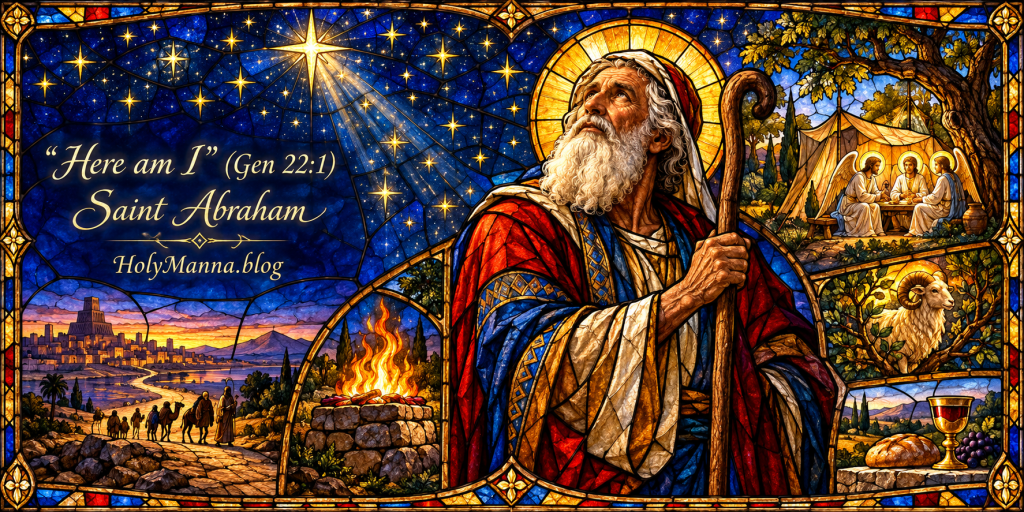
The Father of All Believers
Every October 9th, the Roman Martyrology pauses to honor a man who lived roughly 4,000 years ago, long before the Church, long before the apostles, long before Moses ever climbed Sinai. The entry reads: “Commemoration of Saint Abraham, patriarch and father of all believers, who, called by God, left his land, Ur of the Chaldees, and set out for the land promised by God to him and to his descendants.” That title, father of all believers, is not a poetic flourish. It is the Church’s settled teaching, drawn straight from Saint Paul, who calls Abraham “the father of all who believe” in Romans 4:11. The Catechism confirms that honoring him as a saint is no novelty: “The patriarchs, prophets and certain other Old Testament figures have been and always will be honored as saints in all the Church’s liturgical traditions” (CCC 61).
Abraham was never canonized, because he predates the entire canonization process by millennia. His sainthood rests on something older and sturdier: the witness of Scripture and the unbroken veneration of the Church. In fact, he is one of only a handful of human beings named at Mass itself. Whenever a priest prays the Roman Canon, Eucharistic Prayer I, he asks God to accept the offering as He once accepted “the sacrifice of Abraham, our father in faith.” Think about that for a moment. At altars across the world, every single day, the Church reaches back 40 centuries and claims this Mesopotamian herdsman as her father. He is named daily in the Benedictus and the Magnificat, the Gospel canticles the Church sings at morning and evening prayer. Jesus Himself said, “Your father Abraham rejoiced that he was to see my day; he saw it and was glad” (The Gospel of John, Jn 8:56).
Why does a man with no martyrdom, no monastery, no written works, and no canonization cause hold such a place? Because Abraham is the Church’s original model of faith itself. The Catechism teaches that “Abraham thus fulfills the definition of faith in Hebrews 11:1” and that because he was strong in his faith, he “became the father of all who believe” (CCC 146). Everything the Church means by the word faith, she learned first by watching Abraham walk.
A Call Out of Ur
Abraham enters history as Abram, son of Terah, born in Ur of the Chaldeans, a wealthy and sophisticated city of ancient Mesopotamia in what is today southern Iraq. The Book of Genesis introduces his family simply: Terah fathered Abram, Nahor, and Haran; Haran died young, leaving behind a son named Lot; and Abram married Sarai, a woman Genesis 11:30 describes with quiet sorrow, noting that she was barren and had no child. Honest history requires a word of caution here. Scholars generally place Abraham’s life somewhere around 2000 to 1700 years before Christ, but no precise dates can be established, and the Church does not propose any. The traditional identification of Ur with the excavated site of Tell el-Muqayyar in southern Iraq is the common view, though some scholars have argued for a location farther north. What matters for faith is what Genesis actually records: a real man, in a real pagan city, in a world crowded with idols.
That last detail matters. Ur was a center of moon worship, and The Book of Joshua preserves the blunt family background: “Your fathers lived of old beyond the Euphrates, Terah, the father of Abraham and of Nahor; and they served other gods” (Josh 24:2). Abraham was not raised in the faith. He was raised in paganism, and God called him out of it anyway. This is why the Church can honestly speak of his conversion, the first great conversion story in salvation history. Terah took the family from Ur and settled in Haran, in upper Mesopotamia, and it was there, after Terah’s death, that the call came.
Genesis 12 records the words that changed the human story: “Go from your country and your kindred and your father’s house to the land that I will show you. And I will make of you a great nation, and I will bless you, and make your name great, so that you will be a blessing… and by you all the families of the earth shall bless themselves” (Gen 12:1-3). Notice what God did not give him: a map, a timeline, an explanation. Abram was 75 years old, settled, comfortable, and childless, and God asked him to walk away from everything familiar toward a destination He refused to name in advance. The response takes Genesis exactly one verse: “So Abram went, as the LORD had told him” (Gen 12:4).
The Catechism treats this moment as the hinge of salvation history: “In order to gather together scattered humanity God calls Abram from his country, his kindred and his father’s house, and makes him Abraham, that is, ‘the father of a multitude of nations’” (CCC 59). And The Letter to the Hebrews holds up that first obedient step as the very definition of what faith looks like in motion: “By faith Abraham obeyed when he was called to go out to a place which he was to receive as an inheritance; and he went out, not knowing where he was to go” (Heb 11:8). The Catechism quotes that verse directly when it presents Abraham as the model of the obedience of faith, teaching that to obey in faith is to submit freely to the word that has been heard, because its truth is guaranteed by God, and naming Abraham as the model the Church holds up (CCC 144-145). He went out not knowing where he was to go. That single sentence is the whole spiritual life in miniature, and it is what Abraham is most known for: not a miracle he performed, not a book he wrote, but a trust so total that God could build the entire future of His people on it.
Covenants, Strangers at the Tent, and a Son Born of Laughter
An honest word before the wonders: Abraham did not perform miracles the way later saints did. He healed no lepers and raised no dead. Instead, God worked wonders in him, through him, and for him, and that distinction is itself a lesson. The patriarch’s greatness was never his own power; it was his availability to God’s power. His life in Canaan reads as one long conversation with the Lord, which is exactly how the Catechism presents him, opening its entire history of prayer with Abraham and teaching that when God calls him, “Abraham goes forth ‘as the Lord had told him’; Abraham’s heart is entirely submissive to the Word and so he obeys” (CCC 2570). Wherever he camped, he built an altar. Attentiveness first, action second.
The first wonder was providential rather than spectacular. When Lot was captured in a war of kings, Abraham armed 318 men of his household, pursued armies that had just crushed 5 kingdoms, and brought back his nephew and all the captives (Genesis 14). On his return he was met by the mysterious priest-king Melchizedek, who brought out bread and wine and blessed him. The Church has never forgotten that scene; the Roman Canon places Abraham’s sacrifice side by side with the offering of Melchizedek at every Mass, because both point forward to the Eucharist.
Then came the covenant. God brought Abram outside under the Mesopotamian night sky and said, “Look toward heaven, and number the stars, if you are able to number them… So shall your descendants be” (Gen 15:5). This was said to a childless old man married to a barren wife, and the next verse became one of the most important sentences in the entire Bible: “And he believed the LORD; and he reckoned it to him as righteousness” (Gen 15:6). Saint Paul builds his whole theology of justification by faith on that verse in Romans 4 and Galatians 3. Later, God sealed the covenant with a new name: “No longer shall your name be Abram, but your name shall be Abraham; for I have made you the father of a multitude of nations” (Gen 17:5). In the biblical world, a name was a destiny. God renamed a childless man father of a multitude and expected him to answer to it.
The most beloved scene of his life came at the oaks of Mamre. Abraham sat at his tent door in the heat of the day, saw 3 strangers approaching, and ran to meet them, bowing to the earth, washing their feet, and setting before them the finest meal his household could produce (Genesis 18). The visitors were no ordinary travelers; the text reveals that the Lord Himself had come to him. Christian tradition has long seen in the hospitality of Abraham a mysterious foreshadowing of the Trinity, an intuition made famous in the Church’s iconography, including the 5th-century mosaics of Santa Maria Maggiore in Rome. The Catechism draws the spiritual lesson directly, teaching that because Abraham believed in God and walked in his presence and in covenant with him, “the patriarch is ready to welcome a mysterious Guest into his tent” (CCC 2571). The Letter to the Hebrews turns the scene into a standing instruction for every Christian household: “Do not neglect to show hospitality to strangers, for thereby some have entertained angels unawares” (Heb 13:2).
At that same meal, the Lord promised that Sarah would bear a son within the year, and when Sarah laughed behind the tent flap, God answered with a question the Church has treasured ever since: “Is anything too hard for the LORD?” (Gen 18:14). The miracle arrived on schedule. Isaac, whose very name means laughter, was born to a mother of about 90 and a father of 100 (Genesis 21), a child so biologically impossible that Scripture itself treats his birth as pure gift. The Roman Martyrology highlights precisely this, honoring the son given to Abraham “already old and from a sterile wife.”
That same chapter 18 shows the other side of Abraham’s friendship with God: intercession. Learning that Sodom faced destruction, Abraham stood before the Lord and bargained like a Middle Eastern merchant for the lives of strangers, pressing from 50 righteous men down to 10. The Catechism holds this up as the pattern of all intercessory prayer, teaching that Abraham intercedes “with bold confidence” for the doomed cities (CCC 2571). The reader should remember Abraham precisely for this blend of virtues: courage in battle, generosity at table, audacity in prayer, and patience under promises that took 25 years to keep. He is worth emulating because he shows that holiness is not a performance; it is a long walk with God, altar by altar, through ordinary days.
The Longest Walk in Scripture
Abraham was not a martyr, and the Church has never claimed otherwise. Yet few saints in the whole calendar endured a trial as severe as his, and his hardships deserve to be told in full. Begin with the ordinary ones, because they were real and they lasted decades. He left his homeland at 75 and never owned the land he was promised; the only ground he ever purchased in Canaan was a grave. Famine drove him down to Egypt almost immediately, where fear for his life led him to present Sarah as his sister, a failure of nerve that Scripture records without flattery, and that God had to rescue him from by afflicting Pharaoh’s house with plagues (Genesis 12). The Bible is refreshingly honest about its heroes. Abraham doubted, Abraham schemed, and Abraham waited. Above all, he waited. A quarter century passed between the promise of a son and the cry of a newborn, and in the middle of that long silence he and Sarah tried to force God’s hand through Hagar, Sarah’s servant, a decision that brought jealousy, division, and lasting sorrow into his own tent (Genesis 16). Anyone who has ever grown tired of waiting on God has a brother in Abraham.
Then came the trial that towers over everything else in his story. Genesis 22 opens with words that still stop the heart: “Take your son, your only son Isaac, whom you love, and go to the land of Moriah, and offer him there as a burnt offering upon one of the mountains of which I shall tell you” (Gen 22:2). Everything God had promised, every star in that night sky, lived in Isaac. The command seemed to unmake the covenant itself. And Scripture gives Abraham no speech, no protest, no bargaining session like the one he held for Sodom. It gives him only obedience and a 3-day walk: “So Abraham rose early in the morning, saddled his ass, and took two of his young men with him, and his son Isaac” (Gen 22:3).
The most piercing moment of the journey belongs to Isaac, who carried the wood for his own sacrifice and asked where the lamb was. His father’s answer is Abraham’s most famous recorded sentence, and the Church reads it as prophecy: “God will provide himself the lamb for a burnt offering, my son” (Gen 22:8). On the mountain, with the knife raised, the angel of the Lord called out: “Do not lay your hand on the lad or do anything to him; for now I know that you fear God, seeing you have not withheld your son, your only son, from me” (Gen 22:12). A ram caught in a thicket took Isaac’s place, God Himself providing the victim, exactly as Abraham had said.
How could a man obey such a command? The Letter to the Hebrews answers that Abraham reasoned his way to an impossible hope: “He considered that God was able to raise men even from the dead” (Heb 11:19). The Catechism presents Moriah as the summit of his purification, teaching that “as a final stage in the purification of his faith, Abraham, ‘who had received the promises,’ is asked to sacrifice the son God had given him” and that his faith does not weaken, “and so the father of believers is conformed to the likeness of the Father who will not spare his own Son but will deliver him up for us all” (CCC 2572). There it is. The Church has always read Moriah as a rehearsal of Calvary: a beloved only son, wood laid on his shoulders, a hill in the land of Moriah, and a Father who provides the Lamb. Saint John Chrysostom, a Doctor of the Church, preached that what moved God on that mountain was not the knife but the heart, and he called Abraham the father of faith and the master of obedience. The Fathers saw in Isaac’s silent consent a type of Christ’s meekness, and in Abraham’s readiness a type of the Father’s love. Abraham walked down that mountain with his son alive and his faith proven, and the promise was renewed with an oath: “By your descendants shall all the nations of the earth bless themselves, because you have obeyed my voice” (Gen 22:18). He would still bury Sarah, still live as a stranger in the land, and still die without seeing the nation he was promised. Hebrews says of him and his household that they died in faith, “not having received what was promised, but having seen it and greeted it from afar” (Heb 11:13). That, too, is a hardship: to spend an entire life on a promise whose fulfillment belongs to someone else.
From the Bosom of Abraham to the Altar of Every Mass
Abraham died at 175 years old, “an old man and full of years,” and in one of the most quietly moving verses of Genesis, his sons Isaac and Ishmael, long divided, stood together to bury him beside Sarah in the cave of Machpelah at Hebron (Gen 25:8-9). The purchase of that cave is recorded in detail in Genesis 23; the identification of the exact site in modern Hebron, enclosed within a massive structure dating to the time of Herod and known today as the Tomb of the Patriarchs, rests on ancient tradition, and pilgrims of multiple faiths have venerated it for many centuries. No corporal relics of Abraham are venerated in the Latin Church; his legacy is of a different order entirely.
Because Abraham predates the age of documented saintly intercessions, there are no formally investigated miracles attributed to him after death in the way the Church investigates them for modern saints, and this post will not invent any. What Scripture does reveal is something greater: his continuing place in the economy of salvation. Jesus Himself used Abraham’s name for the resting place of the righteous dead. In the parable of Lazarus, the poor man dies “and was carried by the angels to Abraham’s bosom” (The Gospel of Luke, Lk 16:22). The Church’s ancient prayer for the dead, the In Paradisum, still asks the angels to carry every departed soul where Lazarus once was carried. And Jesus declared that the patriarch is alive in God, reminding the Sadducees that the Lord is the God of Abraham, Isaac, and Jacob, “not God of the dead, but of the living” (Mt 22:32).
One tradition deserves to be told honestly. A famous story, found in ancient Jewish writings outside the Bible, recounts that young Abram, already convinced of the one true God, smashed the idols in his father Terah’s workshop, leaving the largest idol standing with a stick in its hand, and then telling his father that the big idol had destroyed the others, forcing Terah to admit that the idols could do nothing at all. It is a beloved story about the absurdity of idolatry, and it shaped how generations imagined Abraham’s conversion, but it does not appear anywhere in Scripture and it cannot be verified.
Abraham’s cultural and liturgical footprint is almost impossible to overstate. The 5th-century mosaics of Santa Maria Maggiore in Rome, among the oldest in any church, depict his hospitality at Mamre. The 6th-century mosaics of Ravenna set his sacrifice beside those of Abel and Melchizedek, directly connected to the altar, teaching in glass and gold what the Roman Canon says in words. Every Mass using Eucharistic Prayer I asks God to accept the Church’s offering as He accepted “the sacrifice of Abraham, our father in faith.” The Catechism teaches that the covenant with Abraham was the remote preparation for the gathering of the People of God that becomes the Church (CCC 762), and that God’s promise to Abraham inaugurated the economy of salvation that culminates in Christ (CCC 705-706). On the world stage, Jews, Christians, and Muslims all look back to Abraham, and on March 6th, 2021, Pope Francis traveled to the Plain of Ur in Iraq, the patriarch’s own homeland, for a historic interreligious encounter, declaring there that the greatest blasphemy is to profane God’s name by hating one’s brothers and sisters. Nearly 4,000 years after his death, the man from Ur was still drawing the nations together, exactly as the promise foretold. His nephew Lot follows him in the Roman Martyrology one day later, on October 10th, a small liturgical echo of a family that walked out of Mesopotamia together.
Hoping Against Hope in an Age of Anxiety
It would be easy to file Abraham under ancient history, a bearded figure from a world of tents and camels with nothing to say to a generation of apartment leases and job applications. That would be a mistake, because Abraham’s situation is strangely modern. He was asked to make the biggest decision of his life without enough information. He waited years for something he had been promised, watching the calendar contradict the promise. He tried to take a shortcut when the waiting hurt too much, and he lived with the fallout. He loved someone more than his own life and had to learn that even that love belonged to God first. If any of that sounds familiar, then Abraham is not ancient history. He is a companion.
The Catechism points every believer to him when hope runs thin, teaching that in hope, Abraham “believed against hope” and so became the father of many nations (CCC 165), and that Christian hope takes up and fulfills the hope of the chosen people, “which has its origin and model in the hope of Abraham” (CCC 1819). Hoping against hope is not optimism. Optimism looks at circumstances and calculates the odds. Hope looks at God and remembers His character. Abraham’s circumstances said no for 25 straight years, and he kept walking anyway, because the promise did not rest on circumstances. Where in your life right now are the circumstances saying no while God is asking you to keep walking?
There are concrete ways to take the patriarch’s virtues into an ordinary week. Practice his obedience in small departures: say yes to the prompting you have been postponing, whether that is returning to Confession after years away, forgiving a family member, or finally having the conversation about faith with a friend. Practice his hospitality: Abraham ran to serve 3 strangers in the hottest hour of the day, so invite someone to your table who cannot repay you, and treat the interruption as a visitation. Practice his intercession: he haggled with God for a city that had done nothing for him, so pray boldly and specifically for people who will never know you prayed. Practice his patience: build a small altar in your schedule, a fixed daily time of prayer, and keep it even when nothing seems to be happening, because altars are how Abraham marked a land he did not yet possess. What is the Isaac in your life, the good thing you are most afraid to surrender to God, and what would it look like to open your hands this week? When you look back on your own journey, where has God already provided the ram, the rescue you did not see coming until you reached the top of the hill?
Engage With Us!
Saint Abraham’s story belongs to every believer, because every believer is his child in faith. Share your thoughts and reflections in the comments below; this community grows the same way Abraham’s family did, one act of trust at a time. Here are some questions to pray with and discuss.
- Abraham left Ur without knowing his destination. What familiar comfort might God be asking you to leave behind in order to follow Him more closely?
- Sarah laughed at a promise that seemed impossible, and God asked whether anything is too hard for the Lord. Where have you quietly stopped believing that God can act in your life?
- Abraham waited 25 years for Isaac. How do you handle the seasons when God seems silent, and what would faithful waiting look like for you this month?
- At Mamre, Abraham ran to serve strangers and found himself hosting the Lord. Who is the unexpected guest or inconvenient person God is placing in your path right now?
- Abraham interceded boldly for Sodom. Is there a person, a city, or a situation you have given up praying for that deserves your bold intercession again?
- On Moriah, Abraham trusted that God would provide. What sacrifice is God inviting you to make, and do you believe He can bring life out of what you surrender?
The God who called Abraham out of Ur is still calling, and His promises have not weakened with age. Step out in faith this week, even without the full map, and trust the One who counts the stars and keeps His word. Live boldly, love generously, welcome the stranger, and do everything with the love and mercy that Jesus taught us.
Saint Abraham, Father of the Faith, pray for us!
Follow us on YouTube, TikTok, Instagram and Facebook for more insights and reflections on living a faith-filled life.


Leave a comment