Friday of the Twenty-seventh Week in Ordinary Time – Lectionary: 465
The Covenant God Keeps and the House He Claims
Some promises are made for a moment, and some are made forever. On this Friday of the Twenty-seventh Week in Ordinary Time, October 9th, the Church sets before the faithful a story about a promise God made roughly four thousand years ago and never once forgot. The central theme uniting these readings is covenant faithfulness fulfilled in Christ: God remembers His covenant forever, and in Jesus, the Stronger One, He has kept it, breaking the curse, blessing all nations through Abraham’s faith, and reclaiming the house of the human heart, which must then be filled with His presence rather than left swept and empty.
In The Letter to the Galatians, Saint Paul reaches back to Abraham, the wandering herdsman who believed an impossible promise, and shows that faith, not ethnic descent or legal performance, makes someone a child of that promise. Psalm 111 answers like a congregation singing back its amen, insisting that “The Lord will remember his covenant for ever.” Then The Gospel of Luke shows what covenant fulfillment looks like in real time: Jesus casting out a demon by the finger of God while the crowd accuses Him of working for the enemy.
The cultural backdrop matters here. First-century Jews lived with a vivid awareness of the spiritual world, and exorcists were a known feature of religious life. Gentile converts in Galatia, meanwhile, were being pressured to earn by law what God had already given by grace. Both audiences faced the same temptation that faces believers today, which is trusting something smaller than God to secure the soul. These readings tear that illusion down and hand back something far better, a Father who keeps His word.
First Reading — Galatians 3:7-14
Paul Stakes Everything on a Promise Older Than the Law
Saint Paul wrote The Letter to the Galatians to churches he had founded in central Asia Minor, likely between the late 40s and mid 50s AD. After he moved on, agitators arrived insisting that Gentile converts needed circumcision and full observance of the Mosaic Law to belong to God’s people. Paul responds with controlled fire. He reaches past Moses, past Sinai, all the way back to Abraham, who was declared righteous by faith centuries before the Law existed. This passage fits the day’s central theme perfectly, because it proves that God’s covenant with Abraham was never abandoned or replaced. It was fulfilled, at terrible cost, on the Cross.
Galatians 3:7-14
Brothers and sisters:
Realize that it is those who have faith
who are children of Abraham.
Scripture, which saw in advance that God
would justify the Gentiles by faith,
foretold the good news to Abraham, saying,
Through you shall all the nations be blessed.
Consequently, those who have faith are blessed
along with Abraham who had faith.
For all who depend on works of the law are under a curse;
for it is written, Cursed be everyone
who does not persevere in doing all the things
written in the book of the law.
And that no one is justified before God by the law is clear,
for the one who is righteous by faith will live.
But the law does not depend on faith;
rather, the one who does these things will live by them.
Christ ransomed us from the curse of the law by becoming a curse for us,
for it is written, Cursed be everyone who hangs on a tree,
that the blessing of Abraham might be extended
to the Gentiles through Christ Jesus,
so that we might receive the promise of the Spirit through faith.
Detailed Exegesis
Verse 7: “Realize that it is those who have faith who are children of Abraham.”
Paul redefines family. In a culture where identity ran through bloodline, this claim was explosive. Membership in Abraham’s household comes through sharing Abraham’s trust in God, the trust described in Genesis 15:6, where his belief was credited to him as righteousness. CCC 146 teaches that Abraham became the father of all who believe.
Verse 8: “Scripture, which saw in advance that God would justify the Gentiles by faith, foretold the good news to Abraham, saying, Through you shall all the nations be blessed.”
Paul personifies Scripture as if it could see the future, because its divine Author does. The quotation comes from Genesis 12:3. The Gospel was already present in seed form two thousand years before Bethlehem, which means the salvation of the nations was never God’s backup plan.
Verse 9: “Consequently, those who have faith are blessed along with Abraham who had faith.”
The blessing is not a private inheritance hoarded by one tribe. Everyone who believes stands beside Abraham under the same open sky of promise, Jew and Gentile alike.
Verse 10: “For all who depend on works of the law are under a curse; for it is written, Cursed be everyone who does not persevere in doing all the things written in the book of the law.”
Quoting Deuteronomy 27:26, Paul exposes the trap of legalism. The Law demands total, perpetual observance, and no fallen human being delivers that. Anyone banking salvation on personal performance has signed a contract that cannot be fulfilled.
Verse 11: “And that no one is justified before God by the law is clear, for the one who is righteous by faith will live.”
Here Paul cites Habakkuk 2:4, a single prophetic line that echoes through Romans 1:17 and Hebrews 10:38 and reshaped salvation history. Righteousness is received through living trust in God, not manufactured by human effort.
Verse 12: “But the law does not depend on faith; rather, the one who does these things will live by them.”
Citing Leviticus 18:5, Paul contrasts two operating systems. The Law runs on performance, while the promise runs on trust. The Law remains holy and good as a teacher, yet it was never designed to be a savior.
Verse 13: “Christ ransomed us from the curse of the law by becoming a curse for us, for it is written, Cursed be everyone who hangs on a tree.”
This is the thunderclap of the passage. Paul quotes Deuteronomy 21:23, which declared a hanged man accursed, and dares to apply it to the Messiah. The Greek verb for ransomed comes from the marketplace, describing the purchase of a slave’s freedom. The crucifixion, which looked like proof that Jesus was rejected by God, was actually God absorbing the curse so that it would die with Him.
Verse 14: “that the blessing of Abraham might be extended to the Gentiles through Christ Jesus, so that we might receive the promise of the Spirit through faith.”
The purpose of the whole exchange now comes into view. The curse was broken so the blessing could travel, reaching every nation, and the blessing’s content is nothing less than the Holy Spirit dwelling in believers.
Teachings
The Catechism grounds this passage in the Church’s doctrine of justification. CCC 1992 teaches: “Justification has been merited for us by the Passion of Christ who offered himself on the cross as a living victim, holy and pleasing to God, and whose blood has become the instrument of atonement for the sins of all men. Justification is conferred in Baptism, the sacrament of faith. It conforms us to the righteousness of God, who makes us inwardly just by the power of his mercy.” Notice how Catholic teaching holds together what Paul holds together, faith and the sacramental life flowing from Christ’s one sacrifice.
On Abraham, CCC 146 teaches: “Abraham thus fulfills the definition of faith in Hebrews 11:1: ‘Faith is the assurance of things hoped for, the conviction of things not seen’: ‘Abraham believed God, and it was reckoned to him as righteousness.’ Because he was ‘strong in his faith,’ Abraham became the ‘father of all who believe.’
Saint John Chrysostom, the golden-mouthed Doctor of the Church, preached on verse 13 with unforgettable clarity in his Commentary on Galatians: “As then both he who hanged on a tree, and he who transgresses the Law, is cursed, and as it was necessary for him who is about to relieve from a curse himself to be free from it, but to receive another instead of it, therefore Christ took upon Him such another, and thereby relieved us from the curse. It was like an innocent man’s undertaking to die for another sentenced to death, and so rescuing him from punishment.” Chrysostom’s image of the innocent volunteer stepping into the condemned man’s place captures the heart of redemption better than a library of theology textbooks.
Reflection
Most people never try to earn salvation by keeping the Mosaic Law, yet quiet legalism survives in subtler forms. It shows up as spiritual scorekeeping, the nagging sense that God’s love must be maintained through flawless performance, or the despair that follows a fall into old sin. Paul’s words dismantle that anxiety. The starting point of the Christian life is trust in what Christ has already accomplished, and good works then flow from gratitude rather than fear.
A concrete way to live this reading is to bring that hidden scorekeeping to the Sacrament of Reconciliation, naming not only sins but also the ways self-reliance has crowded out trust. Another is to pray slowly with Genesis 15, standing with Abraham under the stars and letting God make promises. Where does the temptation arise to earn what God wants to give freely? What would change in daily prayer if it began from the certainty of being already ransomed? Sitting honestly with those questions turns doctrine into devotion.
Responsorial Psalm — Psalm 111:1b-6
A Memory That Never Fails and a Table That Never Empties
Psalm 111 is a hymn of praise built as an alphabetical acrostic, with each successive line beginning with the next letter of the Hebrew alphabet, as if the psalmist wanted to praise God from A to Z. It opens with Hallelujah and was composed for the liturgical assembly, where Israel rehearsed out loud the great deeds of the Lord so that no generation would forget them. The Church places it here as the congregation’s answer to Saint Paul, because today’s refrain, “The Lord will remember his covenant for ever,” is the very truth Galatians 3 just proved from history. God made a promise to Abraham, and God kept it.
Psalm 111:1b-6
R. (5) The Lord will remember his covenant for ever.
I will give thanks to the LORD with all my heart
in the company and assembly of the just.
Great are the works of the LORD,
exquisite in all their delights.
R. The Lord will remember his covenant for ever.
Majesty and glory are his work,
and his justice endures forever.
He has won renown for his wondrous deeds;
gracious and merciful is the LORD.
R. The Lord will remember his covenant for ever.
He has given food to those who fear him;
he will forever be mindful of his covenant.
He has made known to his people the power of his works,
giving them the inheritance of the nations.
R. The Lord will remember his covenant for ever.
Detailed Exegesis
Verse 1b: “I will give thanks to the LORD with all my heart in the company and assembly of the just.”
Praise here is wholehearted and communal. The psalmist does not thank God privately in a corner but in the gathered assembly, which foreshadows the Mass, where the Church still gives thanks together, since the very word Eucharist means thanksgiving.
Verse 2: “Great are the works of the LORD, exquisite in all their delights.”
God’s works are not merely useful but delightful, worthy of study and savoring. Those who love the Lord linger over what He has done, the way friends retell favorite stories, and that lingering is itself a form of prayer.
Verse 3: “Majesty and glory are his work, and his justice endures forever.”
Human achievements fade and empires crumble, yet the justice of God outlasts them all. His saving righteousness is not a mood that passes but a permanent feature of who He is.
Verse 4: “He has won renown for his wondrous deeds; gracious and merciful is the LORD.”
This line echoes God’s self-revelation to Moses in Exodus 34:6 as merciful and gracious. Israel’s entire memory of God, from the Red Sea onward, is a memory of mercy in action rather than abstract power.
Verse 5: “He has given food to those who fear him; he will forever be mindful of his covenant.”
The first meaning points to the manna in the wilderness, bread given daily to a people who could not feed themselves. The Fathers of the Church heard something greater underneath, the Bread of Life Himself, given to those who approach with reverent fear. Divine feeding and divine remembering stand side by side in one verse, because the Eucharist is both.
Verse 6: “He has made known to his people the power of his works, giving them the inheritance of the nations.”
Israel received a land it did not conquer by its own strength. Read alongside Galatians 3:8, the inheritance of the nations takes on a breathtaking second meaning, since in Christ the nations themselves become the inheritance, gathered into Abraham’s family by faith.
Teachings
Saint Augustine, Doctor of the Church, read verse 5 with eucharistic eyes in his Exposition on Psalm 111: “What too would fear profit, unless the gracious and merciful Lord gave meat unto them that fear Him? Meat that does not spoil, bread that comes down from heaven, which He gave to no deservings of ours.” For Augustine, the food of this psalm is finally the bread come down from heaven, given not to merit but to mercy.
The Catechism explains why remembering stands at the center of this psalm and of the Mass. CCC 1363 teaches: “In the sense of Sacred Scripture the memorial is not merely the recollection of past events but the proclamation of the mighty works wrought by God for men. In the liturgical celebration of these events, they become in a certain way present and real. This is how Israel understands its liberation from Egypt: every time Passover is celebrated, the Exodus events are made present to the memory of believers so that they may conform their lives to them.” When God remembers His covenant, He does not merely recall it, He makes it present and active.
The Church gathers this whole mystery into one ancient prayer, cited in CCC 1402: “O sacred banquet in which Christ is received as food, the memory of his Passion is renewed, the soul is filled with grace and a pledge of the life to come is given to us.” Food, memory, covenant, and future glory, every thread of Psalm 111 meets in the Blessed Sacrament.
Reflection
Gratitude is a discipline of memory, and forgetfulness is the quiet enemy of faith. Anxiety usually grows in the soil of a short memory, when past rescues fade and the current crisis fills the whole horizon. The psalmist’s remedy is deliberate remembering done out loud and in community.
A practical way to live this psalm is to keep a simple record of answered prayers and unmistakable mercies, then reread it whenever trust runs low. Another is to arrive at Mass a few minutes early and consciously bring one specific act of thanksgiving to the altar, letting the word Eucharist become personal rather than technical. Receiving Holy Communion with the fifth verse in mind transforms the moment, since the One who gives food to those who fear Him is placing covenant faithfulness directly on the tongue. Which of God’s past mercies has quietly slipped out of memory and deserves to be retold? What would it look like to thank God with all the heart, rather than with the leftovers of attention? The assembly of the just is still singing, and there is room in the choir.
Holy Gospel — Luke 11:15-26
The Accusation, the Stronger One, and the Peril of the Empty House
This scene unfolds on the great journey to Jerusalem that shapes the second half of The Gospel of Luke. Jesus has just freed a mute man from a demon, and instead of rejoicing, some in the crowd accuse Him of sorcery by Beelzebul, a name associated with the ancient Philistine deity mocked in 2 Kings 1:2 and used by this time for the prince of demons. Exorcism was a known practice in first-century Judaism, so the question was never whether demons were real but whose power was at work. The passage carries the day’s central theme to its climax, since the covenant God remembered is now being kept in person, as the Stronger One strips the enemy and reclaims what belongs to God.
Luke 11:15-26
When Jesus had driven out a demon, some of the crowd said:
“By the power of Beelzebul, the prince of demons,
he drives out demons.”
Others, to test him, asked him for a sign from heaven.
But he knew their thoughts and said to them,
“Every kingdom divided against itself will be laid waste
and house will fall against house.
And if Satan is divided against himself, how will his kingdom stand?
For you say that it is by Beelzebul that I drive out demons.
If I, then, drive out demons by Beelzebul,
by whom do your own people drive them out?
Therefore they will be your judges.
But if it is by the finger of God that I drive out demons,
then the Kingdom of God has come upon you.
When a strong man fully armed guards his palace,
his possessions are safe.
But when one stronger than he attacks and overcomes him,
he takes away the armor on which he relied
and distributes the spoils.
Whoever is not with me is against me,
and whoever does not gather with me scatters.“When an unclean spirit goes out of someone,
it roams through arid regions searching for rest
but, finding none, it says,
‘I shall return to my home from which I came.’
But upon returning, it finds it swept clean and put in order.
Then it goes and brings back seven other spirits
more wicked than itself who move in and dwell there,
and the last condition of that man is worse than the first.”
Detailed Exegesis
Verse 15: “When Jesus had driven out a demon, some of the crowd said: ‘By the power of Beelzebul, the prince of demons, he drives out demons.’”
Confronted with an undeniable miracle, the skeptics attack its source rather than deny the fact. A hardened heart can watch God work and still call it evil.
Verse 16: “Others, to test him, asked him for a sign from heaven.”
A liberated man stands in front of them, yet they demand more spectacle. Signs never satisfy a heart that has already decided not to believe.
Verse 17: “But he knew their thoughts and said to them, ‘Every kingdom divided against itself will be laid waste and house will fall against house.’”
Luke notes that Jesus knew their thoughts, a quiet claim of divine knowledge. His first answer is pure logic: internal division destroys any kingdom.
Verse 18: “And if Satan is divided against himself, how will his kingdom stand? For you say that it is by Beelzebul that I drive out demons.”
The accusation collapses under its own weight. Satan waging war on his own forces would be absurd, and Jesus exposes the charge as desperation rather than reasoning.
Verse 19: “If I, then, drive out demons by Beelzebul, by whom do your own people drive them out? Therefore they will be your judges.”
Jewish exorcists operated within their own communities. If exorcism proves a pact with the devil, their own sons stand condemned by the same logic, so the accusers’ double standard testifies against them.
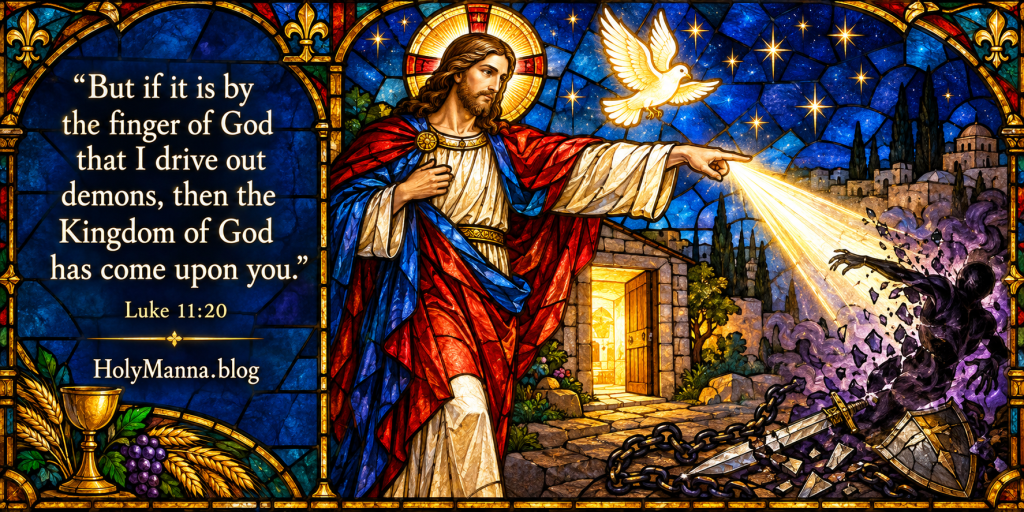
Verse 20: “But if it is by the finger of God that I drive out demons, then the Kingdom of God has come upon you.”
The phrase recalls Exodus 8:19, where Pharaoh’s own magicians admitted that the plagues were the finger of God. The Church identifies that finger with the Holy Spirit, and the verse declares that the Kingdom is not a distant hope but a present arrival standing in front of them.
Verse 21: “When a strong man fully armed guards his palace, his possessions are safe.”
The strong man is Satan, and his so-called peace is the false calm of an unchallenged tyrant guarding stolen goods, meaning human souls.
Verse 22: “But when one stronger than he attacks and overcomes him, he takes away the armor on which he relied and distributes the spoils.”
Jesus is the Stronger One whom John the Baptist foretold in Luke 3:16. Through the Cross and Resurrection He disarms the enemy and distributes the spoils, which are freed captives and the graces poured out on them.
Verse 23: “Whoever is not with me is against me, and whoever does not gather with me scatters.”
In this war there is no neutral ground. Christ gathers and Satan scatters, so attempted neutrality quietly serves the scatterer.
Verse 24: “When an unclean spirit goes out of someone, it roams through arid regions searching for rest but, finding none, it says, ‘I shall return to my home from which I came.’”
The expelled spirit remains restless and possessive, still calling its former victim home. Evil does not retire gracefully, and the delivered soul remains a target.
Verse 25: “But upon returning, it finds it swept clean and put in order.”
Swept and ordered, yet unoccupied. Here lies the warning, since a soul that has been cleansed but not filled with God is simply vacant real estate awaiting a squatter.
Verse 26: “Then it goes and brings back seven other spirits more wicked than itself who move in and dwell there, and the last condition of that man is worse than the first.”
Relapse proves worse than the original bondage, an echo later sounded in 2 Peter 2:20. Deliverance without discipleship ends in disaster, because the point of the exorcism was never emptiness but divine occupancy.
Teachings
CCC 700 unlocks the central image: “The finger. ‘It is by the finger of God that [Jesus] cast out demons.’ If God’s law was written on tablets of stone ‘by the finger of God,’ then the ‘letter from Christ’ entrusted to the care of the apostles, is written ‘with the Spirit of the living God, not on tablets of stone but on tablets of human hearts.’ The hymn ‘Veni Creator Spiritus’ invokes the Holy Spirit as the ‘finger of the Father’s right hand.’ The finger of God is the Holy Spirit Himself, the same Spirit promised through faith in Galatians 3:14.
CCC 550 teaches: “The coming of God’s kingdom means the defeat of Satan’s: ‘If it is by the Spirit of God that I cast out demons, then the kingdom of God has come upon you.’ Jesus’ exorcisms free some individuals from the domination of demons. They anticipate Jesus’ great victory over ‘the ruler of this world.’ The kingdom of God will be definitively established through Christ’s cross: ‘God reigned from the wood.’
Saint Cyril of Alexandria, Doctor of the Church, preached on this very parable in his Commentary on Luke: “He has conquered the ruler of this world. Having, so to speak, hamstrung him and stripped him of the power he possessed, he has given him over for a prey to his followers.” For Cyril, the devil’s defeat is so complete that the hunter has become the prey.
Reflection
This Gospel speaks directly to anyone who has ever cleaned up a life without filling it. Breaking a habit, deleting an app, or walking away from a toxic situation is real progress, yet sweeping the house is only half the work. The empty space must be claimed by Someone, through daily prayer, Scripture, frequent Confession, and above all the Eucharist, which places the Stronger One Himself in the center of the home.
A concrete step is to replace every removed vice with a named virtue and a scheduled practice, so that grace occupies the ground sin vacated. Another is to end each day with a brief examen, asking where Christ was gathering and where scattering crept in. Which rooms of the heart have been swept clean yet left unoccupied? Where does the temptation toward spiritual neutrality hide in daily choices? The Kingdom has come, and the King does not want a tidy house, He wants a home.
The House Belongs to the King
Step back and watch the whole story come together. A promise was spoken to an old nomad under a desert sky, that through him every nation on earth would be blessed. Centuries rolled by, kingdoms rose and fell, and the promise looked forgotten. Then the psalmist stood up in the assembly and sang what Israel refused to stop believing, that “The Lord will remember his covenant for ever.” And finally, on a dusty road toward Jerusalem, the promise showed up in person, casting out demons by the finger of God and announcing that the Kingdom had arrived.
That is the shape of today’s liturgy. Galatians 3 reveals the price of the promise, Christ becoming a curse on the tree so the blessing could reach the nations. Psalm 111 reveals the character of the Promiser, gracious, merciful, and incapable of forgetting. Luke 11 reveals the power of the fulfillment, the Stronger One disarming the enemy and warning that a delivered soul must become a dwelling, not a vacancy.
So the invitation is simple and urgent. Trust the promise the way Abraham did, with a faith that walks. Remember the mercies the way the psalmist did, out loud and often. And hand over the keys of the house the way the Gospel demands, holding nothing back, because neutrality is not an option and emptiness is not safety. Go to Confession and let the sweeping happen. Go to Mass and let the filling happen, receiving the food given to those who fear Him. The God who remembered His covenant for four thousand years has not forgotten a single soul reading these words today. The Stronger One is at the door, and He did not come to visit. He came to stay.
Engage With Us!
These readings were never meant to stay on the page, so share your reflections in the comments below. Your story of covenant faithfulness, hard-won trust, or a house newly filled with grace might be exactly what another reader needs today. Here are some questions to pray with before you write:
- In Galatians 3:7-14, Saint Paul teaches that faith, not performance, makes someone a child of Abraham. Where in your spiritual life are you still trying to earn what Christ already purchased for you on the Cross?
- In Psalm 111:1b-6, the psalmist praises God in the assembly and declares that the Lord remembers His covenant forever. What specific mercy from your own past do you need to remember and retell this week?
- In Luke 11:15-26, Jesus warns that a soul swept clean but left empty invites a worse relapse. What concrete practice of prayer, Scripture, or the sacraments will you use to fill the space that sin once occupied?
- Taken together, these readings proclaim that God kept His ancient promise by sending the Stronger One to break the curse and claim your heart as His home. What is one key you are still withholding from Him, and what would it take to hand it over today?
Take these questions into your prayer, your journal, or your conversation after Mass, and then come back and tell the community what God showed you. Living a life of faith is not a solo project, and every honest comment builds up the Body of Christ. Keep trusting the promise, keep remembering the mercies, and do everything this week with the love and mercy Jesus taught us, because the God who remembers His covenant forever is already at work in you.
Sacred Heart of Jesus, we trust in You!
Immaculate Heart of Mary, pray for us!
Saint Michael the Archangel, defend us in battle!
Follow us on YouTube, TikTok, Instagram and Facebook for more insights and reflections on living a faith-filled life.


Leave a comment