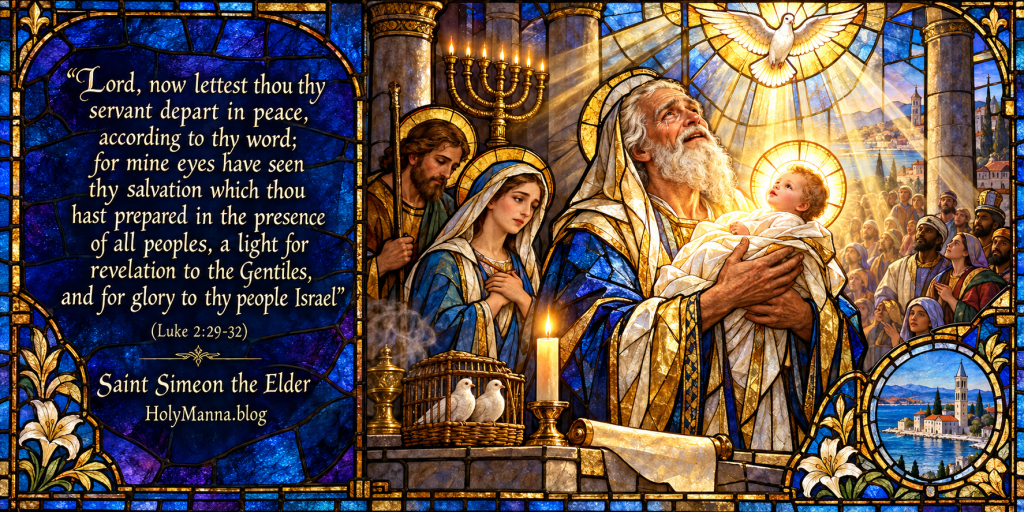
The Man Who Waited for God
Every single night, the Catholic Church ends her day with the prayer of an old man. In rectories and monasteries, in convents and college dorm rooms, and in living rooms everywhere, everyone who prays Night Prayer from the Liturgy of the Hours closes the day with the canticle that Saint Simeon the Elder prayed in the Temple of Jerusalem while holding the infant Jesus in his arms. The Church arranges her prayer this way on purpose, because the Liturgy of the Hours is designed, in the words of the Second Vatican Council, so that “the whole course of the day and night is made holy by the praise of God” (Sacrosanctum Concilium 84, cited in CCC 1174). That means a man who appears in only 11 verses of Scripture has shaped the daily rhythm of Christian life for 2,000 years.
The Church honors him as a prophet and a saint under many names: Simeon the Elder, Simeon the Prophet, Simeon the Just, and in Latin sources Simeon Senex, which simply means Simeon the old man. The Christian East gives him perhaps the most breathtaking title of all, Theodochos, the God-Receiver, because his arms once held the Son of God made flesh. He is celebrated on October 8th in the traditional Roman Martyrology, and the city of Zadar in Croatia, which has guarded his relics for more than 800 years, keeps his feast on that same day with great solemnity. Simeon is venerated as one of the 4 patron saints of Zadar, alongside Saint Anastasia, Saint Chrysogonus, and Saint Zoilus, and his magnificent silver reliquary is one of the great treasures of Catholic Europe.
His story is short in Scripture and long in devotion. It is the story of a man who spent his entire life waiting on a single promise from God, and who discovered at the very end that God keeps His promises in ways more beautiful than anyone dares to imagine.
A Just Man in an Age of Waiting
Scripture tells nothing about Simeon’s birthplace, his parents, his tribe, or his trade. The Gospel of Luke introduces him with a single, dense sentence that carries everything the Church knows for certain about his life: “Now there was a man in Jerusalem, whose name was Simeon, and this man was righteous and devout, looking for the consolation of Israel, and the Holy Spirit was upon him” (Luke 2:25). Every word of that verse matters. He lived in Jerusalem, the city of the Temple, the beating heart of Israel’s worship. He was righteous, meaning he kept the Law of Moses faithfully, and devout, meaning his obedience was not cold rule-keeping but warm, reverent love of God. He was looking for the consolation of Israel, which was the great Messianic hope of the prophets, the comfort promised through Isaiah to a people worn down by exile, occupation, and sin. And the Holy Spirit was upon him, a remarkable statement in an age when many in Israel believed the voice of prophecy had fallen silent for centuries.
Then Luke adds the detail that defines Simeon’s entire existence: “And it had been revealed to him by the Holy Spirit that he should not see death before he had seen the Lord’s Christ” (Luke 2:26). Simeon did not need a conversion from paganism. His was the quieter, harder conversion that most believers actually face: the lifelong deepening of a faith he already held, the daily decision to keep trusting a promise that showed no visible sign of coming true. The Catechism teaches that the Holy Spirit spent centuries preparing a humble remnant, the poor and lowly of the Lord, who awaited the Messiah in hope rather than in power (CCC 711, 716), and it names Simeon as the very crown of that waiting people: “With Simeon and Anna, all Israel awaits its encounter with the Savior” (CCC 529).
Later tradition, especially in the Christian East, fills in the silence of Scripture with stories the Church does not require anyone to believe but which generations have cherished. One tradition holds that Simeon served as a priest of the Temple. Another, far more dramatic tradition makes him one of the 72 scholars who translated the Hebrew Scriptures into Greek in Alexandria, producing the Septuagint, roughly 3 centuries before Christ. In this story, Simeon was assigned the book of Isaiah, and when he reached the prophecy “Behold, a virgin shall conceive and bear a son” (Isaiah 7:14), he doubted. He reached to soften the word virgin into something more believable, and at that moment an angel stopped his hand and promised him that he would not die until he had seen the prophecy fulfilled with his own eyes. The tradition therefore assigns Simeon an almost unimaginable age at the Presentation; some tellings say he was more than 270 years old, and others say 360. It is a stunning story about God defending every syllable of His word, and it has been handed down with love in the East for many centuries, but it must be told as a tradition rather than as history. The timeline alone makes that clear, and the story cannot be verified.
What can be said with confidence is this: whether Simeon’s wait lasted decades or, as the tradition imagines, centuries, Luke presents a man grown old in hope, a living bridge between the promises of the Old Covenant and the dawn of the New.
The Meeting in the Temple
The Law of Moses required two things of a family after the birth of a firstborn son. The mother was to come to the Temple for ritual purification 40 days after the birth (Leviticus 12), and the firstborn son was to be consecrated to God, for as Luke recalls, “Every male that opens the womb shall be called holy to the Lord” (Luke 2:23, citing Exodus 13). So Mary and Joseph traveled from Bethlehem up to Jerusalem with the infant Jesus, offering the sacrifice permitted to the poor, a pair of turtledoves or two young pigeons (Luke 2:24). To any observer in the Temple courts that day, they were simply one more poor family among the crowds.
Simeon saw what no one else saw, because the Holy Spirit who had made the promise now kept it. Luke says that “inspired by the Spirit he came into the temple” (Luke 2:27) at exactly the right hour. An old man moved through the courts, found a young mother holding a 40-day-old child, and did something astonishing. He took the baby into his arms, and the longest wait of his life dissolved into the most famous evening prayer in history: “Lord, now lettest thou thy servant depart in peace, according to thy word; for mine eyes have seen thy salvation which thou hast prepared in the presence of all peoples, a light for revelation to the Gentiles, and for glory to thy people Israel” (Luke 2:29 to 32).
This canticle, known by its Latin opening as the Nunc Dimittis, is a masterpiece of faith compressed into 3 breaths. Simeon speaks like a watchman finally relieved of his post; his master has released him, and he can go in peace. He declares that salvation is something his own eyes have seen, not an idea but a person, a child light enough to hold. And he becomes the first voice in the Gospel to announce publicly that this salvation is for everyone, a light for the Gentile nations and the glory of Israel at the same time. The whole missionary scope of the Church is already present in the arms of one old man.
If the question is what miracles Simeon worked during his life, honesty requires a clear answer: Scripture records none. There are no healings, no multiplied loaves, no raised dead attributed to him in the Gospel. His gift was prophecy, and the miracle of his life ran in the other direction; it was what God worked in him. The Holy Spirit made him a promise, the Holy Spirit governed his timing, and the Holy Spirit opened his eyes to recognize the Messiah hidden in an ordinary baby. The Catechism places this scene at the center of the mysteries of Christ’s infancy: “The presentation of Jesus in the temple shows him to be the firstborn Son who belongs to the Lord” (CCC 529). The event Simeon witnessed is now celebrated by the universal Church every February 2nd as the Feast of the Presentation of the Lord, called Candlemas in the West because candles are blessed and carried in honor of the light Simeon proclaimed, and called the Hypapante, the Meeting, in the East. It is the Fourth Joyful Mystery of the Rosary. Few saints can claim that the single recorded moment of their life became a universal feast, a mystery of the Rosary, and the Church’s nightly prayer.
The Sword He Could Not Keep Silent About
Simeon was not a martyr, and no persecution of him is recorded anywhere. His hardships were of a quieter kind, and for that very reason they may be the most relatable hardships in the entire calendar of saints.
The first hardship was the waiting itself. Simeon grew old in a Jerusalem ruled by Rome and governed by Herod, in an age of political oppression, religious corruption, and widespread despair about whether God still cared. He held onto a private promise with no public evidence, year after year, as his eyes dimmed and his friends died and nothing changed. Anyone who has prayed long for something knows how heavy that fidelity becomes. Simeon carried it to the end without letting go.
The second hardship was the cost of his prophecy. After the canticle, Simeon blessed Mary and Joseph, and then turned to the young mother with words that must have been agonizing to speak: “Behold, this child is set for the fall and rising of many in Israel, and for a sign that is spoken against (and a sword will pierce through your own soul also), that thoughts out of many hearts may be revealed” (Luke 2:34 to 35). God asked an old man, in the happiest moment of his life, to tell a new mother that her Son would be contradicted and rejected, and that her own soul would be pierced. True prophecy is rarely comfortable, and Simeon did not soften it. The Catechism explains what his words pointed toward: “The sword of sorrow predicted for Mary announces Christ’s perfect and unique oblation on the cross that will impart the salvation God had ‘prepared in the presence of all peoples’” (CCC 529). In Simeon’s prophecy the Church already sees Mary standing at the foot of the cross, united with the suffering of her Son in God’s plan of salvation (CCC 964). The joy of Christmas and the sorrow of Good Friday meet for the first time in the mouth of this one old man.
The third hardship was the one he welcomed: readiness to die. The opening words of his canticle are literally a request for dismissal, a servant asking his master for leave to depart. Tradition holds that Simeon died in peace not long after the Presentation, full of days, his life’s one assignment complete. The traditional Roman Martyrology announces on October 8th “The natal day of blessed Simeon the elder”, using the Church’s beautiful habit of calling the day of a saint’s death a natal day, a birthday into Heaven. It should be noted, for the sake of accuracy, that the revised 2004 edition of the Martyrologium Romanum commemorates Simeon on February 3rd instead, joining him with the prophetess Anna on the day after the Presentation, where the two elders are remembered together as the righteous old man and the widow prophetess who greeted the child Jesus as the Messiah and the hope of Israel. Zadar and the older calendar keep October 8th, and both dates honor the same unrepeatable grace.
A Body That Crossed the Sea
The story of Simeon’s relics is one of the most remarkable in the history of the Church, and it stretches across empires, a famous storm, a queen’s guilty conscience, and a city that refused to give him up.
Eastern tradition holds that Simeon was buried in Jerusalem, and Eastern sources report that the Russian pilgrim Anthony, who later became Archbishop of Novgorod, venerated Simeon’s grave in Jerusalem around the year 1200. That report comes down through tradition and cannot be independently verified. What the sources do record is that at some point between the years 565 and 578, during the reign of the Emperor Justin II, a body believed to be that of Simeon was translated from the Holy Land to Constantinople, the capital of the Christian East. Sources differ on the exact year within that window, and that disagreement deserves to be flagged honestly rather than smoothed over.
Then comes the story that the people of Zadar have told for 8 centuries. According to the tradition of the city, a merchant, usually said to be Venetian, was transporting the saint’s sarcophagus by sea from Constantinople when a violent storm on the Adriatic forced his ship to take refuge in the harbor of Zadar, on the Dalmatian coast, around the year 1203. That date matters, because it falls in the era of the Fourth Crusade, when many relics were leaving Constantinople for the West. While the merchant waited out the storm, the relics were entrusted to local religious, word of miracles worked through the saint’s intercession began to spread through the region, and when the time came to sail, the people of Zadar simply refused to let the body leave. This beloved account of how Simeon came to Zadar must be told as a story and a tradition; its details cannot be verified. What is certain and documented is the result: by the 13th century Zadar possessed and venerated the body, and it has done so continuously for more than 800 years. The relics rested first in the church of Saint Mary Major, and in 1632 they were transferred to the church that is today the Sanctuary of Saint Simeon, where they rest above the main altar.
In 1371 the city received a royal visitor, Elizabeth of Bosnia, wife of King Louis I and Queen of Hungary and Croatia, one of the most powerful women in Europe. According to the story told in Zadar, during Mass the queen secretly broke off a piece of the saint’s finger, and some tellings add that she hoped the relic would help her conceive a son. The story continues that she was overcome with remorse, returned what she had taken, and made restitution to the church and the people of the city. That dramatic episode is tradition and cannot be verified. What is firmly documented is the restitution itself, one of the greatest works of goldsmithing of the entire Middle Ages. Between 1377 and 1380 Queen Elizabeth commissioned a monumental reliquary for the saint’s body: a cedarwood sarcophagus more than 5 feet long, overlaid with embossed plates of silver and silver-gilt, crafted by the goldsmith Francesco of Milan, who kept a workshop in Zadar, together with local artisans. The sources disagree on the exact quantities involved; one records that the queen provided roughly 250 kilograms of silver, while another states that the finished chest weighs 343 kilograms and that the queen donated 1,000 marks of silver for it. The chest’s reliefs depict the Presentation in the Temple, scenes from the saint’s story, the queen presenting her gift, and, on the inside of the lid, 3 miracles attributed to the saint. A Gothic inscription in Latin on the chest, translated into English, begins “Simeon the Righteous, holding Jesus, born of a virgin, in his arms”, and goes on to record that he rests in peace in this chest commissioned by the mighty Queen Elizabeth in the year 1380. The chest remains in Zadar to this day, a protected cultural treasure of Croatia and one of the finest medieval reliquaries in existence.
Every year on October 8th, the feast of the saint and of the city, the chest is opened and the remarkably preserved body of Simeon is displayed to the faithful for about a week, drawing pilgrims and visitors from across the world to venerate the man tradition says once held Christ. The people of Zadar also hand down a modern story of his protection: elderly residents recount that in the 1940s, during wartime occupation, the authorities attempted to remove the chest and carry it off to Italy, and that the attempt failed, with the chest remaining in its place, which the city remembers as a miracle of its patron. That account rests on local oral testimony and cannot be verified.
One final chapter is thoroughly documented and genuinely moving. On October 7th, 2010, during Solemn Vespers for the feast, the Archbishop of Zadar, with arrangements made through the Holy See, solemnly handed over a small particle taken from the saint’s preserved body to representatives of the Greek Orthodox Patriarchate of Jerusalem, destined for the Monastery of Saint Simeon in Jerusalem. The old man who once held the infant Christ in a divided world now draws Catholic and Orthodox Christians toward one another across a divided Christendom. His cultural reach extends further still; the Nunc Dimittis, the Song of Simeon, has been set to music for centuries and rises every evening from churches on every continent, and the candles of Candlemas burn each February 2nd because of his proclamation of the light.
Learning to Wait Like Simeon
Simeon’s life lands with particular force on a generation formed by same-day delivery, instant streaming, and the expectation that anything worth having should arrive now. His entire existence was one long Advent, and he teaches 3 lessons that fit directly into modern daily life.
First, wait actively, not passively. Luke does not describe a man sitting idle until something happened. Simeon was righteous and devout the whole time; he kept showing up, kept praying, kept obeying, long before he felt anything or saw anything. That is the actual shape of a mature faith life: Sunday Mass when the weekend is exhausting, a daily routine of prayer when it feels dry, regular Confession when it would be easier to skip it. A concrete way to imitate him is to pray Night Prayer from the Liturgy of the Hours before bed; it takes about 5 minutes, it ends with Simeon’s own canticle, and it trains the heart to close each day at peace in God’s hands. What is one promise of God, one prayer intention, that you have quietly grown tired of waiting for, and what would it look like to keep showing up for it the way Simeon did?
Second, let the Holy Spirit lead you to the Temple. Simeon met Jesus because he went, at the Spirit’s prompting, to the place where Jesus was. The same meeting is available today, because the Catechism teaches that the Eucharist is “the source and summit of the Christian life” (CCC 1324). The Mass is the modern believer’s Temple court, and Eucharistic Adoration is the chance to do almost exactly what Simeon did, to come close to the Lord’s real presence and simply behold Him. Arriving 10 minutes early for Mass to pray, or stopping into an Adoration chapel once a week, turns Simeon’s once-in-history moment into a weekly habit. If you truly believed you would meet Jesus face to face at this Sunday’s Mass, what would you do differently between now and then?
Third, accept the sword. Simeon teaches that real love and real faith include sorrow, and that sorrow does not mean God has abandoned anyone. He spoke a hard truth to Mary with tenderness, and Mary carried that sword all the way to Calvary in union with her Son. Jesus Himself tells every disciple to “take up his cross and follow me” (Matthew 16:24), and the Church teaches that Christ calls His followers to unite their own sufferings with His redemptive sacrifice (CCC 618). In practice, that can mean offering up a painful diagnosis, a job loss, a season of loneliness, or the slow grief of praying for a loved one who has left the faith, instead of numbing it or despairing over it. Where in your life right now is God asking you to speak a difficult truth with love, or to carry a sorrow with hope instead of bitterness?
Simeon never founded an order, never wrote a book, never worked a recorded miracle. He waited faithfully, recognized Jesus when He came, held Him close, spoke the truth, and let go in peace. Holiness rarely gets simpler, or harder, than that.
Engage With Us!
The story of Saint Simeon the Elder belongs to everyone who has ever waited on God, and the conversation should not end here. Readers are warmly invited to share their thoughts, experiences, and reflections in the comments below; someone else’s waiting may be exactly the encouragement another reader needs today. Here are some questions to spark that reflection and discussion:
- Simeon waited his whole life for a single promise. What promise or prayer are you still waiting on, and how has the waiting shaped your faith?
- The Holy Spirit led Simeon to the Temple at exactly the right moment. When has the Spirit nudged you toward a place, a person, or a decision that turned out to be a holy appointment?
- Simeon’s canticle is a prayer of total peace in the face of death. What would need to change in your life for you to pray those words and mean them?
- Simeon told Mary a painful truth with love. Is there a hard conversation you have been avoiding that God may be asking you to have with gentleness?
- The people of Zadar have guarded Simeon’s relics for 800 years. What practices, devotions, or truths of the faith are you guarding and handing on to the people around you?
May the example of Saint Simeon the Elder stir up a patient, watchful, courageous faith in every reader. Keep showing up, keep praying, keep watching for Christ in the ordinary moments, because He still comes to meet those who wait for Him. Live each day ready to hold Jesus close and to let Him hold you, and do everything, the waiting and the working, the joys and the swords, with the love and the mercy that Jesus taught.
Saint Simeon the Elder, pray for us!
Follow us on YouTube, TikTok, Instagram and Facebook for more insights and reflections on living a faith-filled life.


Leave a comment