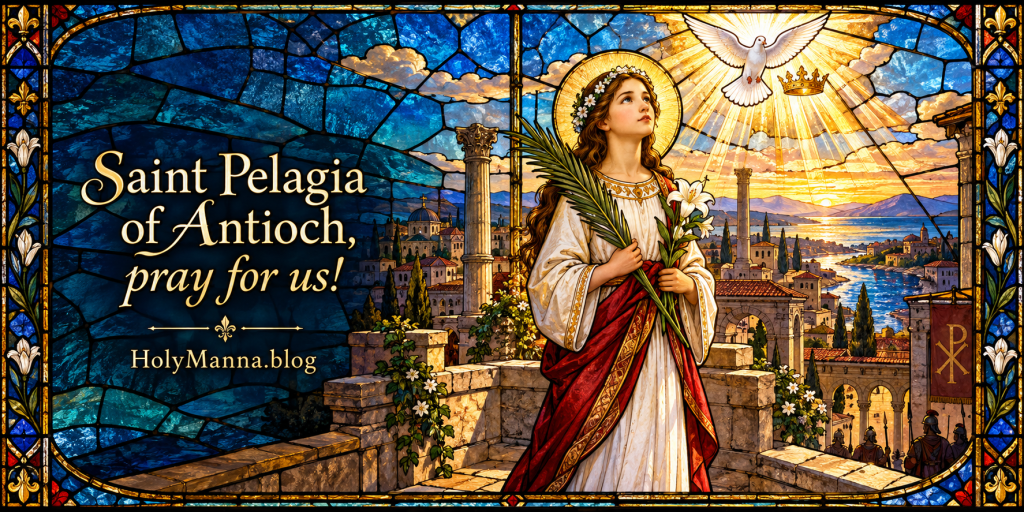
The Fifteen-Year-Old Girl Who Outran an Empire
Each year on October 8th, the Church’s most ancient calendars pause over the name of a girl who was only 15 years old when she stood between an empire and her God. Saint Pelagia of Antioch, virgin and martyr, died during the great persecution unleashed by the Emperor Diocletian, and her memory was preserved not by pious rumor but by 2 of the most authoritative voices Christianity has ever produced. St. Ambrose of Milan wrote of her in his treatise on virginity and in his letters, and St. John Chrysostom, himself a son of Antioch, preached about her at her own shrine within living memory of her death. Both men are Doctors of the Church, and both held her up to their congregations as a model of Christian courage.
The traditional Roman Martyrology commemorates her on June 9th with a brief and weighty line: “At Antioch, St. Pelagia, virgin and martyr, whose eulogy has been presented by St. Ambrose and St. John Chrysostom.” Meanwhile, the oldest surviving martyrology in the world, a Syriac calendar copied in the year 411, already listed her feast on October 8th, and the Christian East has honored her on that date ever since. Readers should also know that 2 other holy women named Pelagia came to share that same October date over the centuries, Pelagia the Penitent and Pelagia of Tarsus, and their stories are constantly mixed together online. This post concerns the first and most historically certain of the 3, the teenage virgin martyr of Antioch herself.
Why does the Church treasure someone so young, who left behind no writings, no foundations, no religious order, and no recorded miracles? The Catechism gives the answer plainly: “Martyrdom is the supreme witness given to the truth of the faith: it means bearing witness even unto death” (CCC 2473). Pelagia gave that supreme witness before she was old enough to marry, and the Church has never forgotten it.
A Daughter of Antioch on the Orontes
Pelagia was born in the late 3rd century in Antioch, the great metropolis of Roman Syria and one of the 3 largest cities of the entire empire. No city on earth, apart from Jerusalem, had deeper Christian roots. The Acts of the Apostles records that “it was in Antioch that the disciples were first called Christians” (Acts 11:26). This was the city where St. Peter shepherded the flock before going to Rome, the city of the martyr bishop St. Ignatius, and later the city of St. John Chrysostom. A Christian child of Antioch grew up walking streets that the apostles themselves had walked.
Honesty requires saying what the historical record does not contain. The names of Pelagia’s parents were not preserved, and nothing verified survives about her family’s wealth, status, or household. There is no documented conversion story, because as far as the sources indicate, Pelagia did not convert as an adult; she was raised within the Christian community of Antioch and belonged to Christ from her youth. What is certain, because St. John Chrysostom says so, is that she was a Christian virgin of about 15 years of age, which in that era meant a young woman who had deliberately committed her purity and her future to the Lord. Her very name carried a kind of poetry; Pelagia comes from the Greek word pelagos, meaning of the sea.
The deepening of her faith is written not in anecdotes but in her resolve. The early Church held consecrated purity in the highest honor, and the Catechism still teaches why: “From apostolic times Christian virgins and widows, called by the Lord to cling only to him with greater freedom of heart, body, and spirit, have decided with the Church’s approval to live in the respective status of virginity or perpetual chastity” (CCC 922). Pelagia belonged to that apostolic lineage of women who gave Christ everything.
Then the world turned violent. In February of the year 303, Diocletian issued the first of his edicts against the Church. Christian basilicas were demolished, copies of the Scriptures were seized and burned, clergy were imprisoned and tortured, and eventually all citizens were ordered to offer sacrifice to the pagan gods under pain of death. It was the most systematic persecution the Roman Empire ever mounted against the faith, and it swept into Antioch with full force. Sources place Pelagia’s death at different points within it; some give the year 303 or 306, while Butler’s Lives of the Saints and other references give 311. The conflict in dating is real and should be acknowledged, but every source agrees on the essential fact that she died within the Diocletianic persecution.
The Quiet Heroism the Fathers Could Not Forget
Content integrity matters at HolyManna, so let it be said clearly: the ancient sources record no miracles worked by Pelagia during her short life. No healings, no visions, no wonders are attributed to her before her death, and inventing them would dishonor her. What the sources record instead is something that impressed 2 Doctors of the Church more than any wonder could have: a teenager whose love for Christ was so settled, so complete, that when the moment of testing came without warning, she did not hesitate.
St. John Chrysostom preached 2 separate sermons about her, an extraordinary honor for any saint, let alone a girl with no public career. In his famous homily on St. Ignatius of Antioch, Chrysostom mentions that her feast had just been celebrated, and his affection is audible across 16 centuries: “Lately, for instance, a maiden quite young, and unmarried, the blessed martyr Pelagia, entertained us, with much joy.” In his language, the feast of a martyr was a banquet spread by the grace of the Holy Spirit, and young Pelagia was the hostess whose courage fed the whole city.
Why should anyone remember and emulate a saint with so short a story? Because her life distills 2 virtues that the Catechism places at the heart of Christian maturity. The first is fortitude: “Fortitude is the moral virtue that ensures firmness in difficulties and constancy in the pursuit of the good” (CCC 1808). The second is chastity, which the Church has never understood as mere repression: “Chastity means the successful integration of sexuality within the person and thereby the inner unity of man in his bodily and spiritual being” (CCC 2337). Pelagia possessed both so fully at 15 that grown bishops held her up before grown congregations. She had evidently taken literally the words of her Lord in The Gospel of Matthew: “And do not be afraid of those who kill the body but cannot kill the soul” (Mt 10:28). Her brief life proves that holiness is not reserved for the old, the ordained, or the learned. Sanctity can be complete in a teenager, because sanctity is measured by love, not by years.
The Soldiers at the Door
The documented account of her martyrdom comes from the homily of St. John Chrysostom, summarized faithfully in the Catholic Encyclopedia, and it unfolds with terrible speed. Soldiers were dispatched to seize Pelagia, evidently to compel her to offer the public pagan sacrifice demanded by the imperial edicts. She was alone in the house; no parent, no guardian, no one was there to protect her. She came out to meet the soldiers herself. When she learned the order they carried, she understood exactly what awaited a beautiful 15-year-old girl in the hands of Roman soldiers and pagan magistrates: not only the demand to betray Christ at the altar of idols, but the near certainty of being violated along the way. She asked the soldiers for permission to go back inside and change her clothing. They granted it. She climbed to the roof of her house and threw herself down, and so she died, on the spot, before any hand could touch her. Chrysostom declares that she died as virgin and martyr, and the Church of Antioch honored her as both from the beginning.
Butler’s Lives of the Saints, drawing on Chrysostom, adds the detail that in that final act “she had Jesus in her breast inspiring and exhorting her.” The ancient Church did not see a frightened girl in freefall; it saw a bride running to her Bridegroom by the only door left open.
St. Ambrose honored her twice in writing. In his Letter 37, he imagines her facing her persecutors with words of defiant serenity: “I die willingly, no man shall touch me, no one with wanton look shall defile my chastity, I will carry away with me my modesty, my honor untainted; these ruffians shall reap no profit from their insolence.” In De Virginibus, Book III, he places on her lips an interior struggle that is strikingly human: “I both wish and fear to die, for I meet not death but seek it.” Honesty requires a clarification here. These speeches are Ambrose’s own rhetorical compositions, a 4th century preacher’s way of honoring what he knew of her intention; they are not transcripts of anything Pelagia said, and no verified words from Pelagia herself survive. Ambrose also passes along a tender tradition, and he signals its status himself: “She is said to have adorned her head, and to have put on a bridal dress, so that one would say that she was going to a bridegroom, not to death.” That image of the martyr dressed as a bride is a tradition rather than established fact, and it cannot be verified.
The accounts also diverge in ways that must be flagged rather than smoothed over. Chrysostom’s version, the earliest and most local, has her die by the fall from her own roof. Some later retellings say she fell into the sea or a river. Ambrose’s narrative in De Virginibus goes further and describes Pelagia together with her mother and sisters perishing in a river while fleeing persecutors, with a prayer that the water receive them. Scholars, including the Bollandists who have studied these texts for centuries, generally conclude that Ambrose wove Pelagia’s memory together with the story of other Antiochene martyrs, Domnina and her daughters, who drowned in a river and whom Chrysostom commemorated in a separate homily. The historical core that stands firm across all witnesses is this: a 15-year-old virgin of Antioch, facing arrest, chose death rather than apostasy and defilement, and the Church immediately venerated her as a martyr.
A thoughtful modern reader will ask the hard question, and the Church does not dodge it. Did Pelagia take her own life, and does the Church not condemn that? The teaching of the Catechism is unambiguous: “Suicide contradicts the natural inclination of the human being to preserve and perpetuate his life” (CCC 2281), and Butler himself, telling her story, pauses to insist that nothing can ever make it lawful for a person directly to procure his own death. Yet the same Church has venerated Pelagia as a martyr for 17 centuries. St. Augustine wrestled with precisely this tension in The City of God, Book I, Chapter 26, where he considers the holy women who died this way during persecution and whom the Church honors. He refuses to condemn them, and he allows that they may have acted not by private human judgment but by a divine prompting known to God, obeying rather than erring. The Fathers judged Pelagia’s heart: her intention was not to destroy God’s gift of life but to remain faithful to Christ when every other path had been closed by violence. The Church proposes for imitation not the manner of her death, which belongs to God’s judgment of an extreme moment, but the totality of her love, which preferred God to absolutely everything else.
The Catechism also speaks a word of mercy that belongs in this story, especially for any reader who has lost someone to suicide: “Grave psychological disturbances, anguish, or grave fear of hardship, suffering, or torture can diminish the responsibility of the one committing suicide” (CCC 2282), and further, “We should not despair of the eternal salvation of persons who have taken their own lives. By ways known to him alone, God can provide the opportunity for salutary repentance” (CCC 2283). The God who read Pelagia’s heart on that rooftop reads every heart, and his mercy is wider than any human verdict. As Psalm 116 sings, “Precious in the sight of the LORD is the death of his faithful ones” (Ps 116:15).
A Name That Echoed for Centuries
Here again integrity comes first: no catalog of specific posthumous healings or named miracle stories attributed to Pelagia’s intercession has survived from antiquity, and none will be invented here. What did survive is something remarkable in its own right, the evidence of massive, immediate, and enduring veneration, which in the ancient Church was itself the fruit of answered prayer at a martyr’s tomb.
Pelagia was buried in the Christian cemetery outside the walls of Antioch, and a shrine rose over her grave. Every year on her feast, the Christians of Antioch poured out of the city in procession to celebrate at her tomb, a crowd so large and so festive that it needed taming. Sometime between 386 and 397, St. John Chrysostom stood at that shrine and preached her homily, scolding those who turned the feast into an excuse for taverns and urging the city to carry her memory home: “I ask and request that you keep this holy virgin in your memory and mind all the time, and neither disgrace the festival nor strip us of the respect we acquire from this feast.” Butler records that by the 5th century churches bearing her name stood both at Antioch and at Constantinople, the imperial capital, a stunning reach for a girl with no rank, no wealth, and no surviving writings. The Syriac martyrology of 411, the oldest such calendar in existence, lists her feast on October 8th, and the Catholic Encyclopedia concludes without hesitation that she is “undoubtedly an historical person.”
Her name itself became a seed. In the 5th century, a writer calling himself James the Deacon told the story of another Pelagia of Antioch, a celebrated actress converted by a holy bishop named Nonnus, who was baptized, gave away her wealth, and ended her days in severe penance on the Mount of Olives disguised as a monk called Pelagius. It is a beautiful and beloved story of repentance, and the Church honors Pelagia the Penitent on October 8th, but the Catholic Encyclopedia judges the tale to be a devotional recasting built from older materials, including a real unnamed actress of Antioch whose conversion Chrysostom mentions in a homily on The Gospel of Matthew. As the history of a distinct woman named Pelagia living in Jerusalem, the story cannot be verified. The same holds for the tradition of Pelagia of Tarsus, said to have been martyred by burning after refusing a marriage connected to Diocletian’s household; that account likewise cannot be verified. Even hostile scholarship ended up strengthening her case. In the 19th century the German scholar Hermann Usener argued that Pelagia was merely a Christian makeover of the goddess Aphrodite, and the Bollandist scholars who examined the evidence rejected the theory for the virgin martyr; her existence rests on the twin testimony of Ambrose and Chrysostom and on the earliest martyrologies, a documentary foundation stronger than that of most figures of her century.
No documented relics of Pelagia are venerated anywhere today. Antioch, the modern Antakya, was shattered repeatedly by earthquakes and conquests across the centuries, and her shrine was lost with so much else of that great Christian city. Her true memorial turned out to be indestructible anyway: the liturgy itself, the calendars of East and West that still carry her name, and the generations of girls across Greece, Russia, the Middle East, and the Christian world who have been baptized Pelagia in her honor.
What a 15-Year-Old Girl Says to a World of Grown Ups
It is tempting to file Pelagia’s story under ancient history, something admirable but remote. Resist that temptation, because her situation is more contemporary than it looks. She lived in a wealthy, sophisticated, entertainment soaked city that regarded Christian conviction as stubbornness and regarded purity as a curiosity. She was young in a culture that wanted her body and had no interest in her soul. She was alone in the house when the test came. Every one of those sentences describes the world you live in right now.
Her first lesson is that chastity is strength, not deprivation. The Catechism teaches that “Chastity includes an apprenticeship in self-mastery which is a training in human freedom” (CCC 2339). Pelagia was free on that rooftop, freer than the armed men below her, because no one could make her betray what she loved. St. Paul had written to another cosmopolitan city words she clearly believed: “You are not your own; you were bought with a price. So glorify God in your body” (1 Corinthians 6:19 to 20). When you are alone and unobserved, with a phone in your hand and no one watching, does your body still belong to Christ?
Her second lesson is that fidelity is built before the crisis, not during it. Pelagia did not improvise heroism in 60 seconds; she had been quietly choosing Christ for years, and the rooftop only revealed what the hidden choices had already built. The same is true in reverse for everyone reading this. The small daily surrenders, the compromises nobody sees, are rehearsals too. What are your daily habits rehearsing you to become? Start small and start today. Guard your eyes online as an act of love, not of fear. Bring your purity failures to Confession quickly and without despair. Choose one recurring temptation this week and plan your exit from it in advance, the way Pelagia saw her moment coming and met it with resolve. If the soldiers of compromise knocked on your door this afternoon, in your workplace, your relationship, or your browser, would they find a door already locked by love?
Engage With Us!
HolyManna would love to hear from you. Share your thoughts and reflections on Saint Pelagia of Antioch in the comments below, and consider these questions as a starting point for prayer and discussion.
- Pelagia was only 15 when her faith was tested to the limit. What formation are you receiving, or giving to the young people in your life, that could sustain that kind of fidelity?
- She was alone in the house when the test came. Where in your life does your integrity depend on being watched, and how can you invite Christ into those unwatched places?
- The Church venerates Pelagia’s total love for Christ while teaching clearly about the sanctity of life. How does holding both truths together deepen your trust in God’s mercy and his judgment of the heart?
- Chastity, says the Catechism, is a training in human freedom. Where have you experienced self-mastery actually making you more free?
- Chrysostom begged his people to keep this holy virgin in their memory at all times. What practical reminder could keep a saint’s witness in front of you this week?
Saint Pelagia had nothing the world counts as power, no age, no office, no protector, and yet 17 centuries later her name still shines because she loved Jesus Christ more than her own life. You do not need to be older, holier, or better situated before you start living for God; you only need to begin. Hold fast to the faith, guard what has been entrusted to you, and do everything this week, at home, at work, and online, with the love and the mercy that Jesus taught us.
Saint Pelagia of Antioch, pray for us!
Follow us on YouTube, TikTok, Instagram and Facebook for more insights and reflections on living a faith-filled life.


Leave a comment