Thursday of the Twenty-seventh Week in Ordinary Time – Lectionary: 464
When the Answer to Every Prayer Is a Person
Some days the readings at Mass feel like three separate conversations. October 8th is not one of those days. Thursday of the Twenty-seventh Week in Ordinary Time, Lectionary 464, reads like a single argument built in three movements, and the argument is about one question: where does the life of God actually come from?
Saint Paul opens with a thunderclap, calling the Galatians foolish for trying to earn by religious performance what they had already received as pure gift. The Spirit came to them through faith in the crucified Christ, not through works of the law. Then the Church places on every tongue the Benedictus, the canticle old Zechariah sang when his voice returned, a song that rehearses the entire history of salvation as one long act of God keeping His word: the prophets, the covenant, the oath sworn to Abraham. Finally, Jesus Himself teaches what to do with a God like that. Knock on His door at midnight. Keep knocking. Ask shamelessly, because the Father is not a drowsy neighbor doing the bare minimum; He is a Father who gives good gifts, and the best gift He gives is the Holy Spirit.
The historical backdrop sharpens everything. Paul’s Galatians were Gentile converts in Asia Minor being pressured to adopt the Mosaic law. Zechariah was a priest of the old covenant announcing its fulfillment. The villagers in Jesus’ parable lived in one-room homes where hospitality was a sacred duty and a midnight request was a genuine crisis. Across all three settings, the same truth holds steady. The central theme of the day is this: the Father who keeps His promises gives His very Spirit to those who ask in faith.
First Reading — Galatians 3:1-5
A Furious Letter Written Out of Love
The Letter to the Galatians is the angriest document in the New Testament, and the anger is the measure of the love behind it. Paul had personally evangelized Galatia, a region of central Asia Minor whose people descended from Celtic tribes that had migrated there centuries before Christ. These Gentiles had received the Gospel, received Baptism, and visibly received the Holy Spirit. Then, after Paul moved on, other teachers arrived, often called Judaizers, insisting that faith in Christ was insufficient and that circumcision and observance of the Mosaic law were necessary for salvation. Scholars date the letter anywhere from around AD 49 to the mid 50s, a range tied to its relationship with the Council of Jerusalem in Acts 15, and the question remains honestly debated. What is not debated is Paul’s alarm. His converts were quietly trading grace for a treadmill, and this passage is his intervention. It fits the day’s theme perfectly, because it establishes the foundation on which the psalm and the Gospel will build: the Spirit is a gift received by faith, never a wage earned by works.
Galatians 3:1-5
O stupid Galatians!
Who has bewitched you,
before whose eyes Jesus Christ was publicly portrayed as crucified?
I want to learn only this from you:
did you receive the Spirit from works of the law,
or from faith in what you heard?
Are you so stupid?
After beginning with the Spirit,
are you now ending with the flesh?
Did you experience so many things in vain?–
if indeed it was in vain.
Does, then, the one who supplies the Spirit to you
and works mighty deeds among you
do so from works of the law
or from faith in what you heard?
Detailed Exegesis
Verse 1: “O stupid Galatians! Who has bewitched you, before whose eyes Jesus Christ was publicly portrayed as crucified?”
The Greek verb for “bewitched,” baskaino, evokes the casting of an evil eye, as though only sorcery could explain such a reversal. Paul’s sharpest point is in the second clause. Christ was crucified in Jerusalem, not Galatia, yet Paul says He was “publicly portrayed” before Galatian eyes, because preaching received in faith makes the Cross vividly present. Abandoning that Gospel is abandoning something they had truly seen.
Verse 2: “I want to learn only this from you: did you receive the Spirit from works of the law, or from faith in what you heard?”
Paul reduces the whole controversy to a single piece of evidence drawn from their own experience. The Galatians had manifestly received the Holy Spirit, and they received Him before any of them observed the Mosaic law. The facts of their own conversion refute the Judaizers.
Verse 3: “Are you so stupid? After beginning with the Spirit, are you now ending with the flesh?”
“Flesh” here means more than circumcision; it means the entire project of self-reliance, the attempt to finish by human effort what God began by grace. A life that starts supernatural cannot be completed by natural means.
Verse 4: “Did you experience so many things in vain? If indeed it was in vain.”
Everything the Galatians lived through, their conversion, their reception of the Spirit, their trials, would be emptied of meaning if grace could be earned. The final clause softens into hope. Paul refuses to believe it was all for nothing, because he still expects their return.
Verse 5: “Does, then, the one who supplies the Spirit to you and works mighty deeds among you do so from works of the law or from faith in what you heard?”
The verbs are present tense. God is still supplying the Spirit and still working wonders among them, and He is doing it the same way He always has, through faith. Grace is not a one-time deposit but an ongoing supply, which is exactly why the Gospel today will command continual asking.
Teachings
Saint John Chrysostom, Doctor of the Church, preached directly on this passage in his Homily 3 on Galatians, and his insight on verse 1 remains stunning: “He says not, ‘crucified,’ but, ‘openly set forth crucified,’ signifying that by the eye of faith they saw more distinctly than some who were present as spectators. For many of the latter received no benefit, but the former, who were not eye-witnesses, yet saw it by faith more clearly.” Chrysostom’s point dismantles the idea that faith is second-class knowledge. Faith sees better than eyesight, because many who physically watched Calvary walked away unchanged, while the Galatians, who saw nothing, were transformed.
The Catechism carries Paul’s teaching forward without compromise. CCC 1996 declares: “Our justification comes from the grace of God. Grace is favor, the free and undeserved help that God gives us to respond to his call to become children of God, adoptive sons, partakers of the divine nature and of eternal life.” And CCC 2010 adds: “Since the initiative belongs to God in the order of grace, no one can merit the initial grace of forgiveness and justification, at the beginning of conversion.” Even faith itself is not a human achievement, for CCC 153 teaches: “Faith is a gift of God, a supernatural virtue infused by him.” The early Church settled this question at the Council of Jerusalem, recounted in Acts 15, where the Apostles declined to impose the full Mosaic law on Gentile converts. The Church has never taught that good works are optional; she teaches that they are the fruit of grace, never its price.
Reflection
The Galatian temptation did not die in the first century. It shows up every time a believer treats God like an employer, quietly keeping score, assuming His love expands with performance and shrinks with failure. That mindset turns prayer into a progress report and the spiritual life into anxiety management. Paul’s remedy is to return to the beginning and remember that everything started as gift. A concrete way to live this reading is to spend 5 minutes tonight recalling the moment faith first felt real, whether at a retreat, a Mass, a confession, or a quiet crisis, and to thank God plainly for what was never earned. Another step is to bring sacramental Confession back into regular rhythm, approaching it not as a penalty box but as the place where grace is resupplied. Where has performance quietly replaced trust in your relationship with God? What would change this week if you truly believed His love for you does not fluctuate with your output?
Responsorial Psalm — Luke 1:68-75
The Song of a Man Who Learned to Believe Again
Today the Church does something unusual. Instead of a psalm from the Psalter, she places on the lips of the faithful the first half of the Benedictus, the canticle of Zechariah from The Gospel of Luke. Zechariah was a priest of the old covenant, struck mute by the angel Gabriel for doubting the promise of a son in his old age. For 9 months he lived in enforced silence, and when he finally obeyed, writing “John is his name,” his tongue was loosed and his first words were this song. The canticle follows the classic Jewish berakah form, a blessing that recounts God’s deeds, and it is packed with covenant vocabulary: David, the prophets, mercy, the holy covenant, the oath sworn to Abraham. The Church treasures it so much that she prays it every single morning at Lauds in the Liturgy of the Hours. Its placement today is deliberate. After Paul insists that the Spirit comes by faith in what was heard, the Church answers with the testimony of a man who heard, doubted, repented, and believed, and his song proves the day’s theme: God keeps every promise He makes.
Luke 1:68-75
R. (68) Blessed be the Lord, the God of Israel; he has come to his people.
He has raised up for us a mighty savior,
born of the house of his servant David.
R. Blessed be the Lord, the God of Israel; he has come to his people.
Through his holy prophets he promised of old
that he would save us from our enemies,
from the hands of all who hate us.
R. Blessed be the Lord, the God of Israel; he has come to his people.
He promised to show mercy to our fathers
and to remember his holy covenant.
R. Blessed be the Lord, the God of Israel; he has come to his people.
This was the oath he swore to our father Abraham:
to set us free from the hands of our enemies,
free to worship him without fear,
holy and righteous in his sight
all the days of our life.
R. Blessed be the Lord, the God of Israel; He has come to his people.
Detailed Exegesis
Verse 68: “Blessed be the Lord, the God of Israel; he has come to his people.”
The canticle opens with blessing, not petition. Zechariah blesses God because God has “visited” His people, a biblical word for divine intervention in history. The visitation is not an idea but a Person already conceived in Mary’s womb.
Verse 69: “He has raised up for us a mighty savior, born of the house of his servant David.”
The underlying image is a “horn of salvation,” a symbol of unstoppable strength drawn from the horned might of a bull. The Davidic reference recalls God’s promise in 2 Samuel 7 of an everlasting throne, now fulfilled in Jesus.
Verse 70: “Through his holy prophets he promised of old.”
Zechariah insists that none of this is improvisation. From Moses through Isaiah, Jeremiah, and Malachi, God had been announcing this moment for centuries, and every prophetic voice converges here.
Verse 71: “that he would save us from our enemies, from the hands of all who hate us.”
Israel longed for rescue from political oppressors, but the salvation Christ brings strikes deeper, at sin, death, and the ancient enemy himself. God answers the prayer beneath the prayer.
Verse 72: “He promised to show mercy to our fathers and to remember his holy covenant.”
In Scripture, when God “remembers,” He acts. The covenant was never forgotten through exile, occupation, or 4 centuries of prophetic silence; it was moving toward fulfillment the entire time.
Verse 73: “This was the oath he swore to our father Abraham.”
An oath is a promise doubled. In Genesis 22, God swore by Himself to bless all nations through Abraham’s descendants, and Zechariah declares that oath now being paid in full.
Verse 74: “to set us free from the hands of our enemies, free to worship him without fear.”
Notice the purpose of freedom. God liberates His people not merely from something but for something, and that something is worship. Freedom finds its meaning on its knees.
Verse 75: “holy and righteous in his sight all the days of our life.”
The canticle’s first half ends with the shape of the redeemed life: holiness and righteousness, lived in God’s sight, not for a season but for every day. Salvation is a permanent relationship, not a rescue episode.
Teachings
Saint Bede the Venerable, Doctor of the Church, commented on this very canticle in his Homily for the Birth of Saint John the Baptist, and Saint John Paul II quoted him when teaching on the Benedictus in his General Audience of October 1st, 2003: “The Lord has visited us as a doctor visits the sick, because to heal the deep-rooted sickness of our pride, he gave us the new example of his humility; he redeemed his people, for at the price of his blood he set us free when we had become servants of sin and slaves of the ancient enemy.” Bede’s image reframes the whole canticle. The visitation of God is a house call from the Divine Physician, and the disease He came to treat is pride, the very disease Paul diagnosed in Galatia.
The Catechism confirms Zechariah’s confidence in CCC 422, teaching that in sending His Son, “God has visited his people. He has fulfilled the promise he made to Abraham and his descendants.” This is why the Church sings the Benedictus at dawn every day of the year. Each sunrise becomes a small rehearsal of the great visitation, and every priest, religious, and layperson praying Lauds joins Zechariah in declaring that God’s promises do not expire. The canticle also stands as a bridge between the covenants, spoken by an old covenant priest about the new covenant Savior, which is precisely the transition Paul defends in today’s first reading.
Reflection
Zechariah is the patron of everyone who has ever doubted and been given a second chance. His months of silence were not wasted; they were a retreat in which a skeptical priest became a believing father, and his first words were praise. A practical way to live this canticle is to actually pray it. Morning Prayer from the Liturgy of the Hours is available in any breviary or Catholic prayer app, and the Benedictus is its daily summit. Praying it for even one week trains the heart to start the day with God’s faithfulness instead of the day’s anxieties. Another step is to keep a short promise list, writing down 3 things God has already done in life that once seemed impossible, and returning to that list when trust runs thin. Which promise of God feels hardest to believe right now? What might God be preparing in you during seasons when He seems silent, as He prepared Zechariah?
Holy Gospel — Luke 11:5-13
Midnight Bread and a Father Who Never Sleeps
This passage lands immediately after one of the most important moments in The Gospel of Luke. In Luke 11:1-4, the disciples watch Jesus pray, ask Him to teach them, and receive the Our Father. What follows today is His commentary on how to pray it, and He begins with a scene His listeners knew intimately. A first-century Galilean village home was usually a single room where the whole family slept together on mats, with the door barred by a wooden beam for the night. Bread was baked fresh each day, so a household could genuinely run out by evening. Hospitality, meanwhile, was a sacred duty; failing to feed a traveler shamed not just the host but the village. So the man knocking at midnight is not being rude. He is in a real bind, and he knows his neighbor is his only hope. From that ordinary emergency, Jesus builds a teaching on persistent prayer that ends with the greatest promise in the passage: the Father gives the Holy Spirit to those who ask. The day’s theme comes full circle here. The Spirit Paul said cannot be earned is the very Spirit Jesus says can be requested.
Luke 11:5-13
Jesus said to his disciples:
“Suppose one of you has a friend
to whom he goes at midnight and says,
‘Friend, lend me three loaves of bread,
for a friend of mine has arrived at my house from a journey
and I have nothing to offer him,’
and he says in reply from within,
‘Do not bother me; the door has already been locked
and my children and I are already in bed.
I cannot get up to give you anything.’
I tell you, if he does not get up to give him the loaves
because of their friendship,
he will get up to give him whatever he needs
because of his persistence.“And I tell you, ask and you will receive;
seek and you will find;
knock and the door will be opened to you.
For everyone who asks, receives;
and the one who seeks, finds;
and to the one who knocks, the door will be opened.
What father among you would hand his son a snake
when he asks for a fish?
Or hand him a scorpion when he asks for an egg?
If you then, who are wicked,
know how to give good gifts to your children,
how much more will the Father in heaven give the Holy Spirit
to those who ask him?”
Detailed Exegesis
Verse 5: “Suppose one of you has a friend to whom he goes at midnight and says, ‘Friend, lend me three loaves of bread,’”
Jesus begins with “suppose one of you,” pulling every listener inside the story. Midnight is the worst possible hour, and 3 loaves is a modest, reasonable request, a meal for one guest. Prayer often begins exactly here, with an urgent need and nowhere else to turn.
Verse 6: “for a friend of mine has arrived at my house from a journey and I have nothing to offer him,”
The man is not begging for himself but interceding for another. His honest admission, “I have nothing to offer him,” is the posture of all true prayer. Intercession starts by acknowledging personal poverty before God’s abundance.
Verse 7: “and he says in reply from within, ‘Do not bother me; the door has already been locked and my children and I are already in bed. I cannot get up to give you anything.’”
Every excuse is practical and true. Unbarring the door would wake the entire family sleeping in that one room. Jesus deliberately paints the most reluctant possible responder, because the parable will argue from lesser to greater.
Verse 8: “I tell you, if he does not get up to give him the loaves because of their friendship, he will get up to give him whatever he needs because of his persistence.”
The Greek word for “persistence,” anaideia, literally means shamelessness. Jesus commends a holy boldness that keeps knocking past embarrassment. And note the overflow: the man asked for 3 loaves, but he receives “whatever he needs.”
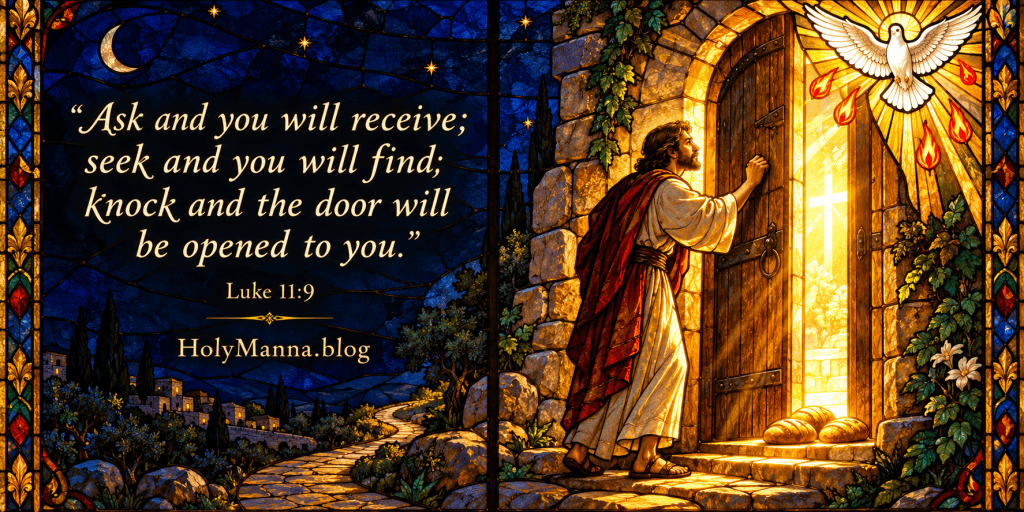
Verse 9: “And I tell you, ask and you will receive; seek and you will find; knock and the door will be opened to you.”
Three commands in ascending intensity, asking with the voice, seeking with the feet, knocking with the fist, and in the Greek they are continuous: keep asking, keep seeking, keep knocking. Prayer is a sustained way of life, not a single transaction.
Verse 10: “For everyone who asks, receives; and the one who seeks, finds; and to the one who knocks, the door will be opened.”
The promise is universal, “everyone,” with no fine print excluding the weak, the doubtful, or the lapsed. God refuses no one who sincerely approaches Him, though His answer may arrive in a form wiser than the request.
Verse 11: “What father among you would hand his son a snake when he asks for a fish?”
Jesus shifts from a grudging neighbor to a loving father. In Galilee, a water snake could resemble a fish; no father would exploit his child’s trust with a cruel imitation. God does not answer prayers with counterfeits.
Verse 12: “Or hand him a scorpion when he asks for an egg?”
A pale scorpion curled up could resemble an egg, and its sting could kill a child. The implication cuts both ways: God never gives what harms, which also means some unanswered prayers are refusals of hidden scorpions.
Verse 13: “If you then, who are wicked, know how to give good gifts to your children, how much more will the Father in heaven give the Holy Spirit to those who ask him?”
Here is the summit. Where The Gospel of Matthew records “good things,” Luke names the gift: the Holy Spirit, God’s own life. The argument runs from lesser to greater; if flawed human parents give well, how much more the Father whose giving has no flaw.
Teachings
The Catechism treats this parable directly. CCC 2613 teaches: “The first, ‘the importunate friend,’ invites us to urgent prayer: ‘Knock, and it will be opened to you.’ To the one who prays like this, the heavenly Father will ‘give whatever he needs,’ and above all the Holy Spirit who contains all gifts.” That final phrase settles a question every praying person eventually asks. When God seems to give something other than what was requested, He is not ignoring the prayer; He is answering it at the deepest level, with the Gift that contains all gifts.
Saint Augustine explains the delays. In the teaching preserved in CCC 2737, he writes: “God wills that our desire should be exercised in prayer, that we may be able to receive what he is prepared to give.” The waiting is not divine reluctance but soul-stretching, enlarging the heart until it can hold what God intends to pour in. And Saint Thérèse of Lisieux, Doctor of the Church, strips prayer of all intimidation in the definition quoted in CCC 2558: “For me, prayer is a surge of the heart; it is a simple look turned toward heaven, it is a cry of recognition and of love, embracing both trial and joy.” It is also worth remembering that Tertullian, writing in the early third century, called the Our Father truly the summary of the whole Gospel, a judgment the Church preserves in CCC 2761, which is why Jesus attaches this parable to that prayer as its living instruction manual.
Reflection
Most people quit praying for something just before the habit would have changed them. The parable’s challenge is not that God needs convincing but that hearts need forming, and persistence is the forge. A concrete way to live this Gospel is to choose one intention, perhaps a family member away from the faith, and commit to knocking daily for the next 30 days without evaluating results along the way. Another is to pray for the Holy Spirit by name each morning, since verse 13 reveals this as the one prayer the Father is most eager to answer; a simple “Come, Holy Spirit” before the feet hit the floor counts. Finally, imitate the midnight friend by interceding boldly for someone else’s need this week, bringing their emptiness to the only Door that always opens. What prayer have you quietly given up on, and what would shameless persistence look like if you took it up again? When you ask God for help, are you willing to receive the Holy Spirit as His answer?
Keep Knocking, the Father Is Already Awake
Put the three readings side by side and a single story emerges. Paul plants the flag: the Spirit is received through faith in the crucified Christ, never earned through performance, because grace by definition cannot be purchased. Zechariah supplies the proof from history. Through prophets, covenants, and an oath sworn to Abraham, God spent centuries promising to visit His people, and then He did, raising up a mighty Savior from the house of David. And Jesus hands over the practical consequence. Since the Father is faithful and His gifts are free, the only reasonable response is to ask, seek, and knock without shame and without quitting.
The day dismantles two opposite errors at once. The first error is the Galatian one, straining to earn what God longs to give. The second is the quiet fatalism that stops asking altogether, assuming heaven’s door is locked and the Householder annoyed. Today’s readings answer both: the door opens to faith, and faith keeps knocking.
So here is the invitation for October 8th. Pray the Our Father slowly today, the very prayer Jesus taught just before this Gospel scene. Bring one persistent intention back to God, especially the one that feels stale from repetition, and add to it the boldest request of all, the Holy Spirit Himself. Zechariah waited decades and sang anyway. The Galatians stumbled and were called back anyway. The friend knocked at midnight and walked home with his arms full anyway. The Father in heaven is not asleep, has never been asleep, and is already reaching for the bar on the door. Knock.
Engage With Us!
Readers are warmly invited to share their reflections in the comments below. Testimonies of answered prayers, seasons of waiting, and honest struggles with trust help build up this whole community of faith, and someone knocking at their own midnight may need exactly those words today.
- In Galatians 3:1-5, Saint Paul asks whether the Spirit came through works of the law or through faith in what was heard. Where in your own spiritual life have you slipped into trying to earn what God has already given freely?
- In Luke 1:68-75, Zechariah blesses the God who remembered His covenant and kept His oath to Abraham. Which promise of God do you most need to trust this season, and how can Zechariah’s story of silence turned to song encourage you?
- In Luke 11:5-13, Jesus promises that the Father will give the Holy Spirit to those who ask Him. What would change in your daily life if your most persistent prayer became a request for the Holy Spirit Himself?
- Taking all three readings together, the Father who keeps His promises gives His Spirit to those who ask in faith. How is God inviting you to stop striving, start trusting, and keep knocking this week?
Living a life of faith does not require perfection at the door; it requires showing up at the door. Keep asking with boldness, keep seeking with hope, and keep knocking with the confidence of a beloved child, and do everything with the love and mercy Jesus taught, so that holiness becomes not a performance for God but a life lived gratefully in His sight, all the days of your life.
Sacred Heart of Jesus, we trust in You!
Immaculate Heart of Mary, pray for us!
Saint Michael the Archangel, defend us in battle!
Follow us on YouTube, TikTok, Instagram and Facebook for more insights and reflections on living a faith-filled life.


Leave a comment