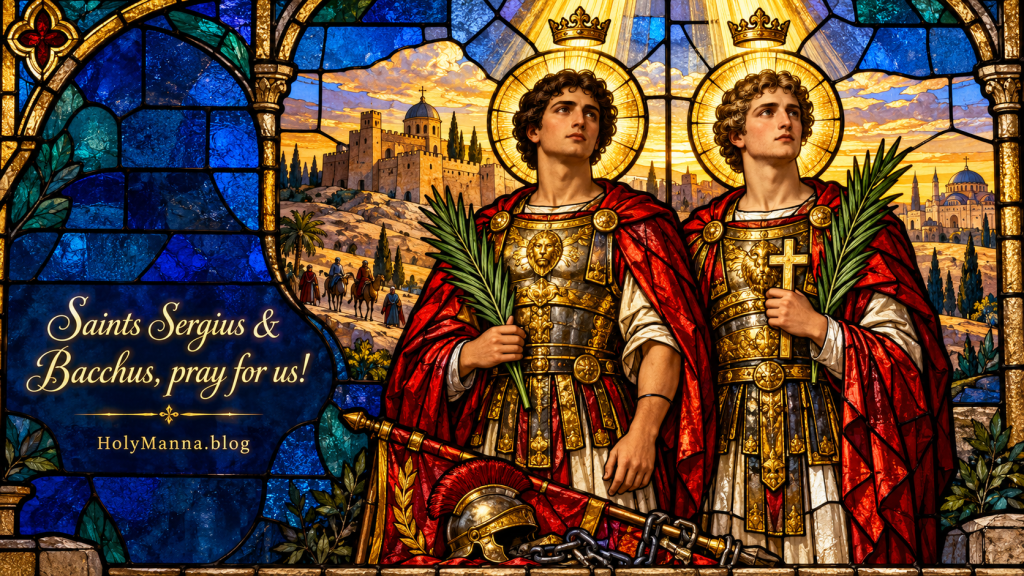
Two Soldiers, One Crown
On October 7th, the Roman Martyrology commemorates 2 of the most celebrated soldier saints in the history of the Church, Saints Sergius and Bacchus. They were officers of the Roman army on the Syrian frontier at the turn of the 4th century, men who wore the emperor’s uniform on the outside and carried Christ on the inside, until the day the two loyalties collided and they chose Christ at the cost of everything. Their witness made such an impression on the ancient world that an entire city grew up around the grave of Sergius, emperors built basilicas in their honor from Constantinople to Rome, and desert tribes rode hundreds of miles to pray at their shrine. Butler’s Lives of the Saints counts Sergius among the most glorious witnesses to Our Lord venerated in the East, and the East and West together have honored the pair for more than 1,500 years.
They matter today for a reason that speaks directly to anyone trying to live the faith in a skeptical world. Sergius and Bacchus were not monks or bishops. They were professionals, respected men with careers, rank, and the favor of the powerful, and they discovered that discipleship eventually presents a bill. The Catechism teaches that “martyrdom is the supreme witness given to the truth of the faith: it means bearing witness even unto death” (CCC 2473). These two friends paid that bill together, and the Church has never forgotten it.
Tradition honors them with real patronages. Sergius is invoked as a patron of Syria and of the Christian Arabs and desert nomads who loved him with extraordinary devotion, and together the two saints have long been honored as patrons of soldiers, having been venerated in the Byzantine Empire as protectors of the army.
Noble Romans on the Syrian Frontier
Honesty comes first at HolyManna, so this section begins with what the historical record actually holds. Nothing certain is documented about the birthplaces, families, childhoods, or conversions of Sergius and Bacchus. The ancient sources describe them simply as Roman citizens of noble rank. The Catholic Encyclopedia records that they served as officers of troops on the frontier of Coele-Syria, with Sergius holding the senior rank of primicerius and Bacchus serving as secundarius, and that they died in the great persecution around the year 303. The Roman Martyrology places their martyrdom in the province of Augusta Euphratensis under the Emperor Maximian, while the ancient account of their passion sets the story under Galerius; the sources conflict on this point, and that conflict deserves to be stated rather than smoothed over.
The main source for their story is a Greek text known as The Passion of Sergius and Bacchus. Scholars, including the Bollandist tradition of critical hagiography and researchers such as Pio Franchi de’ Cavalieri and David Woods, have shown that this text was likely composed in the mid-5th century, more than 100 years after the events it describes, and that it contains anachronisms, including a punishment scene that better matches the reign of Julian the Apostate decades later. What stands on much firmer ground is this: by the early 5th century, a shrine to Sergius already existed at Resafa in Syria, the veneration of the two martyrs was spreading like wildfire across the Christian East, and the whole ancient Church accepted without hesitation that these two soldiers had died for Christ. The Church has always been careful about exactly this distinction. The Catechism notes that “the Church has painstakingly collected the records of those who persevered to the end in witnessing to their faith” (CCC 2474), and where the records are thin, the honest move is to say so.
What can be said with confidence is that the 2 men were converts or children of converts living inside one of the most hostile environments imaginable for a Christian, the officer corps of the pagan Roman army. Military life was saturated with idolatry. Sacrifices to the gods, oaths sworn by the emperor’s genius, festivals of Jupiter; a soldier could scarcely get through a week without paganism being placed in front of him. For 2 believers to rise to high rank while keeping the faith of Jesus Christ alive in their hearts required a quiet, daily heroism that the sources never narrate but that the ending of their story proves.
Faith in the Barracks
Here is a striking fact about Sergius and Bacchus: no miracles are attributed to them during their lifetimes. No healings, no visions granted to crowds, no wonders in the desert. That absence is not a defect in their story; it is the point of their story. Their miracle was fidelity. They show every ordinary believer that a person does not need extraordinary gifts to become a saint, only an unbreakable attachment to Jesus Christ. Scripture itself describes the crown they were pursuing: “I have fought the good fight, I have finished the race, I have kept the faith. Henceforth there is laid up for me the crown of righteousness” (2 Timothy 4:7 to 8).
The traditional account, told here as tradition, relates that the two officers were favorites of the emperor himself, trusted men whose careers were secure as long as their faith stayed hidden. The moment of exposure came, the story goes, when the emperor went to offer sacrifice at the temple of Jupiter and required his entourage to accompany him inside. Sergius and Bacchus hung back. Envious men at court, the account continues, had already whispered that the two were Christians, and now the whisper looked true. Summoned and ordered to sacrifice to the idols, they answered that they honored the one true God and would worship Him alone. This story comes from the later Passion account and cannot be verified in its details.
Whatever the exact circumstances, the substance of their refusal is the historical core that the whole ancient Church accepted, and it is a refusal every Christian is called to make in some form. The Catechism teaches that “idolatry consists in divinizing what is not God” (CCC 2113), and it adds in the same paragraph that man commits idolatry whenever he honors a creature in place of God, whether that creature be power, pleasure, the state, or money. Sergius and Bacchus stood in a temple culture built on exactly those idols, career and empire and self-preservation, and they declined to bend the knee.
Their story also puts something beautiful on display that the modern world badly needs to see: a deep, holy friendship between 2 men, ordered entirely toward God. They served together, prayed together, suffered together, and are venerated together, always as a pair, in icon after icon standing side by side with Christ between them. The Church has a rich teaching here. The Catechism says that “the virtue of chastity blossoms in friendship” and that such friendship “represents a great good for all” (CCC 2347). Some modern writers have tried to reread this friendship through contemporary categories, most famously in a 1994 book by John Boswell, but scholars across confessional lines have found those claims unsupported by the ancient evidence; the oldest account never describes them as anything other than brothers in arms and brothers in Christ. Their bond is best understood exactly as the Church has always understood it, as the kind of friendship Our Lord Himself named the summit of love: “Greater love has no man than this, that a man lay down his life for his friends” (John 15:13).
Stripped of the Belt, Clothed in Christ
The traditional narrative of their martyrdom is one of the most vivid in the ancient martyr literature, and it should be received as what it is, a story handed down in the Passion account written generations later, wrapped around a historically certain death.
According to that tradition, the enraged emperor ordered the two officers publicly degraded. Their military belts were cut off, their gold torques and badges of rank stripped away, and, in a calculated attempt to shame 2 celebrated soldiers, they were dressed in women’s clothing and paraded in chains through the city streets while the crowds jeered. The account relates that the humiliation failed completely. The two walked through the mockery singing psalms, rejoicing that they had been found worthy to suffer something for Christ. The scene recalls the prayer of the psalmist that ancient tradition places on the lips of persecuted believers: “Rise up, come to our help! Deliver us for the sake of thy steadfast love!” (Psalm 44:26). This episode comes from the later Passion and cannot be verified; indeed, scholars note that this specific punishment better fits the practices of the Emperor Julian decades afterward.
The tradition continues that the emperor, unwilling to execute his former favorites himself, sent them east to Barbalissus on the Euphrates, to be tried by Antiochus, the military commander of the frontier, a man who owed his own career to Sergius’s patronage. Antiochus pleaded with them to save themselves. They refused. Bacchus was then scourged so savagely with rawhide thongs that he died under the blows, confessing the name of Jesus with his final breath. The Roman Martyrology, translated from the Latin, records that he was beaten until he gave up his spirit in the confession of Christ.
Then comes the most tender moment in the whole tradition. That night, the account relates, Sergius wavered. His friend was dead, his own tortures were coming, and he was alone. And Bacchus appeared to him, radiant, in the glory of heaven, urging him to persevere, promising that the reward ahead was worth every suffering and that they would soon be together again before the throne of God. One traditional rendering gives his words as “I am still with you in the bond of our union.” This vision and its words come from the Passion account and cannot be verified. Yet the theology inside the story is simply true, and Saint Paul preached it long before either man was born: “Who shall separate us from the love of Christ?” (Romans 8:35). Death does not dissolve the communion of the saints; the Catechism teaches that the union of the pilgrim Church with those in heaven “is in no way interrupted” by death but is “reinforced by an exchange of spiritual goods” (CCC 955).
Strengthened, Sergius endured what came. The tradition holds that his torturers fastened shoes to his feet with the soles studded with long sharp nails and forced him to run some 18 miles ahead of the commander’s chariot, driving the iron through his flesh at every step. The account adds that he ran praying, and that his wounds were found healed by morning, so he was made to run again. Finally, at the fortress town of Resafa in the Syrian desert, Sergius was beheaded, around the year 303 to 305, with the sources conflicting on the precise year. The nail-studded shoes and the miraculous overnight healing belong to the traditional Passion narrative and cannot be verified; the beheading at Resafa is the ancient and universal core of the tradition, anchored by the shrine that stood over his grave within living memory of the persecution era.
Why does the Church treasure even the unverifiable details? Because they were told and retold for a purpose, to teach what fortitude looks like. The Catechism defines it plainly: “Fortitude is the moral virtue that ensures firmness in difficulties and constancy in the pursuit of the good”, and it adds that this virtue “enables one to conquer fear, even fear of death, and to face trials and persecutions” (CCC 1808). Sergius and Bacchus became, for a thousand years of Christians facing their own trials, the picture of that virtue in uniform.
The City That Grew Around a Grave
What happened after their deaths is where tradition gives way to hard, datable history, and the history is astonishing. By around the year 425, a shrine to Sergius stood at Resafa, and the city itself was renamed Sergiopolis, the city of Sergius. Around 431, Alexander, the metropolitan of Hierapolis, restored and enlarged the church over the martyr’s grave, and Resafa became a bishop’s see. In 518 the humble mudbrick shrine was replaced by a great stone basilica, and pilgrims began arriving in numbers that turned a remote desert garrison into one of the greatest pilgrimage centers of the entire Christian East. The Roman Martyrology itself, translated from the Latin, notes that the city where Sergius died was frequently honored by the visits of Christians because of the splendid miracles worked there. Those miracles of healing and protection were reported by pilgrims across centuries; the individual accounts were not formally documented in ways that can be verified today, and that is stated here plainly, but the tide of pilgrims they drew is a matter of historical record.
The devotion reached the highest thrones on earth. The Emperor Justinian I fortified Sergiopolis, raised it to an archdiocese, and built churches in honor of Sergius at Acre and at Constantinople, where the exquisite Church of Saints Sergius and Bacchus, later called the Little Hagia Sophia, still stands as one of the jewels of Byzantine architecture. A story attaches to that church: it holds that when Justinian was a young man, condemned under his uncle the Emperor Justin I on suspicion of treason, Saints Sergius and Bacchus appeared to Justin in a dream and vouched for the young man’s innocence, and that the grateful Justinian built the church in thanksgiving after he came to the throne. This story cannot be verified.
Even more remarkably, devotion to Sergius leapt across the borders of the Roman world. Al-Mundhir, king of the Ghassanids, the great Christian Arab confederation of the Syrian desert, patronized the shrine, and the nomadic tribes of the region took Sergius as their special patron, riding to Sergiopolis on pilgrimage for generations. Most astonishing of all, Khosrau II, the Persian king of kings and a pagan Zoroastrian, sent rich gifts, including a golden cross, to the shrine of Sergius in thanksgiving for favors he attributed to the saint, a gesture recorded by the Byzantine historians of his own era. A Roman soldier’s grave had become a place where empires that were at war with each other knelt at the same tomb.
The West embraced the martyrs just as warmly. Rome has had a church of Saints Sergius and Bacchus since the 7th century, and at one time 4 churches in the city bore their names. In Gaul, the abbey of Saint-Serge at Angers testified to the devotion of the Frankish kings. In Egypt, the ancient Abu Serga church in Coptic Cairo, dating to the 7th century, honors the two martyrs and is built, according to tradition, over a cave where the Holy Family rested during the flight into Egypt; that tradition about the Holy Family cannot be verified. Their feast was kept on October 7th in the West for centuries; in 1716 that date became the feast of Our Lady of the Rosary and their commemoration was moved to October 8th, and in the calendar reform of 1969 their commemoration was restored to October 7th in the Roman Martyrology, where they remain today while the universal Church celebrates the Memorial of Our Lady of the Rosary on the same date. Christian art has always shown them as they lived and died, 2 soldiers in military dress, side by side, carrying the palms of martyrdom.
All of this is the communion of saints made visible in stone and pilgrimage road. The Catechism explains why the Church does this: “It is not merely by the title of example that we cherish the memory of those in heaven; we seek, rather, that by this devotion to the exercise of fraternal charity the union of the whole Church in the Spirit may be strengthened” (CCC 957). The veneration of the relics of the martyrs is itself named by the Catechism among the treasured expressions of the Church’s piety (CCC 1674).
Carrying the Crown Into Monday Morning
Sergius and Bacchus were, in modern terms, successful professionals. They had careers, security, the respect of colleagues, and the favor of the boss. Their faith cost them nothing at all, right up until the day it cost them everything. That is precisely why their story belongs to every believer sitting in an office, a classroom, a barracks, or a group chat today. Most Christians in the West will never face an executioner, but nearly all will face the smaller versions of that temple of Jupiter: the meeting where staying silent about the faith is easier, the joke that mocks what is holy, the policy that quietly asks for a small betrayal of conscience, the relationship where being known as a serious Catholic feels like a liability. The Catechism insists that the duty of witness is not optional: “The duty of Christians to take part in the life of the Church impels them to act as witnesses of the Gospel”, and it teaches that situations arise that require the witness of faith to be given unequivocally (CCC 2472). Where in daily life has faith quietly been kept hidden, the way two officers once kept theirs hidden in the emperor’s court?
Their story also asks something harder and sweeter: an examination of friendship. Bacchus did not merely die beside Sergius; tradition holds that even from heaven he came back to strengthen his friend for holiness. That is the true measure of any friendship, whether it carries both people toward God or away from Him. Our Lord promised, “And do not fear those who kill the body but cannot kill the soul” (Matthew 10:28), and it is far easier to live that fearlessness with a brother or sister in the faith at one’s side. Which friendships in your life make courage for Christ easier, and which ones make it harder? A practical resolution flows straight from their example: find one companion in the faith and become spiritual allies on purpose. Go to Mass together, take on a devotion together, hold each other accountable in confession and in charity. Sanctity was never meant to be a solo mission.
Finally, they teach perseverance under humiliation. The tradition says their enemies tried to make them ridiculous before killing them, and that the mockery bounced off men whose identity was hidden with Christ in God. In an age where public shaming is a recreational sport, that serenity is worth imitating. When mockery comes because of the faith, is the first instinct to shrink back, or to keep walking and keep singing? Small daily practices build that spine: a visible sign of the cross before meals in public, an honest answer when asked about weekend plans that include Mass, a calm refusal to laugh at what degrades the sacred. Fortitude, like any muscle, grows by repetition (CCC 1808).
Engage With Us!
The story of Saints Sergius and Bacchus has been strengthening believers for 17 centuries, and now it is your turn to wrestle with it. Share your thoughts, your questions, and your own experiences of costly faith and holy friendship in the comments below; this community grows stronger every time someone speaks honestly about walking with Christ.
- What is the “temple of Jupiter” in your own life, the place where the pressure to conform quietly asks you to leave Christ at the door?
- Who is the Bacchus to your Sergius, the friend who strengthens you to persevere, and have you ever told that person what their friendship means to your faith?
- Tradition says the two saints sang psalms while being publicly humiliated. How do you typically respond when your faith is mocked, and what would responding with peace look like?
- Sergius and Bacchus achieved holiness without performing a single recorded miracle in life. Does that make sainthood feel more possible for you, and why?
- Pagan kings and desert nomads alike were drawn to the tomb of a faithful soldier. Whose faithfulness first drew you toward Christ, and who might be watching yours?
Take heart from these two soldiers of Christ. Heaven is not reserved for those with spectacular gifts; it is promised to those who stay faithful when fidelity finally costs something, and who love their friends all the way home. Live this week with their courage. Speak the truth gently, stand firm cheerfully, and build friendships that point to eternity, doing everything with the love and mercy that Jesus taught us.
Saints Sergius and Bacchus, pray for us!
Follow us on YouTube, TikTok, Instagram and Facebook for more insights and reflections on living a faith-filled life.


Leave a comment