The Girl Beneath the Eight Domes
Walk to the southern edge of Padua’s great oval piazza, the Prato della Valle, and an enormous church rises before you, crowned with eight domes and stripped of almost all exterior decoration, as if the building itself were practicing humility. This is the Basilica of Santa Giustina, one of the largest churches in Christendom, and beneath its high altar rests a young woman who was killed with a Roman short sword around the year 304. Her name is Justina, and for roughly seventeen centuries the city of Padua has refused to forget her.
Saint Justina of Padua, celebrated on October 7th, is a virgin and martyr of the early Church, one of the countless young Christians who chose death over apostasy during the last and fiercest of the Roman persecutions. She holds real and formally documented patronages. She is the principal patroness of the city of Padua. After Saint Mark the Evangelist, she is honored as the second patroness of Venice, a title the Venetian Republic took so seriously that it stamped her image on its coinage. She is also the patroness of the fortress city of Palmanova and of the town of Santa Giustina in the Veneto, which bears her name.
Her story sits at a fascinating crossroads of history and tradition. The Church has venerated her since Christian antiquity; a basilica stood over her tomb within about two centuries of her death, and one of the great Christian poets of the sixth century told pilgrims to go and kiss her sepulchre. At the same time, the detailed written accounts of her life came much later and cannot be verified. A faithful telling of her story, then, has to do two things at once. It has to honor the ancient and unbroken witness of the Church that a real young woman really died for Christ at Padua, and it has to be honest about which details are documented history and which are later tradition. The Catechism of the Catholic Church teaches that “Martyrdom is the supreme witness given to the truth of the faith: it means bearing witness even unto death” (CCC 2473). That supreme witness, not the decoration around it, is the heart of Justina’s story.
A Daughter of Roman Padua
The documented core of Saint Justina’s life is brief and sobering. She was a young Christian woman of Padua, in what was then the Roman city of Patavium in northern Italy, and she was put to death for the faith during the great persecution, most commonly dated around the year 304 under the emperor Diocletian. Some older accounts give the year 303, and a minority strand of the tradition, recorded by Alban Butler in The Lives of the Saints, places her death far earlier, under Nero. The weight of the sources favors the Diocletianic persecution, and honesty requires saying that the exact year cannot be fixed with certainty.
Everything beyond that core comes from her Acts, written centuries after her death, and from medieval documents of uncertain reliability, including one document from 1117 that scholars regard as a forgery. So the fuller biography that follows must be received as tradition, told as the Church of Padua has lovingly told it, rather than as verified history.
According to that tradition, Justina was born into one of the noblest families of Padua. Her father, Vitalian, is described as a wealthy nobleman and the Prefect of the city. The tradition adds a tender detail: her parents had long been unable to have children, and after they were converted to Christianity by the preaching of Saint Prosdocimus, remembered as the first bishop of Padua, they prayed earnestly for a child. Justina, the story says, was given to them as the answer to that prayer. A child of prayer became, in time, a witness unto blood. This account of her family and birth cannot be verified.
The same tradition holds that Prosdocimus himself instructed Justina in the faith and baptized her, and the Roman Martyrology preserves exactly this memory in its entry for October 7th: “At Padua, Saint Justina, Virgin and Martyr, who was baptized by blessed Prosdocimus, a disciple of Saint Peter. Because she persisted with constancy in the faith of Christ, she was ordered by the prefect to be slain with the sword, and so went to the Lord.” Here the honest storyteller has to pause. Saint Prosdocimus, as a disciple of Saint Peter sent from Antioch, would have died around the year 100. A young woman martyred in 304 could not have been baptized by him. The tradition linking them is chronologically impossible as written, and serious Catholic scholarship, including the Bollandist tradition of critically examining the lives of the saints, has long recognized this. What the tradition is really doing is theological rather than chronological. By binding Justina to Prosdocimus, and through him to Peter, the Church of Padua was professing that its martyr belonged to the one apostolic faith, the Church that the Catechism describes when it says the Church “is apostolic because she is founded on the apostles” (CCC 857). The link is a confession of communion, even though it cannot be true as a historical timeline, and it should be told as such.
What the tradition consistently affirms about her youth is this: from her earliest years Justina gave herself wholly to God, and she consecrated her virginity to Christ by a vow. This detail, whatever its documentation, places her squarely within one of the most ancient and beautiful vocations in the Church. The Catechism teaches that “From apostolic times Christian virgins and widows, called by the Lord to cling only to him with greater freedom of heart, body, and spirit, have decided with the approval of the Church to live in the respective status of virginity or perpetual chastity ‘for the sake of the Kingdom of heaven’” (CCC 922). Justina stands in the same line as Agnes, Agatha, Lucy, and Cecilia, the virgin martyrs whom the early Church cherished above almost all others, because in them two total gifts of self met in a single life: virginity offered to Christ, and life itself offered for Christ.
A Hidden Life Poured Out for Prisoners
The sources record no miracles worked by Justina during her lifetime, and none will be invented here. What the tradition records instead is something quieter and, in its own way, just as supernatural: charity under pressure.
By the opening years of the fourth century, the Roman Empire had turned on the Church with a fury it had never shown before. The edicts of Diocletian ordered churches destroyed, Scriptures burned, clergy imprisoned, and Christians everywhere compelled to sacrifice to the gods of Rome. In Padua, according to Justina’s Acts, the persecution was pressed by the prefect who had succeeded her father, a man the Acts name Maximian, though the Roman Martyrology tradition renders the persecutor’s name as Maximus. That small discrepancy between sources is worth flagging rather than smoothing over, and it is a reminder of how late and uneven the written accounts are.
Into this danger, the tradition says, Justina walked freely. While other Christians of rank kept their heads down, she went to the prisons of Padua to visit the believers held there, to comfort them, to encourage them to stand firm, and to strengthen them for whatever was coming. This account of her prison visits cannot be verified, but it deserves telling, because it captures why the Church holds her up. She was doing, at mortal risk, exactly what Our Lord identified as service rendered to Himself: “I was in prison and you came to me” (The Gospel of Matthew, Mt 25:36). The Catechism lists visiting the imprisoned among the corporal works of mercy, teaching that “The works of mercy are charitable actions by which we come to the aid of our neighbor in his spiritual and bodily necessities” (CCC 2447).
Why should a reader in the twenty-first century remember and emulate this young woman? Because her sanctity was not exotic. She performed no recorded wonders, founded no order, wrote no books. Her holiness consisted of a consecrated heart, hidden fidelity, and courageous love for suffering members of the Body of Christ, right up until that love cost her everything. Most Christians will never be asked for their blood. Every Christian is asked, daily, for exactly the kind of quiet, deliberate, risk-taking charity the tradition remembers in Justina. The Catechism insists that this call is universal: “All Christians in any state or walk of life are called to the fullness of Christian life and to the perfection of charity” (CCC 2013). Justina’s life during her few years on earth was simply that teaching, lived early and lived completely.
The Bridge, the Tribunal, and the Sword
The account of her arrest and death comes from her Acts and must be told as tradition; the fact of her martyrdom itself, however, is the ancient and constant testimony of the Church of Padua.
According to the traditional account, Justina’s visits to imprisoned Christians did not go unnoticed. The prefect ordered her arrest, and soldiers seized her as she was crossing a bridge near Padua, remembered in the sources as the Pont Marin. Brought before the prefect’s tribunal, she faced a scene the acts of the martyrs describe again and again across the empire. Her judge, struck by her youth, beauty, and noble rank, first tried persuasion rather than force. Flattery, promises, and appeals to her family’s standing were deployed to coax from her one small gesture: an offering to the gods of Rome. Later tellings specify the demand as sacrifice to Minerva or to Mars, and the sources do not agree on which, another sign of how the details grew in the telling.
She refused. However the dialogue actually went, and no verified words of Justina survive, so none will be put in her mouth here, her answer was the answer of every martyr: worship belongs to God alone. The Church teaches precisely what was at stake in that refusal. “Idolatry consists in divinizing what is not God” (CCC 2113), and the first commandment admits no exceptions for convenience or survival. The Catechism also teaches that the duty of witness binds the disciple even at the ultimate price: “The duty of Christians to take part in the life of the Church impels them to act as witnesses of the Gospel and of the obligations that flow from it. This witness is a transmission of the faith in words and deeds” (CCC 2472). Justina understood what many comfortable believers forget, that Our Lord attached a promise and a warning to public fidelity: “Every one who acknowledges me before men, I also will acknowledge before my Father who is in heaven; but whoever denies me before men, I also will deny before my Father who is in heaven” (The Gospel of Matthew, Mt 10:32 to 33).
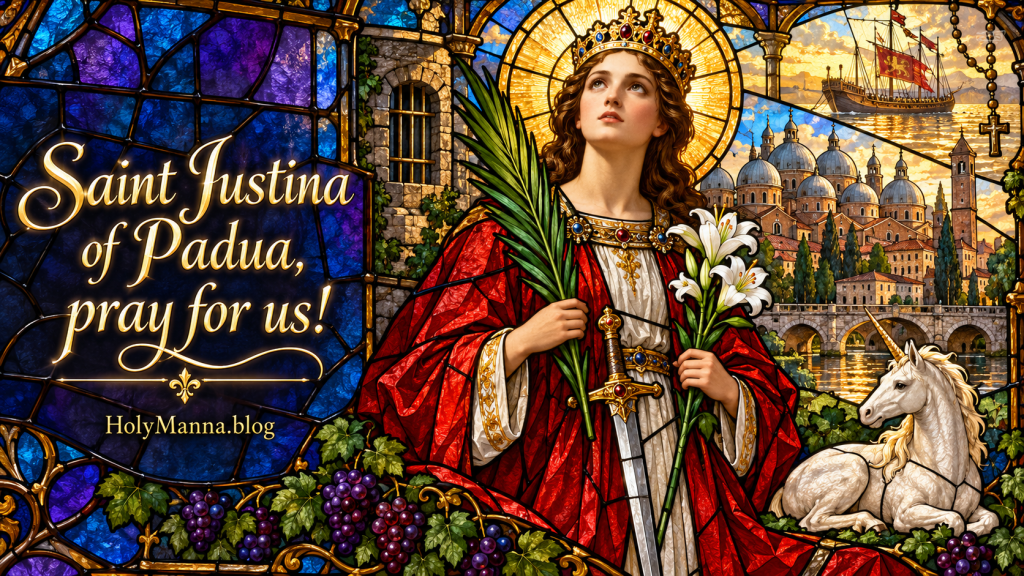
When persuasion failed, the sentence came. The tradition holds that Justina was led out to the Campus Martius, the old Roman field of Mars on the edge of Padua, and there a soldier drove a gladius, the Roman short sword, into her breast. She was not beheaded; the sword through the heart became her mark. The traditional accounts place her death around the year 304 and record that her body was buried in a Christian cemetery near the Roman theater called the Zairo, on the very ground where her basilica stands today. The details of the arrest at the bridge, the tribunal, and the manner of execution come from her unverified Acts, and that cannot be stated too plainly. What is not in doubt is what the Church has professed about her from antiquity: a virgin named Justina persevered in the faith of Christ at Padua and was slain with the sword, and in that moment she received what Our Lord promised in The Book of Revelation: “Be faithful unto death, and I will give you the crown of life” (Rev 2:10). The Catechism explains why the Church treasures such deaths rather than mourning them as defeats: the martyr “bears witness to Christ who died and rose, to whom he is united by charity” (CCC 2473). A seventeen-centuries-long devotion began at the point of that sword.
Seventeen Centuries Over a Tomb
If the written accounts of Justina’s life are late, the evidence of her cult is astonishingly early, and this is where her story becomes historically solid ground.
By the 520s, barely two centuries after her death, a church dedicated to Justina and to the other early Christian martyrs of Padua already stood over her burial place, built under the patronage of a Roman official named Opilius and housing her relics. In the sixth century her fame had spread far beyond the Veneto. She appears among the virgin martyrs depicted in the presbytery arch of the Euphrasian Basilica at Poreč and in the great mosaic procession of virgins at Sant’Apollinare Nuovo in Ravenna, some of the most celebrated Christian art of that age. In the same century, Venantius Fortunatus, the poet who would end his days as a bishop in Gaul, ranked her among the most illustrious holy virgins of the whole Church, writing, in Butler’s rendering, that her name “makes Padua illustrious” just as Euphemia glorifies Chalcedon and Eulalia the city of Mérida. In his poem on the life of Saint Martin, Fortunatus urged travelers bound for Padua to “kiss the sacred sepulchre of the blessed Justina.” When a sixth-century bishop and poet is directing pilgrims to a martyr’s tomb, the historian can be confident the martyr is no invention.
Her tomb then gathered a monastic city around itself. By the tenth century, monks were serving the pilgrims who streamed to the relics, and in 971 the Bishop of Padua placed the community under the Rule of Saint Benedict. In 1174, during excavations after an earthquake and rebuilding, the monks rediscovered the remains of their patroness, and in 1177 they found remains venerated as those of Saint Luke the Evangelist, which the abbey guards to this day. The tradition attached to her cemetery holds that the relics of several other martyrs who suffered with her were also found there, a story preserved in her Acts and those of Saint Prosdocimus which cannot be verified. In 1502 her relics were solemnly placed beneath the high altar of the new church, where they remain.
No catalogue of individually named healing miracles at her tomb has come down through the major sources, and so none will be invented; the enduring miracle the sources actually document is the tomb’s magnetism itself, fifteen centuries of pilgrims, monks, and saints drawn to the grave of a teenage girl. The Church is unembarrassed by this devotion, because it flows from the communion of saints. The Catechism teaches of those in heaven that “They do not cease to intercede with the Father for us, as they proffer the merits which they acquired on earth through the one mediator between God and men, Christ Jesus” (CCC 956), and that our communion with them “unites us to Christ, from whom as from its fountain and head issues all grace” (CCC 957).
From Justina’s abbey came one of the great reform movements in Benedictine history. In the early fifteenth century, with Butler dating the settlement of the reform to 1417 and other sources tracing its beginning to Abbot Ludovico Barbo from 1409, a renewal of monastic observance took root at Santa Giustina and spread across Italy as the Congregation of Saint Justina of Padua. When the mother abbey of Monte Cassino itself joined the reform, Pope Julius II transferred the headship there, and the movement became the Cassinese Congregation, with Justina’s monastery honored as second in rank. A martyred girl of Padua thus became, centuries after her death, the namesake of a reform that renewed the sons of Saint Benedict.
Beginning in 1501 the church was magnificently rebuilt into the vast basilica that stands today, its eight domes rising over the Prato della Valle, its chapels holding the tombs of Prosdocimus, Maximus, Urius, Felicitas, and Julian, along with relics venerated as those of the Apostle Matthias and the Evangelist Luke. Paolo Veronese painted his monumental Martyrdom of Saint Justina for its high altar. Napoleon suppressed the abbey in 1810; the monks returned, and the monastery was reopened in 1919, and Benedictine life continues there now.
Then there is Venice, and the sea. On October 7th, 1571, the fleet of the Holy League, assembled under Pope Saint Pius V, met and shattered the Ottoman fleet at Lepanto. The Church attributes that deliverance above all to Our Lady, invoked through the Rosary, which is why October 7th is now the Memorial of Our Lady of the Rosary. But the Venetians, whose galleys bore so much of the battle, did not fail to notice that the victory fell on the feast of Justina. Her devotion in Venice soared. She was honored, after Saint Mark, as the second patroness of the Republic; her image was stamped on Venetian coinage; and Girolamo Campagna’s statue of Justina was set over the door of the Venetian Arsenal, so that every warship of the Republic thereafter was built beneath her gaze. In the countryside of the Veneto her feast marked the end of the grape harvest and the customary day for settling agricultural contracts, so that even the rhythms of farm and vineyard turned on her name. In art she is everywhere in northern Italy: crowned as a princess with the sword transfixing her breast, holding the martyr’s palm, or accompanied by a unicorn, the old symbol of virginity, in paintings by Mantegna, Moretto da Brescia, Veronese, and many others.
What a 4th Century Teenager Asks of You
It would be easy to file Justina away as a beautiful, distant figure in a mosaic. She deserves better, and honestly, so do you. Her life presses at least three questions into the present.
First, her consecration. Justina decided early that God would have all of her, and she arranged her whole life around that decision before any crisis arrived. The martyrs did not improvise their courage at the tribunal; they had already given everything away long before. The same principle holds for every state of life, because “All Christians in any state or walk of life are called to the fullness of Christian life and to the perfection of charity” (CCC 2013). What decision about belonging wholly to God are you postponing until some imagined quieter season of life?
Second, her charity. The tradition remembers her not at prayer in a safe villa but in the prisons, with the frightened and the condemned. Visiting the imprisoned, feeding the hungry, and comforting the afflicted are not extra credit; they are corporal works of mercy, the ordinary family business of the Church (CCC 2447). Someone within reach is imprisoned right now, whether behind bars, inside an illness, in an addiction, or in loneliness. Who is the imprisoned person God has placed within your reach, and what would it cost you to go to them this week?
Third, her refusal. Justina died because she would not perform one small public gesture that everyone assured her meant nothing. The modern world rarely demands incense to Minerva, but it constantly proposes small apostasies: the joke joined, the conviction hidden, the silence kept, the profile carefully scrubbed of anything too Catholic. Our Lord’s words remain exactly as He spoke them: “Every one who acknowledges me before men, I also will acknowledge before my Father who is in heaven” (Mt 10:32). Where in your daily life are you quietly being asked to offer the pinch of incense, and what would faithfulness look like there instead?
Practical ways to weave her witness into ordinary days are close at hand. Keep her feast on October 7th by praying the Rosary, uniting the martyr of Padua with Our Lady of the Rosary, whose day it is. Perform one deliberate work of mercy in her honor, especially toward someone isolated or confined. Make one small, visible act of Catholic identity this week, a blessing prayed openly before a meal, a truthful word spoken with charity, and offer it through her intercession. And when courage runs thin, remember that the Church does not merely admire her; it asks her help, because “They do not cease to intercede with the Father for us” (CCC 956).
Engage With Us!
Saint Justina’s story has been carried for seventeen centuries by people who talked about her, prayed with her, and handed her on. Keep that chain going: share your thoughts and reflections in the comments below. Which part of her story struck you, and where did it meet your own life?
To spark the conversation, consider these questions:
- Justina’s courage at the tribunal grew out of a hidden life already given to God. What daily habit of prayer could you begin now, so that your faith is ready before it is tested?
- The tradition remembers her visiting Christians in prison at the risk of her life. Who in your life is “imprisoned” by illness, loneliness, addiction, or actual incarceration, and what concrete step could you take toward them this month?
- Justina refused a small public gesture of idolatry that would have saved her life. What small compromises of faith feel harmless in your world, and how might you lovingly refuse one of them?
- Her cult is ancient even though many details of her story cannot be verified. How does the difference between documented history and pious tradition affect, or strengthen, your own devotion to the saints?
- Venice saw the victory at Lepanto on her feast day and responded with public gratitude. When God has delivered you from something, how have you thanked Him publicly, and how could you?
Saint Justina was young, and she gave everything. You do not need a Roman tribunal to do the same; you need only today, offered whole. Live this day, and every day, with the love and mercy that Jesus taught us, acknowledging Him before others in word and deed, serving Him in the imprisoned and the forgotten, and trusting that the God who crowned a girl of Padua sees every hidden fidelity of yours.
Saint Justina of Padua, Virgin and Martyr, pray for us!
Follow us on YouTube, TikTok, Instagram and Facebook for more insights and reflections on living a faith-filled life.


Leave a comment