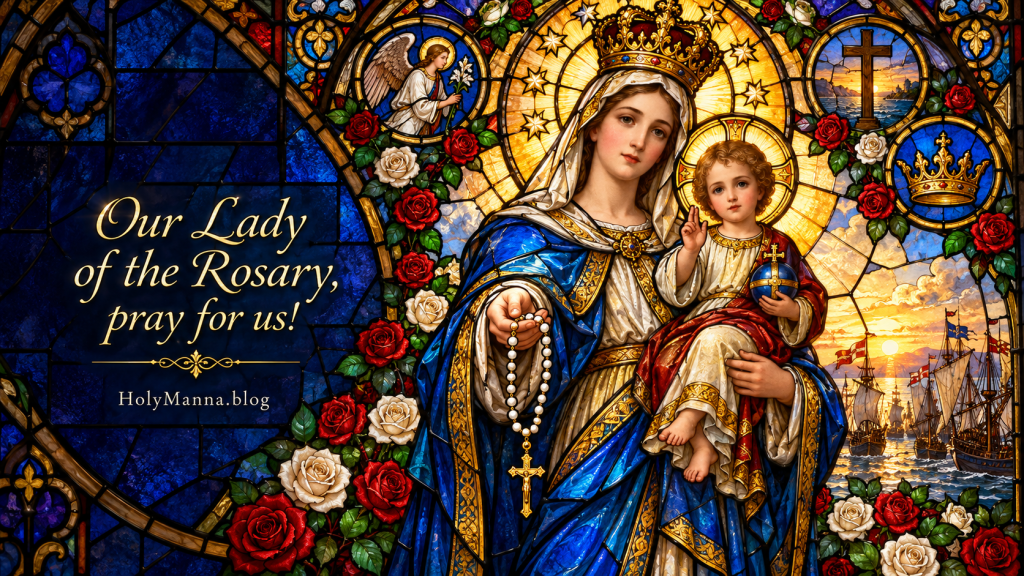
When the Whole Church Prayed the Rosary
Every year on October 7th, the universal Church keeps the Memorial of Our Lady of the Rosary, a celebration with one of the most dramatic origin stories on the entire liturgical calendar. It was born in 1571, in the smoke and chaos of a naval battle that historians consider a turning point in Western history, and it has grown across more than 4 centuries into a worldwide celebration of the prayer that popes, saints, and ordinary believers have clung to in every storm. This Memorial is not simply about a string of beads. It is about what happens when the people of God pray with the persistence of children who trust their Mother.
The Catechism of the Catholic Church describes the rosary as “an epitome of the whole Gospel” (CCC 971, quoting Marialis Cultus 42). That single phrase explains why this celebration stands so close to the heart of Marian devotion. The rosary is not a prayer that sits alongside the Gospel; it is the Gospel, prayed. Decade by decade, the faithful walk through the Annunciation, the Nativity, the public ministry, the Passion, the Resurrection, and the glory of Christ, all while holding the hand of the woman who lived those mysteries first and, as The Gospel of Luke says, “kept all these things, pondering them in her heart” (Luke 2:19).
October 7th also reveals something essential about Mary’s place in the life of the Church. She is not a distant queen collecting honors. She is a mother in action, an intercessor whose prayers accompany her children through every danger, whether that danger is an enemy fleet in the Gulf of Patras or the quiet anxieties that keep a young professional awake at 2 in the morning. The Church teaches that Mary, taken up to heaven, “did not lay aside this saving office but by her manifold intercession continues to bring us the gifts of eternal salvation” (CCC 969, quoting Lumen Gentium 62). The Memorial of Our Lady of the Rosary celebrates that ongoing motherhood, and it places into every believer’s hands the very prayer through which her intercession has been sought for centuries.
The Road to Lepanto
The story of this celebration begins in the 16th century, in a Europe that felt its future slipping away. The Ottoman Empire had taken Constantinople in 1453 and had been advancing by land and sea ever since. In 1570 Ottoman forces invaded Cyprus, and by August of 1571 the fortress city of Famagusta had fallen after a long siege. The Mediterranean, the highway of Christian trade, pilgrimage, and communication, stood in real danger of becoming an Ottoman lake, and Rome itself feared invasion.
Pope St. Pius V, a Dominican friar who had prayed the rosary his whole religious life, responded on 2 fronts. Diplomatically, he forged the Holy League, an alliance of Spain, Venice, Genoa, the Papal States, and the Knights of Malta, placing the combined fleet under the command of Don Juan of Austria, a leader only 24 years old. Spiritually, he called on the whole of Europe to storm heaven. He asked the faithful to pray the rosary for the success of the fleet, and the Confraternity of the Rosary in Rome held solemn processions of intercession. Aboard the ships themselves, chaplains led soldiers and rowers in the rosary as the fleets closed in on one another.
On October 7th, 1571, near the port of Lepanto in the Gulf of Patras, hundreds of galleys collided in one of the largest naval battles the world had ever seen. After hours of brutal fighting, the Holy League won a decisive victory, and Ottoman naval dominance in the Mediterranean was broken. A cherished tradition, passed down in early accounts of the pope’s life, holds that Pius V, in the middle of a meeting in Rome that very afternoon, rose suddenly, went to a window, and announced that the Holy League had triumphed, long before any courier could have arrived with the news. That account is presented here as tradition rather than documented fact, since messengers did not reach Rome for roughly 2 weeks; what is certain is that the pope attributed the victory not to cannons but to the Queen of Heaven.
In thanksgiving, Pius V established a commemoration of Our Lady of Victory. Pope Leo XIII later recalled in Supremi Apostolatus Officio that Pius V “desired that a feast in honor of Our Lady of Victories should celebrate the anniversary of so memorable a struggle, the feast which Gregory XIII dedicated under the title of ‘The Holy Rosary’” (Supremi Apostolatus Officio 6). Gregory XIII assigned the celebration in 1573 to the first Sunday of October for churches possessing a rosary altar or confraternity. Clement X extended it to all of Spain, and Clement XI, after another victory over Ottoman forces at Peterwardein on August 5th, 1716, extended it to the universal Church. St. Pius X restored the celebration to October 7th itself in 1913, and the reform of the liturgical calendar in 1969 gave it the title used today, Our Lady of the Rosary, with the rank of Memorial.
From Dominic’s Preaching to Fatima’s Final Word
Long before Lepanto, tradition already connected the rosary to a heavenly gift. According to a beloved tradition, Our Lady entrusted the rosary to St. Dominic in the early 13th century as a spiritual weapon against the Albigensian heresy. The Church has never issued a formal historical judgment verifying this account, and the documented record shows the prayer developing gradually, as ordinary believers prayed 150 Hail Marys in imitation of the 150 psalms, a practice the Catechism recalls when it notes that “medieval piety in the West developed the prayer of the rosary as a popular substitute for the Liturgy of the Hours” (CCC 2678). Yet the tradition of St. Dominic carries real truth about the Dominican Order’s tireless role in spreading the prayer, and the popes themselves have honored it. The 15th century Dominican friar Alan de la Roche preached it across Europe, and St. Pius V wrote in his bull Consueverunt Romani Pontifices of September 17th, 1569 that “Dominic looked to that simple way of praying and beseeching God, accessible to all and wholly pious, which is called the Rosary, or Psalter of the Blessed Virgin Mary” (Consueverunt Romani Pontifices).
In the modern era, approved apparitions have placed the rosary at the center of Mary’s own requests. At Lourdes in 1858, the Lady who appeared 18 times to St. Bernadette Soubirous carried a rosary on her arm and let its beads pass through her fingers while Bernadette prayed; Bishop Bertrand-Sévère Laurence declared the apparitions worthy of belief on January 18th, 1862. This apparition is approved by the Church.
At Fatima in 1917, Mary appeared 6 times to Lúcia dos Santos and her cousins Francisco and Jacinta Marto, from May 13th to October 13th, and in every single apparition she asked for the daily rosary, begging prayer and penance for peace while the First World War devoured a continent. In the final apparition, before a crowd estimated at 70,000 people who then witnessed the Miracle of the Sun, she revealed her name: “I am the Lady of the Rosary”. Bishop José Alves Correia da Silva of Leiria declared the apparitions worthy of belief on October 13th, 1930. This apparition is approved by the Church, and Francisco and Jacinta were canonized on May 13th, 2017.
More recently, apparitions reported from 1983 at San Nicolás, Argentina, under the title Mary of the Rosary of San Nicolás, were declared worthy of belief by Bishop Héctor Cardelli on May 22nd, 2016. This apparition is approved at the diocesan level.
Every one of these events remains private revelation, non-binding on the faithful. The Catechism teaches that “it is not their role to improve or complete Christ’s definitive Revelation, but to help live more fully by it in a certain period of history” (CCC 67). What is striking is their consistency. Across centuries and continents, when the Mother of God speaks, she asks for the rosary, and she points beyond herself to her Son, just as she did at Cana: “Do whatever he tells you” (John 2:5).
A Compendium of the Gospel on a String of Beads
Some people, especially those returning to the faith, wonder whether the rosary gives Mary too much attention or reduces prayer to repetition. St. John Paul II answered both worries in his apostolic letter Rosarium Virginis Mariae of October 16th, 2002, where he taught that the rosary, “though clearly Marian in character, is at heart a Christocentric prayer” (Rosarium Virginis Mariae 1). He put it even more simply: “To recite the Rosary is nothing other than to contemplate with Mary the face of Christ” (Rosarium Virginis Mariae 3). And he described what happens to the person who perseveres in it: “With the Rosary, the Christian people sits at the school of Mary and is led to contemplate the beauty on the face of Christ and to experience the depths of his love” (Rosarium Virginis Mariae 1). In that same letter he added the 5 Luminous Mysteries on Christ’s public ministry and proclaimed a Year of the Rosary from October of 2002 to October of 2003.
The prayer is built from Scripture itself. The first half of the Hail Mary joins the greeting of the angel Gabriel, “Hail, full of grace, the Lord is with you” (Luke 1:28), to the Spirit-filled cry of Elizabeth, “Blessed are you among women, and blessed is the fruit of your womb!” (Luke 1:42). The Our Father comes from the lips of Christ himself in The Gospel of Matthew (Matthew 6:9-13), and every mystery is a Gospel scene. This is why the Catechism lists the rosary among the great forms of Christian meditation: “Christian prayer tries above all to meditate on the mysteries of Christ, as in lectio divina or the rosary” (CCC 2708).
The celebration also illuminates the Church’s Marian doctrine. Mary’s power in prayer flows from her obedience of faith. St. Irenaeus, quoted in the Catechism, teaches that “being obedient she became the cause of salvation for herself and for the whole human race” (CCC 494), because at the Annunciation she answered, “Behold, I am the handmaid of the Lord; let it be done to me according to your word” (Luke 1:38; CCC 494). The Second Vatican Council, in chapter 8 of Lumen Gentium, insisted that her maternal role takes nothing from her Son; the Catechism repeats that “Mary’s function as mother of men in no way obscures or diminishes this unique mediation of Christ, but rather shows its power” (CCC 970, quoting Lumen Gentium 60). Because of that motherhood, “the Blessed Virgin is invoked in the Church under the titles of Advocate, Helper, Benefactress, and Mediatrix” (CCC 969, quoting Lumen Gentium 62), and “the prayer of the Church is sustained by the prayer of Mary and united with it in hope” (CCC 2679).
The magisterium has poured extraordinary energy into this devotion. Pope Leo XIII, remembered as the Rosary Pope, wrote 12 encyclicals on the rosary between 1883 and 1898, beginning with Supremi Apostolatus Officio of September 1st, 1883, where he observed that “it has always been the habit of Catholics in danger and in troublous times to fly for refuge to Mary” (Supremi Apostolatus Officio 2), and he dedicated the month of October to the rosary. St. Paul VI, in Marialis Cultus of February 2nd, 1974, praised the rosary’s Gospel character and called for Marian devotion that is deeply biblical and liturgical, a vision the Catechism echoes when it teaches that “the Church’s devotion to the Blessed Virgin is intrinsic to Christian worship” (CCC 971).
Beads, Basilicas, and Roads That Lead Home
The rosary has always traveled with a family of devotions around it. The Confraternity of the Rosary, established at Cologne in 1475 and entrusted to the Dominican Order, united members across Europe in a shared commitment to the prayer, and rosary confraternities like the one that processed through Rome before Lepanto still exist today. Since Leo XIII, the entire month of October has been dedicated to the rosary, with parishes praying it publicly before or after daily Mass. The First Saturdays devotion, flowing from the approved Fatima revelations and from later private revelations reported by Sister Lúcia, joins Confession, Holy Communion, the rosary, and 15 minutes of meditation on its mysteries in reparation to the Immaculate Heart of Mary.
No place on earth embodies rosary devotion like Pompeii, Italy. In 1872 a young lawyer named Bartolo Longo, who had drifted away from the faith into occult spiritism during his student years, arrived in the impoverished Valley of Pompeii after a profound conversion. He later recounted, in his own testimony, hearing interior words that changed his life: “If you spread the Rosary, you will be saved!” That account is his personal story rather than a formally judged revelation, but its fruits are beyond dispute. He built the Pontifical Shrine of Our Lady of the Rosary of Pompeii, founded orphanages and schools for the children of prisoners, and composed the famous Supplication to Our Lady of the Rosary of Pompeii, prayed by millions each May 8th and on the first Sunday of October. St. John Paul II wrote that “by his whole life’s work and especially by the practice of the ‘Fifteen Saturdays’, Bartolo Longo promoted the Christocentric and contemplative heart of the Rosary” (Rosarium Virginis Mariae 8). Beatified on October 26th, 1980, Bartolo Longo was canonized by Pope Leo XIV on October 19th, 2025, giving the Church a brand new saint of the rosary.
Pilgrims meet Our Lady of the Rosary at her great shrines. At Fatima, the Basilica of Our Lady of the Rosary, consecrated on October 7th, 1953, rises over the Cova da Iria where she appeared, and candlelight rosary processions fill the esplanade. At Lourdes, the Rosary Basilica glows with mosaics of the mysteries, and every evening pilgrims process with torches while praying the beads. Whether at a world-famous basilica or a small parish chapel, the pattern is the same: the rosary gathers the Church into the school of Mary and sends believers home closer to her Son.
How the World Keeps October 7th
Few celebrations show the global reach of Catholic devotion like this one. In the Philippines, the faithful honor Our Lady of the Rosary as La Naval de Manila. In October of 1646, a badly outnumbered Spanish and Filipino fleet fought 5 naval battles against a Dutch armada, with crews praying the rosary and vowing a pilgrimage of thanksgiving to Our Lady. After a formal investigation, an ecclesiastical council in Manila declared in 1662 that the victories were miraculous, granted through the intercession of Our Lady of the Rosary. The venerated image of La Naval was canonically crowned in 1907, and every October a grand procession sets out from Santo Domingo Church in Quezon City, one of the largest Marian celebrations in all of Asia.
In Colombia, Our Lady of the Rosary of Chiquinquirá is venerated as patroness of the nation. The shrine’s account tells of a faded 16th century painting of the Virgin of the Rosary that was miraculously renewed on December 26th, 1586, while a devoted woman named María Ramos prayed before it; the restored image now draws millions of pilgrims to the basilica at Chiquinquirá. In Argentina, an entire city, Rosario, bears her name, and the approved apparitions at San Nicolás have made that Marian title a living devotion for a new generation. In Spain, especially in Andalusia, the Rosario de la Aurora tradition sends the faithful into the streets before sunrise, singing and praying the rosary as dawn breaks over their towns, a custom carried to Latin America by missionaries.
The celebration has left its mark on culture far beyond the liturgy. G. K. Chesterton immortalized the battle behind the celebration in his 1911 poem Lepanto, and Caravaggio painted the Madonna of the Rosary, showing Our Lady directing that the beads be given to the poor. Countless parishes on every continent bear the name Holy Rosary, and each October, public square rosaries, parish rallies, and family devotions multiply across the world. From Manila to Chiquinquirá to a living room in Texas, the same 5 decades rise like incense, proof that Mary’s school has students in every nation.
Taking Up the Weapon of Peace
So what does a 16th century naval battle have to do with your Tuesday? More than it might seem. Lepanto teaches that prayer is not decoration on top of real life; it is a real force within it. The men on those galleys could not control the wind, the enemy, or the outcome, so they prayed the rosary and entrusted everything to the Mother of God. Your battles look different, a job market that feels merciless, a diagnosis, a marriage under strain, an addiction to the glowing rectangle in your pocket, but the strategy of the saints has not changed. When you cannot control the outcome, you can still pick up the beads.
Start small and start today. If a full rosary feels overwhelming, pray a single decade: 1 Our Father, 10 Hail Marys, 1 Glory Be, while holding 1 mystery of Christ’s life in your mind. That takes about 3 minutes, roughly the time you spend deciding what to watch next. Keep a rosary where your hands already go, in your pocket, on your nightstand, in the cupholder of your car. Pray a decade while walking the dog or waiting for coffee to brew. Invite your spouse, your roommate, or your kids to pray 1 decade after dinner; the family that struggles through distracted, imperfect decades together is still sitting in the school of Mary.
Let the mysteries interpret your life. When you carry the Sorrowful Mysteries into a season of suffering, you discover that Christ has already walked your road. When the Joyful Mysteries accompany a new job, a new baby, or a new beginning, gratitude replaces anxiety. Fatima’s message was aimed at ordinary people in a world at war, and its request was almost embarrassingly doable: pray the rosary every day. St. Bartolo Longo proves the other half of the lesson: no one is too far gone. A man who once dabbled in the occult became a canonized apostle of the rosary because he let Mary lead him back to her Son. Whatever your history, the beads are an open door, and the Mother waiting on the other side of it wants nothing more than to walk you to Jesus.
Engage With Us!
Our Lady of the Rosary has been fighting for her children for centuries, and she is fighting for you too. Share your thoughts and reflections in the comments below; your story might be exactly the encouragement another reader needs this October.
- Which set of mysteries, Joyful, Luminous, Sorrowful, or Glorious, speaks most to your life right now, and why?
- When have you experienced the rosary carrying you through a battle you could not win on your own?
- What is the biggest obstacle keeping you from praying the rosary daily, and what is 1 practical step you could take this week to overcome it?
- How does knowing that Mary asked for the rosary at Lourdes, Fatima, and San Nicolás change the way you approach this prayer?
- Who in your life could you invite to pray just 1 decade with you this month?
May this Memorial stir up a new love for the beads in your hands and the mysteries they hold. Commit to 1 decade a day this October, trust that no prayer offered through Mary is ever wasted, and let us grow together in faith under the guidance of our Blessed Mother, who never stops leading her children to the face of her Son.
Our Lady of the Rosary, pray for us!
Follow us on YouTube, TikTok, Instagram and Facebook for more insights and reflections on living a faith-filled life.


Leave a comment