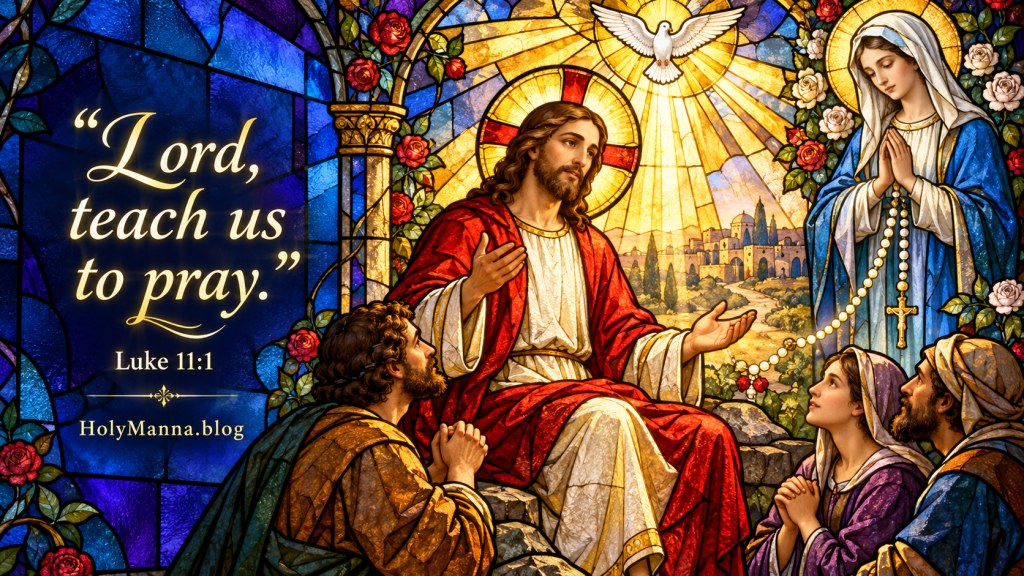
Memorial of Our Lady of the Rosary – Lectionary: 463
The Whole World in a Single Word
Some prayers are so familiar that the words can slide past the heart without ever waking it up. Today, October 7th, the Memorial of Our Lady of the Rosary, the Church slows those words down and asks everyone to hear them as if for the first time. The central theme uniting today’s readings is this: the Gospel is for everyone, and it begins with the word Father. In the First Reading from The Letter to the Galatians, St. Paul defends the truth that one and the same Good News saves Jew and Gentile alike, even when defending it means correcting St. Peter himself, face to face. The Responsorial Psalm, Psalm 117, the shortest psalm in the entire Bible, throws the doors open wide and summons every nation on earth to praise the LORD. Then, in The Gospel of Luke, Jesus answers a disciple’s simple request, “Lord, teach us to pray,” by handing the Church the Our Father, the prayer that makes all those nations into one family before one Father. The memorial itself seals the theme. This date commemorates the Battle of Lepanto in 1571, when Pope St. Pius V begged all of Europe to pray the Rosary, and a badly outnumbered Christian fleet won a victory he attributed to Our Lady’s intercession. St. John Paul II, in Rosarium Virginis Mariae, described the Rosary as a compendium of the Gospel, and every single decade of that compendium opens with the prayer Jesus teaches today. One Gospel, one family, one prayer. That is the story of this day.
First Reading — Galatians 2:1-2, 7-14
When Telling the Truth Costs Something
St. Paul wrote to the churches of Galatia because outside agitators, often called Judaizers, had convinced these new Gentile Christians that faith in Jesus was not enough; they also needed circumcision and the Mosaic law to be saved. Paul answers by telling his own story. He recounts the meeting in Jerusalem where the pillars of the Church recognized his mission to the Gentiles, and then the painful moment in Antioch when he publicly corrected St. Peter for backing away from Gentile believers. This passage fits today’s theme perfectly, because everything Paul fights for here protects a single truth: there is one Gospel for all peoples, and no one gets a second-class seat at the table of God.
Galatians 2:1-2, 7-14
Brothers and sisters:
After fourteen years I again went up to Jerusalem with Barnabas,
taking Titus along also.
I went up in accord with a revelation,
and I presented to them the Gospel that I preach to the Gentiles–
but privately to those of repute–
so that I might not be running, or have run, in vain.
On the contrary,
when they saw that I had been entrusted with the Gospel to the uncircumcised,
just as Peter to the circumcised,
for the one who worked in Peter for an apostolate to the circumcised
worked also in me for the Gentiles,
and when they recognized the grace bestowed upon me,
James and Cephas and John,
who were reputed to be pillars,
gave me and Barnabas their right hands in partnership,
that we should go to the Gentiles
and they to the circumcised.
Only, we were to be mindful of the poor,
which is the very thing I was eager to do.And when Cephas came to Antioch,
I opposed him to his face because he clearly was wrong.
For, until some people came from James,
he used to eat with the Gentiles;
but when they came, he began to draw back and separated himself,
because he was afraid of the circumcised.
And the rest of the Jews acted hypocritically along with him,
with the result that even Barnabas
was carried away by their hypocrisy.
But when I saw that they were not on the right road
in line with the truth of the Gospel,
I said to Cephas in front of all,
“If you, though a Jew,
are living like a Gentile and not like a Jew,
how can you compel the Gentiles to live like Jews?”
Detailed Exegesis
Verse 1: “After fourteen years I again went up to Jerusalem with Barnabas, taking Titus along also.”
Paul establishes his credentials with dates and witnesses. Barnabas was a respected Jewish Christian, and Titus was an uncircumcised Greek convert. Bringing Titus to Jerusalem was a living test case of the question at hand.
Verse 2: “I went up in accord with a revelation, and I presented to them the Gospel that I preach to the Gentiles, but privately to those of repute, so that I might not be running, or have run, in vain.”
Notice something beautiful and deeply Catholic here. Paul received his Gospel by revelation, yet he still submitted it to the leaders of the Church for confirmation. Personal inspiration and Church authority are not enemies; they verify each other. This instinct lives on in CCC 85, which teaches that the task of authentically interpreting the Word of God has been entrusted to the living teaching office of the Church.
Verse 7: “On the contrary, when they saw that I had been entrusted with the Gospel to the uncircumcised, just as Peter to the circumcised,”
The leaders did not invent a new Gospel for Gentiles. They recognized one Gospel with two mission fields. Same message, different audiences.
Verse 8: “for the one who worked in Peter for an apostolate to the circumcised worked also in me for the Gentiles,”
The same God powers both missions. Paul is saying that the Holy Spirit does not compete with Himself.
Verse 9: “and when they recognized the grace bestowed upon me, James and Cephas and John, who were reputed to be pillars, gave me and Barnabas their right hands in partnership, that we should go to the Gentiles and they to the circumcised.”
The handshake of partnership, in Greek koinonia, is communion. This is a snapshot of the early Church acting exactly as the Catholic Church still understands herself: apostles in visible communion, dividing labor but never dividing truth.
Verse 10: “Only, we were to be mindful of the poor, which is the very thing I was eager to do.”
The one condition attached to this great doctrinal agreement was care for the poor. Doctrine and charity travel together, always.
Verse 11: “And when Cephas came to Antioch, I opposed him to his face because he clearly was wrong.”
Here comes the hard part. Antioch was a mixed community where Jewish and Gentile Christians shared meals. Peter, the first pope, made a mistake, not in his teaching, but in his behavior.
Verse 12: “For, until some people came from James, he used to eat with the Gentiles; but when they came, he began to draw back and separated himself, because he was afraid of the circumcised.”
Scripture names the root of the failure: fear. Peter believed the right thing and did the wrong thing, which is a temptation every Christian knows intimately.
Verse 13: “And the rest of the Jews acted hypocritically along with him, with the result that even Barnabas was carried away by their hypocrisy.”
Sin is contagious, especially the sin of respectable people. Even good Barnabas got swept up.
Verse 14: “But when I saw that they were not on the right road in line with the truth of the Gospel, I said to Cephas in front of all, ‘If you, though a Jew, are living like a Gentile and not like a Jew, how can you compel the Gentiles to live like Jews?’”
Because the scandal was public, the correction had to be public. What was at stake was not table manners but “the truth of the Gospel” itself: whether Gentiles are full members of God’s family through faith in Christ.
Teachings
This passage sparked one of the most famous debates between two Doctors of the Church. St. Jerome had suggested the confrontation was staged for teaching purposes, but St. Augustine would not accept that reading, insisting in his letters that if the apostles play-acted, Scripture itself becomes unreliable. Augustine drew a stunning lesson from Peter’s response in Letter 82: “And Peter himself received, with the holy and loving humility which became him, the rebuke which Paul, in the interests of truth, and with the boldness of love, administered. Therein Peter left to those that came after him an example, that, if at any time they deviated from the right path, they should not think it beneath them to accept correction from those who were their juniors.” For Augustine, Peter’s humility in accepting correction was an example even rarer and holier than Paul’s courage in giving it. The Church has always taught that this kind of correction is an act of love, not rebellion. CCC 1829 teaches that “charity demands beneficence and fraternal correction.” Notice, too, what this episode does not undermine. Peter’s failure was one of conduct, not of doctrine; he never taught that Gentiles must be circumcised. The Church distinguishes the pope’s personal weakness from his teaching office, and CCC 890 explains that the Magisterium exists “to preserve God’s people from deviations and defections” in matters of faith. Peter sinned in fear; Peter never taught error. Both truths matter.
Reflection
This reading meets you right where hypocrisy lives, in the gap between what you believe and what you do when certain people are watching. Peter did not change his theology at Antioch; he changed his seat at the table because he feared the opinion of an influential crowd. Consider one concrete step this week: identify the room where you go quiet about your faith, whether that is a group chat, an office, or a family dinner, and resolve to be the same Catholic in that room that you are at Mass. A second step comes from Paul: when correction is needed, give it face to face, with love, and never through gossip behind someone’s back. A third comes from Peter: when correction comes to you, receive it with humility instead of defensiveness, because being corrected well is a mark of holiness. Where in your life are you drawing back from the table out of fear of what others might think? When someone corrects you with love, do you respond more like the humble Peter or like a wounded ego?
Responsorial Psalm — Psalm 117:1bc-2
The Shortest Psalm with the Widest Reach
Psalm 117 holds a charming distinction: it is the shortest chapter in the entire Bible, only 2 verses long. Yet those 2 verses contain the widest invitation in the Old Testament, a summons for every nation and every people on earth to praise the God of Israel. Ancient Israel sang it among the Hallel psalms at the great pilgrimage feasts, which means Jesus Himself almost certainly sang it. Its placement today is no accident. The Church pairs it with Paul’s defense of the Gentile mission because Paul himself quotes this exact psalm in Romans 15:11 to prove that God always intended the nations to glorify Him. The refrain, drawn from the missionary command of Mark 16:15, makes the point unmistakable: “Go out to all the world, and tell the Good News.”
Psalm 117:1bc-2
R. Go out to all the world, and tell the Good News.
Praise the LORD, all you nations,
glorify him, all you peoples!
R. Go out to all the world, and tell the Good News.
For steadfast is his kindness toward us,
and the fidelity of the LORD endures forever.
R. Go out to all the world, and tell the Good News.
Detailed Exegesis
Verse 1: “Praise the LORD, all you nations, glorify him, all you peoples!”
The Hebrew word for nations here is goyim, the Gentiles. Centuries before Christ, Israel’s own prayer book already insisted that the pagan nations belonged in God’s choir. What Paul fought for at Antioch was written in Israel’s hymnal all along.
Verse 2: “For steadfast is his kindness toward us, and the fidelity of the LORD endures forever.”
The reason for the praise is God’s covenant love, in Hebrew hesed, His steadfast kindness, joined to His emet, His enduring fidelity. The nations are invited to praise God precisely because of what He has done for Israel, since Israel’s story was always meant to become the whole world’s story.
Teachings
The Church reads this psalm as a prophecy of her own missionary nature. CCC 849 teaches that the Church has been divinely sent to all nations so that she might be “the universal sacrament of salvation.” That phrase, drawn from the Second Vatican Council, means the Church does not merely have a mission; she is a mission. The shortness of this psalm carries its own lesson, one the Fathers loved: the message is simple enough for anyone to memorize and universal enough for everyone to sing.
Reflection
A 2-verse psalm makes a fitting examination of conscience, because evangelization does not require a theology degree; it requires 2 verses’ worth of courage. Try this concrete practice: share one small, genuine piece of your faith this week with someone outside your Catholic circle, perhaps by mentioning that you prayed for a coworker, or by simply saying grace visibly at lunch. If God’s kindness toward you is truly steadfast, who in your life has never heard you say so? What would it look like for you to go out to your own little corner of the world this week?
Holy Gospel — Luke 11:1-4
The Prayer That Contains Everything
Luke sets this scene on the road to Jerusalem, and it begins not with a sermon but with a sight: the disciples watching Jesus pray. Something about the way He prayed made them hungry, and one of them finally asked for lessons. What Jesus gave them in answer is the most prayed prayer in human history. Luke’s version is shorter than Matthew’s, with 5 petitions rather than 7, and it carries the flavor of daily, on-the-road discipleship. On the Memorial of Our Lady of the Rosary, this Gospel lands with special weight, because the Our Father opens every decade of the Rosary. The Church prays this prayer more than 50 times in a full 20-decade Rosary week after week, and today she asks whether those words are still awake in the heart.
Luke 11:1-4
Jesus was praying in a certain place, and when he had finished,
one of his disciples said to him,
“Lord, teach us to pray just as John taught his disciples.”
He said to them, “When you pray, say:Father, hallowed be your name,
your Kingdom come.
Give us each day our daily bread
and forgive us our sins
for we ourselves forgive everyone in debt to us,
and do not subject us to the final test.”
Detailed Exegesis
Verse 1: “Jesus was praying in a certain place, and when he had finished, one of his disciples said to him, ‘Lord, teach us to pray just as John taught his disciples.’”
Rabbis of the time commonly taught their disciples signature prayers, and John the Baptist had done the same. But notice the deeper spark: the disciples asked because they watched Jesus pray. Witness came before words. The most persuasive argument for prayer is a person who actually prays.
Verse 2: “He said to them, ‘When you pray, say: Father, hallowed be your name, your Kingdom come.’”
Everything hangs on the first word. Jesus authorizes His disciples to address the Almighty God with the intimate word Father, and in doing so He adopts them into His own relationship with God. This is why the prayer belongs to Jew and Gentile alike, which ties this Gospel directly to Galatians: one Father means one family. To hallow God’s name is to ask that His name be kept holy in the world, and “your Kingdom come” begs for the full arrival of His reign, beginning in the one praying.
Verse 3: “Give us each day our daily bread”
Luke’s distinctive phrase “each day” teaches a manna-style dependence, enough for today, trust for tomorrow. The Fathers of the Church also heard a deeper register here. CCC 2837 preserves St. Augustine’s reading: “The Eucharist is our daily bread.” The petition covers both the grocery bill and the altar.
Verse 4: “and forgive us our sins for we ourselves forgive everyone in debt to us, and do not subject us to the final test.”
This is the only petition with a condition attached, and the Catechism does not soften it. CCC 2838 says plainly of this petition: “This petition is astonishing.” Forgiveness received and forgiveness given are welded together; the one who refuses to forgive closes the very hand that needs to receive mercy. The final phrase asks for protection in the ultimate trial, the decisive battle between faith and despair.
Teachings
The Church’s esteem for this prayer is almost impossible to overstate. CCC 2761 hands on the judgment of Tertullian, one of the earliest Christian writers, that the Lord’s Prayer “is truly the summary of the whole gospel.” St. Augustine went further in his letter to the widow Proba, quoted in CCC 2762: “Run through all the words of the holy prayers [in Scripture], and I do not think that you will find anything in them that is not contained and included in the Lord’s Prayer.” And St. Thomas Aquinas, the Angelic Doctor, crowned it in the words preserved in CCC 2763: “The Lord’s Prayer is the most perfect of prayers. . . . In it we ask, not only for all the things we can rightly desire, but also in the sequence that they should be desired.” Here the memorial and the Gospel embrace. St. John Paul II taught in Rosarium Virginis Mariae that the Rosary, though clearly Marian in character, is at heart a Christocentric prayer containing the depth of the Gospel message in its entirety, of which it can be called a compendium. So the Rosary is the compendium of the Gospel, the Our Father is the summary of the Gospel, and the Rosary begins every decade with the Our Father. History adds its own testimony: before the Battle of Lepanto on October 7th, 1571, Pope St. Pius V called the whole Church to the Rosary, and he attributed the fleet’s stunning victory to Our Lady’s intercession, establishing the feast celebrated today.
Reflection
The disciples’ request is still the best prayer for a beginner and for a veteran: teach me to pray. Try praying the Our Father once today at one-tenth speed, pausing on each phrase, especially on the first word. Let Father actually mean Father. Then take up the Rosary, even a single decade, and let Our Lady walk you through the Gospel one mystery at a time; that is what the Church is really celebrating today. Finally, take verse 4 seriously and name one person you have not forgiven, then hand that debt to God before the day ends. When you say the word Father, do you mean it, or has it become wallpaper? What would change in your week if you asked only for this day’s bread and trusted God with the rest?
One Family on Its Knees
Step back and watch the whole day come together like a story told in three movements. In Antioch, Paul stakes everything on the truth that one Gospel saves every people, and Peter, in a moment rarer and holier than courage itself, humbly accepts the correction. In the psalm, that truth becomes a song, the shortest psalm in the Bible flinging the widest invitation in history: praise the LORD, all you nations. And on a dusty road to Jerusalem, Jesus reveals why the invitation works at all, because the God of every nation wants to be called Father. The Memorial of Our Lady of the Rosary gathers all of it into a strand of beads. When Pope St. Pius V faced an impossible battle in 1571, he did not first call for more ships; he called for more Rosaries, and the Church has marked October 7th in gratitude ever since. Every decade of that Rosary opens with the summary of the whole Gospel, the Our Father, prayed while Mary, the first and best disciple, teaches souls to ponder her Son. The invitation of this day is beautifully simple. Believers are asked to guard the truth of the Gospel with Paul’s boldness, to receive correction with Peter’s humility, to proclaim God’s kindness with the psalmist’s joy, and to pray with the trust of a child saying Father. The Rosary holds all four in a single devotion. Anyone who feels the Gospel is too big to live should start where Jesus started His disciples: with 5 small petitions, prayed slowly, held in Mary’s hands. The world was changed once by a Church on its knees. It can happen again.
Engage With Us!
Every reflection shared in the comments below becomes part of a bigger conversation, and someone reading today may need exactly the insight God has placed on your heart, so please do not keep it to yourself. Here are some questions to pray with and respond to:
- In Galatians 2:1-2, 7-14, Peter drew back from the table out of fear of what others would think, and Paul corrected him face to face with love. Which role challenges you more right now, giving honest correction or humbly receiving it, and why?
- In Psalm 117:1bc-2, every nation is summoned to praise God for His steadfast kindness. What is one concrete moment of God’s kindness in your own life that you could actually tell someone about this week?
- In Luke 11:1-4, Jesus teaches the disciples to call God Father and to ask only for each day’s bread. Which single phrase of the Our Father is hardest for you to pray and truly mean?
- Taking today’s readings together on this Memorial of Our Lady of the Rosary, how might praying even one decade of the Rosary daily help you live the one Gospel, for all people, that Paul defended and Jesus summarized?
Living a life of faith is not about grand gestures; it is about small fidelities repeated with love, a truth spoken kindly, a correction received humbly, a decade prayed slowly. Do everything this week with the love and mercy Jesus taught, and let Our Lady of the Rosary lead you, bead by bead, closer to her Son.
Sacred Heart of Jesus, we trust in You!
Immaculate Heart of Mary, pray for us!
Saint Michael the Archangel, defend us in battle!
Follow us on YouTube, TikTok, Instagram and Facebook for more insights and reflections on living a faith-filled life.


Leave a comment