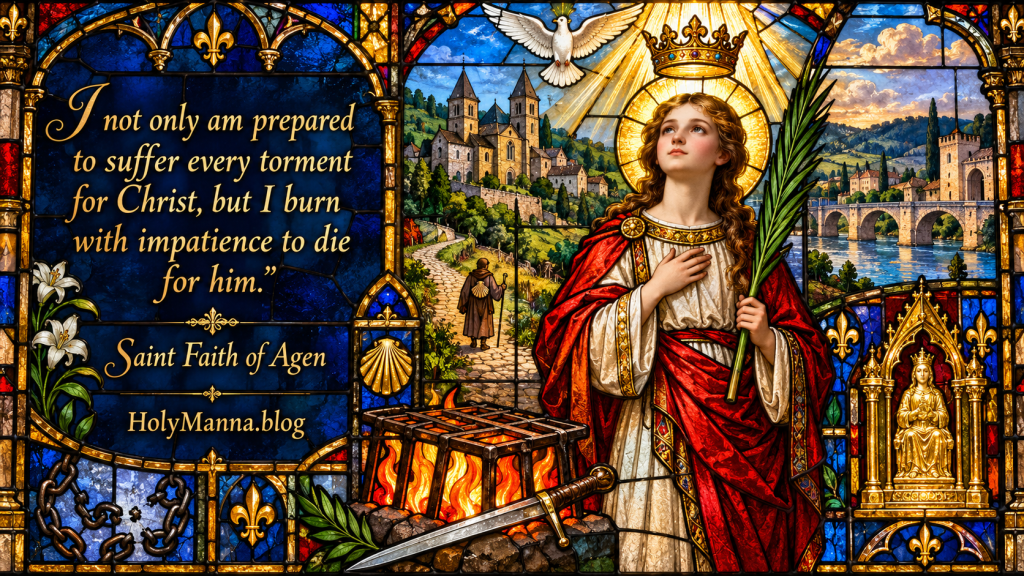
The Girl Who Stared Down an Empire
Some saints leave behind shelves of writings, decades of preaching, and long lists of institutions they founded. Saint Faith of Agen left almost nothing except her name and her witness, and yet that was enough to set a continent on fire with devotion. She was a girl of roughly 12 or 13 years old when she stood before a Roman official in the south of Gaul, sometime around the year 287, 290, or 303, and refused to trade Jesus Christ for her own life. The Church has never forgotten her. Her feast is celebrated on October 6th, and she has been honored on that date since at least the sixth century, when her name appears in the ancient martyrology associated with Saint Jerome, the Martyrologium Hieronymianum.
Known in Latin as Sancta Fides, in French as Sainte Foy, and in Spanish as Santa Fe, she became one of the most beloved virgin martyrs of medieval Europe. Pilgrims walking to Santiago de Compostela stopped at her shrine in Conques by the tens of thousands. Prisoners who believed she had broken their chains hung their fetters on the walls of her abbey. Soldiers carried her name into battle. To this day she is invoked as a patroness of pilgrims, prisoners, and soldiers, and some Catholic sources also list her as a patroness for those suffering from eye diseases and blindness, because of the most famous miracle attributed to her intercession.
Her story is, at its heart, the story the Church tells about every martyr. The Catechism teaches, “Martyrdom is the supreme witness given to the truth of the faith: it means bearing witness even unto death” (CCC 2473). Saint Faith bore that witness as a child, and the weight of her small testimony has proven heavier than the empire that tried to crush it. One clarification is worth making at the outset. Saint Faith of Agen is a distinct saint from the young martyr named Faith who belongs to the group of three sisters, Faith, Hope, and Charity, daughters of Saint Sophia, whose commemoration falls on August 1st. The two have often been confused over the centuries, but the Church venerates them separately.
A Child of Agen
Faith was born in Agen, a Roman town on the Garonne River in the province of Aquitaine, in what is now southwestern France. Honesty requires saying plainly what history can and cannot tell about her early years. The documented historical core is ancient but slender. Her name, her city, her virginity, her martyrdom, and her feast date of October 6th are attested in the earliest layers of the Church’s martyrologies. The detailed narrative of her life, however, comes from a Passio, an account of her passion, whose original text is now lost and which survives in summarized form in the ninth-century martyrology of Florus of Lyon and in later medieval retellings. That means the Church knows with confidence that a real girl named Fides gave her life for Christ at Agen, while the particulars of her story reach the faithful as sacred tradition rather than as verified courtroom records.
According to that tradition, Faith was born around the year 290 into a wealthy and noble family of Agen. Some tellings add that her pagan parents entrusted her upbringing to a nurse who happened to be a Christian, and that through this humble woman the girl came to know and love Jesus Christ. Growing up with every comfort the Roman world could offer, she is said to have consecrated herself entirely to God at a young age, quietly indifferent to the wealth and status that surrounded her. These details of her family background and formation cannot be verified.
What can be said with confidence is what her name itself proclaims. Her parents, or perhaps the Church that adopted her memory, gave her the name Fides, which simply means faith. The Letter to the Hebrews defines that word for every generation: “Now faith is the assurance of things hoped for, the conviction of things not seen” (Hebrews 11:1). This child would be asked, in the most literal way imaginable, whether she possessed the thing she was named for. She is most known for her answer. Her yes to Christ under threat of fire, and the extraordinary shrine at Conques that later grew up around her relics, made her one of the most venerated saints of the Middle Ages, a heavenly friend to pilgrims, prisoners, and soldiers across Europe and eventually the Americas.
The Witness That Converted a Cave-Dweller
Saint Faith worked no recorded miracles during her short life. There were no healings at her hands, no multiplied loaves, no prophecies. Her one great work was her witness, and the tradition of the Church insists that this witness was itself an instrument of grace powerful enough to convert others on the spot.
The clearest testimony to this comes from the Church’s own liturgical memory. The traditional Roman Martyrology for October 6th reads: “At Agen, in France, the birthday of St. Faith, virgin and martyr, whose example encouraged blessed Caprasius so much that he happily terminated his combat by martyrdom.” In the language of the martyrology, her “birthday” means the day she was born into eternal life. The entry is remarkable because it defines her not by what she suffered but by what her suffering accomplished in another soul.
That other soul was Saint Caprasius, whose own feast falls on October 20th. According to the tradition preserved in the Roman Martyrology, Caprasius had hidden himself in a cavern outside Agen to escape the violence of the persecution. When the report of the young virgin’s courage reached him, something changed in him. The Martyrology recounts that he prayed to God that, if he were deemed worthy of the glory of martyrdom, clear water might flow from the rock of his cavern. The tradition holds that God granted the sign, water flowed from the stone, and Caprasius came out of hiding, presented himself to the persecutors, and after a valiant struggle won the palm of martyrdom under the emperor Maximian. The accounts of Caprasius come from hagiographic sources written no earlier than the ninth century, and this story of the spring, like the details of his life, cannot be verified.
Yet the theological heart of the story is precisely what the Church teaches about the communion of saints. The Catechism explains why the Church keeps these memorials at all: “When the Church keeps the memorials of martyrs and other saints during the annual cycle, she proclaims the Paschal mystery in those ‘who have suffered and have been glorified with Christ’” (CCC 1173). Faith matters, and deserves to be remembered and imitated, because in her weakness the strength of Christ became visible. A frightened man hiding in a cave saw a child stand firm, and he found his own courage. Saint Paul heard the Lord say, “My grace is sufficient for you, for my power is made perfect in weakness” (2 Corinthians 12:9), and the tradition of Agen shows that principle written in the life of a girl barely into her teens. She had no army, no eloquence, no status that Rome recognized. She had only her baptism and her name, and it proved to be enough.
Fire Could Not Frighten Her
The persecution that swept over Agen belonged to the era of the emperors Diocletian and Maximian, the last and most ferocious of the Roman persecutions of the Church. Sources disagree on the exact year of Faith’s death, placing it variously in 287, in 290, or in 303 within the great Diocletianic persecution, and that conflict among the sources should be stated honestly rather than smoothed over. What the tradition agrees on is the man who presided over her trial: Dacian, a Roman procurator whose name appears in the passion accounts of several martyrs of Gaul and Spain, and who arrived in Agen determined to force its Christians to sacrifice to the pagan gods.
The traditional Passio, as transmitted through the centuries and rendered into English in Butler’s Lives of the Saints, tells the story of her trial in the form of a dialogue. According to that tradition, Faith was among the first brought before the tribunal. Standing before the judge, she made the sign of the cross and prayed: “Lord Jesus, who art always ready to assist your servants, fortify me at this hour, and enable me to answer in a manner worthy of you.” Dacian, putting on an air of mildness, asked her name. She answered: “My name is Faith, and I endeavor to support in reality what that flame signifies.”
The judge then appealed to her youth and her beauty, urging her to renounce her religion and sacrifice to Diana, a goddess of her own sex who would reward her richly. Faith’s reply, in the tradition, was blunt: “The divinities of the Gentiles are devils: how then can you advise me to sacrifice to them?” Enraged, Dacian threatened her with instant torture unless she offered sacrifice. The account says that the girl, calling to mind the courage of the martyrs and the crown promised to those who persevere, answered: “I not only am prepared to suffer every torment for Christ, but I burn with impatience to die for him.”
Dacian then ordered a brazen bed to be produced. The tradition describes Faith being stretched upon this metal grill over burning coals, roasted alive before the crowd, and finally beheaded. It must be said plainly that this dialogue and these details come from acta written centuries after the events; they are the Church’s cherished tradition of her passion, and they cannot be verified as a verbatim historical record.
Yet the tradition does not end with her death, because her suffering did not leave the crowd unmoved. The accounts say that many of the spectators, watching a child endure the fire with such peace, cried out in sympathy, and that some openly professed Christ. Dacian had those bystanders beheaded as well. Among those said to have died with her or immediately after her, tradition names Saint Alberta of Agen and, in his own hour, Saint Caprasius. These companion martyrdoms rest on the same late traditions and cannot be independently verified.
Whatever the precise details of that terrible day, the Church’s confidence in the fact of her martyrdom stands on the most ancient evidence available for any saint of Gaul, and the meaning of her death is exactly what Jesus promised in The Book of Revelation: “Be faithful unto death, and I will give you the crown of life” (Revelation 2:10). A girl named Faith was faithful unto death. The crown followed.
The Little Saint Who Moved Mountains, and Monks
If Faith’s life was brief and hidden, her afterlife in the devotion of the Church has been long, colorful, and astonishing.
Veneration began early at Agen itself. In the fifth century, Dulcitius, the Bishop of Agen, ordered the construction of a basilica in her honor, where her relics were enshrined. That basilica was restored in the eighth century and enlarged in the fifteenth, though sadly it was demolished in 1892 to make way for urban development. By the ninth century her fame had spread well beyond her home city, and that fame set the stage for one of the strangest and most famous episodes in the history of relics.
The monks of the remote abbey of Conques, tucked into a rugged gorge in the Rouergue region, longed for the relics of a great saint to sustain their struggling monastery. According to the medieval account known as the Translatio, written between 1020 and 1060, a monk of Conques traveled to Agen, spent years there earning the trust of the community that guarded Faith’s shrine, and then, on January 14th, 866, carried her relics away to Conques. One reference work places the enshrinement at Conques as early as 855, a discrepancy worth noting, though 866 is the widely accepted date. Medieval Christians had a name for this practice, furta sacra, holy theft, and the monks of Conques defended it with a striking theological claim: no one can steal a saint who does not wish to move. In their eyes, Faith herself had chosen Conques, and the flood of miracles that followed was taken as her ratification of the move. The modern reader may raise an eyebrow at the ethics of the affair, and fairly so, but the historical result is beyond dispute. Conques became one of the great pilgrimage centers of Europe.
In the last quarter of the ninth century, a portion of her skull was enclosed in a golden reliquary-statue, seated like a small enthroned queen, covered over the centuries with gold, gems, cameos, and the offerings of countless pilgrims. This statue, known as the Majesty of Sainte Foy, was created at a time when large three-dimensional sculpture was still rare and even suspect in Christian art, and it survives to this day in the treasury at Conques as one of the oldest and most famous reliquaries in all of Christendom.
Then came the miracles, and with them one of the most valuable documents of the medieval Church. Around the year 1013, a learned schoolmaster named Bernard of Angers traveled to Conques, openly skeptical of the enthusiasm surrounding this little girl martyr and uneasy about the golden statue itself. What he found there converted his skepticism into devotion. His own turning point, by his account, came when he witnessed a miracle involving a cleric named Odalric. Bernard went on to make three journeys to Conques and to gather forty-nine accounts of miracles, which became the first two books of the Liber miraculorum sancte Fidis, the Book of Sainte Foy’s Miracles. After his death, three anonymous authors at Conques continued the collection with two further books.
The miracles recorded there are extraordinary in their range. The most famous concerns a man named Guibert, whose eyes had been torn out by an enemy. According to the Book of Miracles, which gives this story pride of place as its opening chapter and dates it to around the year 983, Saint Faith appeared to Guibert and his sight was fully restored, so that he became known ever after as Guibert the Illuminated. Other accounts tell of the sick healed, of eyesight restored again and again, of the dead raised, and of prisoners whose chains broke open through her intercession, which is why freed captives hung their fetters at her shrine and why she became a patroness of prisoners. Medieval writers even noticed something unusual in her miracles: a streak of playfulness. Many stories portray a mischievous young saint who teased, prodded, and sometimes sharply corrected the people she helped, especially those who were stingy toward her shrine, and these came to be affectionately known as her joca, her little jokes. Every one of these miracle stories comes from medieval accounts; they are genuine historical documents of what pilgrims believed and reported, but the miracles themselves cannot be verified.
How should a Catholic think about all of this? The Church has never been embarrassed by relics, shrines, and pilgrim roads. The Catechism teaches that “the religious sense of the Christian people has always found expression in various forms of piety surrounding the Church’s sacramental life, such as the veneration of relics, visits to sanctuaries, pilgrimages, processions” (CCC 1674). And behind every miracle story stands the sober doctrine of the communion of saints: “They do not cease to intercede with the Father for us, as they proffer the merits which they acquired on earth through the one mediator between God and men, Christ Jesus” (CCC 956). Whatever weight one gives to any single medieval account, the constant teaching of the Church is that Saint Faith is alive in Christ and prays for the faithful still.
Her cultural footprint is enormous. Conques sits on the Le Puy route of the Camino de Santiago, and the Romanesque abbey church of Sainte-Foy, crowned by its famous carved tympanum of the Last Judgment, still welcomes pilgrims walking to Compostela; it is inscribed on the UNESCO World Heritage list among the Routes of Santiago de Compostela in France. Devotion to her spread across Europe, with notable churches at Conches in Normandy and Sélestat in Alsace, chapels dedicated to her in Westminster Abbey and old St. Paul’s in London, and churches and towns bearing her name, Santa Fe, Holy Faith, carried by Spanish devotion across the Atlantic to the Americas. A girl who never left her home town became a companion to travelers on half the roads of Christendom.
What a Teenager From Agen Can Teach Grown-Ups
It is tempting to file Saint Faith away as a beautiful but distant figure, a stained-glass child from a brutal age with little to say to adults juggling careers, relationships, mortgages, and smartphones. That would be a mistake, because her situation was, in its essentials, startlingly modern. She lived in a prosperous, sophisticated, pluralistic society that was perfectly happy to tolerate her private beliefs so long as she would perform one small public gesture of conformity. A pinch of incense, a nod to Diana, and she could have gone home to her comfortable life. The pressure she faced was not first of all to hate Christ but simply to keep him negotiable.
Most Christians today will never face a brazier, but nearly all face that same quiet transaction. It shows up in the meeting where staying silent about one’s convictions is the easy path, in the group chat where faith is the punchline, in the relationship where Sunday Mass becomes the first thing traded away, in the online space where a believer’s honest voice invites ridicule. The Catechism does not treat public witness as optional heroics for a spiritual elite: “The disciple of Christ must not only keep the faith and live on it, but also profess it, confidently bear witness to it, and spread it” (CCC 1816). Jesus himself attached a promise and a warning to that duty: “Every one who acknowledges me before men, I also will acknowledge before my Father who is in heaven; but whoever denies me before men, I also will deny before my Father who is in heaven” (Matthew 10:32 to 33).
Saint Faith’s first lesson, then, is integrity of identity. When Dacian asked who she was, tradition says she answered with her name and her creed in a single breath. If a stranger examined the pattern of your week, your calendar, your spending, and your conversations, would your identity as a Christian be as obvious as your name? Her second lesson is the power of visible courage. She did not convert Caprasius by arguing with him; she converted him by standing firm where he could see her. Every parent, coworker, and friend is somebody’s Caprasius, watching from a cave and quietly deciding whether faith is worth the cost. Her third lesson is that youth is no obstacle to holiness. Saint Paul told Timothy, “Let no one despise your youth, but set the believers an example in speech and conduct, in love, in faith, in purity” (1 Timothy 4:12), and Faith did exactly that before she was old enough to marry.
There are practical ways to weave her witness into ordinary life. A person can begin the day, as she began her trial, with the sign of the cross made slowly and deliberately, asking Christ to fortify them for whatever the day will demand. They can resolve to name their faith naturally in one conversation this week instead of hiding it. They can practice small, unglamorous fidelities, keeping Sunday Mass unmovable, praying grace in public, telling the truth when it costs something, because a soul that will not bend in small trades will not bend in large ones. They can pray for persecuted Christians around the world, who face Dacian’s bargain in its original form. And they can remember prisoners, the poor, and the sick, the very people her medieval devotees brought to her shrine, with concrete acts of compassion. What is the pinch of incense in your own life, the small compromise the world keeps asking for in exchange for its comfort and approval? And who might find their courage because they saw you keep yours?
Engage With Us!
Saint Faith’s story has been drawing hearts to Christ for more than 1,700 years, and it is still doing that work today. Readers are warmly invited to share their thoughts, their questions, and their own experiences of costly faithfulness in the comments below; someone reading may be sitting in their own cave, waiting for exactly that encouragement. To help the reflection go deeper, consider these questions:
- Saint Faith’s name and her identity were one and the same. What would it take for your daily choices to proclaim your baptismal identity as clearly as her name proclaimed hers?
- Tradition says Saint Caprasius found his courage by watching Faith suffer with peace. Who in your life is quietly watching your example, and what are they learning from it?
- What “pinch of incense” does the world ask of you, the small compromise that would make life easier at the price of your witness to Christ?
- Pilgrims walked hundreds of miles to Conques to honor a teenage girl. What would a pilgrimage, literal or spiritual, look like in your own life this year?
- Saint Faith is a patroness of pilgrims, prisoners, and soldiers. Which of these groups could you serve or pray for in a concrete way this week?
May the witness of Saint Faith of Agen stir up a bolder, warmer, more joyful faith in everyone who reads her story. The same Lord who fortified a young girl before a Roman tribunal stands ready to fortify every believer today, in every boardroom, classroom, and kitchen where his name is on the line. Live your faith out loud, hold nothing back from God, and do everything, the great things and the small, with the love and the mercy that Jesus taught his disciples.
Saint Faith of Agen, pray for us!
Follow us on YouTube, TikTok, Instagram and Facebook for more insights and reflections on living a faith-filled life.


Leave a comment