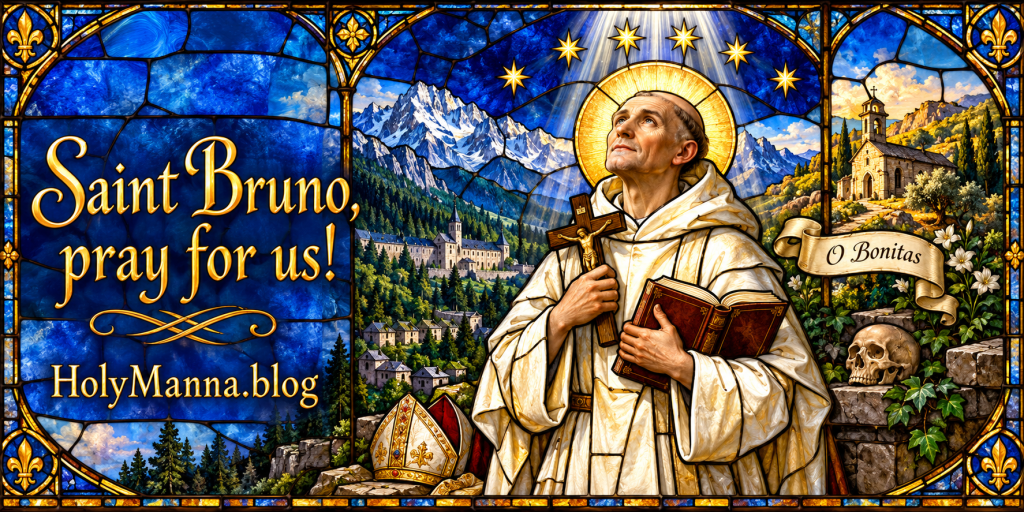
The Man Who Chose Silence
Imagine one of the most respected professors in Europe, a man whose former student now sits on the Chair of Saint Peter, a man whom an entire city wants to make its archbishop. Now imagine that man quietly packing up his life, giving everything away, and disappearing into a snowbound mountain valley to live in a wooden hut and pray. That man is Saint Bruno, priest, teacher, and founder of the Carthusian Order, whose Optional Memorial the Church celebrates on October 6th. Born around 1030 and dying in 1101, Bruno stands as one of the great witnesses in Church history to a single, piercing truth: God alone is enough. His life speaks with unusual force to a generation drowning in notifications, ambition, and noise, because Bruno had every worldly success a man of his age could want, and he found that none of it satisfied the hunger in his soul.
Bruno is the beloved patron of Calabria in southern Italy, the land where he spent his final years and where his relics rest to this day. He is also invoked, according to long-standing Catholic practice, for the deliverance of those suffering from demonic possession, and he is honored as a patron of exorcists. Some Catholic sources additionally list him as a patron saint of Germany, his homeland, though this patronage is less consistently documented than the others. What makes Bruno remarkable is not a dramatic martyrdom or a catalogue of public wonders. What makes him remarkable is a lifetime of hidden fidelity, the kind of sanctity The Catechism describes when it teaches that hermits “devote their life to the praise of God and salvation of the world through a stricter separation from the world, the silence of solitude and assiduous prayer and penance” (CCC 920). Bruno lived that definition before the Church ever wrote it down.
A Son of Cologne, A Star of Reims
Bruno was born in Cologne, Germany, around the year 1030, into the Hartenfaust family, one of the principal families of that great Rhineland city. Very little is known with certainty about his childhood, and honest history requires saying so. He most likely received his first education at the collegiate school of Saint Cunibert in Cologne, and as a young man he was made a canon of Saint Cunibert’s Church. While still quite young he traveled to Reims in France, drawn by the reputation of its famous cathedral school, one of the intellectual powerhouses of eleventh-century Europe.
Reims is where Bruno’s star rose. He returned there around 1056 as a professor, became head of the cathedral school the following year, and for nearly two decades formed the minds of clergy and future leaders across Europe. He taught the arts and theology, and his students remembered him with something close to awe. One of those students was Odo of Châtillon, who would later become Pope Blessed Urban II, the pope who called the First Crusade and carried forward the great Gregorian reform of the Church. During these years Bruno also composed learned commentaries on The Psalms and later on the Epistles of Saint Paul, works that earned him a real place among the scholars of his century. In 1074 he was appointed chancellor of the archdiocese of Reims, one of the highest offices a priest could hold short of a bishopric.
Then came the crisis that changed everything. The new archbishop of Reims, Manasses de Gournay, was a scandal: worldly, violent, and widely regarded as having bought his office. In 1076 Bruno and several fellow priests took the enormous risk of denouncing Manasses as unfit. The archbishop retaliated, and Bruno was forced to flee the city, his property confiscated. When Manasses was finally deposed around 1080, Bruno returned in vindication, and the people of Reims wanted to make him their archbishop. Here is the hinge of his whole life. Bruno said no.
He said no because something deeper had already taken hold of him. In a letter written years later to his friend Raoul le Verd, provost of Reims, Bruno recalled a day when he, Raoul, and another canon named Fulcius sat talking in a small garden. Their conversation turned to the emptiness of worldly ambition and the beauty of eternal things, and the three men, set on fire with love for God, vowed together to abandon the world and pursue the religious life. Raoul and Fulcius let the moment pass. Bruno did not. He resigned everything, the chancellorship, the prospect of the miter, the comfortable prestige of a celebrated career, and set out to become one of the pauperes Christi, the poor of Christ.
There is also a famous story attached to Bruno’s conversion, preserved as a tradition within the Carthusian Order and made famous by painters over the centuries. According to this tradition, Bruno was present in Paris at the funeral of a renowned and seemingly virtuous teacher named Raymond Diocrès. As the funeral prayers were chanted, the dead man is said to have risen from his bier and cried out that he had been judged and condemned by the just judgment of God for his hidden sins. The tradition holds that this terrifying prodigy convinced Bruno of the vanity of worldly reputation and drove him into solitude. It is a gripping story, and the Church’s own historians have handled it honestly: the earliest biographers of Bruno say nothing of it, Bruno himself never mentions it in his surviving letter recounting his conversion, and there is no proof he ever visited Paris. This story cannot be verified.
Seven Stars Over the Alps
After leaving Reims, Bruno first placed himself under the direction of Saint Robert of Molesme, the holy abbot who would later found the Cistercian Order. But Bruno quickly discerned that ordinary community life, for all its goodness, was not his calling. He longed for the desert, for the radical solitude of the ancient hermits of Egypt. After a short stay at Sèche-Fontaine, he set out in 1084 with six companions, four priests and two laymen, toward the Alps, to seek the help of Hugh of Châteauneuf, the saintly bishop of Grenoble, who according to some authors had himself once been Bruno’s pupil.
What happened next is one of the most cherished traditions of the Carthusian Order. It is told that on the night before the seven men arrived, Bishop Hugh dreamed that God was building a dwelling for His glory in the wilderness of his diocese, and that seven stars were showing the way to it. When Bruno and his six companions appeared at his door, the bishop understood the dream: these were the seven stars. To this day the emblem of the Carthusian Order is a globe surmounted by a cross and encircled by seven stars, a permanent memorial of that vision. The dream is preserved in the early accounts of Saint Hugh’s life and in the constant tradition of the order, though like most private visions of that era it rests on the testimony of tradition rather than independent documentation.
Hugh personally led the seven men into a remote, savage valley of the Chartreuse massif, some 3,500 feet up in the mountains, ringed by cliffs and buried in snow for much of the year. There, in 1084, they built a small oratory and individual wooden cells, and the Carthusian Order was born, though none of them would have used the word “order” yet. They were simply hermits living near one another: praying alone in their cells, gathering for the liturgy, working with their hands, and copying manuscripts so that, even in silence, they could preach the Word of God with their pens. Bruno wrote no formal rule. His life was the rule. Only decades later, around 1127, did Guigo, the fifth prior of the Grande Chartreuse, write down the Customs of Chartreuse at the request of new communities that wished to follow the same way of life.
Why does this hidden life matter so much? Because the Church teaches that the contemplative vocation is not an escape from the world but a hidden engine of grace within it. The Catechism says of hermits that “they manifest to everyone the interior aspect of the mystery of the Church, that is, personal intimacy with Christ” (CCC 921). Bruno’s monastery produced no missions, no schools, no hospitals, and yet the Church has always understood that the Carthusians, by their unceasing prayer, serve the salvation of the world. Bruno himself put it best in his letter to Raoul le Verd: “Only those who have experienced the solitude and silence of the wilderness can know what benefit and divine joy they bring to those who love them.” And again, describing what God works in that silence: “In the solitude and silence of the wilderness, for their labor in the contest, God gives his athletes the reward they desire: a peace that the world does not know and joy in the Holy Spirit.”
Those who knew Bruno testified that his contemplation overflowed into a single constant exclamation. He was often found walking the mountain paths repeating the cry of his heart, “O Bonitas!”, which means, “O Goodness!” That two-word prayer, marveling at the goodness of God, became so identified with him that artists have painted him with the words on a scroll in his hands. It is worth pausing on this. The most learned man of his generation, the master of the schools of Reims, distilled all his theology into wonder at the sheer goodness of God. No miracles of healing or public wonders are recorded of Bruno during his lifetime by the sober sources of the Church; his contemporaries insisted instead on the miracle of his life itself, his learning, his eloquence, and above all his holiness, and the historical record is honored by saying exactly that.
Exile, Interruption, and the Cost of Saying Yes
Bruno was never martyred, but his life was a long apprenticeship in loss, and each loss cut deeply. He lost his homeland when he left Cologne for Reims. He lost his position, his property, and his safety when he stood up to Archbishop Manasses, an act of moral courage that made him a fugitive in the very city where he had been a celebrity. He lost the garden of his first fervor when his friends Raoul and Fulcius, who had vowed with him to leave the world, quietly returned to their comfortable lives, leaving Bruno to keep the vow alone. Years later he would write to Raoul with affectionate persistence, urging him to remember that garden and the promises made there, and warning him with a teacher’s homely image about a soul stretched thin by worldly business: “If the bow is stretched for too long, it becomes slack and unfit for its purpose.”
Then, in 1090, came the hardest loss of all. After only six years in his beloved Chartreuse, Bruno received a summons he could not refuse. Pope Urban II, his former student, facing a brutal struggle with the Holy Roman Emperor Henry IV and the antipope Clement III, called Bruno to Rome to serve as his personal adviser in the work of reforming the clergy. Obedience to the Vicar of Christ meant abandoning the silence Bruno had sacrificed everything to find. He went. His brothers at Chartreuse were so devastated by his departure that the community nearly dissolved, and Bruno had to write to encourage them to persevere. In Rome he lived amid the noise and intrigue of a papal court at war; when imperial forces seized the city, Bruno fled south with the pope. Urban II, recognizing his holiness, wanted to make him archbishop of Reggio in Calabria. Once again Bruno refused a miter. He begged instead for permission to return to the desert, and the pope granted it on one condition: Bruno must remain in Italy, within reach, in case the pope should need him.
So around 1091, in the wild uplands of Calabria, on land given by the Norman ruler Count Roger of Sicily, Bruno founded his second hermitage, Santa Maria della Torre, in the place known today as Serra San Bruno in his honor. There he spent his final decade exactly as he had lived at Chartreuse: praying, keeping silence, and guiding his small band of hermits. He became a trusted spiritual friend of Count Roger. An old tradition, recounted in later lives of the saint, tells that during Roger’s siege of Capua in 1098, Bruno appeared to the count in a dream and warned him of a conspiracy against his life, which the count then thwarted. This story cannot be verified.
The endurance Bruno showed through all these upheavals is precisely what The Catechism describes when it teaches that “there is no holiness without renunciation and spiritual battle” (CCC 2015). Bruno’s battle was not against Roman executioners but against every attachment that competes with God: reputation, security, homeland, even the holy consolation of his own monastery. On October 6th, 1101, sensing death approaching, Bruno gathered his brothers, recounted his life to them, and made a solemn profession of faith preserved in the records of his order. In it he confessed the Holy Trinity and then, with striking precision, the mystery of the Eucharist, declaring his faith that the bread and wine consecrated on the altar are truly the Body and Blood of the Lord Jesus Christ. This was no accident. The heresy of Berengarius, which denied the real change of the bread and wine, had troubled the Church in Bruno’s own lifetime, and the dying hermit wanted his last public word to defend the truth the Church would later state so clearly in The Catechism: in the Eucharist “the body and blood, together with the soul and divinity, of our Lord Jesus Christ and, therefore, the whole Christ is truly, really, and substantially contained” (CCC 1374). Having confessed that faith, Bruno died among his sons, far from Cologne, far from Reims, far from Chartreuse, and completely at home in God.
The Silence That Echoed Across Europe
What happened after Bruno’s death reveals how loudly a silent life can speak. Following a custom of the age, the Carthusians of Calabria sent out a roll-bearer, a messenger who traveled with a long parchment scroll hung about his neck through Italy, France, Germany, and England, announcing Bruno’s death. At each church, monastery, and cathedral chapter, the community would inscribe on the roll its tribute to the dead man and its promise of prayers. Many such mortuary rolls survive from the Middle Ages, but few are as extensive or as full of praise as Bruno’s. Scores of communities, most of whom had never met him, testified to his reputation for learning and holiness. It remains one of the most remarkable contemporary testimonies ever assembled for a saint.
Bruno was buried at his Calabrian hermitage, in the cemetery of the church of Saint Mary, and the Catholic historical record states plainly that many miracles were worked at his tomb. The sober sources of the Church do not preserve detailed narratives of individual healings with names and dates, and honesty requires saying that rather than inventing them; what the record affirms is a steady stream of favors and cures that fueled centuries of devotion. That devotion produced a canonical situation almost unique among great founders: Bruno was never formally canonized, because his own Carthusians, true to their founder’s spirit, shrank from the publicity a canonization process would bring. Instead, Pope Leo X authorized his cult for the Carthusian Order in 1514, Pope Gregory XV extended his feast to the whole Church on February 17th, 1623, and Pope Clement X raised its rank in 1674. In this the Church exercised the authority The Catechism describes: “By canonizing some of the faithful, i.e., by solemnly proclaiming that they practiced heroic virtue and lived in fidelity to God’s grace, the Church recognizes the power of the Spirit of holiness within her” (CCC 828).
Devotion to Bruno remains wonderfully alive in Calabria, where he is the region’s beloved popular saint. Every year great crowds gather at the Charterhouse of Saint Stephen in Serra San Bruno on the Monday and Tuesday after Pentecost, when his relics are carried in solemn procession to the hermitage of Saint Mary where he lived, and pilgrims visit the places sanctified by his presence, including the pond where tradition holds the saint prayed in penance. Medals struck in his honor are distributed to the faithful, and small Carthusian habits worn by the children of the region are blessed, a tender local custom entrusting the young to the hermit’s protection. It is in this context of deliverance and protection that Bruno came to be invoked against demonic possession; traditional Catholic sources attest that he is especially invoked, and successfully, for the deliverance of the possessed, and sacred art preserves a medieval image of Bruno casting out a spirit from a possessed woman, though the story behind that painting is a tradition whose historical details cannot be verified.
His larger legacy is simply the Carthusian Order itself, still alive after more than nine centuries, still keeping the silence Bruno kept, at the Grande Chartreuse in France, at Serra San Bruno, and in charterhouses around the world. The Church has long repeated the proud saying that the Carthusian Order has never needed to be reformed because it has never been deformed. The order’s famous motto, “Stat crux dum volvitur orbis,” meaning, “The cross stands firm while the world turns,” is frequently attributed online to Bruno personally, but it is properly the motto of his order rather than a documented saying of the man himself; it nonetheless distills his life perfectly. Even the name of his first wilderness has entered the world’s vocabulary, for the Chartreuse massif gave its name to the order, to charterhouses across Europe, and, centuries later, to the famous herbal liqueur produced by his monks.
What a Silent Monk Says to a Noisy Generation
Saint Bruno never wrote a rule, never led a crusade, never preached to crowds, and yet he answers, with almost surgical precision, the deepest ailments of modern life. He speaks first to the restless achiever. Bruno had the eleventh-century equivalent of the dream career: elite education, prestige, influence, a direct line to the pope. He discovered that success without God is a beautifully furnished emptiness, and he had the courage to act on that discovery. What is the “chancellorship” in your own life, the achievement or ambition you would find hardest to lay on the altar if God asked for it?
He speaks next to the distracted. Bruno’s whole spirituality is built on the conviction that God is heard in silence, a conviction the Church makes her own when The Catechism teaches that contemplation is “a gaze of faith, fixed on Jesus” and calls silence “the symbol of the world to come” (CCC 2715, CCC 2717). Nobody needs to move to the Alps to obey that teaching. Ten minutes of daily silent prayer, a phone left in another room, an hour of adoration on a Saturday, a “cell” made of an early morning and a closed door: these are Carthusian moves scaled to ordinary life. When was the last time you gave God ten full minutes of undivided silence, and what would it cost you to give Him that tomorrow morning?
Bruno also speaks to anyone who has ever made a fervent promise to God and watched it fade. Remember the garden at Reims: three friends vowed to leave everything, and only one kept the vow. Bruno’s letter to Raoul, written decades later, is proof that God does not forget the promises made in moments of grace, and that it is never too late to keep them. He speaks, too, to those facing interruption and detour. Bruno wanted Chartreuse; God, through the pope, wanted him in Rome and then Calabria. He obeyed, and his obedience doubled his legacy, for without the Roman detour there would be no Serra San Bruno. Where in your life might an unwelcome interruption actually be God’s redirection? Finally, Bruno teaches the shortest prayer in the world. When words fail, when theology exhausts itself, there remains his cry: “O Bonitas!” O Goodness! Anyone can pray that in traffic, in a hospital waiting room, at a graveside, or at sunrise. It is a whole spirituality in two words, and it is Bruno’s gift to every busy soul that still wants to become a saint.
Engage With Us!
Saint Bruno gave up everything the world calls success and found a joy the world cannot give. His story raises questions worth sitting with in silence, exactly as he would want. Share your thoughts and reflections in the comments below; this community grows stronger every time someone has the courage to speak honestly about their walk with God. To help the conversation begin, here are some questions for prayerful reflection.
- Bruno walked away from prestige and an archbishopric to seek God in silence. What honor, comfort, or ambition is God inviting you to hold more loosely?
- Bruno and his friends made a vow to God in a garden, and only Bruno kept it. Is there a promise you once made to God that He may be inviting you to renew today?
- The Catechism calls silence “the symbol of the world to come” (CCC 2717). What one concrete change could you make this week to build a small “cell” of daily silence into your schedule?
- Bruno’s favorite prayer was simply “O Bonitas!”, “O Goodness!” Where did you see the goodness of God in your life this past week?
- Bruno obeyed when the pope’s summons shattered his plans, and God brought greater fruit from the detour. How might God be working through an interruption you are facing right now?
May the witness of Saint Bruno stir up a holy hunger for silence in a noisy age, and may his cry of wonder become yours as well. Live this day, and every day, with the love and mercy that Jesus taught us, doing even the smallest hidden things for the glory of God, and trusting, with Saint Bruno, that while the whole world turns, the cross of Christ stands firm.
Saint Bruno, pray for us!
Follow us on YouTube, TikTok, Instagram and Facebook for more insights and reflections on living a faith-filled life.


Leave a comment