Tuesday of the Twenty-seventh Week in Ordinary Time – Lectionary: 462
Before You Ever Lifted a Finger, He Knew You
There is a question that quietly haunts a lot of people somewhere between their 20s and their 40s: Am I doing enough? Enough at work, enough at home, enough in the parish, enough for God. The readings for Tuesday, October 6th, the Twenty-seventh Week in Ordinary Time, walk straight into that question and gently turn it upside down.
The central theme uniting today’s readings is this: before anyone does anything for God, God has already known, formed, and called them, and the first task of discipleship is to receive that love before rushing to act on it. Saint Paul tells the Galatians that God “from my mother’s womb had set me apart and called me through his grace.” The psalmist marvels, “you knit me in my mother’s womb.” And in Bethany, Jesus defends a woman who chose simply to sit at His feet, saying, “There is need of only one thing.”
The historical backdrop makes the message sharper. Paul writes to Galatian churches rattled by teachers who measured holiness by human performance of the Law. David sings in a world where pagan gods were distant and indifferent, while Israel’s God counts every step and every thought. And Luke records a dinner scene in a culture where a woman sitting at a rabbi’s feet as a disciple was almost unthinkable. In each case, God overturns the scorekeeping instinct of the human heart.
Today is an invitation to stop performing and start receiving. The doing will come, and it will matter. But it comes second. What would change if the day began at His feet instead of at the to-do list?
First Reading — Galatians 1:13-24
The Résumé That Grace Tore Up
Saint Paul opens this passage by handing the Galatians his old résumé, and it is impressive in the worst way. He was writing around the years 49 to 55 to young churches in central Asia Minor that were being told his Gospel was secondhand, a watered-down version of what the “real” Apostles taught in Jerusalem. Paul’s defense is remarkable: he does not point to credentials, connections, or study. He points to a call that God issued before Paul had done a single thing, good or bad. This is the heartbeat of today’s theme. Grace came first, and everything else, including three quiet years in Arabia and fifteen days with Peter, flowed from it.
Galatians 1:13-24
Brothers and sisters:
You heard of my former way of life in Judaism,
how I persecuted the Church of God beyond measure
and tried to destroy it,
and progressed in Judaism
beyond many of my contemporaries among my race,
since I was even more a zealot for my ancestral traditions.
But when he, who from my mother’s womb had set me apart
and called me through his grace,
was pleased to reveal his Son to me,
so that I might proclaim him to the Gentiles,
I did not immediately consult flesh and blood,
nor did I go up to Jerusalem
to those who were Apostles before me;
rather, I went into Arabia and then returned to Damascus.Then after three years I went up to Jerusalem to confer with Cephas
and remained with him for fifteen days.
But I did not see any other of the Apostles,
only James the brother of the Lord.
(As to what I am writing to you, behold,
before God, I am not lying.)
Then I went into the regions of Syria and Cilicia.
And I was unknown personally to the churches of Judea
that are in Christ;
they only kept hearing that “the one who once was persecuting us
is now preaching the faith he once tried to destroy.”
So they glorified God because of me.
Detailed Exegesis
Verse 13: “You heard of my former way of life in Judaism, how I persecuted the Church of God beyond measure and tried to destroy it.”
Paul does not soften his past. The Acts of the Apostles records him guarding cloaks at the stoning of Stephen and dragging believers to prison. Calling the community “the Church of God” is significant; the persecutor now confesses that the very people he hunted belonged to God Himself.
Verse 14: “and progressed in Judaism beyond many of my contemporaries among my race, since I was even more a zealot for my ancestral traditions.”
Paul was no half-hearted Pharisee. Trained under Gamaliel, he outpaced his peers in zeal. His problem was never a lack of religious effort; it was effort aimed without the light of Christ. Sincerity alone does not guarantee truth.
Verse 15: “But when he, who from my mother’s womb had set me apart and called me through his grace,”
Here is the hinge of the entire reading. Paul borrows the language of Jeremiah 1:5 and Isaiah 49:1, the great prophetic calls from the womb. Before Paul persecuted anyone, before he achieved anything, God had already chosen him. The call was pure gift, which is exactly what the word “grace” means.
Verse 16: “was pleased to reveal his Son to me, so that I might proclaim him to the Gentiles, I did not immediately consult flesh and blood,”
Revelation, not research, made Paul an apostle. The phrase “flesh and blood” recalls Jesus’ words to Peter in The Gospel of Matthew, that the Father, not man, reveals the Son. Notice also that the call carried a mission inside it: revelation was given “so that” he might proclaim.
Verse 17: “nor did I go up to Jerusalem to those who were Apostles before me; rather, I went into Arabia and then returned to Damascus.”
Arabia here means the Nabataean territory near Damascus. Tradition has long read this as Paul’s hidden season, a time of prayer and preparation before public ministry. Even the man knocked down by heaven needed silence before speaking.
Verses 18-19: “Then after three years I went up to Jerusalem to confer with Cephas and remained with him for fifteen days. But I did not see any other of the Apostles, only James the brother of the Lord.”
Paul’s Gospel came from Christ, yet he still sought out “Cephas,” Peter, the rock. Fifteen days with the first Pope is a quiet lesson in communion; a private revelation never bypasses the visible Church. As for “James the brother of the Lord,” the Church has always understood this Semitic expression to mean a close kinsman, as CCC 500 teaches, since Mary remained ever virgin.
Verse 20: “(As to what I am writing to you, behold, before God, I am not lying.)”
Paul takes an oath because his opponents accused him of inventing his story. Truthfulness before God undergirds his whole testimony.
Verses 21-23: “Then I went into the regions of Syria and Cilicia. And I was unknown personally to the churches of Judea that are in Christ; they only kept hearing that ‘the one who once was persecuting us is now preaching the faith he once tried to destroy.’”
Cilicia contained Tarsus, Paul’s hometown; grace sent him back to familiar streets as a new man. The Judean churches knew him only by report, and what a report it was. A transformed life became the loudest sermon.
Verse 24: “So they glorified God because of me.”
Not “they glorified me.” The believers looked at Paul and praised God, because a changed life points past itself to the One who changed it.
Teachings
The Catechism draws directly on this passage. CCC 442 teaches: “Paul will write, regarding his conversion on the road to Damascus, ‘When he who had set me apart before I was born, and had called me through his grace, was pleased to reveal his Son to me, in order that I might preach him among the Gentiles.’” Faith in Christ as Son of God is never a human achievement, which is why CCC 153 states plainly: “Faith is a gift of God, a supernatural virtue infused by him.” And CCC 1996 defines the engine of Paul’s whole story: “Our justification comes from the grace of God. Grace is favor, the free and undeserved help that God gives us to respond to his call to become children of God.”
Pope Benedict XVI, in his General Audience of September 3rd, 2008, taught about this very event: “This turning point in his life, this transformation of his whole being was not the fruit of a psychological process, of a maturation or intellectual and moral development. Rather it came from the outside: it was not the fruit of his thought but of his encounter with Jesus Christ.” Saint John Chrysostom, commenting on this chapter, marveled that Paul’s retreat to Arabia showed a man so on fire that he carried the Gospel to rough and uncultivated peoples without waiting for human approval.
Reflection
Paul’s story dismantles the lie that a past disqualifies a person from a calling. If God could set apart the Church’s fiercest persecutor from the womb, no history of sin, cynicism, or wasted years puts anyone beyond His plan. A concrete step for today: write down the one chapter of life that feels most disqualifying, then bring it to prayer, or better, to Confession, and hand it over. Another step: imitate Paul’s Arabia by carving out even ten minutes of silence before the day’s activity begins. What part of your past have you assumed God cannot use? And when others look at your life, do they glorify you, or do they glorify God because of you?
Responsorial Psalm — Psalm 139:1b-3, 13-15, 24
Knit Together in Secret, Known by Name
If Galatians declares that God called Paul from the womb, Psalm 139 explains how that is even possible: God was there, working, before anyone else knew a child existed. Attributed to David, this psalm stands among the most intimate prayers in all of Scripture. The surrounding nations imagined distant deities who barely noticed individual human beings. Israel’s God, by contrast, is portrayed here as a weaver bent over His loom, attentive to every thread. In a culture today that measures worth by output, followers, and performance, this psalm is quietly revolutionary. Worth is settled in the womb, not on the résumé, and that truth anchors the entire day’s theme.
Psalm 139:1b-3, 13-15, 24
R. (24b) Guide me, Lord, along the everlasting way.
O LORD, you have probed me and you know me;
you know when I sit and when I stand;
you understand my thoughts from afar.
My journeys and my rest you scrutinize,
with all my ways you are familiar.
R. Guide me, Lord, along the everlasting way.
Truly you have formed my inmost being;
you knit me in my mother’s womb.
I give you thanks that I am fearfully, wonderfully made;
wonderful are your works.
R. Guide me, Lord, along the everlasting way.
My soul also you knew full well;
nor was my frame unknown to you
When I was made in secret,
when I was fashioned in the depths of the earth.
R. Guide me, Lord, along the everlasting way.
Detailed Exegesis
Verses 1b-2: “O LORD, you have probed me and you know me; you know when I sit and when I stand; you understand my thoughts from afar.”
The Hebrew verb for “probed” suggests the careful search of a miner examining precious ore. God’s knowledge is not surveillance; it is the attentive gaze of love. He knows the unremarkable moments, sitting and standing, not only the dramatic ones.
Verse 3: “My journeys and my rest you scrutinize, with all my ways you are familiar.”
Travel and rest, motion and stillness, Martha’s busyness and Mary’s repose; God is familiar with all of it. Nothing about a person’s daily rhythm is invisible or uninteresting to Him.
Verse 13: “Truly you have formed my inmost being; you knit me in my mother’s womb.”
The image of knitting portrays God as a craftsman working deliberately, stitch by stitch, in the hidden dark. This is the verse that answers Paul: of course God could set him apart from the womb, because God was the one at work in the womb.
Verse 14: “I give you thanks that I am fearfully, wonderfully made; wonderful are your works.”
Notice the psalmist’s response to being known: not shame, but thanksgiving. “Fearfully” here carries the sense of awe. Every human being, including the one reading these words, is a work God calls wonderful.
Verse 15: “My soul also you knew full well; nor was my frame unknown to you When I was made in secret, when I was fashioned in the depths of the earth.”
“The depths of the earth” is a poetic image for the hiddenness of the womb, echoing Adam formed from the ground. Before any human eye saw the psalmist, God’s eye already did. The Church hears in this verse the foundation of the dignity of unborn life.
Verse 24 (Refrain): “Guide me, Lord, along the everlasting way.”
The psalm ends in surrender. Being known so completely leads not to fear but to trust: the God who formed the path can be trusted to guide it, all the way into eternity.
Teachings
The Catechism quotes this psalm when defending the smallest among us. CCC 2270 teaches: “Human life must be respected and protected absolutely from the moment of conception. From the first moment of his existence, a human being must be recognized as having the rights of a person, among which is the inviolable right of every innocent being to life.” The paragraph cites Psalm 139:15 directly, because the Church’s defense of life is not a political posture; it is the logical consequence of a God who knits.
This intimate knowing also explains the restlessness so many feel. CCC 27 teaches: “The desire for God is written in the human heart, because man is created by God and for God; and God never ceases to draw man to himself.” And CCC 356 adds: “Of all visible creatures only man is ‘able to know and love his creator.’” The One who knows every thought from afar made human beings precisely so they could know Him back. Saint Augustine’s entire Confessions is, in a sense, a long commentary on this psalm, the story of a man discovering that God had been closer to him than he was to himself all along.
Reflection
This psalm is medicine for anyone who has ever felt invisible, overlooked at work, unseen in a marriage, anonymous in a big parish. The antidote to feeling unknown is not more visibility; it is remembering Who already sees. A practical step: pray verse 14 aloud each morning this week, “I give you thanks that I am fearfully, wonderfully made,” especially on the days it feels least true. Another: let this psalm shape how others are treated, because the coworker, the stranger, and the unborn child were all knit by the same hands. When God probes your thoughts from afar, what does He find you anxious about? And can you thank Him today for the way He made you, not the way you wish He had?
Holy Gospel — Luke 10:38-42
The Better Part at the Feet of Jesus
Saint Luke places this dinner in Bethany immediately after the Parable of the Good Samaritan, and the pairing is deliberate. The Samaritan shows love of neighbor in action; Mary shows love of God in attention. Together they form the two great commandments. The cultural shock of this scene is easy to miss today: in first-century Judaism, sitting “at the feet” of a rabbi was the formal posture of a disciple, and disciples were men. Paul describes his own training “at the feet of Gamaliel” in The Acts of the Apostles with the identical phrase. Jesus welcoming a woman into that posture was quietly revolutionary, and His defense of her choice crowns the day’s theme: receiving the Lord comes before serving Him.
Luke 10:38-42
Jesus entered a village
where a woman whose name was Martha welcomed him.
She had a sister named Mary
who sat beside the Lord at his feet listening to him speak.
Martha, burdened with much serving, came to him and said,
“Lord, do you not care
that my sister has left me by myself to do the serving?
Tell her to help me.”
The Lord said to her in reply,
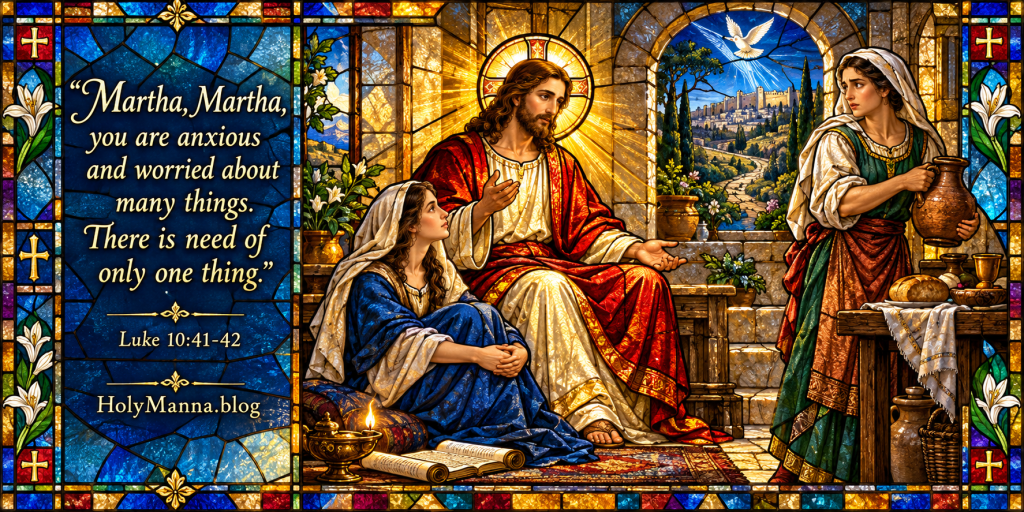
“Martha, Martha, you are anxious and worried about many things.
There is need of only one thing.
Mary has chosen the better part
and it will not be taken from her.”
Detailed Exegesis
Verse 38: “Jesus entered a village where a woman whose name was Martha welcomed him.”
Martha is the householder here, and her welcome is genuine hospitality, a virtue Scripture praises from Abraham onward. Nothing in this Gospel condemns her service; the Lord Himself accepted it. The question the passage raises is not whether to serve but what must come first.
Verse 39: “She had a sister named Mary who sat beside the Lord at his feet listening to him speak.”
Mary takes the disciple’s seat. The verb tense in Greek suggests continuous listening; she settled in. Before she ever does anything for Jesus, she lets Jesus do something for her, filling her with His word.
Verse 40: “Martha, burdened with much serving, came to him and said, ‘Lord, do you not care that my sister has left me by myself to do the serving? Tell her to help me.’”
The word translated “burdened” means pulled apart, dragged in different directions. Martha’s real problem is not the serving but the fragmentation, and it curdles into resentment and even an accusation against the Lord Himself: “do you not care?” Anxiety, left unchecked, always ends up questioning God’s love.
Verse 41: “The Lord said to her in reply, ‘Martha, Martha, you are anxious and worried about many things.’”
The doubled name is tenderness, not scolding. Scripture reserves it for moments of deep personal address: “Simon, Simon,” and on the Damascus road, “Saul, Saul.” The same voice that called Paul by name now calls Martha, diagnosing not her work but her worry.
Verse 42: “There is need of only one thing. Mary has chosen the better part and it will not be taken from her.”
The “one thing” is the Lord Himself, received in listening love. Jesus does not say Martha chose a bad part; He says Mary chose the “better” one, and it is permanent. Meals end, dishes return, projects expire, but union with God “will not be taken.” It is the only investment that survives death.
Teachings
Saint Augustine preached on this exact passage in his Sermon 103 and Sermon 104, and his words remain unmatched: “Martha was troubled, Mary was feasting; the one was arranging many things, the other had her eyes upon the One.” In Sermon 104 he sharpens the contrast: “Martha was intent, how she might feed the Lord; Mary intent how she might be fed by the Lord.” And he lifts the scene into eternity: “In Martha was the image of things present, in Mary of things to come. What Martha was doing, that we are now; what Mary was doing, that we hope for.” Heaven, in other words, is Mary’s posture made permanent.
Saint Gregory the Great, in his Moralia on Job, reads the two sisters as the active and contemplative lives, teaching that action is necessary and good, yet contemplation is greater because it begins on earth the very joy that never ends in heaven. Saint Teresa of Ávila, Doctor of the Church, taught in The Interior Castle that in a mature soul Martha and Mary must finally join together, service flowing out of deep prayer rather than competing with it. The Catechism gathers this tradition into its teaching on contemplation. CCC 2715 states: “Contemplation is a gaze of faith, fixed on Jesus. ‘I look at him and he looks at me’: this is what a certain peasant of Ars in the time of his holy curé used to say while praying before the tabernacle.”
Reflection
Most readers of this blog are Marthas by necessity: jobs, commutes, kids, ministries, group chats that never stop. Jesus is not asking anyone to abandon responsibility; He is asking that responsibility stop being the first thing. A concrete practice: choose one fixed daily appointment at His feet, fifteen minutes with the day’s Gospel, a visit to the tabernacle, a decade of the Rosary before opening email, and guard it the way any other unmissable meeting is guarded. When anxiety rises mid-day, borrow Martha’s honesty but redirect it, telling the Lord plainly what feels heavy. Which “many things” are currently crowding out the one thing in your life? And if Jesus said your name twice today, gently, what worry would He be naming?
The Voice That Knew You First
Step back and watch the readings fold into a single story. A zealous man discovers he was set apart before birth. A psalmist realizes he was knit together in secret by hands that never stopped watching. A woman in Bethany sits down at the feet of God made flesh, and He declares that she has found the one thing that can never be taken away. Three scenes, one truth: God’s knowing, calling love always arrives before human effort, and the soul’s first job is to receive it.
This is genuinely countercultural. The world hands out worth based on productivity, and even good Catholics can quietly turn the faith into a performance review. Today the Church answers with Paul, David, and Mary of Bethany: grace comes first. The persecutor did not earn his apostleship. The psalmist did not knit himself. Mary did not cook her way into the better part. Each simply let God be first, and everything fruitful in their lives grew from that surrender.
So here is the call to action for this Tuesday, October 6th. Before the day ends, sit at His feet on purpose. Open Luke 10, read it slowly, and let the Lord say a name twice, tenderly, the way He said “Martha, Martha.” Bring Him the anxiety, the unfinished list, the past that feels disqualifying, and trade it all for the “one thing.” Then rise and serve, because Martha’s work still needs doing, but do it as someone who has already been fed. The everlasting way begins at His feet, and the prayer for the road is already written: “Guide me, Lord, along the everlasting way.”
Engage With Us!
The conversation does not end here, and every reflection shared helps someone else walking the same road. Share what struck your heart in the comments below; a single honest sentence might be exactly what another reader needs today.
Here are some questions to pray with and respond to:
- From Galatians 1:13-24: Paul says the churches “glorified God because of me” when they saw his transformation. What change in your life, past or still in progress, could lead others to glorify God?
- From Psalm 139:1b-3, 13-15, 24: The psalmist thanks God for being “fearfully, wonderfully made.” What makes it hard to pray that verse honestly, and what would help you mean it?
- From Luke 10:38-42: Jesus told Martha she was “anxious and worried about many things.” Which “many things” most often pull you away from sitting at His feet, and what is one practical way to protect time with Him this week?
- On the uniting message of all the readings: God knew, formed, and called you before you ever did a single thing for Him. How does letting grace come first change the way you approach your work, your relationships, and your prayer?
Living a life of faith is not about impressing God with output; it is about receiving His love first and letting everything else overflow from it. Whatever this week holds, choose the better part daily, and do everything in it with the love and mercy Jesus taught us.
Sacred Heart of Jesus, we trust in You!
Immaculate Heart of Mary, pray for us!
Saint Michael the Archangel, defend us in battle!
Follow us on YouTube, TikTok, Instagram and Facebook for more insights and reflections on living a faith-filled life.


Leave a comment