Divine Mercy Found a Messenger
Every so often, God reaches into the most overlooked corner of the world and pulls out someone who changes everything. In the 20th century, a century of trenches, gulags, and gas chambers, He reached into a tiny Polish farming village and chose a girl with 3 years of schooling, no dowry, and no prospects. Her name was Helena Kowalska. The Church now knows her as Saint Faustina Kowalska, Virgin, Sister of Our Lady of Mercy, and the Apostle of Divine Mercy, celebrated on October 5th with an Optional Memorial on the General Roman Calendar.
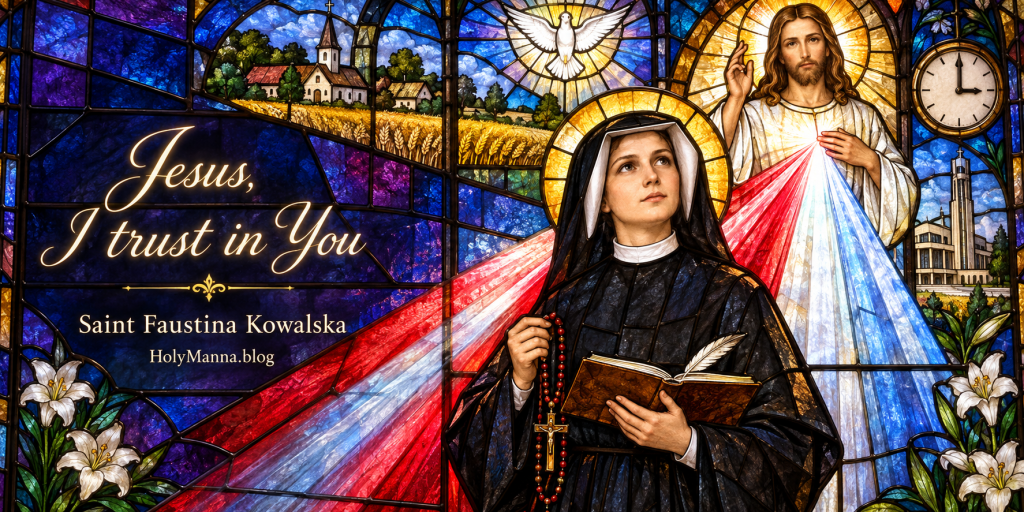
If you have ever seen the image of Jesus with red and pale rays streaming from His Heart above the words “Jesus, I trust in You”, you have already met her legacy. If you have ever prayed the Chaplet of Divine Mercy at 3 o’clock, or celebrated Divine Mercy Sunday on the Sunday after Easter, you have prayed inside the mission God gave to this hidden nun. Her Diary, written under obedience in convent notebooks, has been translated into more than 20 languages and has become one of the most read spiritual works of modern times. Saint John Paul II canonized her on April 30th, 2000, making her the first saint raised to the altars in the new millennium, and on that same day he gave the whole Church the Feast of Divine Mercy she had asked for.
In canonizing her, the Church did what The Catechism describes: by solemnly proclaiming that a member of the faithful practiced heroic virtue, “the Church recognizes the power of the Spirit of holiness within her” (CCC 828). Together with Saint John Paul II, Saint Faustina was named a patron of World Youth Day 2016 in Kraków, a fitting honor for a saint whose message speaks so directly to a generation hungry for mercy.
A Farm Girl Who Could Not Outrun God
Helena Kowalska was born on August 25th, 1905 in Głogowiec, a small village near Łódź in a Poland that did not yet exist on any map, since her homeland was then carved up under the Russian partition. She was the third of 10 children born to Stanisław and Marianna Kowalski, peasant farmers who were poor in everything except faith. Her father rose before dawn to sing the traditional Polish hours of Our Lady while he worked. Helena was baptized in the parish church of Świnice Warckie, and by the age of 7 she was already sensing a call from God during Vespers before the Blessed Sacrament.
Her circumstances gave her almost nothing to work with. She attended school for only about 3 years. At 16 she left home to work as a domestic servant in Aleksandrów Łódzki and later in Łódź, sending money back to help her family. When she asked her parents for permission to enter a convent, they refused; there was no money for the dowry and wardrobe that religious life then required. So Helena did what a lot of young people do with a calling that scares them. She tried to drown it out.
In 1924, she went with her sister to a dance in Park Wenecja in Łódź. In the middle of the music, she saw Jesus at her side, stripped and covered with wounds, and she recorded His words in her Diary: “How long shall I put up with you and how long will you keep putting Me off?” (Diary, 9). She slipped out of the dance, went straight to the Cathedral of Saint Stanislaus Kostka, prostrated herself before the Blessed Sacrament, and heard the command to leave for Warsaw at once. She went with little more than the dress she was wearing.
Warsaw did not exactly roll out a welcome. She knocked on the doors of numerous convents and was turned away again and again; a poor servant girl with no education was not what most communities were looking for. Finally the superior of the Congregation of the Sisters of Our Lady of Mercy on Żytnia Street agreed to accept her, on the condition that she first work to pay for her own wardrobe. Helena spent about a year as a housekeeper for the Lipszyc family in Ostrówek near Warsaw, saving every coin, and entered the convent on August 1st, 1925, a few weeks before her 20th birthday. On April 30th, 1926 she received the habit and a new name, Sister Maria Faustina of the Blessed Sacrament. By a striking act of providence, she would be canonized exactly 74 years later, on April 30th, 2000. She made her first vows in 1928 and her perpetual vows on May 1st, 1933 in Kraków. For the rest of her short life she served in the congregation’s houses in Warsaw, Płock, Vilnius, Kraków, and elsewhere, always in the humblest roles: cook, gardener, and doorkeeper.
Visions in the Convent Kitchen
Here is what makes Faustina’s story so startling. Nothing about her external life changed. She peeled potatoes, tended the garden, and answered the door. And in the middle of that hidden routine, heaven opened.
On February 22nd, 1931, in her cell in Płock, she saw Jesus clothed in a white garment, one hand raised in blessing, the other touching His garment at the breast, with two great rays streaming forth, one red and one pale. She recorded His command: “Paint an image according to the pattern you see, with the signature: Jesus, I trust in You” (Diary, 47), along with His promise, “I promise that the soul that will venerate this image will not perish” (Diary, 48). Faustina could not paint, and when she told her confessors, some dismissed her. The burden of carrying a command she could not fulfill weighed on her for years.
God’s answer came in Vilnius, where she was transferred in 1933. There she met Father Michał Sopoćko, a priest and professor who became her confessor and spiritual director, and whom the Church herself beatified in 2008. Sopoćko was no pushover. He first ordered a full psychiatric evaluation of Sister Faustina, which she passed with a clean bill of mental health, and only then took her mission seriously. He directed her to write down everything the Lord told her, which is how the Diary came to exist, and in 1934 he commissioned the artist Eugeniusz Kazimirowski to paint the image under Faustina’s direction. When she saw the finished canvas, she wept because it could not capture the beauty of the Lord she had seen. She then recorded the answer she received: “Not in the beauty of the color, nor of the brush lies the greatness of this image, but in My grace” (Diary, 313). That image was first publicly venerated at the Gate of Dawn in Vilnius from April 26th to 28th, 1935, during the closing celebrations of the Jubilee of the Redemption, and Father Sopoćko preached on Divine Mercy.
The graces kept coming. In September 1935 she received the Chaplet of Divine Mercy, a short prayer offered on ordinary rosary beads pleading the Passion of Jesus for mercy on the whole world (Diary, 474 to 476). She was taught to honor 3 o’clock in the afternoon, the hour of Christ’s death, as the Hour of Mercy. And she recorded the Lord’s desire for a feast of mercy on the Sunday after Easter, with an astonishing promise attached: “On that day the very depths of My tender mercy are open” (Diary, 699). She also recorded words that sum up the entire message: “Mankind will not have peace until it turns with trust to My mercy” (Diary, 300), and, even more simply, “I am Love and Mercy itself” (Diary, 1074).
The official Vatican biography published for her canonization states that her convent years were filled with extraordinary gifts, listing revelations, visions, hidden stigmata, participation in the Passion of the Lord, bilocation, the reading of souls, prophecy, and the rare grace of mystical espousal. It matters to be precise here. Faustina worked no public healing wonders during her lifetime; no crowds followed her, and almost no one outside her confessors knew what was happening in her soul. Her miracles during life were interior, and they belong to the category the Church calls private revelation. The Catechism teaches that such revelations, when recognized by the Church’s authority, do not add to the deposit of faith but exist “to help live more fully by it in a certain period of history” (CCC 67). That is exactly what the Church, after decades of rigorous examination, judged Faustina’s revelations to be: a God-given help for living the Gospel of mercy in a merciless century. And the heart of that Gospel is not new at all, for as The Catechism teaches, “The Gospel is the revelation in Jesus Christ of God’s mercy to sinners” (CCC 1846).
What should the reader emulate in her? Not the visions, which are pure gift, but the response. Faustina turned mercy into a daily practice inside a completely ordinary life. Her own prayer shows the method: “Help me, O Lord, that my eyes may be merciful, so that I may never suspect or judge from appearances, but look for what is beautiful in my neighbors’ souls and come to their aid” (Diary, 163). She went on to ask the same for her ears, her tongue, her hands, her feet, and her heart. That prayer is available to anyone, no mystical graces required.
The Long, Dark Road of Trust
Saint Faustina was not a martyr, but her road was steep, and she climbed it in the dark more often than in the light.
Inside the convent, she suffered from the very ordinariness that hid her. Some of her fellow sisters found her piety suspect and her claims impossible; a barely educated cook reporting conversations with Jesus invited mockery, and she received her share of it. Some superiors and confessors doubted her, and for a soul under obedience, that doubt cut deep. She also passed through what the great mystics call the dark night, long stretches when the God who had spoken to her so intimately seemed utterly absent, and she had to walk forward on naked trust. The very word she attached to the image, trust, was not a slogan for her. It was the muscle she had to use every single day.
Then came the physical suffering. Tuberculosis attacked first her lungs and then her digestive tract, and in its early stages her illness was misunderstood; when she grew too weak for heavy convent work, some assumed she was lazy or feigning. The disease was real, and it was merciless. She spent long months at the Prądnik sanatorium in Kraków, from late 1936 into 1937 and again in 1938, surrounded by the dying, and she used even that ward as a mission field, praying with and for the souls around her. The Vatican biography records that she accepted her immense sufferings as a voluntary sacrifice offered for sinners, uniting her pain to the Passion of her Lord.
Through it all, she held a quiet certainty about God’s plan. She wrote in her Diary: “I feel certain that my mission will not come to an end upon my death, but will begin” (Diary, 281). On the evening of October 5th, 1938, at the convent in Kraków-Łagiewniki, Sister Maria Faustina died peacefully at about 10:45, worn out by tuberculosis and sacrifice. She was 33 years old, the age of her crucified Lord. She was buried in the convent cemetery, mourned by her community, and completely unknown to the world.
The Spark That Set the World Ablaze
Her prophecy came true almost immediately. Within a year of her death, Poland was invaded and the Second World War engulfed the world in exactly the kind of darkness that makes mercy either laughable or absolutely necessary. Polish Catholics chose necessary. Devotion to the Divine Mercy spread through occupied Poland and traveled with Polish soldiers and refugees across the globe. In 1943 the artist Adolf Hyła painted a new version of the image as a votive offering; placed in the convent chapel at Łagiewniki, it became the most reproduced sacred image of the modern era.
Then came a twist that only God could write. In 1959 the Holy Office in Rome banned the devotion in the forms Faustina had proposed, a decision later traced in large part to faulty translations of her Diary and incomplete information. For nearly two decades the message sat under an official cloud. The man who lifted the cloud was the Archbishop of Kraków, Karol Wojtyła. He opened the informative process into her life and virtues in 1965, had her remains transferred from the cemetery to the Łagiewniki chapel in 1966, and commissioned the theologian Father Ignacy Różycki to produce a rigorous analysis of the Diary. The ban was lifted in April 1978. Six months later, Karol Wojtyła walked onto the balcony of Saint Peter’s as Pope John Paul II, and in 1980 he gave the Church an entire encyclical on Divine Mercy, Dives in Misericordia.
The Church demands miracles before raising anyone to the altars, and Faustina’s cause received two remarkable ones. The first concerned Maureen Digan of Massachusetts. Struck in her teens by lymphedema, a progressive and incurable disease, she endured roughly 50 operations, lost a leg, and lost her faith along the way. In March 1981, at her husband’s urging, she traveled to Faustina’s tomb at Łagiewniki. Praying there, skeptical and in pain, she reported hearing interior words from Faustina: “If you ask for my help, I will give it to you”, and her pain simply stopped. Back in the United States, five independent doctors examined her and concluded she was completely healed with no medical explanation. The Church recognized the healing as a miracle in 1992, and Faustina was beatified by John Paul II on April 18th, 1993, on Divine Mercy Sunday.
The second miracle touched Father Ronald Pytel, pastor of Holy Rosary Parish in Baltimore, a church that serves as a diocesan shrine of the Divine Mercy. In 1995, calcification of his aortic valve left him with a permanently damaged left ventricle, and his cardiologist, a world-renowned specialist from Johns Hopkins, judged that his heart would never be normal. On October 5th, 1995, the anniversary of Faustina’s death, his parish gathered to pray for his healing through her intercession. Venerating her relic, he collapsed, felt paralyzed yet completely at peace, and at his next examination his cardiologist found the heart healed. Vatican medical experts evaluated the healing as scientifically unexplainable, the theological commission attributed it to Faustina’s intercession, and the decree was promulgated in the presence of John Paul II on December 20th, 1999. Father Pytel himself always insisted that Faustina had simply put in a word with Jesus, and that it was the Lord’s own Heart that touched his. Both healings were subjected to the Church’s exhaustive verification process, a living confirmation of what The Catechism teaches about the saints in glory, namely that “they do not cease to intercede with the Father for us” (CCC 956).
On April 30th, 2000, before an overflowing Saint Peter’s Square, John Paul II canonized Sister Maria Faustina Kowalska as the first saint of the new millennium and, in the same celebration, established Divine Mercy Sunday for the universal Church. In his homily he presented her life and witness to the whole Church as “a gift of God for our time”. Two years later, on August 17th, 2002, he consecrated the great Basilica of Divine Mercy at Kraków-Łagiewniki and entrusted the entire world to Divine Mercy, invoking the prophecy Faustina had recorded about her homeland: “From her will come forth the spark that will prepare the world for My final coming” (Diary, 1732). The shrine at Łagiewniki now draws an estimated 2 million pilgrims each year, and the Vilnius Shrine of Divine Mercy houses the original Kazimirowski image, making both cities major destinations of Divine Mercy pilgrimage.
The story kept unfolding in ways no novelist would dare invent. John Paul II, the pope of Divine Mercy, died on April 2nd, 2005, on the vigil of Divine Mercy Sunday. He was beatified on Divine Mercy Sunday in 2011 and canonized on Divine Mercy Sunday in 2014. In 2016, World Youth Day came to Kraków under the theme of the merciful, with Saint Faustina and Saint John Paul II as its patrons, and millions of young people prayed at her tomb during the Jubilee of Mercy. Finally, on May 18th, 2020, the 100th anniversary of John Paul II’s birth, Pope Francis inscribed her Optional Memorial into the General Roman Calendar, so that on October 5th the whole Church now honors her at the altar. Beyond the two approved miracles, shrines of the Divine Mercy around the world continue to receive countless testimonies of healings, conversions, and graces attributed to her intercession; these are told and treasured as testimonies of the faithful, and they cannot be individually verified.
Trust on an Ordinary Day
It would be easy to file Saint Faustina under “mystic” and admire her from a safe distance. That would miss the point of her entire life. Strip away the visions and what remains is this: a young woman with no advantages, doing repetitive and invisible work, who decided to trust Jesus completely and to treat every person who crossed her path as a candidate for mercy. That life is available to you today.
Start with receiving mercy, because no one can give what they have not received. Faustina’s message drives souls back to the confessional, where, as The Catechism teaches, those who approach the sacrament of Penance “obtain pardon from God’s mercy for the offense committed against him” (CCC 1422). When was your last honest Confession, and what is really keeping you from going back? The promise attached to Divine Mercy is not for the people who have it all together. It is for the ones who are certain they have wrecked things beyond repair. Faustina’s Lord is emphatic that no sin outweighs His mercy for the soul that trusts.
Then move to giving mercy, because Faustina insisted that trust in God and mercy toward neighbor are two halves of one devotion. The Catechism defines the works of mercy as “charitable actions by which we come to the aid of our neighbor in his spiritual and bodily necessities” (CCC 2447), and Faustina practiced them with potatoes and door handles, not grand gestures. Practical ways to follow her are almost embarrassingly simple. Set a quiet alarm for 3 o’clock in the afternoon and pause for even 60 seconds to say, “Jesus, I trust in You,” uniting yourself to the hour of His death. Learn the Chaplet of Divine Mercy; it takes about 7 minutes on the beads already sitting in your drawer. Pray Faustina’s prayer from Diary, 163 over your eyes, ears, tongue, hands, feet, and heart, and then pick one of them to convert this week. Perform one hidden act of mercy each day that no one will ever discover. Go to Confession monthly, and plan now to celebrate Divine Mercy Sunday on the Sunday after Easter.
Where in your life have you stopped trusting God, quietly deciding that some situation, some person, or some sin of yours is beyond His reach? Faustina would tell you that this exact spot is where the rays from His Heart are aimed. And who in your daily routine, the coworker, the family member, the stranger at the door, is waiting for you to be the mercy of Jesus to them? She answered doors for a living. So, in the end, does every Christian.
Engage With Us!
Saint Faustina’s story is not finished, because the mission she said would begin at her death is still running through the lives of ordinary believers, which now includes you. Share your thoughts and reflections in the comments below; your experience of Divine Mercy might be exactly what another reader needs today. Here are some questions to get the conversation going.
- What does the signature on the Divine Mercy image, “Jesus, I trust in You,” actually cost you to say right now, and in what area of life is it hardest to mean it?
- Saint Faustina was rejected by numerous convents before one accepted her. How have rejections or closed doors in your own life turned out to be part of God’s plan?
- Her holiness was hidden inside cooking, gardening, and answering doors. What ordinary task in your day could become your own school of mercy?
- Maureen Digan had lost her faith before the healing that led to Faustina’s beatification. Have you ever received mercy at a moment when you were not even looking for God?
- Which of the works of mercy described in CCC 2447 could you commit to practicing this week, and for whom?
May the witness of Saint Faustina Kowalska remind every reader that no soul is too far gone, no life too small, and no century too dark for the mercy of God. Live this week with her signature written over your heart, trust Jesus with the thing you have been holding back, and do everything, from the biggest decision to the smallest chore, with the love and mercy that Jesus taught us.
Saint Faustina Kowalska, Apostle of Divine Mercy, pray for us!
Follow us on YouTube, TikTok, Instagram and Facebook for more insights and reflections on living a faith-filled life.


Leave a comment