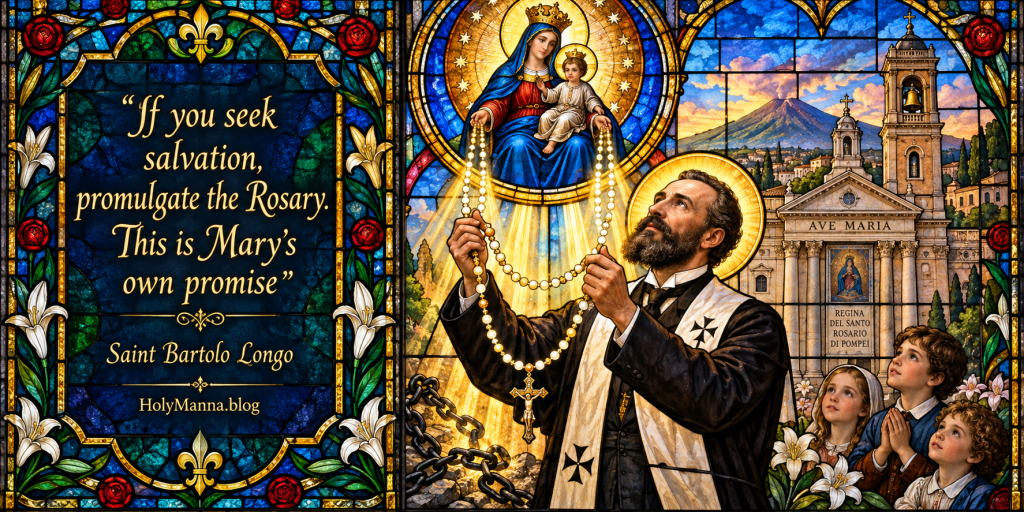
The Devil’s Priest Who Became Our Lady’s Knight
Every so often the Church canonizes a saint whose story answers one specific objection, the one whispered in the dark at three in the morning: someone has gone too far, and God cannot want them back. Saint Bartolo Longo, layman, husband, lawyer, Third Order Dominican, and Apostle of the Rosary, is the Church’s thunderous answer to that whisper. He renounced the faith outright, threw himself into spiritism and the occult, and was formally consecrated as a priest of a satanic sect. This same man then built one of the greatest Marian shrines on earth, the Pontifical Shrine of Our Lady of the Rosary of Pompeii, raised generations of orphans and children of prisoners, and died with Our Lady’s name as his last longing. Pope Saint John Paul II beatified him on October 26th, 1980, and Pope Leo XIV canonized him in Saint Peter’s Square on October 19th, 2025, among the first saints of the new pontificate. His feast is kept on October 5th, the day he entered eternal life in 1926.
The Church teaches that by canonizing certain of the faithful she “proclaims that they practiced heroic virtue and lived in fidelity to God’s grace” and holds them up as models and intercessors, as The Catechism explains in CCC 828. In Bartolo Longo the model is startling and the message is simple. No one is beyond the reach of grace, and the Rosary is a lifeline strong enough to pull a soul back from the edge of hell itself.
A Rosary Planted in Puglia, Uprooted in Naples
Bartolo Longo was born on February 10th, 1841 in Latiano, a small town near Brindisi in the Puglia region of southern Italy, then part of the Kingdom of the Two Sicilies. His family was wealthy and devoutly Catholic. His father was a physician who loved music, and the household prayed the Rosary together daily, a detail that would prove decisive decades later. His mother died when Bartolo was only about ten years old, a wound that marked his childhood. He was educated by the Piarist Fathers, and it was in those school years that he absorbed the habit of praying the Rosary every day. Even in his darkest years he never fully let go of that thread, and the priest who now directs the historical archive of the Pompeii shrine has observed that it was precisely through that small door that Mary triumphed over his heart and brought him back to Christ.
In 1863 the young Longo moved to Naples to complete his law studies, and there everything unraveled. Italy in the 1860s was boiling with anticlerical fervor, and the university was saturated with it. Bartolo read the skeptics of his day, embraced a positivism that denied any supernatural reality, and joined loudly in the fashionable contempt for the Church. But a heart cannot live long on pure denial; he did not become a man who believed in nothing, he became a man who would believe in almost anything. He was drawn into the spiritist circles then flourishing in Naples, attended séances, practiced occult rituals, and gave himself over so completely that, after a period of fasting and preparation, he was formally consecrated as a priest of the sect. Catholic accounts of his life describe this as a satanic priesthood, and Longo himself later understood his spiritism as nothing less than service of Satan. He even preached publicly against the Catholic faith. The Catechism names exactly what he had fallen into when it condemns “all forms of divination” and warns that “spiritism often implies divination or magical practices,” teaching that recourse to such things contradicts the honor and reverence owed to God alone, as stated in CCC 2116 and CCC 2117.
The wages of that priesthood were paid quickly. His health collapsed. He was tormented by nervous exhaustion, anxiety, and a crushing depression that brought him near despair. Into that darkness stepped a friend, the professor Vincenzo Pepe, who loved him enough to be blunt. Accounts of the saint’s life consistently report Pepe confronting him with a piercing question, “Do you want to die in an insane asylum and be damned forever?” The exact wording varies slightly across the tellings, but the confrontation itself belongs to the settled record of his conversion. Pepe brought his broken friend to a Dominican, Father Alberto Radente, who heard Bartolo’s confession over the course of about a month and became his spiritual father for life. This is the sacrament working exactly as the Church describes it, for The Catechism teaches in CCC 1468 that “the whole power of the sacrament of Penance consists in restoring us to God’s grace and joining us with him in an intimate friendship.” Around the same time he came to know Saint Caterina Volpicelli, a holy Neapolitan woman canonized in 2009, whose circle of devout friends prayed for him and drew him into a life of charity.
His conversion was not a private mood; it demanded a public break. Reconciled and resolute, Bartolo walked into one final séance, lifted up a sign of the Blessed Virgin before the assembly, and declared, “I renounce spiritism because it is nothing but a maze of error and falsehood.” The sources differ on whether he raised a rosary or a medal of Our Lady in that moment, and honesty requires saying so, but his renunciation itself is firmly attested. On March 25th, 1871, the Solemnity of the Annunciation, he was received into the Third Order of Saint Dominic and took a new name that was really a mission statement, Fratel Rosario, Brother Rosary. The Church calls this movement of the heart a “radical reorientation of our whole life, a return, a conversion to God with all our heart,” as The Catechism teaches in CCC 1431, and Bartolo Longo lived it to the letter.
A Vow in the Valley and a City Born of Faith
Conversion did not instantly heal him. In 1872 Longo traveled to the Valley of Pompeii as legal administrator for the estates of a widowed noblewoman, Countess Marianna De Fusco, and what he found there appalled him. The ancient city buried by Vesuvius in the year 79 was a ruin, but the living valley beside it was a spiritual ruin, a malaria ridden countryside of desperate poverty, superstition, and near total religious ignorance, where the little church stood mostly empty. Worse, his own past rose up to strangle him. He became convinced that his old consecration still bound him to Satan, and by his own testimony he fell into a despair so black that he contemplated ending his life.
What happened next comes to us from his own memoirs, in his own words, which is what gives the account its extraordinary strength. He wrote, “I felt my heart bursting. In such darkness of soul, a friendly voice seemed to whisper in my ear those words that I myself had read and that my holy friend, now deceased, often repeated to me: If you seek salvation, spread the Rosary. These are Mary’s promises. Those who propagate the Rosary are saved!” The promise itself, that whoever propagates the Rosary will be saved, belongs to the cherished tradition of Our Lady’s words to Saint Dominic, a devotional tradition rather than documented history, but for Bartolo it landed like lightning. He continued, “Falling to my knees, I exclaimed: ‘If your words are true that he who propagates your Rosary will be saved, I shall reach salvation because I shall not leave this earth without propagating your Rosary.’ At that moment the little bell of the parish church rang out, inviting the people to pray the Angelus.” He took the bell as a signature upon his vow, and he kept that vow for fifty four years.
He began with almost nothing. He gathered the farmers and taught them the mysteries of the Rosary. Beginning in 1873 he organized an annual festival in honor of Our Lady of the Rosary, complete with music, fireworks, and games, because he understood something every evangelist of the young should remember, that joy draws souls where lectures cannot. In 1875 he promised the people that a mission would close with the enthronement of an image of Our Lady of the Rosary, and then he had to find one. Through his confessor Father Radente he received a battered old canvas of Our Lady of the Rosary with Saints Dominic and Catherine of Siena, which Radente had once bought from a junk shop dealer in Naples for a trifling sum and left in the keeping of a nun, Sister Maria Concetta de Litala. Longo recorded his own dismay at the painting’s condition and poor artistic quality. According to his own written account, the canvas arrived in Pompeii on November 13th, 1875 carried atop a cart of manure, a humiliation he came to treasure as a parable of grace; the charming detail rests on his testimony. He had the image restored and enthroned, and almost at once the reports of miracles began.
Tradition holds that the first grace was the healing of a young woman named Clorinda Lucarelli, afflicted with violent epileptic seizures, who was restored to health after prayer before the image. This healing circulates widely in Catholic sources, but its documentation is devotional rather than the product of a formal juridical process, and it cannot be independently verified. What is beyond dispute is what followed. Pilgrims began to pour into the valley, three hundred local families pledged a penny a month, and on May 8th, 1876, with the blessing of the Bishop of Nola, the cornerstone of a great new church was laid. The church was consecrated in 1891 and would eventually be enlarged into the magnificent basilica that today receives millions of pilgrims each year. Around it Longo built not just a shrine but a civilization, with schools, workshops, housing, and a printing press, so that the modern city of Pompei quite literally grew up around a Rosary. The Archbishop of Pompeii has said that Longo was not only the founder of a sanctuary but the founder of a new city, a city born of faith.
One reported event from those years deserves careful telling. In 1884 a gravely ill girl of Naples, Fortuna Agrelli, was said to have been healed after a novena of Rosaries during which Our Lady appeared to her as the Virgin of the Rosary of Pompeii, asking for three novenas of petition and three of thanksgiving. From this account grew the beloved Fifty Four Day Rosary Novena still prayed around the world. This is a private revelation; the Church has never issued a formal judgment on the apparition itself, even as the devotion that flowed from it spread with ecclesiastical encouragement, and the story cannot be verified as established historical fact.
Longo’s apostolate of the pen was just as tireless. In 1883 he composed the famous Supplica, the Petition to Our Lady of the Rosary of Pompeii, which is still prayed by millions at noon every May 8th and on the first Sunday of October, uniting the whole Catholic world to that once forgotten valley. He promoted the devotion of the Fifteen Saturdays, wrote books and novenas, and founded a magazine to spread the Rosary. He summed up his entire program in a single line, “What is my vocation? To write about Mary, to have Mary praised, to have Mary loved.” The Church has always cherished exactly this instinct, for The Catechism teaches in CCC 971 that the Church’s devotion to the Blessed Virgin “finds its expression in the liturgical feasts dedicated to the Mother of God and in Marian prayer, such as the rosary, an ‘epitome of the whole Gospel.’”
His charity matched his devotion, because for Longo the two were one thing. In 1887 he opened an orphanage for girls. In 1892 he did something almost scandalous for his era; he founded a home for the sons of imprisoned criminals, and in 1922 another for their daughters. The fashionable criminology of the day taught that the children of criminals were born delinquents, doomed to repeat their fathers’ crimes. Longo answered that theory not with a pamphlet but with a family, taking in some 135 orphan girls and 70 children of prisoners in his lifetime, educating them, teaching them trades, and proving by their flourishing lives that grace is stronger than heredity. He founded the Dominican Sisters, Daughters of the Holy Rosary of Pompeii, to carry these works forward, and they continue to this day. In all of this he lived what The Catechism calls the works of mercy, “charitable actions by which we come to the aid of our neighbor in his spiritual and bodily necessities,” as taught in CCC 2447, and he embodied the vocation of the laity described in CCC 898, to “seek the kingdom of God by engaging in temporal affairs and directing them according to God’s will.”
There was also a marriage, one of the most unusual in the lives of the saints. For years Longo worked side by side with Countess De Fusco, who funded and championed his works, and eventually gossip began to swirl about the widow and the lawyer. The two brought the matter to their friend Pope Leo XIII, the great pope of the Rosary, and on his counsel they married in 1885. By mutual agreement they lived the marriage in complete continence, as brother and sister, consecrated together to Our Lady and to the orphans of Pompeii, a marriage ordered entirely to mission.
Slandered, Stripped, and Set Free
Bartolo Longo was not a martyr, but his road was steep, and his hardships came in three long waves. The first was interior. For years after his conversion he carried the terror that his satanic consecration had marked him permanently, a scrupulous dread that God’s mercy had an exception clause with his name on it. His vow in the valley was the breaking of that dread, but the memory of his past never left him; it became instead the engine of his gratitude. The Church answers his old fear directly, teaching in CCC 982 that “there is no offense, however serious, that the Church cannot forgive,” and that Christ “desires that the gates of forgiveness should always be open to anyone who turns away from sin.” Longo’s entire life is that paragraph written in stone and brick and orphans’ laughter.
The second wave was calumny. A converted occultist handling enormous sums of money, working in intimate partnership with a wealthy widow, made an irresistible target. He endured decades of whispered accusations, insinuations of impropriety, and charges of financial self dealing around the shrine’s funds. The marriage counseled by Pope Leo XIII answered one set of rumors, but others followed, and they wounded him deeply. He answered them the way the saints answer, with transparency, patience, and silence where silence was the more charitable reply, exercising the virtue The Catechism describes in CCC 1808 as fortitude, “the moral virtue that ensures firmness in difficulties and constancy in the pursuit of the good.”
The third wave was the hardest and the holiest. In 1906, to place his work beyond every suspicion and every attachment, Bartolo Longo gave everything away, handing the entire shrine, its institutions, its funds, and its administration over to the Holy See and retaining nothing for himself. The founder became a guest in his own foundation, spending his final twenty years in poverty, prayer, and quiet service, confessing twice a week and praying his Rosary among the pilgrims. Those who knew him in those years described a man visibly absorbed in God; one inhabitant of Pompeii recalled, “I often saw him with his arms outstretched and his eyes fixed on heaven or on the image of Our Lady, or even with his eyes half-closed, totally enraptured without being aware of those around or near him.” In 1925, near the end of his life, the Church honored him with a knighthood in the Equestrian Order of the Holy Sepulchre of Jerusalem. His beloved wife the Countess died in 1924, and Bartolo followed her on October 5th, 1926, at the age of 85. His last recorded words gather his whole story into a single breath, “My only desire is to see Mary, who has saved me and who will save me from the clutches of Satan.”
The Miracles That Would Not Stop
The call for his canonization began almost as soon as he was buried in the crypt of the basilica he had built, beneath the image he had rescued from a junk shop. Pilgrims prayed at his tomb, and reports of graces and healings attributed to his intercession accumulated through the twentieth century, recorded among the countless ex votos that line the shrine; the individual accounts are testimonies of faith and cannot each be verified. His cause was opened in 1947. For his beatification, one miracle attributed to his intercession was formally examined and recognized in 1979, reported in Catholic sources as the healing of an Italian mother in 1945, though the details are thinly documented in English language accounts. On October 26th, 1980, Pope Saint John Paul II beatified him before a crowd of more than thirty thousand and gave him the title by which the whole Church now knows him, the Apostle of the Rosary.
The popes could not stay away from Pompeii afterward. Saint John Paul II, in his 2002 apostolic letter Rosarium Virginis Mariae, held Blessed Bartolo up by name as a model for the whole Church, quoting his prayer that calls the Rosary the “sweet chain which unites us to God.” Pope Benedict XVI came on October 19th, 2008 to pray at his tomb and asked aloud where this apostle of Mary had found such energy and perseverance, answering that it was the Rosary, accepted as a true gift from Our Lady’s Heart. That visit fell exactly seventeen years to the day before Longo’s canonization.
The final chapter was itself dramatic. No second miracle had been formally recognized, which for decades left the cause suspended. Weighing the exceptional character of his life and the breadth of devotion surrounding him, the Church proceeded by papal dispensation from the second miracle, a decision Pope Francis approved on February 25th, 2025 while hospitalized at Gemelli Hospital, in one of the last major acts of his pontificate. Pope Leo XIV confirmed it at the consistory of June 13th, 2025, and on Sunday, October 19th, 2025, World Mission Sunday, he canonized Saint Bartolo Longo in Saint Peter’s Square alongside six other new saints, among them José Gregorio Hernández, the beloved doctor of the poor of Venezuela, and Peter To Rot, the martyr catechist of Papua New Guinea. With that Mass, Bartolo Longo also became the first canonized knight of the Order of the Holy Sepulchre.
Today the Basilica of Our Lady of the Most Holy Rosary of Pompeii is one of the most visited Marian shrines in the world, drawing millions of pilgrims every year to the valley where a despairing man once heard a bell. Twice a year, at noon on May 8th and on the first Sunday of October, Catholics across the globe pray his Supplica in union with the shrine, so that a prayer written by a former satanic priest now rises to heaven from millions of lips. The city of Pompei itself stands as his living monument, a town that exists because one man kept a vow.
No One Is Too Far Gone
Saint Bartolo Longo’s life presses three truths into the hands of anyone willing to receive them. The first is that despair is a liar. Bartolo believed, with what felt like ironclad logic, that his consecration to Satan had settled his eternal fate. The Church, and Our Lady, disagreed. The Catechism teaches in CCC 1848 that “where sin abounded, grace abounded all the more,” and his story is that verse with a street address. Whatever the reader carries, an abandoned faith, years of serious sin, even flirtation with the occult, the door back is the same door Bartolo used: an honest friend, a good confession, and Our Lady’s Rosary. Is there a corner of your past that you have quietly decided is beyond God’s mercy, and what would it mean to bring it to Confession this week?
The second truth is that the Rosary is not a decoration; it is a rescue rope. Bartolo did not merely pray the Rosary, he propagated it, because he had staked his salvation on Our Lady’s promise. The Catechism describes this meditative prayer in CCC 2708, teaching that meditation engages “thought, imagination, emotion, and desire” to deepen faith and convert the heart. A practical rule of life flows straight from Pompeii: pray at least a decade daily without fail, keep a rosary within arm’s reach, and then do what Bartolo did, give rosaries away and teach one person to pray it. Who in your life is drifting the way Bartolo once drifted, and could you become for them what Vincenzo Pepe was for him?
The third truth is that repentance matures into repair. Father Radente told Bartolo that he had to mend the damage his old life had caused, and the answer was not a feeling but a lifetime of concrete mercy, orphans housed, prisoners’ children educated, a wasteland rebuilt. Conversion that never becomes charity is only half converted. Consider adopting one of Bartolo’s own works in miniature: support a prison ministry, mentor a young person the world has written off, or serve the poorest family in the parish. If grace has rebuilt any part of your life, what is one concrete work of mercy you could begin this month as your act of repair?
Engage With Us!
Saint Bartolo Longo’s story belongs in the comments as much as it belongs in the history books, so readers are warmly invited to share their thoughts, their conversion stories, and their favorite Rosary graces in the comments below. To spark that conversation, here are a few questions for reflection.
- Saint Bartolo believed for years that his past had placed him beyond God’s mercy. What fear or wound have you been holding back from Confession, and what would trusting CCC 982, that no offense is beyond the Church’s power to forgive, look like in your life?
- Bartolo’s rescue began with one blunt, loving friend. Who has been the Vincenzo Pepe in your life, and to whom might God be sending you in that same role?
- He staked everything on a promise attached to the Rosary. What would change in your daily routine if you treated the Rosary as a lifeline rather than an optional devotion?
- In 1906 he gave away everything he had built in order to belong wholly to God. What is one thing, a project, a reputation, a possession, that you sense God inviting you to hold more loosely?
- His repentance became repair through orphanages and homes for prisoners’ children. What concrete work of mercy could become your own valley of Pompeii?
Take heart from the man who was once a priest of darkness and is now a saint of the Rosary. If heaven’s gates opened that wide for Bartolo Longo, they stand open for everyone reading these words. Pick up the beads he loved, return to the sacraments he treasured, and go out to serve the forgotten as he did, doing everything with the love and mercy that Jesus taught us.
Saint Bartolo Longo, pray for us!
Follow us on YouTube, TikTok, Instagram and Facebook for more insights and reflections on living a faith-filled life.


Leave a comment