Monday of the Twenty-seventh Week in Ordinary Time – Lectionary: 461
When Truth Puts on Work Gloves
There is a question hiding inside this Monday of the Twenty-seventh Week in Ordinary Time, October 5th, 2026, and it is uncomfortable in the best way: what good is the true faith if it never gets its hands dirty? The readings of Lectionary 461 hold two things together that the modern world loves to separate, doctrinal truth and practical mercy. Saint Paul opens with fire, pronouncing an anathema on anyone, even “an angel from heaven,” who would tamper with the Gospel received from Jesus Christ. The Galatian churches were being told that Christ was not enough, that salvation needed additions and edits. Paul’s answer is that the Gospel is not his to change, because it “came through a revelation of Jesus Christ.” Psalm 111 then sings the reason such confidence is possible: “The Lord will remember his covenant for ever.” God’s works are “faithful and just,” His precepts “reliable forever and ever.” A trustworthy God gives a trustworthy Gospel. Then The Gospel of Luke reveals what that unchangeable Gospel actually looks like when it walks down a dangerous road. A scholar asks who his neighbor is, and Jesus tells the story of the Good Samaritan, ending not with a definition but with a command: “Go and do likewise.” The central theme uniting these readings is that the one true Gospel, guarded whole and entire, is proven authentic by mercy in action. Truth without love becomes a museum piece, and love without truth becomes a mood. The Church has always insisted on both, and this Monday’s liturgy shows why they were never meant to be separated.
First Reading — Galatians 1:6-12
The Apostle Who Refused to Water It Down
Every other letter of Saint Paul opens with a thanksgiving for the community receiving it. This one does not, and the silence is deafening. Writing around the middle of the first century to the churches of Galatia in central Asia Minor, Paul had just learned that agitators, often called Judaizers, were persuading his converts that faith in Christ required supplementation, especially circumcision and observance of the Mosaic law. This was the very controversy the apostles would settle at the Council of Jerusalem, recorded in Acts 15. For Paul, this was not a dispute over style but over salvation itself, because a Gospel plus anything is no longer the Gospel. His astonishment, his double curse, and his defense of his apostolic credentials all serve the day’s central theme: the Gospel is a gift received from God, not a product developed by men, and it cannot be edited to please an audience.
Galatians 1:6-12
Brothers and sisters:
I am amazed that you are so quickly forsaking
the one who called you by the grace of Christ
for a different gospel (not that there is another).
But there are some who are disturbing you
and wish to pervert the Gospel of Christ.
But even if we or an angel from heaven
should preach to you a gospel
other than the one that we preached to you,
let that one be accursed!
As we have said before, and now I say again,
if anyone preaches to you a gospel
other than the one that you received,
let that one be accursed!Am I now currying favor with human beings or God?
Or am I seeking to please people?
If I were still trying to please people,
I would not be a slave of Christ.Now I want you to know, brothers and sisters,
that the Gospel preached by me is not of human origin.
For I did not receive it from a human being, nor was I taught it,
but it came through a revelation of Jesus Christ.
Detailed Exegesis
Verse 6: “I am amazed that you are so quickly forsaking the one who called you by the grace of Christ for a different gospel.” Paul does not say they are forsaking a doctrine but a person, “the one who called you.” Abandoning the Gospel is never merely an intellectual shift; it is walking away from God Himself, and the speed of the desertion wounds the apostle deeply.
Verse 7: “(not that there is another). But there are some who are disturbing you and wish to pervert the Gospel of Christ.” Paul immediately corrects his own phrase. A “different gospel” is a contradiction in terms, because there is only one. The false teachers are not offering an alternative; they are corrupting the original, and the Greek verb suggests twisting something into its opposite.
Verse 8: “But even if we or an angel from heaven should preach to you a gospel other than the one that we preached to you, let that one be accursed!” Paul places even himself under judgment. The messenger, however impressive, never outranks the message. Not even angelic splendor can authorize a new revelation contrary to the Gospel once delivered.
Verse 9: “As we have said before, and now I say again, if anyone preaches to you a gospel other than the one that you received, let that one be accursed!” The repetition is deliberate solemnity, not carelessness. The key word is “received.” The Gospel is handed on, which is the literal meaning of tradition, and the Church is its steward, never its author.
Verse 10: “Am I now currying favor with human beings or God? Or am I seeking to please people? If I were still trying to please people, I would not be a slave of Christ.” Paul’s enemies apparently accused him of softening the law’s demands to win Gentile approval. His answer is that a people-pleaser does not collect scars, and Paul had plenty. Slavery to Christ is the only freedom from slavery to human opinion.
Verse 11: “Now I want you to know, brothers and sisters, that the Gospel preached by me is not of human origin.” Even amid the rebuke, he calls them “brothers and sisters.” Correction inside the Church is a family matter, driven by love. The Gospel’s origin is the ground of its authority.
Verse 12: “For I did not receive it from a human being, nor was I taught it, but it came through a revelation of Jesus Christ.” Paul points to the Damascus road, where the risen Lord Himself appeared to him. The Gospel is divine revelation, which is precisely why no committee, no culture, and no century may amend it.
Teachings
The Church has guarded this passage as the charter of doctrinal fidelity. The Catechism teaches in CCC 85 that “the task of giving an authentic interpretation of the Word of God, whether in its written form or in the form of Tradition, has been entrusted to the living teaching office of the Church alone. Its authority in this matter is exercised in the name of Jesus Christ.” The Magisterium exists not to invent new gospels but to protect the one received, serving the Word rather than standing above it. In the fifth century, Saint Vincent of Lérins meditated on this very warning about angels preaching otherwise and gave the Church his celebrated rule in the Commonitorium: “Moreover, in the Catholic Church itself, all possible care must be taken, that we hold that faith which has been believed everywhere, always, by all.” History proves the stakes. When the Arian crisis of the fourth century pressured bishops to soften the divinity of Christ, Saint Athanasius endured five exiles rather than alter one syllable of the faith, standing in the same line as Paul before him. The lesson for today is sobering and freeing at once. Every generation faces its own Judaizers, voices insisting the Gospel needs updating to survive. Paul’s anathema is severe because souls are at stake, yet it is also a comfort, because it means the faith handed to believers today is the same faith that came “through a revelation of Jesus Christ.”
Reflection
It is easy to nod along with Paul until the question turns personal: which parts of the Gospel do you quietly edit to make your life more comfortable? Perhaps it is a teaching on forgiveness, on generosity, on chastity, or on Sunday worship. The temptation to preach a customized gospel to oneself is far more common than preaching one from a pulpit. A concrete step this week would be to choose the one Church teaching that feels hardest to accept, then read what the Catechism actually says about it with an open heart, asking the Holy Spirit for docility rather than debate points. Another step is to examine people-pleasing honestly. Paul asked whether he was “currying favor with human beings or God,” and that examination belongs in every believer’s evening prayer. When was the last time you stayed silent about your faith to avoid an awkward moment? Whose approval do you actually work hardest to win, and what would change if it were God’s? Fidelity rarely looks dramatic. Most days it looks like small refusals to bend.
Responsorial Psalm — Psalm 111:1b-2, 5, 7-10c
A Song for a God Who Never Forgets
Psalm 111 is a small masterpiece of Hebrew craftsmanship, an acrostic in which each line begins with a successive letter of the alphabet, as if to say that everything from A to Z belongs in the praise of God. It was sung publicly, “in the company and assembly of the just,” most likely in Temple worship, and it functions as a thanksgiving hymn for God’s covenant fidelity. Positioned between Paul’s defense of the unchanging Gospel and Christ’s parable of mercy, the psalm supplies the logic that connects them. The Gospel can be trusted forever because the God who gave it is “reliable forever and ever,” and mercy can be risked because it imitates a God who “has sent deliverance to his people.”
Psalm 111:1b-2, 5, 7-8, 9, 10c
R. (5) The Lord will remember his covenant for ever.
or:
R. Alleluia.
I will give thanks to the LORD with all my heart
in the company and assembly of the just.
Great are the works of the LORD,
exquisite in all their delights.
R. The Lord will remember his covenant for ever.
or:
R. Alleluia.
The works of his hands are faithful and just;
sure are all his precepts,
Reliable forever and ever,
wrought in truth and equity.
R. The Lord will remember his covenant for ever.
or:
R. Alleluia.
He has sent deliverance to his people;
he has ratified his covenant forever;
holy and awesome is his name.
His praise endures forever.
R. The Lord will remember his covenant for ever.
or:
R. Alleluia.
Detailed Exegesis
The refrain, drawn from verse 5: “The Lord will remember his covenant for ever.” In Scripture, God’s remembering is never nostalgia; it is action. When God remembers Noah, the waters recede, and when He remembers His covenant in Egypt, the Exodus begins. The refrain proclaims that God’s fidelity is not a mood but a promise with a history.
Verse 1b: “I will give thanks to the LORD with all my heart in the company and assembly of the just.” Gratitude here is total, “with all my heart,” and it is communal. Biblical praise is not a private hobby; it happens in the assembly, which is the very meaning of the word from which “church” descends.
Verse 2: “Great are the works of the LORD, exquisite in all their delights.” The psalmist invites study and wonder together. God’s works, creation and redemption alike, reward those who ponder them, and delight is presented as a proper response to theology.
Verses 7 and 8: “The works of his hands are faithful and just; sure are all his precepts, Reliable forever and ever, wrought in truth and equity.” What God does and what God commands share the same character. His precepts are not arbitrary rules but expressions of His own truthfulness, which is exactly why Paul could stake everything on the Gospel’s permanence.
Verse 9: “He has sent deliverance to his people; he has ratified his covenant forever; holy and awesome is his name.” For Israel this meant the Exodus; for the Church it points to the redemption won by Christ, the new and eternal covenant ratified in His Blood. The verse ends in reverence before the divine name.
Verse 10c: “His praise endures forever.” The psalm closes where eternity begins. Kingdoms and trends expire, but the praise of God outlasts them all.
Teachings
The Catechism lingers on the holiness of the divine name that verse 9 proclaims. CCC 2143 teaches that the revealed name of God “belongs to the order of trust and intimacy,” adding, “The Lord’s name is holy.” God’s name is not a label but a self-gift, and Israel’s awe before it was the fruit of covenant closeness, not distance. The psalm’s confidence in God’s covenant memory also illuminates the Eucharist, which the Church celebrates as the memorial in which Christ’s saving deliverance is made present, the ultimate proof that the Lord remembers His covenant forever. Saint Augustine, in his Expositions on the Psalms, consistently reads such psalms as the voice of Christ and His Church praising the Father together, so that when believers sing “His praise endures forever,” they join a song that will never end. The famous line of verse 10, that the fear of the Lord is the beginning of wisdom, frames the entire psalm: reverent trust in a faithful God is where all right thinking starts.
Reflection
The psalmist thanked God “with all my heart” and did it publicly. When you receive good news, who hears about it first, and does God ever make the list? A simple practice for this week is to keep a covenant memory of your own, writing down one concrete way God has been faithful each evening, because gratitude grows wherever it is recorded. Another practice is to bring that thanksgiving to Mass, the assembly of the just, and to mean the words of the liturgy rather than merely reciting them. Do you actually trust that God’s precepts are “reliable forever and ever,” or do you treat some of them as negotiable suggestions? A God who remembers His covenant deserves a people who remember His goodness.
Holy Gospel — Luke 10:25-37
The Question That Tried to Shrink Love
The road from Jerusalem to Jericho drops about 3,300 feet in roughly 17 miles, winding through desert ravines that made perfect cover for bandits; Saint Jerome noted that the route was grimly nicknamed the “Way of Blood.” Jesus sets His most famous parable on that road in answer to a scholar of the law who wanted a boundary line drawn around the word “neighbor.” The choice of a Samaritan hero was scandalous, since Jews and Samaritans had despised each other for centuries over a schism reaching back to the Assyrian conquest and the rival temple on Mount Gerizim. Here the day’s central theme reaches its climax. Paul defended the Gospel’s content, the psalm celebrated the Gospel’s reliability, and now Christ demonstrates the Gospel’s shape, which is mercy that refuses to ask whether the wounded man qualifies.
Luke 10:25-37
There was a scholar of the law who stood up to test Jesus and said,
“Teacher, what must I do to inherit eternal life?”
Jesus said to him, “What is written in the law?
How do you read it?”
He said in reply,
“You shall love the Lord, your God,
with all your heart,
with all your being,
with all your strength,
and with all your mind,
and your neighbor as yourself.”
He replied to him, “You have answered correctly;
do this and you will live.”But because he wished to justify himself, he said to Jesus,
“And who is my neighbor?”
Jesus replied,
“A man fell victim to robbers
as he went down from Jerusalem to Jericho.
They stripped and beat him and went off leaving him half-dead.
A priest happened to be going down that road,
but when he saw him, he passed by on the opposite side.
Likewise a Levite came to the place,
and when he saw him, he passed by on the opposite side.
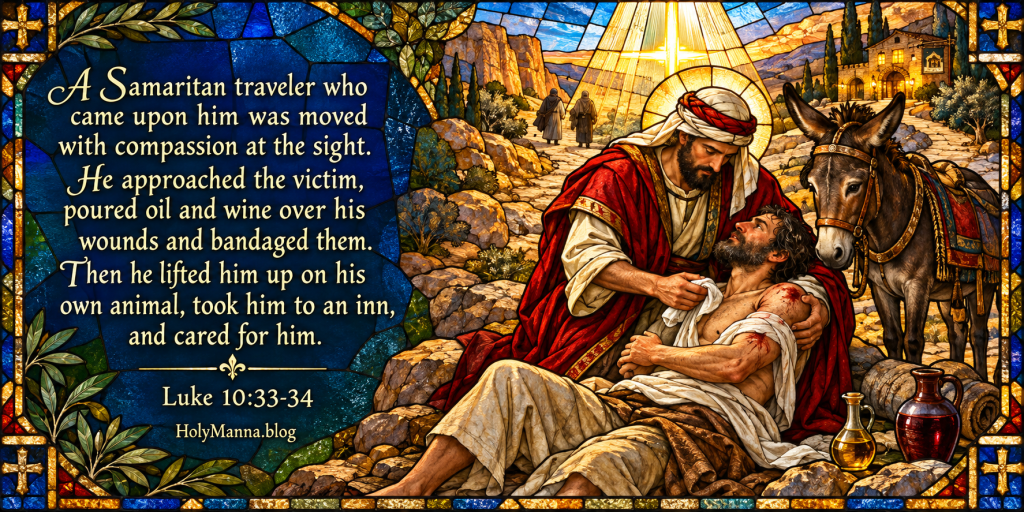
But a Samaritan traveler who came upon him
was moved with compassion at the sight.
He approached the victim,
poured oil and wine over his wounds and bandaged them.
Then he lifted him up on his own animal,
took him to an inn, and cared for him.
The next day he took out two silver coins
and gave them to the innkeeper with the instruction,
‘Take care of him.
If you spend more than what I have given you,
I shall repay you on my way back.’
Which of these three, in your opinion,
was neighbor to the robbers’ victim?”
He answered, “The one who treated him with mercy.”
Jesus said to him, “Go and do likewise.”
Detailed Exegesis
Verse 25: “There was a scholar of the law who stood up to test Jesus and said, ‘Teacher, what must I do to inherit eternal life?’” The question is the greatest one a human being can ask, yet it is posed as a test rather than a plea. Jesus will answer it anyway, because grace works even through mixed motives.
Verse 26: “Jesus said to him, ‘What is written in the law? How do you read it?’” The Master answers a question with a question, honoring the scholar’s expertise while directing him back to God’s Word. Revelation, not debate, holds the answer.
Verse 27: “He said in reply, ‘You shall love the Lord, your God, with all your heart, with all your being, with all your strength, and with all your mind, and your neighbor as yourself.’” The scholar fuses Deuteronomy 6:5 and Leviticus 19:18, the twin commandments Jesus Himself names as the greatest. Love of God and love of neighbor are welded together and cannot be separated without destroying both.
Verse 28: “He replied to him, ‘You have answered correctly; do this and you will live.’” Jesus affirms the answer and then adds the sting: “do this.” Eternal life is not inherited by knowing the right words but by living them.
Verse 29: “But because he wished to justify himself, he said to Jesus, ‘And who is my neighbor?’” The scholar wants a limit, a category small enough to have already fulfilled. Self-justification always tries to shrink love down to a manageable size.
Verse 30: “A man fell victim to robbers as he went down from Jerusalem to Jericho. They stripped and beat him and went off leaving him half-dead.” The victim has no name, nationality, or status; stripped of everything, he is simply a human being in need. That anonymity is the point.
Verses 31 and 32: “A priest happened to be going down that road, but when he saw him, he passed by on the opposite side. Likewise a Levite came to the place, and when he saw him, he passed by on the opposite side.” Both religious professionals see and swerve. Contact with a corpse brought ritual impurity under the law, yet the parable exposes a religion that protects its purity while abandoning its purpose. Both men saw; neither stopped.
Verse 33: “But a Samaritan traveler who came upon him was moved with compassion at the sight.” The Greek verb for compassion describes being moved in one’s inmost being, the same word Luke uses for Jesus Himself and for the father of the prodigal son. The despised outsider carries the very heart of God.
Verse 34: “He approached the victim, poured oil and wine over his wounds and bandaged them. Then he lifted him up on his own animal, took him to an inn, and cared for him.” Compassion becomes ten concrete verbs. Oil soothed and wine disinfected, standard first-century wound care, and walking beside his own animal, the Samaritan takes the vulnerable position on a dangerous road.
Verse 35: “The next day he took out two silver coins and gave them to the innkeeper with the instruction, ‘Take care of him. If you spend more than what I have given you, I shall repay you on my way back.’” Two denarii covered roughly two weeks of lodging. Mercy here has follow-through, an open account, and a promised return.
Verse 36: “Which of these three, in your opinion, was neighbor to the robbers’ victim?” Jesus reverses the question. The scholar asked who deserves his love; Jesus asks who acted with love. Neighbor is not a category to define but an identity to become.
Verse 37: “He answered, ‘The one who treated him with mercy.’ Jesus said to him, ‘Go and do likewise.’” The scholar cannot bring himself to say “the Samaritan,” yet he names the truth: mercy. The parable ends as a commission, and every hearer walks out of it under orders.
Teachings
The Church Fathers heard in this parable the whole drama of salvation. Origen, in his Homilies on Luke, Homily 34, hands on an interpretation he received from an earlier teacher: “One of the elders wanted to interpret the parable as follows. The man who was going down is Adam. Jerusalem is paradise, and Jericho is the world. The robbers are hostile powers. The priest is the Law, the Levite is the prophets, and the Samaritan is Christ. The wounds are disobedience, the beast is the Lord’s body, the pandochium (that is, the stable), which accepts all who wish to enter, is the Church.” In this ancient reading, echoed by Saint Augustine, humanity is the wounded traveler and Christ is the Good Samaritan who binds up fallen human nature and entrusts it to the Church until His return. The Catechism keeps this vision alive in CCC 1465, teaching that in Confession “the priest is fulfilling the ministry of the Good Shepherd who seeks the lost sheep, of the Good Samaritan who binds up wounds, of the Father who awaits the prodigal son and welcomes him on his return.” On the moral level, CCC 1825 teaches that “the Lord asks us to love as he does, even our enemies, to make ourselves the neighbor of those farthest away, and to love children and the poor as Christ himself,” and CCC 1932 adds that “the duty of making oneself a neighbor to others and actively serving them becomes even more urgent when it involves the disadvantaged.” Received mercy becomes commanded mercy.
Reflection
Everyone lives somewhere on the Jericho road, and honesty asks which character you resemble today. Who is the person you most naturally pass by on the opposite side, and what would it cost you to cross over? The priest and Levite had reasons, schedules, and rules, and so does every modern believer scrolling past need. One concrete step is to choose a single wounded traveler this week, a grieving coworker, an estranged relative, a homeless person on a familiar corner, and to imitate the Samaritan’s pattern: approach, tend, and follow up. Another step is to remember that before anyone can play the Samaritan, each soul is first the man in the ditch, rescued by Christ and carried to the inn of the Church. Frequent Confession and the Eucharist are the oil and wine He still pours out. When did you last let Jesus bandage your wounds instead of hiding them? Mercy received is the only reliable fuel for mercy given, and the command still stands: “Go and do likewise.”
The Inn Is Open and the Road Is Waiting
Put the three readings side by side and a single portrait of the Christian life emerges. Saint Paul guards the Gospel with his anathema because it is not human property; it “came through a revelation of Jesus Christ.” The psalmist sings that this revealing God is worthy of total trust, for “the Lord will remember his covenant for ever.” Then Jesus shows what the unedited Gospel looks like in motion: a despised outsider kneeling in the dust of the Jericho road, pouring oil and wine into a stranger’s wounds. Truth and mercy are not rivals; they are the two hands of the same faith. A Church that changed its Gospel to suit the times would have nothing left worth giving to the man in the ditch, and a Church that knew its doctrine but passed by on the opposite side would have betrayed that doctrine’s very heart. The Fathers saw something even more beautiful hiding in the parable, that Christ Himself is the Good Samaritan and every soul is the wounded traveler He rescued, carried, and entrusted to the inn of the Church until He comes back. That means the call to mercy is not a demand made of the strong but an invitation extended to the healed. This week offers its own stretch of dangerous road, an inbox, a dinner table, a sidewalk, and somewhere along it lies a person the world has stripped and left half-dead in spirit. The faithful God who never forgets His covenant is asking His people not to forget theirs. Hold the faith whole, receive His mercy often, and then spend it freely, because the Master has promised to repay on His way back. “Go and do likewise.”
Engage With Us!
The conversation does not end when the post does, so share your reflections in the comments below. Stories of faith lived on ordinary roads encourage everyone who reads them, and every comment builds up this little assembly of the just. Here are some questions to pray with today:
- In Galatians 1:6-12, Saint Paul warns against any gospel other than the one received from Christ. Which teaching of the faith are you most tempted to edit for comfort or approval, and what would full fidelity look like this week?
- In Psalm 111:1b-2, 5, 7-8, 9, 10c, the psalmist gives thanks with all his heart because God remembers His covenant forever. What specific act of God’s faithfulness in your own life deserves public thanksgiving, and who will hear about it?
- In Luke 10:25-37, Jesus commands the scholar of the law to imitate the Samaritan’s mercy. Who is the wounded traveler on your Jericho road right now, and what is one concrete way you will approach, tend, and follow up?
- Taking all the readings together, how can you hold the fullness of the faith without compromise while loving your neighbor without limits, so that truth and mercy meet in your daily life?
Living faith was never meant to be a spectator sport. Guard what has been handed down, thank the God who never forgets, and cross the road toward whoever needs you most, doing everything with the love and mercy Jesus taught us.
Sacred Heart of Jesus, we trust in You!
Immaculate Heart of Mary, pray for us!
Saint Michael the Archangel, defend us in battle!
Follow us on YouTube, TikTok, Instagram and Facebook for more insights and reflections on living a faith-filled life.


Leave a comment