The Bishop Who Built Jerusalem in Italy
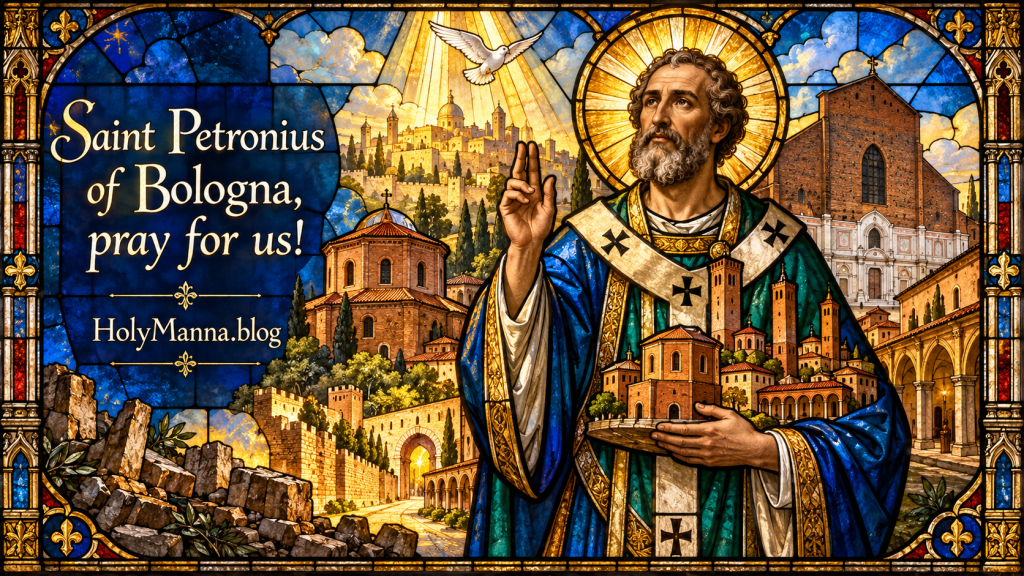
Every October 4th, while most of the Catholic world turns its eyes to Assisi, the city of Bologna turns its eyes to a man who wore the miter eight centuries before Saint Francis was born. Saint Petronius, Bishop of Bologna, who died sometime before the year 450, is one of those saints whose life sits quietly in the shadows of history and yet whose legacy towers, quite literally, over an entire city. He is the principal patron of Bologna, both the city and the archdiocese, as well as the town of Castel Bolognese, and in sacred art he is shown as a bishop cradling a miniature model of Bologna in his hands, as if the whole city were a child he carried.
That image tells you almost everything you need to know about him. Petronius was not a martyr, not a famous preacher whose sermons filled volumes, not a wonder-worker trailed by crowds. He was a builder and a shepherd. He took a city that had been sacked three times by invading armies, a city whose churches lay in ruins and whose faith had been infected by heresy, and he rebuilt both the stones and the souls. The Church honors men like this because sanctity is not always dramatic. The Catechism teaches that “By canonizing some of the faithful, i.e., by solemnly proclaiming that they practiced heroic virtue and lived in fidelity to God’s grace, the Church recognizes the power of the Spirit of holiness within her and sustains the hope of believers by proposing the saints to them as models and intercessors” (CCC 828). Petronius practiced heroic virtue with a trowel in one hand and a crozier in the other, and Bologna has never forgotten it.
From the Imperial Court to the Desert Sands
The honest truth, and honesty matters when telling the lives of the saints, is that very little about Petronius can be documented with certainty. The Catholic Encyclopedia states plainly that the only certain historical information about him comes from two ancient witnesses: a letter written by Bishop Eucherius of Lyons, who died around 450 to 455, and the De viris illustribus of Gennadius of Marseilles. Everything else comes from later tradition, and this post will be careful to say which is which.
What the two ancient sources reveal is remarkable enough. Gennadius records that Petronius belonged to a noble Roman family whose members occupied high positions at the imperial court at Milan and in the provincial administrations at the end of the fourth century and the beginning of the fifth. Butler’s Lives of the Saints identifies his father as a man also named Petronius, a praetorian prefect famous for his eloquence, and several sources place that prefecture in Gaul. In other words, this future saint was born into the late Roman equivalent of a powerful political dynasty. Wealth, connections, education, and a clear path to imperial office were all his by birthright.
He walked away from all of it. Bishop Eucherius, writing while Petronius was still alive or only recently deceased, held him up alongside Saint Hilary of Arles as a living example of conversion; in Butler’s words, “St. Eucherius mentions that, lately, St. Hilary of Arles, and St. Petronius, then living in Italy, had passed from the highest state of worldly pomp to the service of the church.” Eucherius also testified that the holy bishop was then renowned throughout Italy for his virtues. This is the rarest kind of praise, the kind given by a contemporary who had no reason to flatter a bishop of another city.
Butler adds that Petronius trained himself in severe ascetic discipline from childhood, even while living in his father’s house, and that as a young man he traveled East to the deserts of Palestine and Egypt to learn Christian perfection from the great monastic fathers, staying with luminaries such as Saint John of Lycopolis. A word of caution belongs here. This account of the Eastern journey rests partly on an ancient book about the Egyptian monks that Gennadius attributed to Petronius, but the Catholic Encyclopedia holds that the true author of that work was Rufinus of Aquileia. The pilgrimage itself is affirmed by the Catholic tradition surrounding him, and his later building projects strongly suggest a man who had seen Jerusalem with his own eyes, but the details of his desert itinerary cannot be verified with certainty. For the same reason, no verified quotations from Saint Petronius himself survive; the writings once circulated under his name belong to other authors, and the faithful should be wary of any purported sayings of Saint Petronius found online.
What is beyond dispute is the shape of the story: a man of privilege who chose penance, a courtier’s son who chose the desert, an heir of empire who chose the Kingdom. The Catechism describes exactly this path: “The way of perfection passes by way of the Cross. There is no holiness without renunciation and spiritual battle” (CCC 2015). Petronius fought that battle barefoot, in Butler’s telling, across the wildernesses of the East, and he came home not exhausted but transformed.
Rebuilding a City, Stone by Stone and Soul by Soul
Around the year 431, Petronius was made Bishop of Bologna. Butler records that he had arrived in Rome in 430, that the previous bishop, Felix, had died, and that Pope Celestine I chose Petronius for the vacant see. Some sources give the year of his election as 432 rather than 430 or 431, and readers deserve to know that the exact date is uncertain. What is certain is the condition of the city he inherited.
Bologna in the early fifth century was a wounded place. Butler reports that the city had been plundered three times in the years just before, once by the pagan Goth Radagaisus and twice by Alaric, the Arian Goth whose armies also sacked Rome itself in 410. Imagine becoming pastor of a city where the churches are rubble, the population is traumatized, and the Arian heresy, which denied the full divinity of Jesus Christ, still lingers among the people like smoke after a fire. The Church had already answered that heresy definitively; as The Catechism recalls, the first ecumenical council at Nicaea confessed that the Son of God is “begotten, not made, of the same substance (homoousios) as the Father” (CCC 465). But confessing truth in a council and restoring truth in a battered city are two different labors, and the second one fell to Petronius.
He met the challenge on both fronts at once. In Butler’s summary, “St. Petronius purged it of the remains of Arianism, and repaired the ruins of the city, and especially the churches.” That single sentence contains a whole episcopate. He understood something the modern world constantly forgets, that doctrine and daily life, worship and walls, orthodoxy and architecture, all rise or fall together. A people cannot love a Christ they do not know rightly, and they cannot worship well in ruins.
His masterpiece was the church complex of Santo Stefano, which still stands in Bologna today and is affectionately called the Sette Chiese, the Seven Churches, and even Santa Gerusalemme, holy Jerusalem. Petronius designed it in deliberate imitation of the shrines of the Holy Land, echoing Golgotha and the tomb of Christ, so that the Christians of Bologna, most of whom would never see Jerusalem, could walk the geography of their salvation at home. The octagonal church of the Holy Sepulchre at its heart mirrors the Constantinian shrine over the empty tomb. A tradition holds that Petronius raised this complex over a former pagan temple of the goddess Isis, a fitting image of grace conquering the old gods, though that detail comes from tradition and cannot be verified. Butler, citing the historian Sigonius and the scholarly Pope Benedict XIV, credits Petronius with founding several other churches across Bologna as well, dedicated to Saint Thecla, Saint Agatha, Saint Lucy, Saint Bartholomew, Saint John the Evangelist, Saint Mark, and Saint Martin, and with enriching the city with the relics of the saints, especially those of the martyr Saint Florian, which he brought from Vicenza and enshrined in Santo Stefano. The Catholic Encyclopedia notes that his buildings belong to the same golden moment when Pope Saint Leo the Great was raising basilicas in Rome and the empress Galla Placidia was adorning Ravenna.
Why does a building program matter to holiness? Because in the Catholic imagination, churches are never mere shelters. The Catechism teaches that “These visible churches are not simply gathering places but signify and make visible the Church living in this place, the dwelling of God with men reconciled and united in Christ” (CCC 1180). When Petronius rebuilt Bologna’s churches, he was preaching a sermon in brick: God has not abandoned this city. As for miracles during his lifetime, honesty requires saying that the two contemporary sources record none in detail; his contemporaries instead testified to something the modern age underrates, a reputation for extraordinary virtue. Later medieval tradition would attribute wonders and mighty deeds to him, and those stories are told below in their proper place, clearly marked as tradition.
The Hidden Cost of Shepherding a Ruined World
Petronius was not a martyr. He died of natural causes, during the joint reigns of the emperors Theodosius II and Valentinian III, which places his death before the year 450; some Catholic sources say around 445, others around 450, and the exact year simply cannot be fixed. But the absence of a martyr’s death does not mean the absence of a cross. His hardships were the slow, grinding kind that most believers actually face.
Consider what his fidelity cost him. He surrendered an aristocratic inheritance and the security of imperial favor at the very moment the Western Empire was collapsing, when a man of his connections might have bought safety. He embraced, according to Butler, austere penances and constant mortification, walking his long Eastern pilgrimage barefoot, and he refused to soften that discipline when he received the dignity of a bishop. Butler paints the picture in one magnificent sentence: “He who had performed his tedious journey through the eastern wildernesses barefoot, joining to its fatigues the most austere penitential austerities, and who had brought home not a dissipated mind, but an improved spirit of compunction and devotion, because he had made prayer and mortification his constant companions, would be far from remitting any thing of those exercises when raised to the pastoral dignity in the church.”
Then there was the burden of the office itself. He governed a diocese in an age of invasion, refugee crisis, economic ruin, and theological confusion, with no guarantee that the armies would not return. He carried out the patient, unglamorous confrontation with Arianism, winning back hearts one by one to the full truth about Jesus Christ. The Catechism teaches that “The individual bishops are the visible source and foundation of unity in their own particular Churches” (CCC 886), and unity was precisely what war and heresy had shattered in Bologna. To be its visible source of unity in the 430s and 440s was to absorb, day after day, the fears and fractures of an entire people. He did it for roughly two decades, and then he went home to God, so quietly that history did not even record the day of his death with precision. For nearly seven hundred years afterward, he was almost forgotten.
The Relics That Woke a Sleeping City
Then came October 4th, 1141. On that day, according to Bolognese tradition, the remains of Saint Petronius were discovered within the Santo Stefano complex he had built. The rediscovery of the relics is a documented historical event of the twelfth century, and it changed everything. A saint who had slept in obscurity for centuries suddenly became the beating heart of one of medieval Europe’s greatest cities. Shortly after the discovery, a church was raised in his honor, and a legendary Vita Sancti Petronii was composed, filling the silence of history with stories.
Those stories deserve to be told, and to be told honestly. The medieval life presents Petronius as a kinsman of the emperor Theodosius II and relates that through this imperial connection he obtained extraordinary privileges for Bologna, including expanded city walls, guarantees of civic liberty, imperial protection, and even the founding of the famous University of Bologna, which proudly calls itself the oldest university in Europe. These are beloved traditions, and they shaped Bologna’s identity for centuries, but they cannot be verified; the Catholic Encyclopedia states that the tradition attributing the university’s foundation to Theodosius II in 433 is now generally rejected, and modern Catholic scholarship recognizes that the twelfth-century life reflects the civic hopes of its own era far more than the facts of the fifth century. Likewise, the centuries of Bolognese piety that credit Saint Petronius with protecting the city from invasions and obtaining healings for those who sought his intercession rest on tradition and popular devotion rather than on formally documented cases, and that too should be said plainly. None of this honest sifting diminishes the saint. The Church has always distinguished the historical record from the embroidery of love, and she teaches with confidence that the saints in glory truly do intercede for us: “They do not cease to intercede with the Father for us, as they proffer the merits which they acquired on earth through the one mediator between God and men, Christ Jesus” (CCC 956).
What is beyond dispute is the astonishing devotion that followed. In 1253 the free Commune of Bologna proclaimed Petronius the principal patron of the city. In 1388 the city’s Council of Six Hundred resolved to build him a temple worthy of that title, and in 1390 construction began on the Basilica di San Petronio on the Piazza Maggiore, a project so audacious that it remains one of the largest brick churches on earth. Its façade stands unfinished to this day, a strangely beautiful monument to human ambition meeting human limits. Within its walls, in 1530, Pope Clement VII crowned Charles V as Holy Roman Emperor, making the church of this quiet fifth-century bishop the stage for one of the pivotal ceremonies of European history. The basilica, long owned by the city itself as a civic temple, passed to the diocese in 1929 and was finally consecrated in 1954.
The relics themselves have their own story. For centuries the saint’s body rested in the replica of the Holy Sepulchre at Santo Stefano, where tradition says pilgrims once crawled into the shrine to venerate him, while his head was kept at San Petronio in a magnificent reliquary donated by Pope Benedict XIV, the great eighteenth-century pontiff who had himself been Archbishop of Bologna. Old Bolognese customs grew up around the shrine, including the tradition that expectant mothers would walk thirty-three times around the Holy Sepulchre, one circuit for each year of the Savior’s earthly life, before praying at a nearby image of the Madonna; these customs are traditions of popular piety and their origins cannot be verified. Then, in the Jubilee year 2000, Cardinal Giacomo Biffi solemnly transferred the saint’s body from Santo Stefano to the Basilica di San Petronio, reuniting it with the head after long centuries. Every October 4th, Bologna still celebrates its patron with Mass at the basilica and festivities that spill across the city. All of this, the pilgrimages, the relics, the processions, sits squarely within what the Church cherishes; The Catechism affirms that the religious sense of the Christian people has always found expression in forms of piety “such as the veneration of relics, visits to sanctuaries, pilgrimages, processions” (CCC 1674).
Building What Lasts
What does a fifth-century bishop-builder have to say to a commuter scrolling this post seventeen centuries later? More than you might expect.
Petronius inherited ruins. So does nearly everyone, in some corner of life. A broken family history, a parish that has grown cold, a culture confused about who Christ is, a personal faith flattened by years of neglect. The temptation is to mourn the rubble or to flee it. Petronius did neither. He rebuilt, patiently, locally, beginning with the house of God. Scripture gives the principle behind his whole episcopate: “Unless the LORD builds the house, those who build it labor in vain” (Psalm 127:1). He built with God, and what he built with God has outlasted the empire that destroyed it. Where in your own life have you been staring at ruins that God is inviting you to rebuild?
He also teaches something countercultural about ambition. Petronius had every worldly advantage and traded it for a barefoot pilgrimage and a battered diocese. The world would call that a demotion; heaven calls it promotion. Saint Peter tells every baptized person to “like living stones be yourselves built into a spiritual house, to be a holy priesthood, to offer spiritual sacrifices acceptable to God through Jesus Christ” (1 Peter 2:5). You may never lay a brick, but every act of honesty at work, every rosary prayed when you are tired, every wound forgiven, is masonry in a cathedral you cannot yet see. What “high position” or comfort might God be asking you to hold more loosely so that your hands are free to build His house?
Finally, Petronius built Jerusalem in Bologna because he knew his people could not travel to the real one, and because he knew that even the real one is only a signpost. The Letter to the Hebrews says it perfectly: “For here we have no lasting city, but we seek the city which is to come” (Hebrews 13:14). Practical ways to live his witness this week are close at hand. Visit a church outside of Mass and simply sit with the Lord, remembering that the building itself preaches. Take up one small, hidden mortification, a skipped indulgence or an earlier alarm, offered for someone who has drifted from the truth about Christ. Learn one paragraph of The Catechism on the divinity of Jesus, because the quiet answer to modern confusion, like the answer to Arianism, is a Catholic who actually knows the faith. And if life has handed you a season of obscurity, take heart from a saint who was nearly forgotten for seven hundred years; God never mislays His servants. Are you willing to serve faithfully even if no one notices for a very long time?
Engage With Us!
Saint Petronius spent his life rebuilding what war and heresy had torn down, and his story now belongs to you. Share your thoughts and reflections in the comments below; this little corner of the internet is meant to be a porch where friends talk about the things that matter most. To get the conversation started, consider these questions:
- Petronius walked away from wealth and imperial connections to serve a ruined city. What is one comfort or ambition you sense God asking you to surrender, and what makes that surrender hard?
- He rebuilt Bologna’s churches so that his people could encounter God in beauty. How does the physical space where you worship shape your prayer, and what could you do to treat your parish church with greater reverence?
- His relics lay in obscurity for nearly seven centuries before God brought them to light. Where in your life do you need patience with hiddenness, trusting that faithfulness matters even when unseen?
- Petronius confronted the Arian confusion about who Jesus is. If a friend asked you today why the divinity of Christ matters, what would you say?
- He recreated Jerusalem at home for people who could never make the pilgrimage. How can you bring the holy places, through prayer, Scripture, or sacred art, into your own home this month?
Whatever ruins you are facing, remember that the same God who raised a new Jerusalem in the middle of a sacked Roman city is fully able to rebuild whatever lies broken in you. Live this day as a living stone in His house. Pray boldly, work patiently, forgive quickly, and do everything with the love and mercy that Jesus taught us, so that when your work is finally uncovered, like the relics of an old bishop under an ancient floor, it may be found full of grace.
Saint Petronius of Bologna, pray for us!
Follow us on YouTube, TikTok, Instagram and Facebook for more insights and reflections on living a faith-filled life.


Leave a comment