The Beggar Who Rebuilt the Church
Every October 4th, the Church celebrates one of the most beloved saints who ever lived, a man so thoroughly conformed to Christ that his own generation called him a second Christ, an alter Christus. Saint Francis of Assisi was a soldier, a deacon, and a founder, but none of those titles quite captures him. He was a rich young man who fell in love with Lady Poverty, a failed knight who became a herald of the great King, a merchant’s son who traded silk for sackcloth and gained everything by giving everything away. Eight centuries later, his footprints still mark the Church: the worldwide Franciscan family of friars, Poor Clares, and lay members of the Third Order; the Christmas creche in nearly every Catholic home; and a witness of Gospel joy that keeps drawing seekers back to Jesus Christ.
Francis matters because he took the Gospel literally and found that it works. As the Catechism teaches, “by canonizing some of the faithful, i.e., by solemnly proclaiming that they practiced heroic virtue and lived in fidelity to God’s grace, the Church recognizes the power of the Spirit of holiness within her and sustains the hope of believers by proposing the saints to them as models and intercessors” (CCC 828). Francis is one of the clearest models the Church has ever proposed, and he holds several formally documented patronages. Pope Pius XII declared him co-patron of Italy, together with Saint Catherine of Siena, in 1939. Saint John Paul II, in the 1979 document Inter Sanctos, named him the heavenly patron of ecology and of those who promote its care. He is also honored as the patron of animals and of merchants, the very trade of the father he left behind.
From Silk to Sackcloth
Francis was born in Assisi, a hill town in the Umbria region of central Italy, in 1181 or 1182; the early sources do not settle the year, and honest Catholic scholarship leaves both dates on the table. His father, Pietro di Bernardone, was a prosperous cloth merchant. His mother, known to tradition as Lady Pica, had him baptized Giovanni, John, while his father was away on business in France. When Pietro returned, he began calling the boy Francesco, “the little Frenchman,” and the nickname became one of the most recognizable names in Christian history.
Young Francis was not a pious child. He was charming, extravagant, and worldly, the ringleader of Assisi’s wealthy young men, spending his father’s money on feasts and fine clothes and dreaming of glory as a knight. That dream met reality in 1202, when war broke out between Assisi and its rival city Perugia. Francis was captured at the Battle of Collestrada, spent roughly a year as a prisoner of war, and fell seriously ill after his release. Something in him began to shift during that long captivity and convalescence, though he did not yet know what.
He tried the old dream one more time. In 1205 he set out for Apulia to fight under the nobleman Walter of Brienne, outfitted in splendid armor. According to The Legend of the Three Companions, one of the earliest accounts of his life, he got only as far as Spoleto, where in a dream a voice asked him, “Who can do more good for you, the lord or the servant?” and then asked why he was abandoning the Lord for the servant. The dream is reported in the early sources rather than independently documented; what is certain is that Francis turned around, rode home, and never sought knighthood again.
What followed was not one dramatic moment but a series of encounters that God used to remake him. The first, and the one Francis himself considered decisive, was his meeting with a leper. Lepers were the most feared people of the medieval world, and Francis admitted he found them revolting. Then one day, riding near Assisi, he came upon a leper on the road, dismounted, gave the man alms, and kissed him. This needs no biographer’s word; Francis recorded it himself in his Testament: “When I was in sin, it seemed too bitter for me to see lepers. And the Lord Himself led me among them, and I showed mercy to them. And when I left them, what had seemed bitter to me was turned into sweetness of soul and body.” That is conversion in Francis’s own handwriting, and it matches what the Church teaches about the interior turn to God, which is expressed in visible works of penance and made real in concrete love of neighbor (CCC 1430 and CCC 1435).
The second encounter came in the crumbling chapel of San Damiano outside Assisi’s walls. Praying before its painted crucifix, Francis heard Christ speak to him, according to the early biographers Thomas of Celano and the Three Companions: “Francis, go, repair my house, which, as you see, is falling into ruin.” This locution is reported very early and very consistently, though as a private mystical experience it remains a matter of pious trust rather than verifiable record. Francis took the words literally. He sold cloth from his father’s shop to fund the repairs, and Pietro dragged him before Bishop Guido of Assisi to demand his money back and disinherit him. Francis returned the money, then stripped off the very clothes his father had given him and handed those back too, standing before the whole town with nothing. The early lives record his words: “Until now I have called Pietro di Bernardone my father. From now on I will say freely, Our Father, who art in heaven.” The bishop wrapped his own cloak around him, and Francis walked out of Assisi owning nothing, and freer than he had ever been.
For the next two years he lived as a penitent, begging stones and rebuilding three ruined chapels with his own hands: San Damiano, San Pietro, and the tiny Portiuncula, Saint Mary of the Angels, which would become the cradle of his movement. Then, at Mass at the Portiuncula in February 1208, he heard the Gospel in which Jesus sends out the apostles: “Take no gold, nor silver, nor copper in your belts, no bag for your journey, nor two tunics, nor sandals, nor a staff” (The Gospel of Matthew, Mt 10:9 to 10). Thomas of Celano, writing within two years of the saint’s death, records his reaction: “This is what I want; this is what I seek; this is what I desire with all my heart.” Francis threw away his shoes and staff, put on a rough tunic tied with a cord, and began to preach penance and peace. He finally understood that the house Christ wanted repaired was not made of stones.
The Gospel Without a Gloss
Men started following him almost immediately. Bernard of Quintavalle, one of Assisi’s wealthy citizens, sold everything and gave it to the poor; Peter Catani, a lawyer, joined the same day. When the little band reached eleven, Francis wrote a short rule of life composed mostly of Gospel verses and walked to Rome to seek approval from Pope Innocent III, the most powerful pope of the Middle Ages; the sources conflict on whether this happened in 1209 or 1210. The early biographers recount that Innocent, initially hesitant, had a dream of the Lateran Basilica tilting toward collapse while a small poor man held it up on his shoulders, and that he recognized Francis as that man. The dream is reported in the early lives and depicted by Giotto, though it cannot be independently verified. What is documented is the outcome: Innocent III gave the little brothers oral approval, and the Order of Friars Minor, the “Lesser Brothers,” was born.
The movement grew with astonishing speed, because people could see that these men actually lived what they preached. In 1212, an eighteen-year-old noblewoman of Assisi named Clare slipped out of her family home on the night after Palm Sunday and came to the Portiuncula, where Francis cut her hair and received her vows; from her enclosure at San Damiano, the very chapel Francis had rebuilt, Saint Clare founded what became the Poor Clares. For married men and women who could not leave their homes, there grew the Third Order, which continues today as the Secular Franciscan Order. Within a decade, thousands of friars were preaching across Europe.
Why should anyone remember and imitate Francis? Because he demonstrated that the Beatitudes are not poetry but a livable program. The Catechism teaches that “Jesus enjoins his disciples to prefer him to everything and everyone, and bids them ‘renounce all that [they have]’ for his sake and that of the Gospel” (CCC 2544), and it insists that poverty of spirit is the doorway to the Kingdom (CCC 2546). Francis did not soften that teaching; his ambition was to live the Gospel “without gloss,” without the fine print that lets comfortable people off the hook. The definitive Rule of 1223, approved by Pope Honorius III on November 29th, 1223, opens with words Francis wrote and the Church confirmed: “The Rule and Life of the Lesser Brothers is this: to observe the Holy Gospel of our Lord Jesus Christ by living in obedience, without anything of one’s own, and in chastity.” One sentence, and an entire revolution.
His tenderness toward creation flowed from the same source. Francis loved animals not as mascots of nature but as fellow creatures of the Father, which is precisely how the Church still frames it: “Animals are God’s creatures. He surrounds them with his providential care. By their mere existence they bless him and give him glory” (CCC 2416), and the Catechism names Francis himself as the model of that kindness. Thomas of Celano records the famous scene near Bevagna when Francis preached to a great flock of birds, telling them to praise the Creator who gave them feathers, wings, and the air itself, and the birds stayed still until he blessed them; that account is very early, drawn from the testimony of his companions. A later and even more famous story comes from The Little Flowers of Saint Francis, a 14th-century collection: the fierce wolf that terrorized the town of Gubbio, which Francis confronted, addressed as “Brother Wolf,” and reconciled to the townspeople, who fed it until it died of old age. It is a beloved tradition that beautifully expresses who Francis was, but it appears only in that later collection, and it cannot be verified.
The early sources also record miracles worked through Francis during his lifetime. Celano’s First Life tells of a crippled boy at Toscanella whom Francis blessed and healed so that he stood and walked, of a paralyzed man named Peter at Narni restored when Francis made the Sign of the Cross over him, of a woman granted her sight, and of lepers cleansed under his care. These healings were gathered from witnesses within living memory and accepted by the Church, though the individual episodes rest on the credibility of those early accounts rather than on records that can be independently verified today.
Two documented episodes reveal the full range of his heart. In 1219, in the middle of the Fifth Crusade, Francis crossed the battle lines at Damietta in Egypt, unarmed, to preach Christ to Sultan al-Malik al-Kamil. This is not pious embroidery; it is attested by Jacques de Vitry, a bishop and contemporary who wrote about it in his letters. The Sultan did not convert, but he received Francis with honor and sent him back unharmed, astonished by a Christian who came with no weapon but the Gospel. Then, at Christmas 1223 in the mountain village of Greccio, Francis arranged a manger with hay, an ox, and a donkey, so that people could see with their own eyes the poverty in which the newborn King entered the world. Celano records that Mass was celebrated over the manger, that Francis, as deacon, sang the Gospel and preached on the Babe of Bethlehem, and that one virtuous man present reported seeing a sleeping infant in the manger whom Francis seemed to wake. The celebration itself is documented and gave the Church the tradition of the Nativity scene; the vision of the Child is a reported testimony, and it cannot be verified.
The Marks of Christ and the Welcome of Sister Death
Francis was not martyred, though not for lack of desire; he sailed for the East partly hoping to give his life for Christ, and he came home alive. His martyrdom took another shape, the slow, hidden kind that most believers actually face. Jesus set the terms for every disciple: “If any man would come after me, let him deny himself and take up his cross and follow me” (The Gospel of Matthew, Mt 16:24), and the Catechism explains that the Lord calls his disciples to take up their cross and follow him, since the cross is the path opened to all (CCC 618). Francis walked that path to its end.
The hardships came in waves. There was the early humiliation in Assisi, where the former toast of the town was pelted with mud and called a madman, with his own father cursing him in the street. There was the grinding daily poverty he chose and never softened: begging his food, sleeping on the ground, owning nothing. Hardest of all, perhaps, was watching his own order strain under its success. By 1220 there were thousands of friars, many of whom had never met him, and pressure mounted to relax the radical poverty at the heart of his vision. Worn out and unwilling to govern by force, Francis resigned the daily leadership of the order in 1220 and spent his remaining years pleading, mostly by example, for fidelity to the original dream.
His body broke down alongside these trials. He had contracted a painful eye disease, most likely in Egypt, that was slowly blinding him, and years of fasting and exposure brought recurring fevers. At the urging of his brothers, he submitted to the brutal medicine of the age: a doctor cauterized his face from jaw to eyebrow with a red-hot iron. The early sources record that Francis addressed the flame beforehand: “Brother Fire, God made you beautiful and strong and useful; I pray you be courteous to me.” His companions reported that he showed no sign of pain; the moment rests on their testimony, consistent with everything else known of him.
Then came La Verna. In September 1224, Francis withdrew to that rugged mountain in Tuscany for a forty-day fast in honor of Saint Michael the Archangel, accompanied by a few brothers including his close companion Brother Leo. Around the feast of the Exaltation of the Holy Cross, September 14th, while rapt in prayer, he received a vision of a seraph bearing the image of the Crucified, and when the vision passed, the wounds of Christ were impressed in his own flesh: nail marks in his hands and feet and a wound in his side. This is the first recorded case of the stigmata in the history of the Church, and it is among the best attested of medieval miracles: Brother Leo and the companions saw and cared for the wounds, which Francis tried to conceal for his remaining two years, and Celano described them in the official biography after many had seen them at his passing. In Francis, the words of Saint Paul became literal: “I bear on my body the marks of Jesus” (The Letter to the Galatians, Gal 6:17).
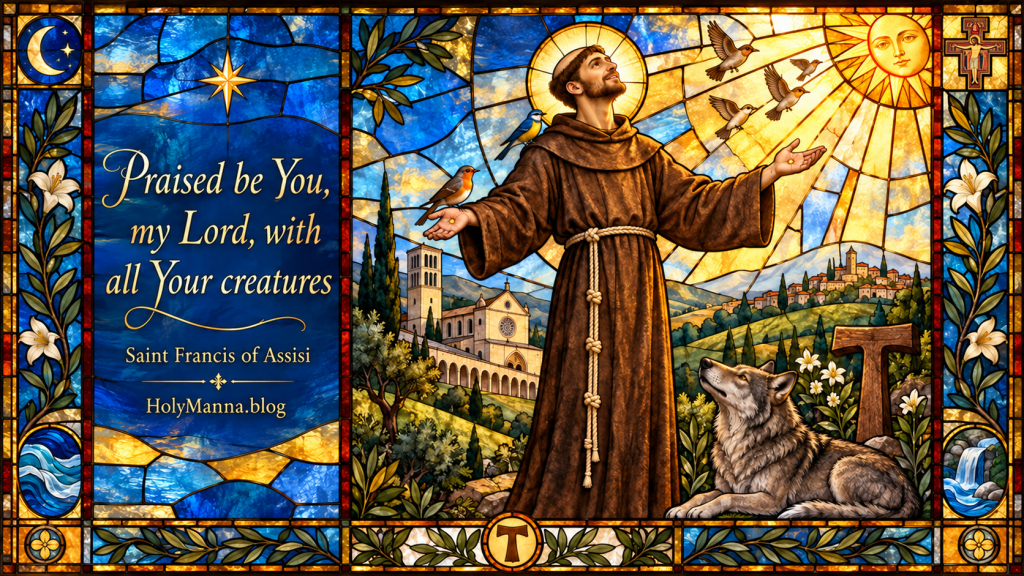
Nearly blind and in constant pain, Francis did not write a complaint. He wrote a song. In 1225, lying in a hut beside San Damiano where Clare and her sisters cared for him, he composed the Canticle of the Creatures, also called the Canticle of Brother Sun, one of the earliest masterpieces of Italian literature: “Praised be You, my Lord, with all Your creatures, especially Sir Brother Sun, who is the day and through whom You give us light.” Verse by verse he praised God through Brother Wind, Sister Water, Brother Fire, and Sister Mother Earth, and when he learned his death was close, he added a final stanza that the Catechism itself quotes when it teaches Christians how to die: “Praised are you, my Lord, for our sister bodily Death, from whom no living man can escape” (CCC 1014). Only a man certain of the Resurrection calls death his sister.
On the evening of October 3rd, 1226, at the Portiuncula, Francis asked to be laid on the bare ground, had the Passion according to The Gospel of John read aloud, and welcomed Sister Death singing Psalm 142. Celano records the last instruction he left his brothers, words that still land like a commission: “I have done what is mine to do; may Christ teach you what is yours.” He was about forty-four years old.
Two Years to the Altars
What happened next was almost unheard of. On July 16th, 1228, less than two years after his death, Pope Gregory IX, who as Cardinal Ugolino had been Francis’s personal friend and protector, canonized him at Assisi. The pope laid the first stone of the Basilica of San Francesco the following day, and in 1230 the saint’s body was translated into it. During that translation the relics were hidden deep beneath the lower basilica to protect them from theft, so effectively that their exact location was lost for centuries; they were rediscovered in 1818, and pilgrims today can pray at the stone tomb in the crypt.
The miracles began at once. For the canonization, Thomas of Celano compiled accounts of healings worked through Francis’s intercession after his death, and later gathered many more in his Treatise on the Miracles: the crippled who walked after praying at his tomb, the blind who received sight, the sick healed after invoking him, the possessed set free. A girl with a deformed neck was said to have been straightened at his tomb, and a man with a withered leg restored after the saint appeared to him. These accounts were examined and accepted by the Church in the 13th century as part of his cause; at the same time, the individual stories rest on medieval testimony and cannot be independently verified today. One further tradition deserves mention because millions of pilgrims still live by it: the Portiuncula Pardon, the plenary indulgence attached to the chapel of Saint Mary of the Angels each August 2nd. Tradition holds that Christ Himself granted this pardon at Francis’s request in a vision, and that Pope Honorius III confirmed it. The indulgence itself is real and remains in force under the Church’s ordinary conditions, but the story of its miraculous origin comes from later accounts and cannot be verified.
The cultural and national impact of this one poor man is difficult to overstate. Assisi remains one of the great pilgrimage destinations of the world, its basilica adorned with the fresco cycle attributed to Giotto, and La Verna still draws pilgrims to the mountain of the stigmata. His Canticle stands at the headwaters of Italian literature. Saint John Paul II chose Assisi in 1986 for the historic World Day of Prayer for Peace, and Pope Francis became the first pope to take his name in 2013, titling his encyclical on creation Laudato Si’, “Praised be You,” the opening words of the Canticle. Even the city of San Francisco, half a world away from Umbria, carries his name. Eight hundred years on, the little poor man is everywhere.
Walking Barefoot Into an Ordinary Life
It is tempting to admire Francis from a safe distance, to file him under lovable eccentrics, birdbaths, and pet blessings. He deserves better, and so do you. Francis is dangerous precisely because he proves that an ordinary layman with no theology degree, no connections, and no plan beyond obedience can be set on fire by the Gospel. The Catechism insists that this call is universal: “All Christians in any state or walk of life are called to the fullness of Christian life and to the perfection of charity” (CCC 2013). Sanctity is not a Franciscan specialty. It is your baptismal job description.
Start where Francis started, with the leper. Everyone has one: the person you cross the street to avoid, the family member you have written off, the coworker whose presence makes your skin crawl. Francis discovered that Christ was hiding inside the very person he found most repulsive, and that mercy shown there turns bitterness into sweetness. Who is the leper God is leading you toward this week, and what would it cost you to stop, look that person in the eye, and show mercy?
Then take poverty seriously, at whatever scale your vocation allows. Most people are not called to own nothing; every baptized person is called to poverty of spirit, which the Church calls necessary for entering the Kingdom (CCC 2544 to 2547). Saint Paul gives the reason: “Though he was rich, yet for your sake he became poor, so that by his poverty you might become rich” (The Second Letter to the Corinthians, 2 Cor 8:9). Practically, that might mean a monthly purge of possessions given directly to the poor, a hard cap on impulse spending with the difference going to your parish’s outreach, or a fast from the endless scroll of advertisements that manufacture desire. What is one thing you own, or one habit of consuming, that quietly owns you?
Learn from him how to treat creation without falling into ideology. Francis never worshiped nature; he praised the Creator through it, and the Church teaches that our use of created things demands religious respect for the integrity of what God made (CCC 2415 to 2416). Gratitude, restraint, and wonder are Catholic environmentalism. So is saying grace before meals like you mean it.
Finally, hear San Damiano addressed to yourself. The house of God still needs repair, and the repair still begins small: one honest confession, one rebuilt marriage, one hour of adoration, one invitation to a friend who has drifted from the Church. Francis’s last words to his brothers were not nostalgia; they were a handoff. “I have done what is mine to do; may Christ teach you what is yours.” What is yours?
Engage With Us!
Share your thoughts and reflections in the comments below. Saint Francis has a way of unsettling comfortable Catholics in the best possible sense, and hearing how his story lands in your life will encourage everyone who reads along. To get the conversation started, consider these questions:
- Which moment of Francis’s conversion speaks most directly to your own story: the prison, the leper, the crucifix of San Damiano, or the Gospel heard at Mass?
- Who is the “leper” in your life right now, and what concrete act of mercy could you offer that person this week?
- Francis renounced his inheritance to gain freedom in Christ. What possession, ambition, or grudge is God asking you to hand back?
- How could you praise God through creation this month in a way that is genuinely Catholic, rooted in gratitude to the Creator rather than in fashion?
- If Christ said to you tonight, “repair my house,” what is the first repair He would point to in your family, your parish, or your own soul?
Francis proves that one surrendered life can echo for eight centuries, and the same Holy Spirit who set him ablaze dwells in you through baptism. Do not wait for a voice from a crucifix. Take the next small step of obedience today, love the person in front of you without calculation, and do everything, from the grandest sacrifice to the most hidden chore, with the love and mercy that Jesus taught us. He has done what is His to do; now go and do what is yours.
Saint Francis of Assisi, pray for us!
Follow us on YouTube, TikTok, Instagram and Facebook for more insights and reflections on living a faith-filled life.


Leave a comment