Twenty-seventh Sunday in Ordinary Time – Lectionary: 139
A Love Song That Turns Into a Question
Some songs begin sweetly and end with a lump in the throat. The readings for October 4th, 2026, the Twenty-seventh Sunday in Ordinary Time, open with exactly that kind of song. Isaiah stands before a festival crowd and sings about a friend who planted a vineyard with extravagant care, only to harvest wild, bitter grapes. Just as the audience nods along, the prophet turns and reveals that the vineyard is Israel, and the disappointed friend is God Himself.
That single image carries the entire Sunday. The Psalmist takes up the vine and turns Isaiah’s verdict into a desperate prayer: “take care of this vine.” Centuries later, standing in the Temple during the final week of His earthly life, Jesus rebuilds Isaiah’s vineyard stone by stone in the Parable of the Wicked Tenants, and places Himself inside it as the murdered Son who becomes the cornerstone. Then Saint Paul, writing from a prison cell, quietly shows what good fruit actually tastes like: prayer instead of anxiety, thanksgiving in everything, minds fixed on whatever is true, honorable, just, pure, lovely, and gracious.
The central theme uniting these readings is this: God has done everything for His vineyard, and now He comes looking for fruit. In the ancient Near East, a vineyard was a long-term act of love, requiring years of labor before a single harvest. God’s question in Isaiah 5:4 still hangs in the air over every baptized soul: “What more was there to do for my vineyard that I had not done?” These readings invite an honest look at the harvest.
First Reading — Isaiah 5:1-7
When God Sings a Sad Song
Isaiah ministered in Judah during the eighth century before Christ, a time of outward prosperity and inward decay. Wealth was concentrated, courts were corrupt, and worship had become routine. Into that world the prophet brought what scholars call the Song of the Vineyard, one of the most artful passages in the Old Testament. He begins like a wedding singer performing a ballad about a friend, and only at the end does the audience realize the song is about them. The strategy recalls Nathan confronting David: let the listeners render the verdict before they discover they are the defendants. For this Sunday, the passage establishes the great image that Jesus will take up in the Gospel, and it names the fruit God seeks, which is justice and righteousness among His people.
Isaiah 5:1-7
Let me now sing of my friend,
my friend’s song concerning his vineyard.
My friend had a vineyard
on a fertile hillside;
he spaded it, cleared it of stones,
and planted the choicest vines;
within it he built a watchtower,
and hewed out a wine press.
Then he looked for the crop of grapes,
but what it yielded was wild grapes.Now, inhabitants of Jerusalem and people of Judah,
judge between me and my vineyard:
What more was there to do for my vineyard
that I had not done?
Why, when I looked for the crop of grapes,
did it bring forth wild grapes?
Now, I will let you know
what I mean to do with my vineyard:
take away its hedge, give it to grazing,
break through its wall, let it be trampled!
Yes, I will make it a ruin:
it shall not be pruned or hoed,
but overgrown with thorns and briers;
I will command the clouds
not to send rain upon it.
The vineyard of the LORD of hosts is the house of Israel,
and the people of Judah are his cherished plant;
he looked for judgment, but see, bloodshed!
for justice, but hark, the outcry!
Detailed Exegesis
Verse 1: “Let me now sing of my friend, my friend’s song concerning his vineyard. My friend had a vineyard on a fertile hillside;”
The prophet presents himself as the best man singing on behalf of the bridegroom. In the Old Testament, the vineyard often symbolizes Israel as God’s beloved. The fertile hillside signals that nothing about the location was lacking. God chose well, and any failure to come cannot be blamed on the soil.
Verse 2: “he spaded it, cleared it of stones, and planted the choicest vines; within it he built a watchtower, and hewed out a wine press. Then he looked for the crop of grapes, but what it yielded was wild grapes.”
Every verb here is labor. Clearing a rocky Judean hillside took years, the watchtower meant permanent protection, and hewing a wine press out of rock showed confidence in a rich harvest. The “choicest vines” recall the covenant gifts of Torah, temple, and prophets. Wild grapes, sour and useless, represent a people who received everything and produced nothing.
Verse 3: “Now, inhabitants of Jerusalem and people of Judah, judge between me and my vineyard:”
The voice shifts. The friend, God Himself, now speaks and summons the audience as jurors. The genius of the song is that Judah is asked to judge a case that turns out to be its own. God’s justice is never arbitrary, and He invites His people to reason with Him.
Verse 4: “What more was there to do for my vineyard that I had not done? Why, when I looked for the crop of grapes, did it bring forth wild grapes?”
This is one of the most haunting questions in Scripture. God examines His own conduct and finds nothing lacking. The Church places this verse on the lips of Christ in the Good Friday Reproaches, where the Crucified asks His people what He has done to deserve their rejection.
Verse 5: “Now, I will let you know what I mean to do with my vineyard: take away its hedge, give it to grazing, break through its wall, let it be trampled!”
The hedge and wall represent divine protection. Judgment here is not an act of vengeance but a withdrawal of shelter, allowing the consequences of infidelity to arrive. Historically, this pointed toward the Assyrian and later Babylonian invasions that devastated the land.
Verse 6: “Yes, I will make it a ruin: it shall not be pruned or hoed, but overgrown with thorns and briers; I will command the clouds not to send rain upon it.”
Only now does the mask slip completely. No human farmer commands clouds. The singer of this love song is the Lord of creation, and thorns and briers echo the curse of Eden in Genesis 3:18, revealing sin’s harvest as a return to chaos.
Verse 7: “The vineyard of the LORD of hosts is the house of Israel, and the people of Judah are his cherished plant; he looked for judgment, but see, bloodshed! for justice, but hark, the outcry!”
The verdict lands with a devastating Hebrew wordplay: God sought mishpat and found mispach, sought tsedaqah and heard tse’aqah. The fruit God wanted was never grapes at all. It was justice for the poor and fidelity to the covenant.
Teachings
The Church has always read this vineyard as more than ancient history. The Catechism applies the image directly to the Church herself. CCC 755 teaches, “The Church is a cultivated field, the tillage of God. On that land the ancient olive tree grows whose holy roots were the prophets and in which the reconciliation of Jews and Gentiles has been brought about and will be brought about again. That land, like a choice vineyard, has been planted by the heavenly cultivator. Yet the true vine is Christ who gives life and fruitfulness to the branches, that is, to us, who through the Church remain in Christ, without whom we can do nothing.” The wounded love in Isaiah’s song also reveals the depth of God’s covenant affection. CCC 219 teaches, “God’s love for Israel is compared to a father’s love for his son. His love for his people is stronger than a mother’s love for her children. God loves his People more than a bridegroom his beloved; his love will be victorious over even the worst infidelities and will extend to his most precious gift: ‘God so loved the world that he gave his only Son.’” The song ends in ruin, but the love behind it does not end.
Reflection
Isaiah’s song asks a question worth sitting with in prayer: after all God has done, what kind of grapes is your life producing? Consider making a simple inventory this week. Name three concrete gifts God has planted in your life, then ask honestly whether each one is bearing fruit for others or growing wild. Choose one act of justice, perhaps an overdue apology, a donation, or standing up for someone overlooked at work, and offer it to God as this week’s harvest. Where in your life has God cleared stones and built a watchtower, and what has He found growing there? If God asked you what more He could have done for you, how would you answer Him?
Responsorial Psalm — Psalm 80:9, 12-16, 19-20
The Vineyard Learns to Pray
If Isaiah’s song is the verdict, Psalm 80 is the appeal. This communal lament likely arose after the Assyrian armies crushed the northern kingdom in 722 BC, when survivors watched everything Isaiah warned about come true. Remarkably, the psalmist does not argue with God’s justice. Instead, Israel takes the very image of its own condemnation, the ravaged vine, and turns it into a prayer for mercy. The Lectionary underlines the connection by drawing the refrain straight from Isaiah 5:7: the vineyard of the Lord is the house of Israel. This psalm teaches the vineyard’s only real hope, which is not self-improvement but restoration by the God who planted it.
Psalm 80:9, 12-16, 19-20
R. (Is 5:7a) The vineyard of the Lord is the house of Israel.
A vine from Egypt you transplanted;
you drove away the nations and planted it.
It put forth its foliage to the Sea,
its shoots as far as the River.
R. The vineyard of the Lord is the house of Israel.
Why have you broken down its walls,
so that every passer-by plucks its fruit,
The boar from the forest lays it waste,
and the beasts of the field feed upon it?
R. The vineyard of the Lord is the house of Israel.
Once again, O LORD of hosts,
look down from heaven, and see;
take care of this vine,
and protect what your right hand has planted,
the son of man whom you yourself made strong.
R. The vineyard of the Lord is the house of Israel.
Then we will no more withdraw from you;
give us new life, and we will call upon your name.
O LORD, God of hosts, restore us;
if your face shine upon us, then we shall be saved.
R. The vineyard of the Lord is the house of Israel.
Detailed Exegesis
Verse 9: “A vine from Egypt you transplanted; you drove away the nations and planted it.”
The psalmist retells the Exodus as a gardening story. God uprooted His vine from the soil of slavery and planted it in the promised land. Remembering God’s past faithfulness is the foundation of Israel’s boldness in prayer, and it remains the foundation of Christian confidence today.
Verse 12: “It put forth its foliage to the Sea, its shoots as far as the River.”
The vine once stretched from the Mediterranean Sea to the Euphrates River, the ideal borders of the kingdom under David and Solomon. The verse recalls a golden age of flourishing, which makes the present devastation all the more painful to name.
Verse 13: “Why have you broken down its walls, so that every passer-by plucks its fruit,”
Here the psalmist echoes Isaiah’s threat fulfilled: the wall is down, the hedge is gone. The bold question “why” is not irreverence but intimacy. Biblical lament brings honest anguish before God rather than hiding it, trusting that the relationship can bear the weight.
Verse 14: “The boar from the forest lays it waste, and the beasts of the field feed upon it?”
The wild boar, an unclean animal, likely represents the pagan empires trampling God’s people. What God once protected now lies exposed to forces that neither know Him nor care for His planting.
Verse 15: “Once again, O LORD of hosts, look down from heaven, and see; take care of this vine,”
The prayer pivots from complaint to petition. The plea is beautifully modest: simply look, see, and take care. Israel asks God to be what He has always been, the vinedresser who tends what He planted.
Verse 16: “and protect what your right hand has planted, the son of man whom you yourself made strong.”
The vine suddenly becomes a person, “the son of man.” Christian tradition hears in this verse a prophetic whisper of Christ, the true Son of Man and true vine of John 15:1, in whom the vineyard’s restoration will finally come.
Verse 19: “Then we will no more withdraw from you; give us new life, and we will call upon your name.”
Israel promises fidelity, but notice the order. New life comes first as God’s gift, and faithfulness follows as the response. Grace precedes conversion, a truth the Church would later defend against every form of self-salvation.
Verse 20: “O LORD, God of hosts, restore us; if your face shine upon us, then we shall be saved.”
The psalm closes with its great refrain of hope. The shining face of God recalls the priestly blessing of Numbers 6:25. Salvation is not a program but a countenance, the face of God turned toward His people, fully revealed at last in the face of Jesus Christ.
Teachings
This psalm is a school of petition, the humble prayer that admits need. CCC 2629 teaches, “by prayer of petition we express awareness of our relationship with God. We are creatures who are not our own beginning, not the masters of adversity, not our own last end. We are sinners who as Christians know that we have turned away from our Father. Our petition is already a turning back to him.” That last line captures the miracle of Psalm 80: the very act of crying “restore us” is already the beginning of restoration. The Church prays this way constantly. Every Mass opens with a plea for mercy, and every Kyrie is the ruined vineyard asking the vinedresser to return. The psalm also anticipates the definitive answer to its own prayer, since the “son of man” at God’s right hand finds fulfillment in Christ, through whom the Father’s face shines upon humanity.
Reflection
This psalm gives you permission to pray from the ruins. When some part of your life feels trampled, whether a marriage, a friendship, a career, or your own spiritual fervor, you do not need polished words. You can simply hand God the wreckage and say, restore us. Try praying verse 20 slowly each morning this week as a breath prayer, asking God to let His face shine on one specific broken place. What part of your life most needs the prayer “restore us” right now? Do you believe God still remembers the flourishing seasons of your story, and can you thank Him for them even now?
Second Reading — Philippians 4:6-9
What Good Fruit Actually Tastes Like
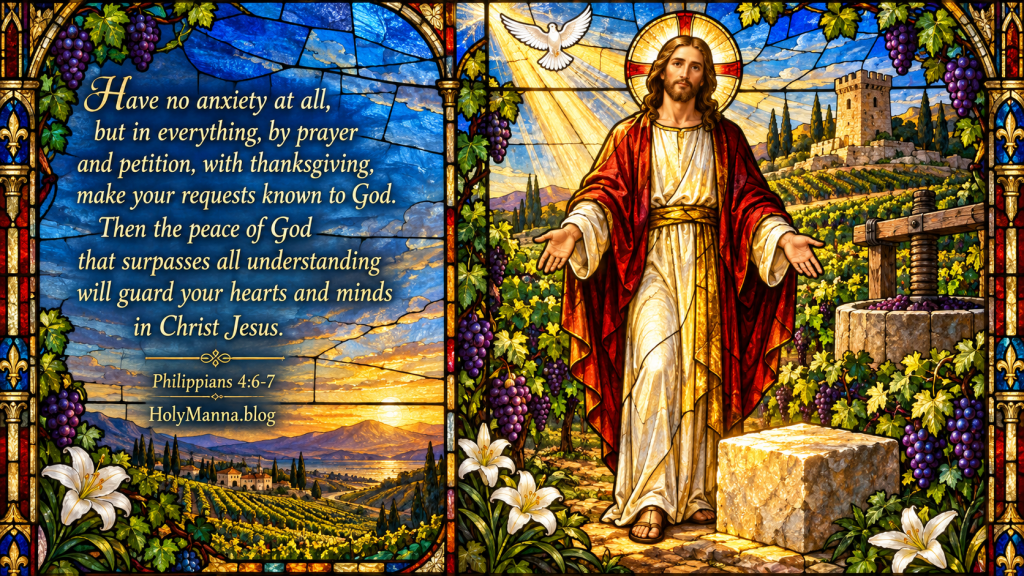
Saint Paul wrote to the Philippians from prison, most likely in Rome around the year 62, while awaiting a trial that could end in his execution. That context transforms these verses from pleasant advice into hard-won testimony. A man in chains tells a small, persecuted community to have no anxiety at all. Within this Sunday’s liturgy, the passage plays a quiet but essential role. Isaiah and the Gospel warn about wild grapes and withheld fruit, but Paul actually describes the harvest God is looking for: a life of trusting prayer, unshakable peace, and habitual goodness. If anyone wonders what a fruitful branch on the true vine looks like in daily life, this is the portrait.
Philippians 4:6-9
Brothers and sisters:
Have no anxiety at all, but in everything,
by prayer and petition, with thanksgiving,
make your requests known to God.
Then the peace of God that surpasses all understanding
will guard your hearts and minds in Christ Jesus.Finally, brothers and sisters,
whatever is true, whatever is honorable,
whatever is just, whatever is pure,
whatever is lovely, whatever is gracious,
if there is any excellence
and if there is anything worthy of praise,
think about these things.
Keep on doing what you have learned and received
and heard and seen in me.
Then the God of peace will be with you.
Detailed Exegesis
Verse 6: “Have no anxiety at all, but in everything, by prayer and petition, with thanksgiving, make your requests known to God.”
Paul does not say Christians will face nothing frightening. He says anxiety must not be the place where a believer lives. The remedy has three parts: prayer, meaning worshipful communion with God, petition, meaning specific requests, and thanksgiving, meaning gratitude offered before the answer arrives. Thanksgiving is the secret ingredient, because a grateful heart remembers that God has been faithful before.
Verse 7: “Then the peace of God that surpasses all understanding will guard your hearts and minds in Christ Jesus.”
The word “guard” is military language. Philippi was a Roman colony with a garrison, so the image would land vividly: God’s peace stands sentry duty over the heart. This peace surpasses understanding because it does not depend on circumstances, as Paul’s own chains prove.
Verse 8: “Finally, brothers and sisters, whatever is true, whatever is honorable, whatever is just, whatever is pure, whatever is lovely, whatever is gracious, if there is any excellence and if there is anything worthy of praise, think about these things.”
Paul offers a curated diet for the mind. He borrows the noblest moral vocabulary of the Greek world and directs it toward Christ, teaching that grace perfects whatever is genuinely good in human culture. Thoughts are seeds, and a mind planted with truth, honor, justice, and beauty will eventually bear that kind of fruit in action.
Verse 9: “Keep on doing what you have learned and received and heard and seen in me. Then the God of peace will be with you.”
Christianity is caught as much as taught. Paul can point to his own life as a living lesson, which is the essence of discipleship and of the Church’s tradition, truth handed on person to person. The passage ends where verse 7 began, with peace, but now deepened: not only the peace of God, but the God of peace Himself.
Teachings
The Catechism roots Paul’s counsel in the very nature of prayer. CCC 2559 teaches, quoting Saint John Damascene, “Prayer is the raising of one’s mind and heart to God or the requesting of good things from God.” And CCC 2633 teaches, “When we share in God’s saving love, we understand that every need can become the object of petition.” Every need means every need, from a medical diagnosis to a difficult Monday. Nothing is too small for the Father who counts hairs and sparrows. Centuries after Paul, Saint Pio of Pietrelcina distilled this passage into the counsel he gave constantly to those who sought his help: “Pray, hope, and don’t worry.” Padre Pio spent decades bearing physical suffering and spiritual attack, yet his counsel echoes the imprisoned Apostle almost word for word. The saints agree because they have tested the promise. Anxiety surrendered in trusting, thankful prayer really is exchanged for a peace the world cannot manufacture and cannot take away.
Reflection
This passage is wonderfully practical, so treat it like a prescription. First, when anxiety rises this week, stop and convert the worry into a specific request, spoken plainly to God, and attach one concrete thanksgiving to it. Second, audit your mental diet for a few days. Notice how much of what you scroll, watch, and replay qualifies as true, honorable, just, pure, lovely, or gracious, and swap fifteen minutes of the noise for something that does. Third, find your “Paul,” a person whose faith you can watch and imitate, and if possible, be that person for someone younger. What is the one anxiety you have been carrying instead of handing over in prayer? What are you feeding your mind, and what kind of fruit is that diet producing?
Holy Gospel — Matthew 21:33-43
The Son Comes to the Vineyard
The setting could not be more charged. It is Holy Week. Jesus has entered Jerusalem to shouts of Hosanna, overturned the money changers’ tables, and now stands in the Temple courts facing the chief priests and elders who have demanded to know by what authority He acts. His answer is a parable that every listener would recognize instantly, because He rebuilds Isaiah’s vineyard piece by piece, the hedge, the wine press, the tower. But then Jesus does something Isaiah never did. In Isaiah, the vineyard itself failed. In Jesus’ telling, the vineyard is fine, and the problem is the tenants, the leaders entrusted with God’s people. Then He writes Himself into the story as the beloved Son, murdered outside the vineyard, days before He would die outside Jerusalem’s walls.
Matthew 21:33-43
Jesus said to the chief priests and the elders of the people:
“Hear another parable.
There was a landowner who planted a vineyard,
put a hedge around it, dug a wine press in it, and built a tower.
Then he leased it to tenants and went on a journey.
When vintage time drew near,
he sent his servants to the tenants to obtain his produce.
But the tenants seized the servants and one they beat,
another they killed, and a third they stoned.
Again he sent other servants, more numerous than the first ones,
but they treated them in the same way.
Finally, he sent his son to them, thinking,
‘They will respect my son.’
But when the tenants saw the son, they said to one another,
‘This is the heir.
Come, let us kill him and acquire his inheritance.’
They seized him, threw him out of the vineyard, and killed him.
What will the owner of the vineyard do to those tenants when he comes?”
They answered him,
“He will put those wretched men to a wretched death
and lease his vineyard to other tenants
who will give him the produce at the proper times.”
Jesus said to them, “Did you never read in the Scriptures:
The stone that the builders rejected
has become the cornerstone;
by the Lord has this been done,
and it is wonderful in our eyes?
Therefore, I say to you,
the kingdom of God will be taken away from you
and given to a people that will produce its fruit.”
Detailed Exegesis
Verse 33: “There was a landowner who planted a vineyard, put a hedge around it, dug a wine press in it, and built a tower. Then he leased it to tenants and went on a journey.”
Jesus quotes Isaiah’s imagery deliberately so the leaders cannot miss the reference. The landowner does all the founding work himself. Saint John Chrysostom, in Homily 68 on Matthew, observes, “For what pertained to the husbandmen, He Himself did, the hedging it round about, the planting the vineyard, and all the rest, and He left little for them to do; to take care of what was there, and to preserve what was given to them.” Leadership among God’s people is always stewardship, never ownership.
Verse 34: “When vintage time drew near, he sent his servants to the tenants to obtain his produce.”
The owner asks only for what is rightly his. In the biblical pattern, the servants are the prophets, sent generation after generation to call Israel back to covenant fruitfulness.
Verse 35: “But the tenants seized the servants and one they beat, another they killed, and a third they stoned.”
The verbs summarize prophetic history with brutal economy. Jeremiah was beaten, prophets were killed, and stoning recalls the fate tradition assigns to Zechariah in 2 Chronicles 24:21. Rejecting God’s messengers is rejecting God’s claim on the harvest.
Verse 36: “Again he sent other servants, more numerous than the first ones, but they treated them in the same way.”
Where any human landlord would have sent soldiers, this owner sends more servants. Chrysostom teaches that the owner’s absence itself reveals the point, writing, “by His going into a far country, He means His great long-suffering.” God’s patience is not indifference. It is mercy stretching out time for repentance.
Verse 37: “Finally, he sent his son to them, thinking, ‘They will respect my son.’”
Here the parable becomes autobiography. The son is qualitatively different from every servant, just as Christ is more than a prophet. The owner’s hope sounds almost naive, and that is the point. It expresses the almost reckless generosity of a God who risks His only Son on love.
Verse 38: “But when the tenants saw the son, they said to one another, ‘This is the heir. Come, let us kill him and acquire his inheritance.’”
The tenants recognize exactly who the son is, and that recognition fuels the murder. Their logic exposes the ancient temptation reaching back to Eden: eliminate the rightful owner and seize what was only ever given in trust.
Verse 39: “They seized him, threw him out of the vineyard, and killed him.”
The detail is prophetic to the letter. Jesus would suffer outside the city gate, as Hebrews 13:12 later notes. He is describing His own death to the very men arranging it, and still He tells them, which means the parable itself is a final act of mercy toward them.
Verse 40: “What will the owner of the vineyard do to those tenants when he comes?”
Like Isaiah before the crowd and Nathan before David, Jesus invites His hearers to render the verdict themselves before they realize whose trial this is.
Verse 41: “They answered him, ‘He will put those wretched men to a wretched death and lease his vineyard to other tenants who will give him the produce at the proper times.’”
The leaders condemn themselves out of their own mouths. Chrysostom notes that in saying this, “they say nothing else than this, publishing their sentence with much greater force.” Notably, the vineyard is not destroyed. God’s plan continues, entrusted to new tenants.
Verse 42: “Jesus said to them, ‘Did you never read in the Scriptures: The stone that the builders rejected has become the cornerstone; by the Lord has this been done, and it is wonderful in our eyes?’”
Jesus quotes Psalm 118:22-23, sung by the Passover pilgrims all around them. The image shifts from vineyard to construction site, and the murdered son becomes the rejected stone. Saint Thomas Aquinas, in his Commentary on the Gospel of Saint Matthew, states plainly, “The stone is Christ, who is called a stone based upon many similitudes.” The rejection is not the end of the story. It is the foundation of a new one.
Verse 43: “Therefore, I say to you, the kingdom of God will be taken away from you and given to a people that will produce its fruit.”
The kingdom passes not to a different ethnicity but to a fruitful people, the Church drawn from Israel and the nations together, beginning with the apostles, who were themselves sons of Israel. The warning stands permanently for every generation of tenants, including the present one: the vineyard belongs to God, and He still expects fruit.
Teachings
The Church hears her own birth certificate in this parable. CCC 756 teaches, “Often, too, the Church is called the building of God. The Lord compared himself to the stone which the builders rejected, but which was made into the corner-stone. On this foundation the Church is built by the apostles and from it the Church receives solidity and unity.” Read alongside CCC 755, quoted above in the First Reading, the two images merge: the Church is both vineyard and building, planted and founded on Christ. The parable therefore lands as both consolation and examination of conscience. Consolation, because human rejection could not defeat God’s plan, and what looked like the vineyard’s darkest crime became, by the Lord’s doing, the cornerstone of salvation. Examination, because every baptized person is now a tenant. Chrysostom’s insight cuts in every direction: God has done nearly everything, and what remains is simply to care for what was given and hand back the harvest.
Reflection
Being a tenant in God’s vineyard changes how you hold everything, because nothing you have is finally yours. Your talents, your income, your relationships, and your time are leased, not owned. This week, pick one area where you have quietly been acting like an owner, perhaps your schedule, your money, or your plans, and deliberately hand the deed back to God in prayer. Then ask what produce He is waiting for from that corner of the vineyard, and take one step toward delivering it, whether that means volunteering, tithing, mentoring, or reconciling. When God’s messengers come to you, through Scripture, the Church, or an inconvenient prompting of conscience, do you receive them or send them away empty? What harvest is the Owner waiting to receive from your life this season?
The Owner Still Believes in His Vineyard
Taken together, these readings tell one continuous story, and it is ultimately a hopeful one. Isaiah sings of a vineyard that broke its planter’s heart. The Psalmist stands in the ruins and prays the only prayer that matters: “restore us.” In the Gospel, the answer arrives in person. The Owner does not abandon the vineyard or write off the harvest. He sends His Son, and even when the Son is seized, thrown out, and killed, God turns that rejection into the cornerstone of a new and unshakable building, the Church. Then Saint Paul, writing from his chains, describes life inside that restored vineyard: anxiety traded for prayer, worry answered with thanksgiving, a mind trained on whatever is true and lovely, and a peace standing guard over the heart like a sentry on the wall.
The question of Isaiah 5:4 has been answered at last. What more could God have done? Nothing. He has done it all, down to the last drop of the wine press, which is His own Blood poured out on Calvary and offered at every Mass. All that remains is the tenants’ part, which Chrysostom described as caring for what was given and returning the fruit at the proper time.
So this Sunday extends a simple invitation. Go to Mass and stand in the vineyard. Receive the Cornerstone in the Eucharist. Then go home and grow something: a reconciled relationship, a generous act of justice, a habit of thankful prayer. The Owner is patient, the soil is good, and the true vine is already supplying the sap. The harvest He is hoping for is a life that looks like His Son.
Engage With Us!
Share your reflections in the comments below. This community grows the way any vineyard does, one honest conversation at a time, and your experience of these readings may be exactly the encouragement another reader needs today. To help you pray with this Sunday’s Scriptures, consider the following questions:
- In Isaiah 5:1-7, God asks what more He could have done for His vineyard. Looking honestly at your own life, what has God planted and protected, and what kind of grapes is it currently producing?
- In Psalm 80:9, 12-16, 19-20, Israel prays over its ruins, “restore us.” What broken or trampled area of your life do you most need to bring to God with that same bold, humble prayer?
- In Philippians 4:6-9, Saint Paul teaches that prayer, petition, and thanksgiving are the antidote to anxiety. What one worry could you convert into a specific, thankful request to God this week?
- In Matthew 21:33-43, Jesus warns that the kingdom is given to a people that will produce its fruit. Where have you been acting like an owner instead of a tenant, and what harvest is God waiting to receive from you?
- Considering all four readings together, what would it look like this week for your life to become the fruitful vineyard God has always intended it to be?
Living a life of faith is not about perfection but about fruitfulness, one small cluster at a time. Keep tending the vines, keep handing the harvest back to the Owner, and do everything with the love and mercy Jesus taught.
Sacred Heart of Jesus, we trust in You!
Immaculate Heart of Mary, pray for us!
Saint Michael the Archangel, defend us in battle!
Follow us on YouTube, TikTok, Instagram and Facebook for more insights and reflections on living a faith-filled life.


Leave a comment