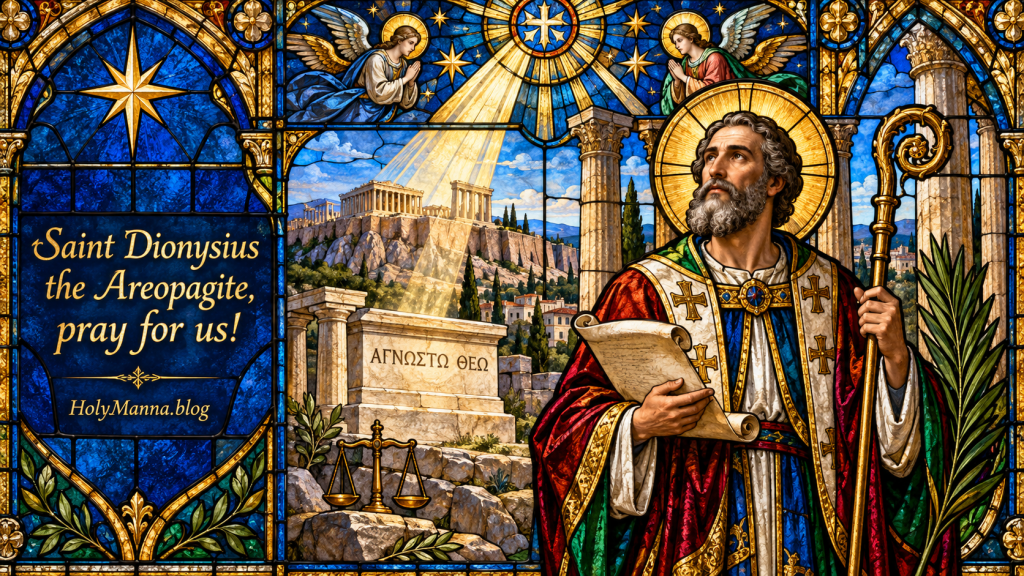
A Verdict That Changed Everything
Every October 3rd, the Church remembers a man who spent his career weighing evidence, and who, when the evidence for Jesus Christ was finally set before him, ruled in favor of the truth at the cost of everything he had. Saint Dionysius the Areopagite was a judge of the Areopagus, the most venerable court in ancient Athens, when Saint Paul stood on that famous hill and proclaimed the God the Athenians had unknowingly honored with an altar inscribed “To an unknown god” (Acts 17:23). Scripture itself records the outcome: “But some men joined him and believed, among them Dionysius the Areopagite and a woman named Damaris and others with them” (Acts 17:34). That single verse made Dionysius one of the most famous converts of the apostolic age, and early Christian testimony remembers him as the first bishop of Athens and, by long tradition, a martyr for the faith.
His story matters for another reason as well. Centuries after his death, his name became attached to some of the most influential mystical writings in Christian history, and also to the beloved martyr-bishop of Paris, Saint Denis. Untangling the historical judge from these later identifications is part of honoring him honestly, and this post will do exactly that, separating documented history from later tradition at every step. Dionysius holds real patronages to this day. He is the patron saint of Athens, he is venerated as the protector of judges and the judiciary, and several towns, including Crotone in Italy and Jerez de la Frontera in Spain, also honor him as patron. For anyone who works in law, weighs decisions for a living, or simply wonders whether an intelligent, successful, skeptical adult can really hand his whole life over to Christ, Saint Dionysius the Areopagite is a friend worth knowing.
A Judge on Mars Hill
The New Testament gives no details about the birth or family of Dionysius, and honesty requires saying so plainly. What Scripture does reveal is remarkable enough. He was an Areopagite, which means he sat as a member of the Areopagus, the ancient council of Athens that met on the rocky hill northwest of the Acropolis, the hill the Romans called Mars Hill. Membership in that body was not handed out lightly. The Areopagus was composed of men of proven public service, mature age, education, and unimpeachable reputation, men who judged the gravest matters in Athenian life. In other words, Dionysius was wealthy in credibility. He belonged to the intellectual and civic elite of the most philosophically sophisticated city in the ancient world.
Later Greek tradition fills in more of the picture, and it should be received as tradition rather than established fact. According to these accounts, Dionysius was born into a prominent Athenian family, received the finest education Athens could offer, and continued his studies in Egypt. One cherished story holds that while he was at Heliopolis in Egypt, he witnessed the unnatural darkness that covered the earth at the hour of the Crucifixion of Jesus, and cried out words to the effect of “Either God himself is suffering, or the world is coming to an end.” It is a beautiful story, and it has been retold for well over a millennium, but it first appears in a letter belonging to the body of writings composed under his name centuries after his death, and it cannot be verified. Some traditions also identify Damaris, the woman converted alongside him in Acts 17:34, as his wife, though Scripture itself says nothing of the kind, and that identification likewise cannot be verified.
What can be trusted completely is the scene Saint Luke paints in The Acts of the Apostles. Paul arrived in Athens around the year 50 and found a city “full of idols” (Acts 17:16). He reasoned in the synagogue and the marketplace until the philosophers of the city brought him before the Areopagus itself to explain this strange new teaching. There, before the very court on which Dionysius sat, Paul delivered one of the greatest sermons ever preached. He honored the Athenians’ religious searching, pointed to their altar to an unknown god, and declared, “What therefore you worship as unknown, this I proclaim to you” (Acts 17:23). He even quoted their own poets back to them: “In him we live and move and have our being” (Acts 17:28). Then he preached the Resurrection of Jesus from the dead, and the room split. “Now when they heard of the resurrection of the dead, some mocked; but others said, ‘We will hear you again about this’” (Acts 17:32). Dionysius did neither. He believed.
The Catechism teaches that this moment on the Areopagus is not just history; it is a portrait of every human heart. “The desire for God is written in the human heart, because man is created by God and for God; and God never ceases to draw man to himself” (CCC 27). The Catechism even points directly to Paul’s Athens sermon when it describes humanity’s long groping search for the God who is not far from anyone (CCC 28). Athens had built an altar to a God it did not know. Dionysius, the honest judge, recognized that Paul had just read the inscription aloud and given the unknown God His name.
Shepherd of Athens, Father of Mystics
The earliest witness to what happened next comes from a source with real historical weight. Around the year 170, another Dionysius, the bishop of Corinth, wrote a letter to the church of Athens, and the Church historian Eusebius preserved his testimony in Ecclesiastical History. Eusebius records that Dionysius the Areopagite, converted by the Apostle Paul as related in Acts, “was the first bishop of the church at Athens.” This is not late medieval embroidery; it is the memory of the Greek churches barely a century after the apostolic age, and the current Roman Martyrology commemorates him on October 3rd on exactly these terms, as the convert of Paul and the first bishop of Athens. It is worth flagging honestly that a few later Greek lists name a certain Hierotheus as the first bishop and Dionysius as the second; the sources conflict on the sequence, but they agree on the substance, that Dionysius shepherded the infant church of Athens.
Consider what that shepherding demanded. Athens was not a mission field of eager hearts; it was a city proud of its philosophy, comfortable in its idols, and openly amused by the Resurrection. The first bishop of such a city needed exactly what Dionysius possessed, a first-rate mind, public credibility, and the courage to spend both for Christ. His conversion demonstrates a truth The Catechism insists upon, that faith and reason are friends, not rivals: “Though faith is above reason, there can never be any real discrepancy between faith and reason” (CCC 159). Dionysius did not stop being a brilliant Athenian when he became a Christian. He brought the entire intellectual inheritance of Athens to the feet of the risen Lord.
Honesty also requires a plain statement here: the earliest sources record no specific miracles worked by Dionysius during his lifetime. Later Eastern tradition tells of extraordinary graces surrounding him, including the tradition that he traveled with Paul for three years and that he was present, along with the apostles, at the Dormition of the Blessed Virgin Mary. These accounts are cherished and ancient, but they rest on late sources and cannot be verified, and this post presents them as tradition rather than as documented history.
Then there is the astonishing afterlife of his name. Around the year 500, probably in Syria, an anonymous Christian theologian composed a body of writings under the name of Dionysius the Areopagite: The Divine Names, The Mystical Theology, The Celestial Hierarchy, The Ecclesiastical Hierarchy, and ten letters. The Church and virtually all scholars today agree that the historical first-century Dionysius did not write these works, and their author is now called Pseudo-Dionysius. Yet the writings themselves are profoundly orthodox and profoundly beautiful. They gave the Church the very word “hierarchy.” They taught that God so exceeds every created concept that the soul ascends to Him finally through love beyond images, entering what The Mystical Theology calls “the truly mysterious darkness of unknowing.” They shaped Saint Maximus the Confessor, Saint Bonaventure, and Saint Thomas Aquinas, who cites “Dionysius” well over a thousand times across his works. They echo in The Cloud of Unknowing and in Saint John of the Cross. The Catechism itself preserves this Dionysian instinct when it teaches that “our human words always fall short of the mystery of God” (CCC 42) and recalls the Fourth Lateran Council’s teaching that “between Creator and creature no similitude can be expressed without implying an even greater dissimilitude” (CCC 43). Because no verified sayings of the historical Dionysius survive, every famous quotation attributed to him online, including the lovely counsel from The Celestial Hierarchy that of all divine things the most divine is to cooperate with God in the salvation of souls, belongs to this later corpus and should be credited to it. The judge of Athens wrote none of it, and yet, in the providence of God, his name became the banner under which Athens’ deepest philosophical longing was finally baptized.
The Cost of Conversion, and a Tale of Two Dionysii
The hardships began the moment Dionysius believed. Read Acts 17:32 to 34 slowly and feel the social temperature of that room. The moment Paul mentioned the Resurrection, “some mocked.” These mockers were Dionysius’ colleagues, his intellectual peers, the men whose respect had defined his entire public life. To rise from that company and join the mocked preacher was social martyrdom before it was ever physical martyrdom. Every adult who has come back to the faith, or come to it for the first time, in a workplace or a friend group that finds Christianity slightly embarrassing knows a small taste of what Dionysius swallowed whole. The Catechism describes the duty he embraced: “The disciple of Christ must not only keep the faith and live on it, but also profess it, confidently bear witness to it, and spread it” (CCC 1816).
As bishop, he then carried the Church of Athens through the era when Rome’s tolerance of Christians was curdling into persecution. Long-standing tradition holds that Saint Dionysius was martyred at Athens during the persecution of the Emperor Domitian, around the year 95 or 96, and some accounts of his martyrdom relate that he was put to death by fire. The current Roman Martyrology honors him among the martyrs, and the Greek churches have always venerated him as a hieromartyr, a bishop-martyr. At the same time, honesty requires noting that the precise date, place, and manner of his death are not documented by contemporary records; the martyrdom itself is the constant tradition of the Church, while the details vary across sources and cannot be verified. Whatever the manner, the meaning is what the Church has always celebrated. “Martyrdom is the supreme witness given to the truth of the faith: it means bearing witness even unto death” (CCC 2473). The judge who once weighed the testimony of others became, at the end, the testimony.
Here the story takes its strangest turn, and a faithful account owes readers the full truth of it. Centuries later, tradition began to merge Dionysius of Athens with a completely different saint, Saint Denis of Paris, the third-century missionary bishop of Gaul who was beheaded with his companions Rusticus and Eleutherius on the hill later called Montmartre. In the ninth century, Abbot Hilduin of the great Abbey of Saint-Denis wove the three figures together, the Athenian judge, the author of the mystical writings, and the martyr of Paris, into a single glorious biography. Out of that merged tradition comes the dramatic story that Dionysius, after his beheading, rose, took up his own head, and walked to the place of his burial while the head continued to praise God. That story properly belongs to Saint Denis of Paris, whose feast is October 9th, and even as attached to Denis it is a pious tradition rather than documented history; as applied to Dionysius the Areopagite it cannot be verified, and the identification of the two saints has been rejected by scholars and by the Church’s modern Martyrology, which lists them separately on their own days. Telling the two Dionysii apart is not a loss for either saint. It is simple truthfulness, and truthfulness is the native language of a judge.
The City That Never Forgot
The veneration of Saint Dionysius after his death spread across both East and West, though here again the honest storyteller must distinguish carefully. No specific, documented healing miracles at his tomb survive from the early sources, and this post will not invent any. What history does show is a river of devotion. Portions of relics venerated as his are kept in several monasteries of Mount Athos, including Docheiariou, Simonopetra, and the monastery that bears his name, Dionysiou, and pilgrims have honored them for centuries. In the West, the Abbey of Saint-Denis near Paris long claimed to possess the relics of Dionysius the Areopagite himself, drawing kings and pilgrims for a thousand years; because that claim depends on the rejected identification of the Areopagite with Denis of Paris, it is presented here as a tradition, and it cannot be verified.
Even so, the fruits of devotion to his name are astonishing and entirely real. When Abbot Suger rebuilt the abbey church of Saint-Denis in the twelfth century, he was steeped in the Dionysian writings and their theology of God as uncreated Light, and he flooded his new church with stained glass and soaring height. That building is widely regarded as the birthplace of Gothic architecture. In a very real sense, every luminous Gothic window in Europe is downstream of the name of Dionysius. Athens, for its part, never forgot her first bishop. He is the patron saint of the city, and his feast on October 3rd is kept there with honor. The Catholic cathedral of Athens is the Basilica of Saint Dionysius the Areopagite, the Greek Orthodox faithful venerate him in a beloved church in the city center, and the graceful pedestrian avenue that curves beneath the Acropolis, steps from the very hill where Paul preached, is named Dionysiou Areopagitou, the street of Dionysius the Areopagite. Judges and lawyers continue to invoke him as their protector, a fitting patronage for a man who rendered the most important verdict of his life against every professional incentive.
All of this is what the Church means by the communion of saints. “Being more closely united to Christ, those who dwell in heaven fix the whole Church more firmly in holiness. They do not cease to intercede with the Father for us” (CCC 956). The Catechism adds that the saints in heaven “contemplate God, praise him and constantly care for those whom they have left on earth” (CCC 2683). Two thousand years after a judge stood up on Mars Hill, he is still standing with those who ask his prayers.
When the Unknown God Calls Your Name
Saint Dionysius speaks with surprising directness to Catholics between twenty and forty-five, because his conversion happened in a world that looks a great deal like this one. Athens was educated, prosperous, spiritually curious, and deeply skeptical of the Resurrection. Sound familiar? The culture did not hand Dionysius his faith; it mocked it. He had to weigh the evidence like the judge he was, and then he had to act on the verdict in public, in front of colleagues who laughed. Where in your life have you already recognized that the evidence points to Christ, but hesitated to stand up in the room?
His story also dignifies the searching that comes before belief. Paul did not begin on the Areopagus by condemning Athens; he began with the altar to the unknown god, honoring the longing before naming its fulfillment. The Catechism affirms that the human heart’s restlessness is itself God’s handwriting: “God never ceases to draw man to himself” (CCC 27). Anyone with friends, siblings, or coworkers who are “spiritual but not religious” can take Paul’s Athenian method as a model, and Dionysius as proof that it works. Start with the altar they have already built, the hunger for meaning, justice, beauty, and love, and gently proclaim the God they worship as unknown. Who in your life is worshiping at an altar to an unknown god, and how might you, like Paul, name that God for them with respect and courage?
There are practical ways to weave his lessons into daily life. Pray this week with Acts 17:16 to 34, slowly, placing yourself on that hill among the mockers and the curious, and ask where you would have stood. Practice intellectual honesty as a spiritual discipline in his honor, refusing to exaggerate, refusing to repeat claims you have not checked, and telling the truth even when it costs you standing, because that is exactly what his conversion required. Bring your mind to your faith the way he did, perhaps by reading a paragraph of The Catechism each day, trusting that “though faith is above reason, there can never be any real discrepancy between faith and reason” (CCC 159). And if your work involves judgment of any kind, decisions about people, money, disputes, or truth, ask his intercession before you decide. When was the last time you rendered a costly verdict for Christ, choosing what is true over what is comfortable?
Engage With Us!
HolyManna would love to hear from you, so please share your thoughts and reflections on Saint Dionysius the Areopagite in the comments below. His journey from the highest court of Athens to the courts of heaven raises questions worth sitting with, and your story might be exactly the encouragement another reader needs. Consider these questions as a starting point for prayer and discussion.
- Dionysius believed while his colleagues mocked; when have you had to profess your faith in a room that was not friendly to it, and what happened in your heart when you did?
- Paul began with the altar to the unknown god rather than with condemnation; what “altars” do you see in today’s culture, and how could you use one of them to start a conversation about Christ?
- Dionysius brought his formidable mind into the Church rather than leaving it at the door; what gift, talent, or expertise of yours is God inviting you to place completely at His service?
- The Church honors Dionysius as a martyr who bore witness even unto death; what small daily “martyrdoms” of honesty, patience, or courage is Christ asking of you right now?
- The true story of Dionysius had to be untangled from later confusions; where in your own spiritual life do you need to seek the truth patiently rather than settle for a comfortable version of it?
Whatever season of faith you are in, whether you are standing firm, searching honestly, or just now hearing the name of the God you have long worshiped as unknown, take heart from the judge of Athens. Render your verdict for Christ, live it out loud, and do everything, at work, at home, and in the quiet of your own heart, with the love and mercy that Jesus taught us.
Saint Dionysius the Areopagite, pray for us!
Follow us on YouTube, TikTok, Instagram and Facebook for more insights and reflections on living a faith-filled life.


Leave a comment