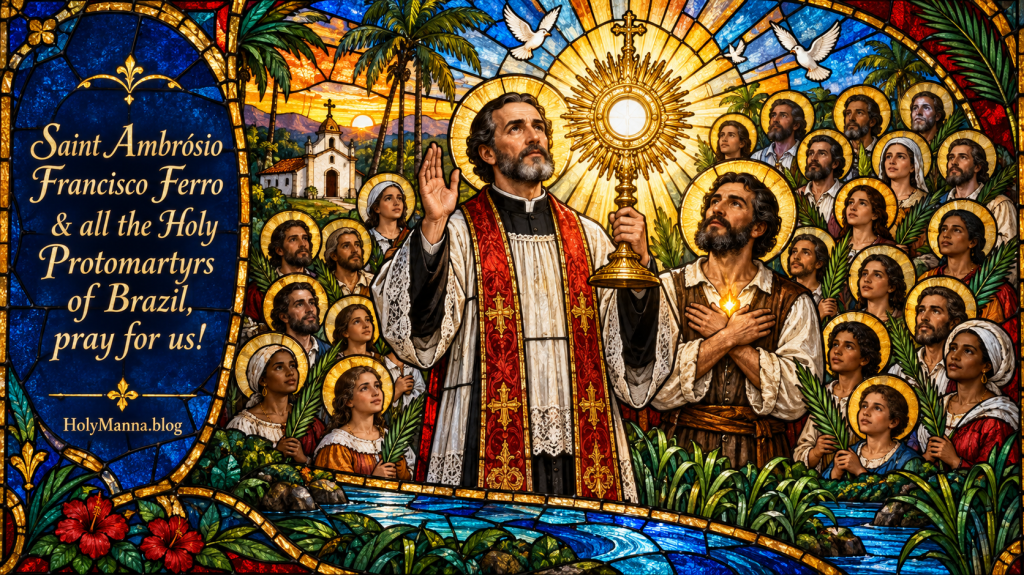
The Blood That Watered Brazil
On October 3rd, the Church lifts her eyes to a riverbank in northeastern Brazil and remembers thirty of her children who chose Christ over their own lives. Saints Ambrósio Francisco Ferro, priest, and his 27 companions, known as the Martyrs of Uruaçu, form the heart of the group the Church calls the Protomartyrs of Brazil. Together with Father André de Soveral and the layman Domingos Carvalho, who were killed a few months earlier at Cunhaú, they make up the thirty Martyrs of Cunhaú and Uruaçu, the first martyrs of Brazilian soil to be raised to the altars. At their beatification on March 5th, 2000, Pope Saint John Paul II declared, “They are the first fruits of the missionary work, the protomartyrs of Brazil.” Seventeen years later, on October 15th, 2017, Pope Francis canonized them in Saint Peter’s Square.
What makes this group so striking is who they were. Only two of the thirty were priests. The rest were ordinary lay Catholics: farmers, fathers, mothers, young daughters, a sacristan, immigrants from Portugal, Spain, and France, and Brazilians born in the colony. They were not theologians or bishops. They were a parish. When the moment of decision came, that parish chose the Eucharist over survival, and the Church has never forgotten it. The Catechism teaches that “Martyrdom is the supreme witness given to the truth of the faith” (CCC 2473), and these thirty gave that witness together, as families and neighbors, side by side.
The Martyrs of Cunhaú and Uruaçu hold the patronage of the Brazilian state of Rio Grande do Norte, where they lived and died, and where their feast on October 3rd is kept as a state holiday and a day of massive pilgrimage.
From the Azores to the Edge of the New World
The historical record on Father Ambrósio Francisco Ferro’s early life is honest in its silence, and this post will be honest with it too. He was born in the Azores, the Portuguese islands in the middle of the Atlantic, at a date that has not been preserved. Like so many Azoreans of his era, he crossed the ocean to Brazil together with relatives, seeking a life in the young colony. He was ordained a priest, and from about 1636 he served as the parish priest of Natal, the small settlement at the mouth of the Potengi River in the captaincy of Rio Grande. That is nearly everything the documents tell us about him before 1645. There are no recorded childhood stories, no famous sermons, no preserved letters. What history does preserve is the only thing that finally matters: he was a shepherd who stayed with his sheep.
His companion in martyrdom from the earlier massacre, Father André de Soveral, is better documented. Born around 1572 in São Vicente, in the captaincy of the same name in what is now the state of São Paulo, Soveral entered the Society of Jesus at about the age of 21. The Jesuits formed him in Latin and moral theology and sent him north to Pernambuco and then into Rio Grande, where he devoted himself to the catechesis of the indigenous Potiguar people, learning to minister in their own language. By 1645 he was serving as pastor of the community at Cunhaú, a sugar-producing estate south of Natal. Some sources describe him in his final years as a diocesan pastor rather than an active Jesuit missionary; the records are not perfectly clear on his canonical status, but they are unanimous that he was the priest of Cunhaú when the storm broke.
The storm had been gathering for fifteen years. In 1630 the Dutch West India Company invaded northeastern Brazil and carved out a Calvinist colony. The Dutch regime restricted and harassed the Catholic faith of the Portuguese and Brazilian population. In 1645, when the Portuguese settlers of Pernambuco rose in insurrection against Dutch rule, reprisals began, and they fell hardest on Catholic communities that had nothing to do with military resistance. The parishes of Rio Grande do Norte, quiet and far from the fighting, were about to become the seedbed of a nation’s faith. As The Catechism recalls in the words of Tertullian, “The blood of martyrs is the seed of Christians” (CCC 852).
Shepherds and Sheep in an Occupied Land
No miracles are documented during the lifetimes of any of these thirty saints, and this post will not invent any. Their claim on the Church’s memory is something in one sense more ordinary and in another sense more demanding: they kept the faith under an occupation designed to smother it, and they kept going to Mass when going to Mass was dangerous.
Consider what parish life meant in Rio Grande in the 1640s. The Dutch authorities tolerated Catholic worship only grudgingly and intermittently. Priests were few. Father Ferro in Natal and Father Soveral in Cunhaú were, for their people, the entire visible structure of the Church: baptisms, confessions, marriages, funerals, and above all the Holy Sacrifice of the Mass. The Catechism teaches that “The Eucharist is the source and summit of the Christian life” (CCC 1324), and for these communities that was not an abstraction. The Mass was the one place where a colonial farmhand, a Portuguese immigrant, a French trader like João Lostau Navarro, a Spaniard like Antônio Vilela Cid, and Brazilian-born families like that of Estêvão Machado de Miranda all knelt together as one Body.
The layman who would become the most famous of the thirty, Mateus Moreira, is described in the sources as a humble worker, and by some accounts a sacristan, one of those quiet men every parish knows, the one who prepares the altar, lights the candles, and stays after to put everything away. His entire recorded biography is essentially his death, and yet his death revealed a lifetime. A man does not die with the Blessed Sacrament on his lips unless he lived with the Blessed Sacrament in his heart.
Why should the reader remember them and emulate them? Because sanctity here did not look like founding an order or writing a summa. It looked like fidelity in an ordinary place under extraordinary pressure. Fathers brought their daughters to Mass knowing the times were dangerous. A priest from the Azores stayed at his post in Natal when he could likely have fled south. The Church holds up the Martyrs of Cunhaú and Uruaçu precisely because they show that the supreme witness of CCC 2473 is within reach of a normal parish, which means it is within reach of every parish today.
The River That Ran Red: October 3rd, 1645
The first blow fell at Cunhaú. On Sunday, July 16th, 1645, Father André de Soveral was celebrating Mass in the chapel of Our Lady of the Candles at the Cunhaú estate when a German mercenary in Dutch service named Jacob Rabe entered and announced that he carried communications from the governing authorities, to be read after Mass. The congregation stayed. After the consecration, at the most sacred moment of the liturgy, Dutch soldiers and their allied Tapuia and Potiguar warriors barred the doors and fell upon the congregation. Around seventy of the faithful were cut down inside the chapel. Father Soveral, the old missionary, spent his last moments praying the prayers for the dying over his people as they were slaughtered around him, until he was killed himself. Of that congregation, only Father Soveral and the layman Domingos Carvalho are known by name among the canonized; the rest of the Cunhaú dead are known to God. One source places this massacre on June 16th rather than July 16th, but the July date is far better attested and is the one the Church observes for Saint André de Soveral.
Terror spread through the captaincy. The Catholics of the Natal region scattered and hid, but the Dutch authorities summoned them to a designated gathering place on the banks of the Uruaçu River, in the area of the present-day town of São Gonçalo do Amarante, under the appearance of official protection. It was a trap. On October 3rd, 1645, soldiers and a force of about two hundred allied indigenous warriors were waiting for them. Some accounts name the commander of the attack as Antônio Paraopaba, a Potiguar leader allied to the Dutch and a zealous Calvinist; others place Jacob Rabe at the scene again. The sources genuinely conflict on who gave the orders that day, and this post will not pretend otherwise. What no source disputes is what was done.
The chroniclers of the period recorded the deaths at Uruaçu in detail, and the details are hard to read. Father Ambrósio Francisco Ferro and his parishioners, including his own relatives, were tortured before they were killed. Limbs were severed and heads were cut off. Some victims were burned; others had their eyes and tongues torn out. A child was pinned to a tree trunk, and another child was cut in half with a sword. Whole families died together: Estêvão Machado de Miranda with two of his daughters, Antônio Vilela with his daughter, Manuel Rodrigues de Moura with his wife, and a daughter of Francisco Dias. Alongside them died José do Porto, Francisco de Bastos, Diogo Pereira, Vicente de Souza Pereira, Francisco Mendes Pereira, João da Silveira, Simão Correia, Antônio Baracho, the Frenchman João Lostau Navarro, the Spaniard Antônio Vilela Cid, and João Martins with seven companions whose names have not come down to us. Twenty-eight died at Uruaçu; with the two named martyrs of Cunhaú, they are the thirty saints the Church canonized.
Then came the moment that gave this feast its soul. The executioners tore the heart of Mateus Moreira out through his back while he was still alive. With his last strength, he cried out, “Praised be the Blessed Sacrament.” This is not pious embroidery added centuries later. It was recorded by the chroniclers, examined in the beatification process, and proclaimed from Saint Peter’s Square by Pope Saint John Paul II himself in his homily of March 5th, 2000. A dying layman, his heart literally exposed, used his final breath not to curse his killers but to bless the Eucharist. The Catechism teaches that the disciple of Christ must be ready to “bear witness to him in the midst of the persecutions of the Church’s pilgrim life” and calls martyrdom the supreme act of that witness (CCC 1816, CCC 2473). The Church has also always treasured the records of such witness, for “The Church has painstakingly collected the records of those who persevered to the end in witnessing to their faith” (CCC 2474). At Uruaçu, the record is five words long, and it is enough.
Why did they die? Not for gold, not for territory, not for politics, though war raged around them. The beatification process established that they were killed in hatred of the Catholic faith, in odium fidei, by a regime that would not tolerate the Mass. They fulfilled the words of the Lord in The Gospel of Matthew: “Blessed are those who are persecuted for righteousness’ sake, for theirs is the kingdom of heaven” (Mt 5:10).
From a Forgotten Riverbank to the Altars of Saint Peter’s
For more than three centuries, the memory of Cunhaú and Uruaçu lived mostly in local devotion and in the chronicles. The formal cause of beatification opened in Natal in 1989. On March 5th, 2000, in the great Jubilee year, Pope Saint John Paul II beatified the thirty in Saint Peter’s Square, presenting them as the protomartyrs of Brazil whose blood watered their homeland and made it fertile for generations of new Christians. A small note of honesty for the careful reader: the English text of that homily speaks of the end of the 17th century, but the events are firmly dated to 1645; the phrase appears to be a slip in the text, not a real historical dispute.
On March 23rd, 2017, Pope Francis approved their canonization, dispensing with the miracle ordinarily required, as the Church may do for martyrs whose witness is certain. It should be said plainly that no miracle attributed to their intercession has been formally recognized by the Church. At the same time, the faithful of Rio Grande do Norte have long attributed graces, healings, and answered prayers to the Holy Martyrs, and devotion to them as heavenly intercessors is strong and growing; these attributed favors are told as testimonies of popular devotion, and they cannot be verified. On October 15th, 2017, Pope Francis canonized Saints André de Soveral, Ambrósio Francisco Ferro, Mateus Moreira, and their 27 companions in Saint Peter’s Square, inscribing them in the catalogue of the saints. Preaching on the new saints that day, the Holy Father said, in words translated from the Portuguese, “The Saints canonized today, above all the numerous martyrs, point out this road to us.” One clarification helps here: Saint John Paul II’s homily counted the group as two priests and 28 lay companions, while the canonization formula counted Soveral, Ferro, and Moreira by name plus 27 companions. Both describe the same thirty saints.
Their legacy on the ground in Brazil is remarkable. In 2002, the Monument to the Holy Martyrs was raised at Uruaçu, in São Gonçalo do Amarante, on the very site of the massacre, and it stands today as an open-air shrine that receives streams of pilgrims. The Shrine of the Holy Martyrs of Cunhaú and Uruaçu in that same region was included among the Jubilee churches for the Extraordinary Jubilee of Mercy in 2016 and again for the Holy Year 2025. In Natal, a great Sanctuary parish of the Holy Martyrs was dedicated on October 3rd, 2009, and ranks among the largest churches in the state. Pilgrims can also visit the historic chapel at Cunhaú in Canguaretama, where the first massacre took place. Civil society has embraced them as well: October 3rd is a legal state holiday in Rio Grande do Norte in honor of the Martyrs, the saints are patrons of the state, and in 2024 the town of São Gonçalo do Amarante formally recognized the Holy Martyrs of Uruaçu as its co-patrons. Mateus Moreira in particular is honored in Brazil in connection with extraordinary ministers of Holy Communion, a fitting patronage for the man who blessed the Blessed Sacrament with his dying breath. Every October 3rd, the quiet community of Uruaçu becomes a destination for thousands of pilgrims, and the Martyrs have become a defining part of the religious and cultural identity of northeastern Brazil.
All of this fulfills what the Church believes about her saints: “our communion with the saints joins us to Christ, from whom as from its fountain and head issues all grace” (CCC 957). The thirty of Cunhaú and Uruaçu are not museum pieces. They are living intercessors for Brazil and for the whole Church.
A Eucharistic Courage for Ordinary People
It is tempting to file a story like this under history, something that happened to other people in another century. But the Martyrs of Uruaçu were not professional heroes. They were a parish: a pastor, a sacristan, dads, moms, teenagers, immigrants, neighbors. Their courage was not manufactured on the riverbank that morning. It was built over years of ordinary fidelity, Sunday after Sunday, Mass after Mass, until the Eucharist was so woven into who they were that even torture could not pull it out of them. The Lord’s words in The Gospel of John were written into their bodies: “unless a grain of wheat falls to the ground and dies, it remains just a grain of wheat; but if it dies, it produces much fruit” (Jn 12:24). The fruit is visible today in the churches, pilgrimages, and living faith of Rio Grande do Norte.
So the question comes to you, reader, in your own century and your own parish. If your faith cost you something real this week, your job, your reputation, your comfort, would there be enough evidence to show you are a Catholic? Mateus Moreira’s five words were possible because of ten thousand ordinary acts of reverence before the tabernacle. When you receive the Eucharist this Sunday, do you receive the source and summit of your life, as CCC 1324 teaches, or just a routine?
There are practical ways to let these saints form you. Make one act of Eucharistic devotion this week beyond Sunday Mass, perhaps a visit to the Blessed Sacrament on your lunch break, or arriving fifteen minutes early to kneel in silence. Pray for persecuted Christians by name; the persecution that struck Uruaçu in 1645 strikes believers on several continents today, and the martyrs of the past are powerful intercessors for the martyrs of the present. Practice fidelity in the small, unglamorous roles of parish life, the way Mateus Moreira did; sign up to serve, to clean, to prepare, to stay after. And as a family, tell the story of these thirty at the dinner table on October 3rd, because families died together at Uruaçu, and families are still the first school of courage. Which of these steps will you actually take before the week is out?
Engage With Us!
The story of Saints Ambrósio Francisco Ferro, Mateus Moreira, and their companions belongs to the whole Church, and that includes you. Share your thoughts and reflections in the comments below; your witness might be exactly what another reader needs today. To guide the conversation, here are some questions to pray with.
- Mateus Moreira used his last breath to say, “Praised be the Blessed Sacrament.” What would it take for the Eucharist to hold that central a place in your daily life?
- The martyrs of Uruaçu were mostly laypeople, including entire families. How does their example challenge the idea that heroic holiness is only for priests and religious?
- Father Ambrósio Francisco Ferro stayed with his people when danger was certain. Where in your life is God asking you to stay faithful instead of walking away?
- The blood of these martyrs became, in Tertullian’s words quoted in CCC 852, the seed of Christians in Brazil. What sacrifice is God inviting you to make so that faith can grow in the people around you?
- How can you concretely support persecuted Christians around the world this month, through prayer, awareness, or giving?
The thirty saints of Cunhaú and Uruaçu prove that ordinary people, formed by the Mass and held together in community, can love God more than life itself. You are called to that same love, not necessarily to a martyr’s death, but certainly to a martyr’s fidelity. Live this week with your heart fixed on the Blessed Sacrament, stay close to your parish family, and do everything, at work, at home, and in secret, with the love and mercy that Jesus taught us.
Saint Ambrósio Francisco Ferro and all the Holy Protomartyrs of Brazil, pray for us!
Follow us on YouTube, TikTok, Instagram and Facebook for more insights and reflections on living a faith-filled life.


Leave a comment