Saturday of the Twenty-sixth Week in Ordinary Time – Lectionary: 460
The Day Heaven Stopped Being a Rumor
There is a difference between hearing about someone and finally meeting them face to face. Anyone who has spent years admiring a grandparent through old photographs, or following a hero from a distance, knows the jolt of the real encounter. The readings for October 3rd, Saturday of the Twenty-sixth Week in Ordinary Time, are about that jolt when the someone is God.
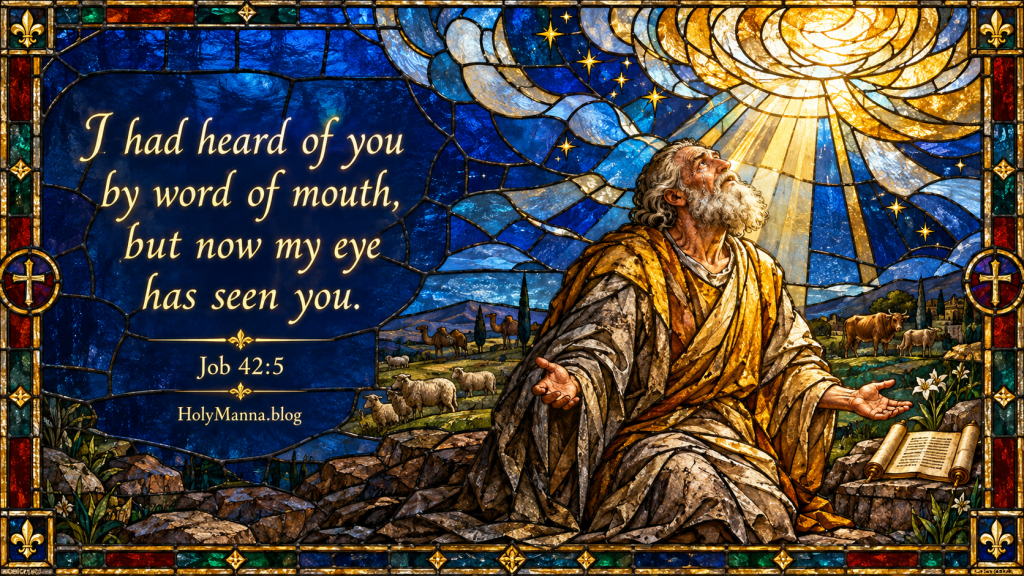
The Church has spent this week walking through The Book of Job, watching a good man lose everything and wrestle honestly with heaven. Today the wrestling ends, not because Job finally gets his explanations, but because he gets something better. “I had heard of you by word of mouth, but now my eye has seen you.” That single line is the hinge of the entire book, and it is the hinge of this entire day. The psalmist stands in the same light, praying, “Lord, let your face shine on me,” and confessing that even affliction taught him to see. Then Saint Luke hands over one of the most tender scenes in the Gospels: seventy-two ordinary disciples come home glowing with success, and Jesus, thrilling with joy in the Holy Spirit, praises the Father for hiding these things from the wise and revealing them to the childlike.
One golden thread runs through all of it. God does not hand His deepest gifts to the impressive, the credentialed, or the self-sufficient. He gives Himself to the humble, and the gift is not primarily answers, miracles, or even restored fortunes. The gift is His own face. Everything else, as Job’s fourteen thousand sheep quietly prove, is a footnote.
First Reading — Job 42:1-3, 5-6, 12-17
The Man Who Stopped Arguing and Started Seeing
For thirty-seven chapters, Job has suffered, argued, lamented, and demanded a hearing from God. His friends offered tidy theology that blamed the victim. Job refused it, and God Himself later vindicates that refusal. Then, beginning in chapter 38, God answered Job out of the whirlwind, not with a courtroom verdict but with a tour of creation that no human mind can master. Today’s passage is Job’s response and the book’s famous epilogue. The Book of Job belongs to Israel’s wisdom literature, set in the land of Uz, with a hero who is not even an Israelite, which makes its message universal: every human being who has ever suffered innocently has a stake in this story. The passage fits the day’s theme perfectly, because Job’s journey ends not in an explanation but in an encounter, and the encounter changes everything.
Job 42:1-3, 5-6, 12-17
Job answered the LORD and said:I know that you can do all things,
and that no purpose of yours can be hindered.
I have dealt with great things that I do not understand;
things too wonderful for me, which I cannot know.
I had heard of you by word of mouth,
but now my eye has seen you.
Therefore I disown what I have said,
and repent in dust and ashes.Thus the LORD blessed the latter days of Job
more than his earlier ones.
For he had fourteen thousand sheep, six thousand camels,
a thousand yoke of oxen, and a thousand she-asses.
And he had seven sons and three daughters,
of whom he called the first Jemimah,
the second Keziah, and the third Kerenhappuch.
In all the land no other women were as beautiful
as the daughters of Job;
and their father gave them an inheritance
along with their brothers.
After this, Job lived a hundred and forty years;
and he saw his children, his grandchildren,
and even his great-grandchildren.
Then Job died, old and full of years.
Detailed Exegesis
Verses 1-2: “Job answered the LORD and said: I know that you can do all things, and that no purpose of yours can be hindered.”
Job’s first words after seeing God are pure surrender to divine omnipotence. Notice what he does not say. He does not say that his suffering now makes sense, or that his questions were answered. He says that God’s purposes cannot be blocked, which means his pain was never proof of God’s absence. Faith here is trust in the Person, not possession of the reasons.
Verse 3: “I have dealt with great things that I do not understand; things too wonderful for me, which I cannot know.”
Job echoes God’s own opening challenge from the whirlwind and pleads guilty, gladly. There is something freeing in this admission. The modern world treats “I do not know” as failure, but Job discovers it is the doorway to wonder. Humility before mystery is not intellectual defeat; it is intellectual honesty in the presence of the infinite.
Verse 5: “I had heard of you by word of mouth, but now my eye has seen you.”
This is the summit of the entire book. Job’s religion had been real but secondhand, received from tradition and report. Suffering stripped everything away until only God remained, and in that emptiness Job encountered God directly. The Church reads every trial through this verse: affliction, mysteriously, can become the place where hearsay faith turns into firsthand faith.
Verse 6: “Therefore I disown what I have said, and repent in dust and ashes.”
Job repents, yet God never accuses him of sin; in fact, in the verses just after this passage, God declares that Job spoke rightly of Him. What Job disowns is the smallness of his previous picture of God. The closer a soul draws to divine holiness, the more clearly it sees its own poverty. That is why the saints, the holiest people in history, always called themselves the greatest sinners.
Verse 12: “Thus the LORD blessed the latter days of Job more than his earlier ones. For he had fourteen thousand sheep, six thousand camels, a thousand yoke of oxen, and a thousand she-asses.”
Compare these numbers with Job 1:3 and the arithmetic is exact: everything is doubled. The restoration is real, but its placement matters. It comes after Job’s surrender, not as a reward for it. God’s generosity overflows, yet the book has already made its point: Job would have been content with verse 5 alone.
Verse 13: “And he had seven sons and three daughters,”
Here the doubling stops, and commentators ancient and modern have noticed why. Sheep can be replaced; children cannot, because children are not lost. Job receives ten new children on earth while ten await him beyond death. Read this way, the verse whispers the hope of resurrection centuries before its full revelation.
Verse 14: “of whom he called the first Jemimah, the second Keziah, and the third Kerenhappuch.”
The daughters are named while the sons are not, a stunning reversal of ancient convention. Their names mean dove, cassia perfume, and horn of eye ornament, images of beauty, fragrance, and radiance. After the ashes, God fills Job’s house with loveliness, a sign that grief does not get the last word.
Verse 15: “In all the land no other women were as beautiful as the daughters of Job; and their father gave them an inheritance along with their brothers.”
In the ancient Near East, daughters normally inherited only when there were no sons, as Numbers 27 shows. Job, transformed by his encounter with God, becomes extravagantly generous beyond what law or custom required. Meeting God enlarges the heart.
Verse 16: “After this, Job lived a hundred and forty years; and he saw his children, his grandchildren, and even his great-grandchildren.”
Seeing the fourth generation is the biblical shorthand for a life crowned with covenant blessing. The man who once sat on an ash heap scraping his sores now watches great-grandchildren play. God’s timeline is longer than any single season of pain.
Verse 17: “Then Job died, old and full of years.”
The book closes with the formula reserved for the patriarchs Abraham and Isaac. Job dies satisfied, not because life gave him no scars, but because his eye had seen God. That is what a full life means in the grammar of Scripture.
Teachings
The Catechism confronts Job’s question head on. CCC 272 teaches, “Faith in God the Father Almighty can be put to the test by the experience of evil and suffering. God can sometimes seem to be absent and incapable of stopping evil. But in the most mysterious way God the Father has revealed his almighty power in the voluntary humiliation and Resurrection of his Son, by which he conquered evil. Christ crucified is thus ‘the power of God and the wisdom of God. For the foolishness of God is wiser than men, and the weakness of God is stronger than men.’” Job glimpsed from afar what the Cross reveals in full: God answers suffering not with a lecture but with His presence, and finally with His own wounds.
Sacred Tradition has treasured this book intensely. Saint Gregory the Great, Pope and Doctor of the Church, spent years composing the Moralia in Job, a commentary of thirty-five books begun for the monks who accompanied him during his service in Constantinople. It became one of the most read works of the entire Middle Ages, and in it Gregory consistently presents Job as a type of Christ, the innocent sufferer, and of the Church, tried but never abandoned. The New Testament itself canonizes Job’s example, for The Letter of James declares, “You have heard of the perseverance of Job, and you have seen the purpose of the Lord, because the Lord is compassionate and merciful” (James 5:11).
Reflection
Almost everyone carries a chapter of life that feels like Job’s ash heap: a diagnosis, a layoff, a betrayal, a loss that no explanation could soften. This reading does not promise that God will double your sheep. It promises something better, that suffering endured in faith can turn a rumor of God into a sight of God. Consider one concrete practice this week: take the hardest thing in your life right now and, instead of asking God why, ask Him where. Where are You, Lord, in this? Then sit in silence for ten minutes and let Him answer with presence rather than words. A second practice: imitate Job’s generosity in verse 15 by giving something to someone who has no claim on it. Has your knowledge of God remained mostly secondhand, received from parents or parish but never tested? What would it take for you to say, with Job, now my eye has seen you?
Responsorial Psalm — Psalm 119:66, 71, 75, 91, 125, 130, 135
A Love Song to the Word That Teaches Through Everything
Psalm 119 is the longest chapter in the Bible, one hundred seventy-six verses arranged as an acrostic of twenty-two stanzas, one for each letter of the Hebrew alphabet. Every stanza circles the same treasure, God’s word, under eight recurring names: law, statutes, precepts, decrees, commands, ordinances, words, and promises. The Church places these particular verses on Job’s lips today, and the fit is uncanny. The psalmist has suffered, and rather than resenting it, he dares to call affliction his teacher. The refrain, drawn from verse 135, reaches back to the priestly blessing of Numbers 6:25 and forward to the day’s central theme: the humble soul standing in the light of God’s face.
Psalm 119:66, 71, 75, 91, 125, 130, 135
R. (135) Lord, let your face shine on me.
Teach me wisdom and knowledge,
for in your commands I trust.
R. Lord, let your face shine on me.
It is good for me that I have been afflicted,
that I may learn your statutes.
R. Lord, let your face shine on me.
I know, O LORD, that your ordinances are just,
and in your faithfulness you have afflicted me.
R. Lord, let your face shine on me.
According to your ordinances they still stand firm:
all things serve you.
R. Lord, let your face shine on me.
I am your servant; give me discernment
that I may know your decrees.
R. Lord, let your face shine on me.
The revelation of your words sheds light,
giving understanding to the simple.
R. Lord, let your face shine on me.
Detailed Exegesis
Verse 66: “Teach me wisdom and knowledge, for in your commands I trust.”
The psalmist does not claim wisdom; he begs for it. Trust comes first, understanding follows. This is the posture Job finally reached and the posture Jesus will praise in the childlike, the exact opposite of the modern instinct to withhold trust until every question is settled.
Verse 71: “It is good for me that I have been afflicted, that I may learn your statutes.”
This may be the boldest sentence in the psalter. The psalmist does not call affliction good in itself; he calls it good for him, because it taught him what comfort never could. Anyone who has grown closer to God through a hard season knows exactly what this verse means, and no one learns it any other way.
Verse 75: “I know, O LORD, that your ordinances are just, and in your faithfulness you have afflicted me.”
Here is the scandal and the consolation: affliction filtered through God’s faithfulness, not His neglect. The psalmist refuses to interpret pain as abandonment. Like Job, he insists that whatever God permits passes first through hands that are just.
Verse 91: “According to your ordinances they still stand firm: all things serve you.”
The vision widens to the cosmos. Sun, seasons, and stars obey God’s decrees, which means the believer’s obedience joins the harmony of creation itself. Even the chaos that touched Job’s life, the psalmist implies, was never outside God’s governance, for all things serve Him.
Verse 125: “I am your servant; give me discernment that I may know your decrees.”
Discernment is asked for, not achieved. Notice the logic: because he is a servant, he needs to know the Master’s will. Identity comes before understanding. The one who belongs to God receives light; the one who belongs to himself stumbles in his own cleverness.
Verse 130: “The revelation of your words sheds light, giving understanding to the simple.”
This verse is the bridge to today’s Gospel. God’s word does not require a doctorate; it requires an open heart. The simple, the anawim, the little ones of God, receive understanding that the sophisticated miss, precisely because they come empty-handed.
Verse 135, the refrain: “Lord, let your face shine on me.”
This is the ancient blessing of Aaron turned into a personal cry. Job wanted to see God’s face; the psalmist begs for God’s face to shine on him; the Gospel will show disciples blessed for what their eyes see. The whole day gathers into these seven words.
Teachings
The Church teaches that this shining face is encountered, above all, in Sacred Scripture itself. CCC 104 declares, “In Sacred Scripture, the Church constantly finds her nourishment and her strength, for she welcomes it not as a human word, ‘but as what it really is, the word of God.’ ‘In the sacred books, the Father who is in heaven comes lovingly to meet his children, and talks with them.’” That second sentence, drawn from the Second Vatican Council’s Dei Verbum, transforms Bible reading from an academic exercise into a family reunion. The psalmist’s one hundred seventy-six verses of delight suddenly make sense: he is not praising a rulebook, he is praising a meeting place. Every verse of Psalm 119 assumes what the Council later stated plainly, that when the simple believer opens the sacred page with trust, the Father Himself comes lovingly to meet him.
Reflection
Try praying verse 71 honestly: It is good for me that I have been afflicted. For most people that prayer sticks in the throat, and that is fine; it took the psalmist affliction to learn it. A concrete step: choose one stanza of Psalm 119 each morning this week, just eight verses, and read it slowly before touching your phone. Let the word be the first light your eyes receive. Another step: name one painful season of your past and write down one thing about God you would never have learned without it. Can you look back at any affliction and honestly call it your teacher? When you open Scripture, do you expect information, or do you expect the Father coming lovingly to meet you?
Holy Gospel — Luke 10:17-24
The Only Time the Gospels Say Jesus Rejoiced
Saint Luke alone records the mission of the seventy-two, sent ahead of Jesus two by two into every town He intended to visit. Ancient manuscripts vary between seventy and seventy-two, and both numbers carry the same symbolism: the nations of the world listed in Genesis 10 and the seventy elders who shared Moses’ spirit in Numbers 11. In other words, this mission previews the Church’s mission to all humanity, carried not by celebrities but by unnamed ordinary disciples. Today’s passage is their homecoming, and it contains a treasure found nowhere else in the four Gospels: the explicit statement that Jesus rejoiced. What He rejoices over, and what He redirects the disciples’ joy toward, is the very heart of this day’s readings.
Luke 10:17-24
The seventy-two disciples returned rejoicing and said to Jesus,
“Lord, even the demons are subject to us because of your name.”
Jesus said, “I have observed Satan fall like lightning from the sky.
Behold, I have given you the power
‘to tread upon serpents’ and scorpions
and upon the full force of the enemy
and nothing will harm you.
Nevertheless, do not rejoice because the spirits are subject to you,
but rejoice because your names are written in heaven.”At that very moment he rejoiced in the Holy Spirit and said,
“I give you praise, Father, Lord of heaven and earth,
for although you have hidden these things
from the wise and the learned
you have revealed them to the childlike.
Yes, Father, such has been your gracious will.
All things have been handed over to me by my Father.
No one knows who the Son is except the Father,
and who the Father is except the Son
and anyone to whom the Son wishes to reveal him.”Turning to the disciples in private he said,
“Blessed are the eyes that see what you see.
For I say to you,
many prophets and kings desired to see what you see,
but did not see it,
and to hear what you hear, but did not hear it.”
Detailed Exegesis
Verse 17: “The seventy-two disciples returned rejoicing and said to Jesus, ‘Lord, even the demons are subject to us because of your name.’”
The mission worked beyond their wildest hopes. Note the little word “even,” the sound of astonished amateurs. They rightly credit the name of Jesus, not their own technique, yet a subtle danger already glimmers: their joy is anchored in what they were able to do.
Verse 18: “Jesus said, ‘I have observed Satan fall like lightning from the sky.’”
While they preached in villages, Jesus saw the cosmic battlefield. Every humble act of ministry participated in the overthrow of the enemy. The image of lightning captures both the suddenness and the finality of the fall: brilliant for a moment, then down and done.
Verse 19: “Behold, I have given you the power ‘to tread upon serpents’ and scorpions and upon the full force of the enemy and nothing will harm you.”
Jesus alludes to Psalm 91:13, the psalm of divine protection. The promise is not immunity from suffering, as the martyrdom of most apostles proves, but immunity from spiritual defeat. Nothing the enemy does can separate a faithful disciple from God, which is the only harm that ultimately counts.
Verse 20: “Nevertheless, do not rejoice because the spirits are subject to you, but rejoice because your names are written in heaven.”
Here is the correction that protects every future missionary from pride. Gifts and successes rise and fall; salvation is the constant. A disciple whose joy depends on results will collapse in a dry season, but a disciple whose joy rests on belonging to God can never be robbed.
Verse 21: “At that very moment he rejoiced in the Holy Spirit and said, ‘I give you praise, Father, Lord of heaven and earth, for although you have hidden these things from the wise and the learned you have revealed them to the childlike. Yes, Father, such has been your gracious will.’”
The Son rejoices in the Spirit and praises the Father, one of the clearest Trinitarian moments in the Synoptic Gospels. And what thrills the heart of Jesus? Not the miracles, but the fact that fishermen, tax collectors, and nobodies received what scholars missed. The childlike are not the childish; they are those humble enough to receive.
Verse 22: “All things have been handed over to me by my Father. No one knows who the Son is except the Father, and who the Father is except the Son and anyone to whom the Son wishes to reveal him.”
This verse soars so high that scholars nicknamed its parallel in The Gospel of Matthew the Johannine thunderbolt, because it sounds like The Gospel of John dropped into Saint Luke. Jesus claims a mutual, exclusive knowledge with the Father that belongs to God alone. Knowing God is therefore never a human achievement; it is always the Son’s gift.
Verse 23: “Turning to the disciples in private he said, ‘Blessed are the eyes that see what you see.’”
Job longed for his eye to see God; these disciples are looking at Him over dinner. The Incarnation makes Job’s climactic experience the daily bread of the apostles. Their blessedness lies not in their talent but in their front-row seat to God made visible.
Verse 24: “For I say to you, many prophets and kings desired to see what you see, but did not see it, and to hear what you hear, but did not hear it.”
Isaiah, David, and every holy soul of the old covenant ached for this moment. The disciples, and every baptized Catholic who kneels before the Eucharist, receive what royalty begged for. Familiarity is the great thief of wonder; this verse is Jesus handing wonder back.
Teachings
The Catechism treasures this scene as one of Christ’s own recorded prayers. CCC 2603 teaches, “The evangelists have preserved two more explicit prayers offered by Christ during his public ministry. Each begins with thanksgiving. In the first, Jesus confesses the Father, acknowledges, and blesses him because he has hidden the mysteries of the Kingdom from those who think themselves learned and has revealed them to infants, the poor of the Beatitudes. His exclamation, ‘Yes, Father!’ expresses the depth of his heart, his adherence to the Father’s ‘good pleasure,’ echoing his mother’s Fiat at the time of his conception and prefiguring what he will say to the Father in his agony.”
On the childlike heart, CCC 2785 teaches that prayer requires “a humble and trusting heart that enables us ‘to turn and become like children’: for it is to ‘little children’ that the Father is revealed.” Concerning Satan’s fall, CCC 395 is sober and consoling: “The power of Satan is, nonetheless, not infinite. He is only a creature, powerful from the fact that he is pure spirit, but still a creature. He cannot prevent the building up of God’s reign.”
Saint Cyril of Alexandria, Doctor of the Church, preached directly on these verses in his Commentary on Luke. On Satan’s fall he writes, “he was cast down from on high to earth: from overweening pride to humiliation: from glory to contempt: from great power to utter weakness.” And on where a disciple’s joy must rest, Cyril concludes, “Even though, therefore, we receive some gift from Christ not unworthy of admiration, we must not think too highly of it, but rather make the hope prepared for us our cause of rejoicing, and that our names are written in the companies of the saints, by Christ’s gift, the Saviour of us all.”
Reflection
Modern life keeps score constantly: followers, metrics, promotions, likes. This Gospel asks a piercing question: where does your joy actually live? If it lives in results, it will die with the next failure. If it lives in the fact that your name is written in heaven through Baptism, it is untouchable. A concrete practice: at the end of each day this week, before reviewing what you accomplished, thank God first for one thing only, that you belong to Him. Another: pick one area where you play the expert, work, parenting, even theology, and deliberately ask God to teach you like a beginner. Do you rejoice more in what you do for God than in what God has done for you? When did you last let yourself be genuinely childlike before the Father, trusting without needing to control?
The Joy No One Can Take From You
Set the three scenes side by side and watch them become one story. An old man on an ash heap finally sees God and says everything he once knew was hearsay. A psalmist looks back at his worst season and calls it his best teacher, then begs for one thing only, the shining of God’s face. Seventy-two exhausted, exhilarated disciples come home bragging about demons, and Jesus, laughing with joy in the Holy Spirit, gently lifts their eyes higher: rejoice that your names are written in heaven.
This is the Gospel’s scandalous economics. Job’s doubled flocks were not the point; seeing God was. The disciples’ spiritual success was not the point; belonging to God was. Everything the world counts, and everything even religious people are tempted to count, turns out to be a footnote beneath one unrepeatable treasure, the face of God turned toward His child.
And here is the part that should stop every reader mid-scroll: what prophets and kings desired and never received now sits available in every Catholic parish. The same Lord who spoke from the whirlwind and rejoiced in the Spirit waits in the tabernacle, speaks through the sacred page, and washes names into the book of heaven at every Baptism. Blessed are the eyes that see what you see.
So take this Saturday and do something childlike with it. Show up to Mass early and just look at Him. Open Psalm 119 and let the Father come lovingly to meet you. Bring Him the ash heap you have been arguing over, and instead of demanding answers, ask for His face. He has been waiting to be more than a rumor in your life. Let today be the day your eye has seen Him.
Engage With Us!
Your story matters here, and this little corner of the internet exists so that faith can be shared, not just read. Drop a comment below with the reflection that struck you most, or with the moment in your own life when God stopped being hearsay and became real. Someone scrolling past may need your words today.
To help you pray with these readings, here are a few questions to carry into the weekend:
- In Job 42:1-3, 5-6, 12-17, Job says he had heard of God by word of mouth but now his eye has seen Him. What affliction or season of loss has moved your faith from secondhand to firsthand, and what did it cost you?
- In Psalm 119:66, 71, 75, 91, 125, 130, 135, the psalmist declares it was good for him to have been afflicted, because affliction taught him God’s statutes. Is there a hardship in your life right now that God might be using as a classroom, and can you thank Him for it yet?
- In Luke 10:17-24, Jesus tells the seventy-two to rejoice not in their power over spirits but because their names are written in heaven. Where does your joy actually live, in your achievements or in your Baptism?
- Taking all the readings together, God reveals His face to the humble and the childlike rather than to the wise and the learned. What would becoming childlike before the Father look like in your week ahead, concretely?
Whatever you carry into this Saturday, carry it knowing your name can be written in heaven and the Father’s face is already turned toward you. Live this day with the love and mercy Jesus taught, and let everything you do, from the smallest chore to the hardest conversation, be done in His name.
Sacred Heart of Jesus, we trust in You!
Immaculate Heart of Mary, pray for us!
Saint Michael the Archangel, defend us in battle!
Follow us on YouTube, TikTok, Instagram and Facebook for more insights and reflections on living a faith-filled life.


Leave a comment