Never Walking Alone
Every October 2nd, the Roman Catholic Church celebrates the Memorial of the Holy Guardian Angels, a day set aside to thank God for one of the most tender expressions of His providence: the pure spirits He assigns to accompany, protect, and guide every human life from its first moment to its last. Coming just days after the Feast of Saints Michael, Gabriel, and Raphael on September 29th and the Memorial of Saint Thérèse of the Child Jesus on October 1st, this celebration closes a remarkable week in the liturgical calendar, a week in which heaven’s friendship with humanity takes center stage.
The Memorial is not a sentimental footnote to the faith. The Catechism of the Catholic Church teaches plainly: “From its beginning until death, human life is surrounded by their watchful care and intercession. Beside each believer stands an angel as protector and shepherd leading him to life” (CCC 336). That second sentence is itself a quotation from Saint Basil the Great, a Doctor of the Church writing in the 4th century, which means the Church has been proclaiming this truth for well over 1,600 years. The guardian angel is not a character from a greeting card. He is a real, personal, intelligent creature of God, standing in the presence of the Father while simultaneously attending to the human being entrusted to his care.
For adults navigating careers, relationships, loneliness, and the noise of modern life, this Memorial carries a message that lands with surprising force: God’s love is not generic. It is assigned. It has a name known to God, a mission, and a face turned always toward the Father. This post walks through where the celebration came from, what Scripture and Tradition actually say, what the Church formally teaches, how the saints lived this devotion, and how it can reshape an ordinary Tuesday.
A Celebration Born in Spain and Given to the World
Devotion to the holy angels is as old as the Church itself, flourishing in both East and West from the earliest centuries. Liturgically, however, the guardian angels were long honored together with Saint Michael on September 29th, the ancient feast commemorating the dedication of a basilica in his honor near Rome. For most of the first millennium and beyond, that single day carried the Church’s public gratitude for the entire angelic world.
The distinct celebration of the guardian angels took shape in Spain. Devotional sources commonly report a feast in their honor celebrated in Valencia as early as 1411, spreading from there through the Iberian Peninsula and into France; that early date rests on secondary accounts, so it is presented here as received tradition rather than settled record. The documented archival trail begins a bit later. The Catholic Encyclopedia, drawing on the liturgical historian Bäumer, records that the church of Córdoba petitioned Rome in 1579 for permission to keep a feast of the guardian angels, and that Valencia received approval in February of 1582 for a proper Office in their honor. At that stage the celebration remained a local treasure of particular churches.
Pope Paul V changed that. On September 27th, 1608, he placed the feast on the general calendar as an optional celebration, and at the request of Ferdinand of Austria, the future emperor, he made it obligatory throughout the lands of the empire, to be kept on the first free day after the feast of Saint Michael. Historians note that the new feast was understood as a kind of supplement to September 29th, giving the guardian angels their own moment of honor. It is a lovely detail of providence that in that same year of 1608, Paul V canonized Saint Frances of Rome, the 15th century Roman wife and mother famed in her canonization records for the extraordinary companionship of her guardian angel.
In 1670, Pope Clement X raised the celebration to an obligatory feast for the entire Church and fixed it permanently on October 2nd, the first unoccupied day after Saint Michael’s feast. The Catholic Encyclopedia records that Pope Leo XIII further elevated its rank in 1883. When Saint Paul VI reformed the General Roman Calendar in 1969, the celebration was classified as a Memorial, the rank it holds today: obligatory, universal, and beloved. From a local Spanish devotion to the whole Catholic world, the story of this Memorial is itself a picture of how the Holy Spirit grows good things quietly, over centuries, until the entire Church is enriched.
Angels Woven Through the Whole of Scripture
Because this Memorial commemorates a truth of the faith rather than an apparition, its deepest foundations are scriptural and traditional, and they run through the entire Bible like a golden thread. The first reading the Church proclaims at Mass on October 2nd comes from Exodus 23:20, where God speaks to Israel on the way to the Promised Land: “See, I am sending an angel before you, to guard you on the way and bring you to the place I have prepared.” God adds a command that doubles as spiritual advice for every generation: “Be attentive to him and heed his voice.” Here is guardianship on a national scale, an angel assigned to shepherd an entire people through the wilderness.
The Psalms make the protection personal. Psalm 91, prayed by the Church every single night at Compline, promises: “For to his angels he has given command about you, that they guard you in all your ways.” The Book of Tobit shows the archangel Raphael traveling in disguise beside young Tobiah, arranging his marriage, healing his father, and revealing himself only at journey’s end. In Daniel 6, an angel shuts the mouths of lions. In Acts 12, an angel walks Saint Peter out of Herod’s prison past sleeping guards, so unexpectedly that the praying Church initially assumes the visitor at the door must be “his angel.” The Letter to the Hebrews asks of the angels: “Are they not all ministering spirits sent to serve, for the sake of those who are to inherit salvation?” (Hebrews 1:14).
Then comes the Gospel of the Memorial, and the words of Christ Himself in Matthew 18:10: “See that you do not despise one of these little ones, for I say to you that their angels in heaven always look upon the face of my heavenly Father.” Jesus speaks of the angels of the little ones as an obvious fact, and He reveals something astonishing: these guardians never lose the beatific vision while carrying out their earthly mission. They guard from within the very presence of God.
The Fathers of the Church received this testimony and taught it without hesitation. Saint Basil the Great wrote that beside each believer stands an angel as protector and shepherd, the very line the Catechism would later enshrine in CCC 336. Saint Jerome, commenting on Matthew 18, marveled: “how great the dignity of the soul, since each one has from his birth an angel commissioned to guard it.” Centuries later, Saint Thomas Aquinas gave the teaching its classic theological form in the Summa Theologiae, Part I, question 113, arguing that the guardianship of angels belongs to the ordering of divine providence, and that each human being is guarded by an angel throughout earthly life. One honest note belongs here, because honesty serves faith: the existence of angels is a truth of faith, as the next section shows, while the specific belief that each individual person has his or her own guardian angel has never been the object of a solemn dogmatic definition. It is, rather, the constant and universal teaching of the Church, what Saint Jerome’s era called the mind of the Church, held everywhere and always, woven into her liturgy, her Catechism, and her prayer.
What the Church Actually Teaches
The Catechism of the Catholic Church devotes a beautiful sequence of paragraphs, CCC 328 through 336, to the angels, and it opens with clarity: “The existence of the spiritual, non-corporeal beings that Sacred Scripture usually calls ‘angels’ is a truth of faith” (CCC 328). Belief in angels is not optional Catholic folklore; it is part of the deposit of faith, confessed every Sunday when the Church proclaims God the maker “of all things visible and invisible.”
Who are they? The Catechism borrows a famous distinction from Saint Augustine: “‘Angel’ is the name of their office, not of their nature. If you seek the name of their nature, it is ‘spirit’; if you seek the name of their office, it is ‘angel’: from what they are, ‘spirit,’ from what they do, ‘angel’” (CCC 329). Angels are servants and messengers of God, creatures of intelligence and will, personal and immortal, surpassing in perfection all visible creatures.
Most importantly, the Catechism insists that “Christ is the center of the angelic world” (CCC 331). The angels belong to Him and serve His saving plan. They announced His birth, ministered to Him in the desert, strengthened Him in agony, proclaimed His Resurrection, and will accompany His return in glory. Devotion to the guardian angels is therefore never a detour from Jesus; it is a road that runs straight to Him, because every angel exists for Him and points to Him. The angels likewise stand near His Mother, whom the Church invokes in the Litany of Loreto as Queen of Angels, for the greatest angelic message ever delivered was Gabriel’s word to Mary at the Annunciation.
The Church experiences angelic help corporately, not only individually. “The whole life of the Church benefits from the mysterious and powerful help of angels” (CCC 334), and in her liturgy the Church joins the angels in adoring the thrice-holy God (CCC 335). This is not poetry. At every Mass, the congregation sings the Sanctus with the choirs of heaven, and in the Roman Canon the priest prays: “command that these gifts be borne by the hands of your holy Angel to your altar on high in the sight of your divine majesty.”
The modern popes have taught this doctrine with warmth and insistence. Saint John Paul II dedicated a series of General Audience catecheses to the angels in the summer of 1986, teaching on July 30th of that year that the angels, as pure spirits, participate in the holiness of God and “in the key moments they surround Christ and accompany him in the fulfillment of his salvific mission in regard to mankind.” Benedict XVI, at the Angelus on October 2nd, 2011, described the guardian angels as “ministers of the divine care for every human being.” Pope Francis, preaching at the Casa Santa Marta on this Memorial in 2014, gave the teaching its most quotable modern form: “No one journeys alone and no one should think that they are alone.” He connected the guardian angel directly to the Gospel’s call to become like children: docile, willing to receive help, humble enough to listen. Preaching again on October 2nd, 2015, he pressed the point into an examination of conscience: “How is my relationship with my guardian angel? Do I listen to him? Do I say good morning to him in the morning?” Doctrine, in the mouths of the popes, becomes friendship.
One further teaching frames anything the Church says about angelic appearances. CCC 67 teaches that private revelations, even those recognized by Church authority, “do not belong, however, to the deposit of faith.” The most cherished modern account of an angelic visitation belongs to Fatima: in 1916, according to the memoirs of Sister Lucia dos Santos, an angel identifying himself as the Angel of Peace appeared three times to the three shepherd children, teaching them prayers of adoration and reparation and preparing them for Our Lady’s visits the following year. The Fatima apparitions were declared worthy of belief by the Bishop of Leiria in 1930; the angelic visions are recounted in Sister Lucia’s later memoirs and are received within that approved devotion. As private revelation, these accounts bind no one, yet they harmonize perfectly with what Scripture and the Catechism already teach: angels adore God, serve His plan, and lead souls toward Him.
How the Saints Befriended Their Angels
Doctrine becomes devotion in the lives of the saints, and few devotions are as consistently attested across the centuries as friendship with the guardian angel. The most universal expression is a prayer many Catholics learned before they learned to read, the Angele Dei: “Angel of God, my guardian dear, to whom God’s love commits me here, ever this day be at my side, to light and guard, to rule and guide. Amen.” The Church has attached indulgences to this prayer for centuries; Pope Pius VI enriched it with indulgences in the 18th century, and the current Enchiridion Indulgentiarum grants a partial indulgence to the faithful who devoutly invoke their guardian angel with an approved prayer such as this one. Praying it takes ten seconds. Its effects, the Church wagers, last considerably longer.
The saints went far beyond ten seconds. The canonization records and early biographies of Saint Frances of Rome, the 15th century Roman noblewoman, wife, mother, and foundress, recount that she enjoyed the nearly continual, visible companionship of her guardian angel, whose light rebuked her faults and steadied her through the deaths of her children and the ruin of her household during war. These accounts come from her hagiographical tradition and are offered as such. Closer to modern times, the biographers of Saint Gemma Galgani, the young Italian mystic who died in 1903, record her speaking with her guardian angel with startling familiarity, even entrusting letters to him; again, these are accounts from her documented life story, cherished by the faithful without being imposed on them. Saint Pio of Pietrelcina, the beloved Padre Pio, urged his spiritual children in his collected letters to send him their guardian angels when they could not reach him in person, treating the angels as reliable messengers in the communion of saints.
Perhaps the most consequential guardian angel story of the 20th century belongs to this very date. On October 2nd, 1928, while making a retreat in Madrid and hearing the bells of a nearby church ring for the Memorial of the Holy Guardian Angels, Saint Josemaría Escrivá received the inspiration to found Opus Dei, a way of seeking holiness in ordinary work and daily life. He retained a lifelong tenderness for the guardian angels, and the anniversary of the founding is kept each year on their Memorial. For a celebration about heaven’s quiet assistance in ordinary life, the timing could hardly be more fitting.
Physical places carry the devotion as well. Bavaria’s Schutzengelkirche in Eichstätt, a splendid 17th century church of the Guardian Angels, testifies to the devotion’s deep roots in German-speaking lands. In the United States, the Guardian Angel Cathedral in Las Vegas places the devotion, with a certain divine humor, in a city that needs it. Countless parishes and schools across the world bear the name Holy Guardian Angels, quietly forming generations of children in the confidence that they are watched over and known.
A Devotion Carried in Many Languages
Few Catholic devotions have sunk as deeply into everyday culture as this one. Across the Spanish-speaking world, generations of children have been tucked into bed with the traditional prayer: “Ángel de la guarda, dulce compañía, no me desampares ni de noche ni de día.” In English the prayer reads: “Angel of my guard, sweet company, do not abandon me by night or by day.” For millions of Catholics from Madrid to Mexico City to Manila, the guardian angel was the first theology lesson they ever received, taught by a mother’s voice in the dark. Grandmothers across Latin America still send loved ones out the door with a blessing entrusting them to their angel.
In Spain, the devotion carries civic weight: the Holy Guardian Angels are the patrons of the National Police, and every October 2nd officers across the country mark their patronal feast with Masses and ceremonies, a striking public acknowledgment that those who guard others are themselves guarded. In Germany, Austria, and Switzerland, the Schutzengel, the guardian angel, occupies a cherished place in popular piety, from baptismal gifts to the guardian angel churches that dot the landscape. The 19th century produced the most recognizable guardian angel image in the world, the widely reproduced painting of a luminous angel hovering over two small children as they cross a broken bridge; whatever its artistic pedigree, it has hung above cribs on every continent and communicated Psalm 91 to people who never opened a Bible.
The Church’s own worship sings the devotion. The Liturgy of the Hours for October 2nd opens with Robert Campbell’s 1850 hymn They Come, God’s Messengers of Love, and its Office of Readings hands every priest, religious, and layperson who prays it a magnificent sermon of Saint Bernard of Clairvaux, considered in the next section. The Memorial also arrives at a culturally rich moment of the calendar, following the Archangels on September 29th, the old Michaelmas that once marked the rhythms of harvest and university terms across Europe, and Saint Thérèse on October 1st. The first week of October thus became, in Catholic cultures, a small season of heaven’s friendship, before Our Lady of the Rosary crowns it on October 7th under the gaze of the Queen of Angels.
Walking Through Ordinary Days With an Unseen Friend
Here is where the Memorial stops being history and starts being about your actual life. The Office of Readings for October 2nd gives the Church the words of Saint Bernard of Clairvaux, preaching on Psalm 91, and his advice remains the single best practical program for this devotion ever written: “These words should fill you with respect, inspire devotion and instill confidence; respect for the presence of angels, devotion because of their loving service, and confidence because of their protection.” Respect, devotion, confidence. Consider what each one asks of you.
Respect means living as though someone holy is actually present, because someone is. The scroll you would be embarrassed to show a friend, the words typed in anger at midnight, the way strangers get treated when no one important is watching: an angel who beholds the face of God witnesses all of it. That thought is not meant to produce scrupulosity but dignity. You are accompanied by nobility; live like it. And remember that this cuts outward too. The coworker who irritates you, the driver who cut you off, the relative you have written off: each of them has an angel gazing on the Father. Christ’s warning in Matthew 18:10 about despising the little ones lands differently once you realize every person you meet comes with a heavenly advocate.
Devotion means giving the relationship actual time. Pope Francis’s questions make a perfect daily checklist: say good morning to your angel, ask his protection before you sleep, ask his advice before the hard conversation, the exam, the interview, the diagnosis appointment. Pray the Angele Dei while the coffee brews. None of this is childish; it is childlike, which is precisely the disposition Jesus praises in the Gospel of this Memorial.
Confidence is the fruit. Saint Bernard finishes his sermon with words that deserve to be memorized by anyone who struggles with anxiety, which is to say nearly everyone between 20 and 45: “They are loyal, prudent, powerful. Why then are we afraid? We have only to follow them, stay close to them, and we shall dwell under the protection of God’s heaven.” The Collect of the Memorial asks God, who in His “unfathomable providence” sends His holy angels to guard His people, that the faithful “may always be defended by their protection and rejoice eternally in their company.” Defended now, rejoicing later, never alone in between. That is the whole Memorial in a single prayer.
Engage With Us!
The conversation should not end here. Share your thoughts, memories, and reflections in the comments below; someone else’s faith may be strengthened by what your guardian angel has carried you through. Take a few minutes with these questions:
- How is your relationship with your guardian angel today, and when was the last time you actually spoke to him?
- Looking back on your life, can you identify a moment of protection, warning, or unexplainable peace that you now recognize as God’s providence at work through His angels?
- Saint Bernard names three responses to the angels: respect, devotion, and confidence. Which one is weakest in your life right now, and what is one concrete step to strengthen it this week?
- Jesus says the angels of the little ones always behold the Father’s face. How would your treatment of the most difficult person in your life change if you remembered that an angel stands beside them too?
- Saint Josemaría heard God’s call on this very Memorial in the middle of an ordinary retreat. What might God be quietly asking of you in the ordinary circumstances of this week?
Whatever this October 2nd holds, walk through it with confidence: heaven has assigned you a companion, and he has never once looked away. Keep praying, keep listening, and keep growing together in faith, with the holy angels at your side and under the guidance of our Blessed Mother, the Queen of Angels, who leads every soul she loves straight to her Son.
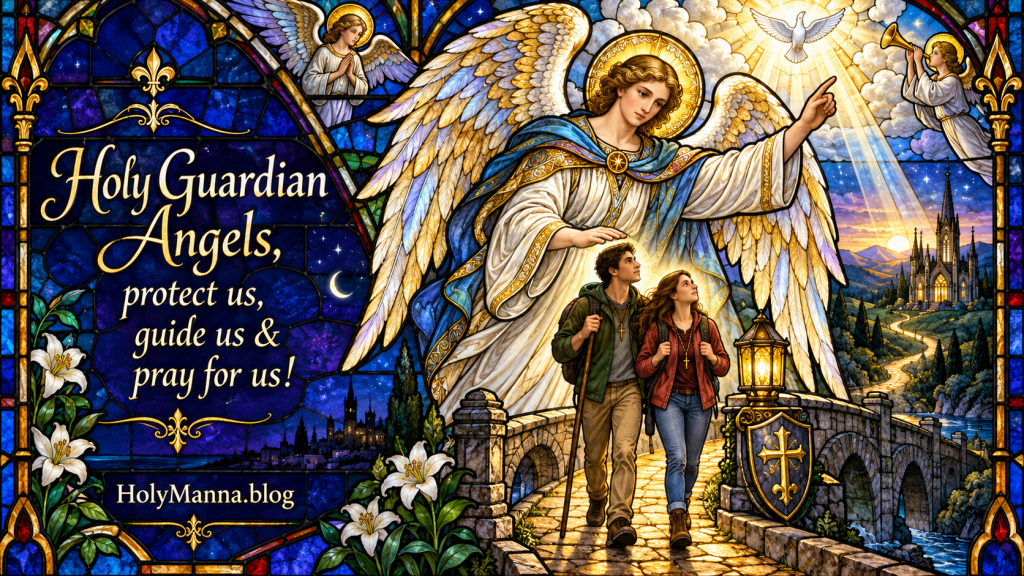
Holy Guardian Angels, protect us, guide us, pray for us!
Follow us on YouTube, TikTok, Instagram and Facebook for more insights and reflections on living a faith-filled life.


Leave a comment