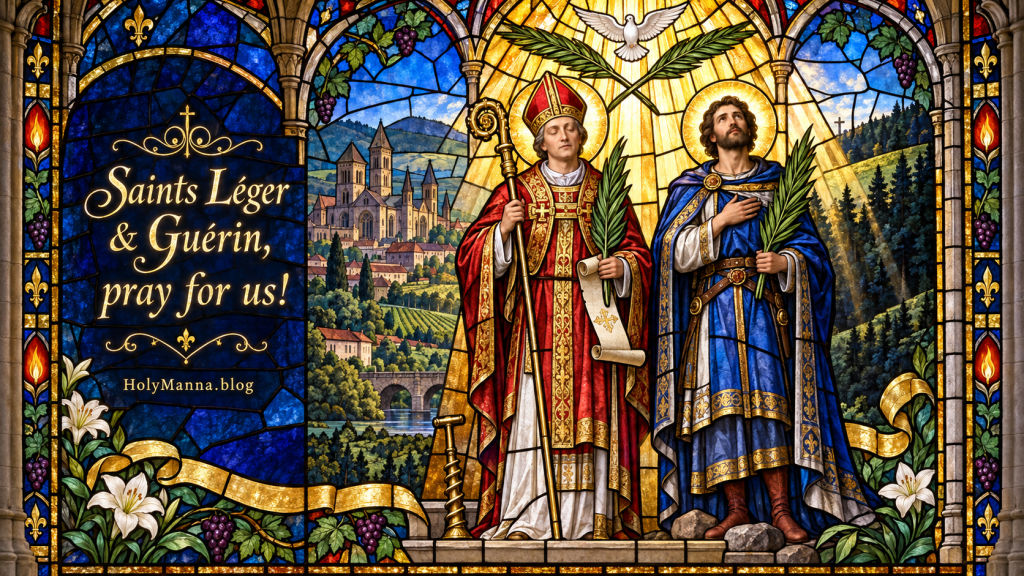
Brothers Bound by Blood and by Grace
Every family hopes to pass something down. Some pass down land, some pass down a name, and some pass down a business. The family behind today’s saints passed down something far more durable: holiness. Saints Léger and Guérin, commemorated together on October 2nd, were blood brothers born into the highest ranks of Frankish nobility in 7th-century Gaul, and their mother, Saint Sigrada, is venerated as a saint in her own right. One brother became a bishop, the other a count. One was blinded, mutilated, and beheaded; the other was tied to a post and stoned. Both died forgiving the man who killed them, and both are honored by the Church as martyrs, witnesses whose deaths proclaimed Christ more loudly than their lives ever could.
Léger, known in Latin as Leodegarius and in older English sources as Leodegar, served as Bishop of Autun in Burgundy and became one of the most beloved saints of medieval France. He is the patron of millers and is invoked against blindness, eye disease, and sore eyes, a patronage that grew directly out of the manner of his suffering, since his persecutors bored out his eyes and he bore it while singing psalms. Guérin, known in Latin as Gerinus and in some sources as Warinus or Gairin, held the rank of count and shared his brother’s fate for sharing his brother’s convictions. The Catechism teaches that “Martyrdom is the supreme witness given to the truth of the faith: it means bearing witness even unto death” (CCC 2473). These two brothers gave that witness side by side, in the same persecution, at the hands of the same tyrant, and the Church has never separated their memory since.
Born into Power, Formed for Heaven
Léger was born around the year 615, with some sources placing it closer to 616, into a family that sat at the very top of Merovingian society. His father is named in the sources as Bodilon, sometimes rendered Bobilo, a high-ranking Burgundian nobleman who held comital rank, and his mother was Sigrada of Alsace, who would later end her days as a nun in the convent of Sainte-Marie at Soissons and is honored as Saint Sigrada with a memorial on August 8th. Guérin, the second brother, was born into the same household, and the early sources indicate the family’s roots ran through Autun and Poitiers. It is a remarkable and well-documented fact that this single Frankish family produced three canonized saints: the mother and both of her sons.
Because of the family’s rank, both boys spent part of their childhood at the royal court of King Clotaire II, the king of the Franks. Court life in that era was a school of ambition, intrigue, and violence, and many young nobles learned those lessons all too well. Léger learned something else. While still young he was sent to Poitiers to be educated under his maternal uncle Dido, also called Desiderius, the Bishop of Poitiers, who placed him under a learned priest and later completed the young man’s formation personally. Butler’s Lives of the Saints records that Léger made great progress in learning, but far greater progress in what the old authors beautifully call the science of the saints, the steady practice of walking in God’s presence through self-denial, humility, and constant union of heart with God.
His uncle recognized the young man’s extraordinary ability and ordained him a deacon at the age of 20, then made him archdeacon and entrusted him with much of the government of the diocese. Around the year 650 Léger withdrew to the monastery of Saint-Maixent in Poitou, and by 651 he was made its abbot, an office he held for roughly six years. As abbot he was a genuine reformer: he introduced the Rule of Saint Benedict to the community and governed with such prudence and sanctity that his reputation traveled all the way to the royal court. Guérin, meanwhile, followed the secular path his rank opened to him, eventually becoming a count, with later sources associating him with the counties of Poitiers and Paris, and raising a family of his own. The brothers took two different roads, one through the cloister and the sanctuary, the other through marriage and public office, and both roads ended at the same crown. That is worth sitting with. Holiness has never been the private property of clergy and religious. The Catechism affirms that “all Christians in any state or walk of life are called to the fullness of Christian life and to the perfection of charity” (CCC 2013).
A Shepherd Who Rebuilt His City
When King Clovis II died in 656, his widow, Saint Bathilde, governed as regent for her young sons, and she gathered holy men around her to help her rule well, among them Saint Eligius and Saint Ouen. The fame of the abbot of Saint-Maixent reached her court, and Léger was summoned to serve as an advisor to the queen and a tutor to her children. Then came the assignment that defined his life. The important Burgundian see of Autun had been vacant for two years and was being torn apart by rival factions, with blood actually being shed over the succession. Léger was named Bishop of Autun, with sources placing his appointment between 659 and about 663, and his arrival calmed the storm. He reconciled the parties, quieted the disturbances, and set about being exactly what a bishop is supposed to be.
The record of his episcopate is a portrait of pastoral seriousness. He took care to relieve the poor of his diocese, so consistently that an old plaque at one of his churches remembers him as a just judge and friend of the poor. He instructed his clergy and preached frequently to his people. He beautified the churches of Autun, magnificently repaired the baptistery of his cathedral, brought the relics of the early martyr Saint Symphorian back to the city, and even rebuilt the city walls. Around the year 670 he convened a diocesan synod at Autun, sometimes counted as the first Council of Autun, which enacted canons for the reformation of morals and discipline. The surviving canons deal chiefly with monastic life: monks were directed to observe the Rule of Saint Benedict, to labor in common, to practice hospitality, to own nothing as private property, and to stay out of the cities except on legitimate monastery business. The synod also promoted the Athanasian Creed and pressed for the faithful administration of the sacraments, especially Baptism. Butler records the bishop’s conviction, reported from the synod, that if monks were truly all they ought to be, their prayers would preserve the world from public calamities. That is not a throwaway line; it is a whole theology of intercession, and it anticipates what The Catechism teaches about the hidden fruitfulness of consecrated life, which “constitutes a closer imitation and an abiding reenactment in the Church” of the form of life the Son of God took up (CCC 932, quoting the conciliar teaching the paragraph preserves).
No miracles are recorded of Léger during his years of peaceful governance, and honesty requires saying so plainly. What the near-contemporary sources do record is something arguably harder than working wonders: a rich, powerful, well-connected man who used every advantage he had for the poor, the clergy, and the Church, and who was willing to lose all of it rather than flatter a king. When young King Childeric II, whom Léger had supported and served so closely that some documents style the bishop a leading figure of the palace, abandoned himself to his passions and contracted a marriage the Church judged unlawful, Léger admonished him first in private, exactly as The Gospel of Matthew prescribes, and when private correction failed, he reproved the king publicly. Courtiers seized the opening, poisoned the king against him, and had the bishop banished to the monastery of Luxeuil. Speaking truth cost Léger his position. It would soon cost him far more.
The Long Road to Calvary in Gaul
To understand what happened next, the reader needs one name: Ebroin. He was the Mayor of the Palace of Neustria, the power behind the Merovingian throne, and the ancient sources are unanimous in painting him as ruthless, vindictive, and insatiably ambitious. Léger had actually saved Ebroin’s life once, interceding with other bishops when the defeated tyrant faced execution, so that he was spared and tonsured a monk at Luxeuil, the same monastery to which Léger himself was later banished. For a time the two men lived under the same roof, and Ebroin promised the bishop his friendship. The promise did not survive contact with opportunity.
In 673 King Childeric II was assassinated, and in the chaos that followed, Léger was restored to Autun and received with rejoicing, while Ebroin abandoned the monastery, murdered the new mayor of the palace, propped up a pretender king, and sent an army into Burgundy. Its first target was Autun. What Léger did next is one of the great episcopal moments in the history of the Church. He refused to flee. He distributed his silver plate and his goods among the poor. He made his will, leaving estates to his church, a testament that still survives. He ordered a fast of 3 days and led a procession with the cross and the relics of the saints around the city walls, prostrating himself at every gate and begging God with tears that if martyrdom was being asked of him, his flock might be spared. He gathered his people in the church and asked pardon of anyone he might have offended by too great severity. And when the enemy pressed the city with fire and sword, the early Life records his words to the defenders: “Fight no longer. If it is on my account they are come, I am ready to give them satisfaction. Let us send one of our brethren to know what they demand.” He received Holy Communion, walked out of the gates, and handed himself over so that Autun would not burn.
What followed is painful to write and was recorded by a near-contemporary. His captors bored out his eyes. The eyewitness tradition preserved in the early Life, and handed on by Butler’s Lives of the Saints, reports that he endured it without letting his hands be tied and without a single groan, singing psalms the whole time. Later, on Ebroin’s orders, he was dragged across sharp stones, his tongue was maimed, and his lips were cut off, mutilations designed to silence a preacher forever. He was then placed in custody at the monastery of Fécamp in Normandy, where he remained about two years. And here the sources record what they regarded as a miracle during his life: though his tongue had been cut, his wounds healed and he spoke again, clearly, and used that recovered voice to instruct the nuns, to offer the Holy Sacrifice daily, and to pray almost without ceasing. The early hagiographers present his restored speech as miraculous, and it is presented here as they presented it, a wonder attested by the tradition rather than a fact that can be clinically verified at this distance.
Now the story turns to Guérin. Ebroin, hunting for a legal pretext to finish what he had started, falsely accused both brothers of complicity in the murder of King Childeric II. Both were dragged before the king and the assembled lords and loaded with reproaches. Léger, blind and mutilated, calmly told Ebroin that he would soon lose the power he had usurped. The brothers were then separated. Guérin was tied to a post and stoned to death, most sources placing this near Arras around the year 677, with one calendar giving 676. The early tradition preserved his dying prayer, and it deserves to be read slowly: “Lord Jesus Christ, who camest not only to call the just, but sinners, receive the soul of thy servant, to whom thou hast granted a death like that of the martyrs.” He continued praying until he died beneath the stones. Notice what he is doing in that prayer. He is quoting his Savior back to Himself, echoing the Lord’s own words in The Gospel of Luke, “I have not come to call the righteous to repentance but sinners” (Lk 5:32), and he is calling himself not a hero but a sinner shown mercy. That is what dying in Christ sounds like.
From his imprisonment, Léger wrote a letter to their mother, Sigrada, by then a nun at Soissons, and this letter genuinely survives to this day. In it he consoled her for Guérin’s death, telling her that what was an occasion of joy and triumph to the angels ought not to be a subject of grief to them. Knowing his mother’s heart, he warned her against harboring resentment toward their persecutors and reminded her that since Christ set the example by praying on the Cross for His own executioners, it must be possible for His followers to love their enemies. He was preaching to his mother, from his own dungeon, the very teaching of the Lord: “Love your enemies, and pray for those who persecute you” (Mt 5:44), and “Father, forgive them, for they know not what they do” (Lk 23:34). The Catechism teaches that “Christian prayer extends to the forgiveness of enemies, transfiguring the disciple by configuring him to his Master” (CCC 2844). Léger did not merely endure his persecutors; he was configured to Christ in the act of forgiving them.
The end came around 678, with some sources dating it to October 2nd, 679, a discrepancy the records do not fully resolve. Because a bishop could not simply be executed, Ebroin gathered a handful of compliant bishops in an assembly that lacked any canonical standing, no proper convocation, no metropolitan authority, and pressed Léger to confess to Childeric’s murder. He constantly refused, calling God to witness his innocence. They tore his tunic from top to bottom as a sign of degradation and handed him over to be killed. Ebroin, terrified that the people would venerate him as a martyr, ordered him taken into a forest, executed, and buried in a hidden pit so the grave could never be found. Even that plan unraveled under the weight of the bishop’s holiness. The count charged with the execution could not bear to watch it and delegated it to 4 officers; the count’s wife wept, and Léger comforted her and promised that God would bless her if she saw to his burial. In the forest, the tradition preserved by Butler recounts, three of the four executioners fell at his feet and begged his forgiveness, and he prayed for them; when he said he was ready, the fourth beheaded him. This detail of the three repentant executioners comes from the hagiographic tradition and cannot be independently verified. He died in the forest near Sarcing in Artois, and the count’s wife buried him in a small oratory there.
A Voice That Outlived the Sword
Ebroin’s entire aim had been to erase Léger, to hide his body and smother his memory. Rarely has a plan failed so completely. Ebroin himself was assassinated within a few years, around 680 or 681, and once he was gone, nothing stood in the way of the truth. An assembly of bishops formally examined the case and proclaimed Léger a martyr. Around 682 his remains were solemnly translated to the abbey of Saint-Maixent, the very monastery he had governed as a young abbot, and a basilica rose in his honor. Butler and the early sources record that many miracles were wrought at his tomb, and the hagiographers who wrote within living memory of the events recount a succession of miracles accompanying the translations of his relics. These miracle accounts come from the early Lives and the medieval tradition and cannot be individually verified, and they are handed on here as the tradition hands them on.
One story from the relic history has charmed the faithful for centuries. Three bishops, of Arras, of Autun, and of Poitiers, each claimed the martyr’s body for his own church, and rather than fight over a man who died forgiving his enemies, they settled the matter by placing three lots upon an altar and drawing them, trusting God to choose. The lot fell to Poitiers. This story comes from the early tradition surrounding the translation of 682 and cannot be verified. What is documented is the later journey of the relics: portions were moved during the Norman invasions, carried to Rennes and then to Ebreuil, a town that took the name Saint-Léger in his honor, and portions are kept to this day in the cathedral of Autun and at the Grand Séminaire of Soissons. In 1458 Cardinal Jean Rolin, Bishop of Autun, had the saint’s feast observed as a holy day of obligation in his diocese, eight centuries after the martyrdom, which says everything about how alive the devotion remained.
The cultural footprint of Saint Léger across France is genuinely astonishing. A great number of churches in France and Belgium bear his name, dozens of French communes are called Saint-Léger in some form, and he is honored with special devotion in the dioceses of Autun and Poitiers. Perhaps the most surprising fact of all belongs to the history of language itself: the Vie de saint Léger, a poem of 240 lines recounting his life and martyrdom, was composed in the 10th century and stands among the very oldest surviving texts written in the French language. Students of French literature, whatever their faith, still begin near this martyred bishop. The man whose tongue was cut out to silence him ended up present at the birth of French literature. God’s sense of irony is impeccable. Guérin’s veneration, though quieter, endured as well; the traditional Roman Martyrology commemorates him alongside his brother on October 2nd, while some modern references assign him a separate memorial on August 25th, and a later genealogical tradition connected with the House of Vergy locates his stoning at Vergy in Burgundy around 681 rather than near Arras, a claim at odds with the earlier sources and noted here only as a variant tradition that cannot be verified.
What Two Dead Brothers Say to a Distracted Age
It would be easy to file Léger and Guérin away as figures from a barbarous age with nothing to say to modern life. That would be a mistake, because the pressures that crushed them are at work in every office, every family, and every feed today, just wearing softer clothes. Léger’s whole crisis began because he told a powerful man a truth that man did not want to hear, and everything he lost traces back to that refusal to flatter. The Catechism teaches that “Fortitude is the moral virtue that ensures firmness in difficulties and constancy in the pursuit of the good” and that it “strengthens the resolve to resist temptations and to overcome obstacles in the moral life” (CCC 1808). Most people will never face an Ebroin, but nearly everyone faces the smaller daily choice between honesty and convenience, between correcting a wrong and staying comfortable. When was the last time telling the truth cost you something, and what did you do?
Then there is the forgiveness. It is one thing to forgive an insult; it is another to write to your grieving mother from prison, after your brother has been stoned and your own eyes taken, and beg her not to hate the man responsible. That letter still exists. It is not pious folklore; it is a real document from a real dungeon, and it points relentlessly to Christ crucified. The disciple of Jesus has no exemption clause here, for the Lord Himself taught His followers to pray, “forgive us our trespasses, as we forgive those who trespass against us”, and The Catechism is unflinching about what that petition demands, teaching that this outpouring of mercy “cannot penetrate our hearts as long as we have not forgiven those who have trespassed against us” (CCC 2840). Is there a name that came to mind just now, someone still unforgiven, and what would it take to hand that name to God today?
Guérin’s witness speaks with its own accent. He was not a bishop or a monk. He was a layman, a nobleman with a career, a wife, and children, and the Church crowned him with the same martyr’s palm as his brother. His dying prayer named himself a sinner whom Christ came to call, which is the most honest thing any Christian can say. The Catechism teaches that the Church is “the holy People of God,” and its members share Christ’s prophetic office when they bear “witness to him” by a life of faith and charity (CCC 785), and it teaches that our communion with the saints in heaven strengthens the whole Church, for “we seek, rather, that by this devotion to the exercise of fraternal charity the union of the whole Church in the Spirit may be strengthened” (CCC 957). The brothers are not museum pieces. They are alive in Christ, they intercede, and they can be asked for help by name. A practical rule of life flows naturally from their story: speak the truth with charity even when it is costly, pray daily by name for the person who has wounded you, receive Holy Communion as strength for the hard road the way Léger did before walking out of the city gates, and remember the poor concretely, since the friend of the poor gave away his plate before he gave away his life. The Lord promised, “Blessed are they that suffer persecution for justice’ sake, for theirs is the kingdom of heaven” (Mt 5:10), and these two brothers are that promise kept.
Engage With Us!
The story of Saints Léger and Guérin is heavy, beautiful, and startlingly relevant, and hearing how it lands in other lives is part of how the Body of Christ works. Readers are warmly invited to share their thoughts, questions, and reflections in the comments below. To help start that conversation, here are a few questions to pray with:
- Léger corrected a king privately before he ever did so publicly, following the Lord’s own pattern. How do you handle correction, both giving it and receiving it, in your family or workplace?
- Guérin died quoting Christ’s mercy toward sinners rather than pleading his own innocence. What would change in your prayer life if you approached God first as a sinner shown mercy?
- Léger gave away his possessions to the poor before surrendering to his enemies. What is one possession or comfort you could give away this week as an act of trust in God?
- From prison, Léger urged his mother to forgive their persecutors. Who in your life is God asking you to forgive, and what is one concrete step toward that forgiveness you can take today?
- Both brothers reached the same crown by different vocations, one as a bishop and one as a layman. How is God calling you to holiness in the exact state of life you are in right now?
However this story has touched your heart, do not let it end as reading material. Ask Saints Léger and Guérin to intercede for you, especially wherever truth-telling or forgiveness feels impossible, and trust that the God who gave two Frankish brothers the strength to bless their killers can give you the strength for whatever today holds. Live your faith out loud, speak the truth with courage, forgive quickly and completely, and do everything, absolutely everything, with the love and mercy that Jesus taught us.
Saints Léger and Guérin, pray for us!
Follow us on YouTube, TikTok, Instagram and Facebook for more insights and reflections on living a faith-filled life.


Leave a comment