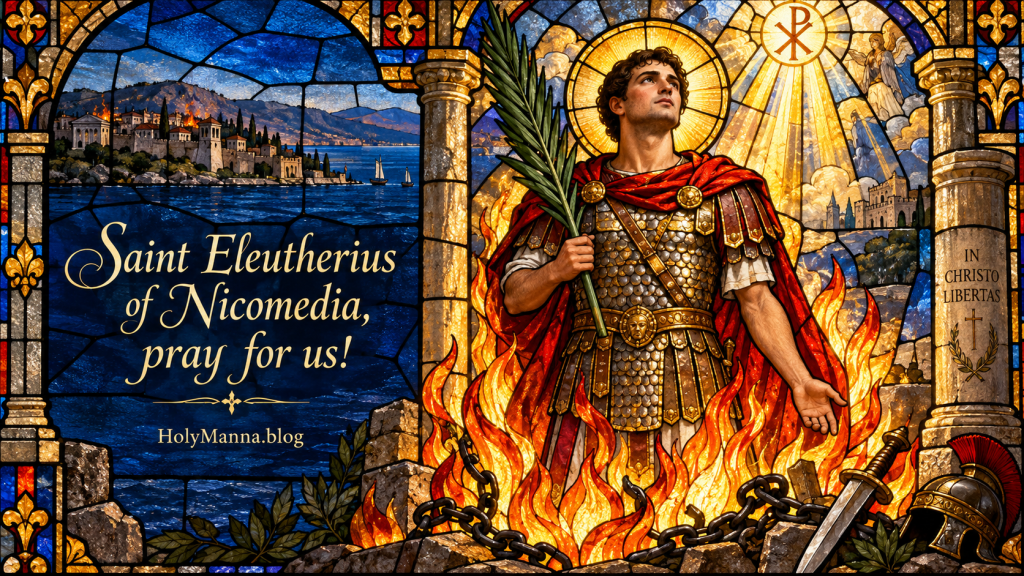
The Free Man in the Fire
Every year on October 2nd, while the universal Church celebrates the Memorial of the Holy Guardian Angels, the Roman Martyrology quietly speaks a name that almost no one recognizes: Saint Eleutherius of Nicomedia, soldier and martyr. He has no basilica. He has no famous biography, no surviving sayings, no devotional society spreading his story. What he has is a single paragraph, faithfully copied and recopied by the Church for roughly seventeen hundred years, testifying that he gave his life for Jesus Christ at the very outbreak of the most ferocious persecution the early Church ever endured.
That paragraph is worth quoting in full, because it is nearly everything the Church remembers about him. The Roman Martyrology for October 2nd reads: “At Nicomedia, St. Eleutherius, soldier and martyr, with numberless others. They were falsely accused of having set fire to the palace of Diocletian and, by order of this most cruel emperor, were barbarously massacred in groups. Some were put to the sword, some consumed by fire, while others were precipitated into the sea. But the principal one, Eleutherius, having endured long tortures, and being found stronger after each one, terminated his victorious martyrdom by fire, as well-tried gold.”
That is the whole file. And yet the Church has judged that paragraph important enough to preserve through the fall of Rome, the rise and collapse of empires, and every revision of her official list of saints, including the current edition of the Martyrologium Romanum promulgated under Pope Saint John Paul II, where Eleutherius still stands on October 2nd. The Catechism explains why the Church treasures records like this one: “The Church has painstakingly collected the records of those who persevered to the end in witnessing to their faith. These are the acts of the Martyrs. They form the archives of truth written in letters of blood” (CCC 2474). Saint Eleutherius is one line in those archives. This post is about why that one line still matters, and why it might matter especially to a generation that fears being forgotten.
It is fitting, too, that he shares his feast with the Guardian Angels, those unseen protectors of whom the Catechism, quoting Saint Basil, says: “Beside each believer stands an angel as protector and shepherd leading him to life” (CCC 336). Eleutherius, like the angels honored on his day, is a companion most Christians have never seen and never named, yet one who stands with them all the same.
A Life Known Only to God
Honesty demands that this be said plainly at the start: nothing is documented about the early life of Saint Eleutherius. No source, ancient or modern, records his birthplace, his family, his upbringing, or the moment he came to believe in Jesus Christ. The old Catholic reference works are refreshingly blunt about it; beyond the facts that he was a soldier and that he was martyred with unnamed companions at Nicomedia around the year 303, they state that no other reliable information has survived. He belongs to the great company of pre-Congregation saints, those venerated by the acclamation of the early Church long before any formal canonization process existed.
What can be said with confidence is the world he inhabited. Nicomedia was no backwater garrison town. Under Diocletian’s division of the empire into four zones of power, Nicomedia, a Greek-founded city on the Sea of Marmara in Asia Minor, served as the capital of the entire eastern quadrant of the Roman Empire, effectively the seat of imperial government in the East. Today it is the Turkish city of İzmit. A soldier stationed there was serving at the very center of power, close to the emperor’s court, his palace, and his politics. Catholic Online describes Eleutherius specifically as a soldier in the army of the co-Emperor Diocletian in Nicomedia. In modern terms, he was a career man in the capital, working inside the system, surrounded daily by an official culture that demanded religious conformity to the gods of Rome and, increasingly, to the cult of the emperors themselves.
And here is the one biographical detail that survives in his very name. Eleutherius comes from the Greek word for freedom; it means, quite literally, “the free one.” Whether it was the name his parents gave him or a name the Christian community remembered him by, Providence saw to it that the man who would be falsely accused, tortured, and burned would be known forever as free. Saint Paul’s words to the Galatians could stand as the caption over his whole hidden life: “For freedom Christ set us free; so stand firm and do not submit again to the yoke of slavery” (Gal 5:1).
His conversion, or his quiet perseverance in a faith he may have held from childhood, is known only to God. But the Catechism reminds every believer of the duty that a man like Eleutherius fulfilled to the letter: “All Christians in whatever state or walk of life are called to the fullness of Christian life and to the perfection of charity” (CCC 2013). Sanctity does not require a documented biography. It requires fidelity, and fidelity is exactly what the Church remembers him for.
Standing Firm When the Capital Burned
To understand what Saint Eleutherius is most known for, the reader has to step into one of the best-documented crises of the early Church: the outbreak of the Great Persecution. Here the historical record becomes suddenly rich, because two near-contemporary writers, Eusebius of Caesarea and Lactantius, both recorded what happened in Nicomedia in the year 303.
On February 23rd of that year, the pagan feast of Terminalia, Diocletian ordered the newly built Christian church of Nicomedia torn down, its Scriptures burned, and its valuables seized. The next day he issued his first edict against the Christians, extending those measures across the empire. Then, within days, catastrophe struck the persecutors’ own house: fire broke out in the imperial palace itself. Lactantius, in On the Deaths of the Persecutors, reports that there were actually two fires about fifteen days apart, and he openly accuses the Caesar Galerius of setting them secretly in order to frame the Christians and inflame Diocletian’s rage. Eusebius, more cautious, admits he does not know how the fire started. Constantine, years later, attributed it to lightning. The historians have never settled who lit the flames. What every source agrees on is what happened next, and it is exactly the scene the Roman Martyrology preserves under the name of Eleutherius.
Eusebius, writing in The Church History, Book VIII, describes it in words that still land like a punch: “A great multitude of martyrs were added… a conflagration having broken out in those very days in the palace at Nicomedia, I know not how, which through a false suspicion was laid to our people. Entire families of the pious in that place were put to death in masses at the royal command, some by the sword, and others by fire… And the executioners bound a large number of others and put them on boats and threw them into the depths of the sea.”
Sword, fire, and sea. Those are precisely the three deaths the Martyrology assigns to the companions of Eleutherius. The Church’s memory of this obscure soldier matches, point for point, the eyewitness-era account of a documented massacre. Whatever else has been lost, the event itself is history, not embellishment.
No miracles are recorded from the lifetime of Saint Eleutherius, and this post will not invent any. His witness is of another kind, and in some ways a more imitable kind. He was, as far as the record shows, an ordinary Christian man in uniform who, when the moment came, refused to purchase his life with a lie or a pinch of incense. The Catechism teaches: “The duty of Christians to take part in the life of the Church impels them to act as witnesses of the Gospel and of the obligations that flow from it. This witness is a transmission of the faith in words and deeds” (CCC 2472). Eleutherius transmitted the faith with his deeds when words were no longer permitted to him. That is why he matters, and why he deserves to be remembered and emulated: he shows that God does not need celebrities. God needs the faithful.
Tried Like Gold in the Furnace
The hardships of Saint Eleutherius began with a lie. He and the Christians of Nicomedia were, in the Martyrology’s words, “falsely accused” of burning the emperor’s palace. It is hard to imagine a more dangerous charge: arson against the imperial residence, in the capital, at the exact moment the government had declared Christianity an enemy of the state. The accusation gave the persecution its pretext and its fury. Eusebius says the suspicion was false; Lactantius goes further and names the true arsonist as Galerius himself. Either way, the Christians of Nicomedia went to their deaths for a crime they did not commit, and Eleutherius went first among them in honor.
The Martyrology records that the martyrs were “barbarously massacred in groups,” some by the sword, some by fire, some drowned in the sea. Eleutherius himself was singled out for something slower. He “endured long tortures,” and here the ancient text adds the detail that gives this saint his enduring character: he was “found stronger after each one.” Read that again slowly. The torturers’ logic is that pain accumulates and resolve erodes. With Eleutherius, the Church remembers the opposite arithmetic. Every torment left him stronger, because the strength was never his own to begin with. Finally, he “terminated his victorious martyrdom by fire, as well-tried gold.”
That image of gold tried in fire is not a poetic flourish invented by the Martyrology’s compilers. It is the Bible’s own language for the martyrs. The Book of Wisdom says of the souls of the just: “Chastised a little, they shall be greatly blessed, because God tried them and found them worthy of himself. As gold in the furnace he proved them, and as sacrificial offerings he took them to himself” (Wis 3:5 to 6). Saint Peter, himself a future martyr, wrote to persecuted Christians in Asia Minor, the very region where Nicomedia stood: “so that the genuineness of your faith, more precious than gold that is perishable even though tested by fire, may prove to be for praise, glory, and honor at the revelation of Jesus Christ” (1 Pt 1:7). The Church that wrote the Martyrology entry knew exactly what she was saying. The fire that Diocletian’s court intended as an execution, God used as a refinery.
The Catechism gives the theology of that moment its full weight: “Martyrdom is the supreme witness given to the truth of the faith: it means bearing witness even unto death. The martyr bears witness to Christ who died and rose, to whom he is united by charity” (CCC 2473). And because many who died in those chaotic massacres may never have reached the baptismal font, the Church adds this consolation: “The Church has always held the firm conviction that those who suffer death for the sake of the faith without having received Baptism are baptized by their death for and with Christ” (CCC 1258). Jesus Himself had already pronounced the beatitude that covers a man executed on a false charge: “Blessed are you when they insult you and persecute you and utter every kind of evil against you falsely because of me. Rejoice and be glad, for your reward will be great in heaven” (Mt 5:11 to 12, The Gospel of Matthew). Eleutherius checks every word of that promise. Insulted, persecuted, accused falsely, and now, the Church believes, rewarded greatly.
A Memory Carried Across Seventeen Centuries
Here again honesty must lead. No miracles after death are attributed to Saint Eleutherius in any known source. There are no recorded healings at his tomb, no relics enshrined in a named church, no pilgrimage routes, no city that claims him as its own. If such stories once existed, the centuries have swallowed them. This post will not manufacture what the tradition does not supply.
And yet his afterlife in the Church’s memory is, in its own quiet way, astonishing. Modern scholarship on the cult of the saints has identified Eleutherius of Nicomedia in the ancient Syriac Martyrology, a calendar of martyrs compiled in the early 400s, barely a century after his death, which already commemorates him on October 2nd. From there his name passed into the Western martyrology tradition and eventually into the Roman Martyrology published under Pope Gregory XIII in 1583, where his entry has been read aloud in monasteries and religious houses for centuries. When the Church thoroughly revised the Martyrology after the Second Vatican Council, trimming away entries that could not be sustained, Eleutherius survived the cut. The current Martyrologium Romanum still lists him at Nicomedia on October 2nd, dating him to the third or fourth century. For a soldier with no biography, no shrine, and no patronage, that is an extraordinary vote of confidence from the Church across seventeen hundred years.
His city, meanwhile, tells its own story. Nicomedia, once the proud eastern capital where Diocletian burned Christians alive, was eclipsed within a generation by Constantinople, the city of the first Christian emperor. Today Nicomedia is İzmit, Turkey, and the empire that condemned Eleutherius is dust, while the Church he died for still prays his name every autumn. Tertullian’s famous observation, quoted by the Catechism, was proven true on the ground where Eleutherius fell: “the blood of martyrs is the seed of Christians” (CCC 852).
There is even a strange little footnote in modern pop culture, one that readers between 20 and 45 may appreciate. In 1997, the animated series The Simpsons aired an episode called “In Marge We Trust,” in which a stained-glass saint comes to life to speak with a pastor in crisis. The saint depicted is explicitly named Eleutherius of Nicomedia, and unlike another invented “saint” in the same scene, he is entirely real. Millions of viewers have seen his name without ever suspecting that behind the joke stands an actual man who burned for Christ. Even a secular culture that has forgotten the martyrs cannot quite stop repeating their names, and sometimes a punchline becomes a doorway; more than one curious viewer has looked him up and found, instead of a gag, the Great Persecution and the Cross. The Catechism describes what the faithful find when they seek out such companions: “Exactly as Christian communion among our fellow pilgrims brings us closer to Christ, so our communion with the saints joins us to Christ, from whom as from its fountain and head issues all grace” (CCC 957).
What Freedom Really Looks Like
So what does a twenty-first century Catholic do with a saint whose entire dossier is one paragraph? Quite a lot, actually, and perhaps more than with some saints whose lives fill volumes, because the very blankness of his story leaves room for the reader to see himself in it.
Consider first the gift of hiddenness. Saint Eleutherius achieved the one thing the modern world dreads most: he was almost completely forgotten. No follower count, no legacy project, no name recognition. And it did not matter at all, because the only audience that ever counted never lost sight of him for a second. His name is written where Jesus told His disciples to want it written, in heaven, and the Church’s stubborn seventeen-century memory of him is only a faint echo of God’s perfect one. For a generation formed by platforms that measure worth in visibility, Eleutherius is quiet medicine. Would your faithfulness survive the removal of every audience except God?
Consider next the false accusation. Eleutherius did not die for something he did; he died for something he was blamed for. Most readers will never face an imperial tribunal, but nearly everyone will eventually be misjudged, misquoted, or blamed unfairly, at work, online, in a family, in a parish. The instinct is to burn energy vindicating oneself at any cost. Eleutherius points to another way: entrust the verdict to God, hold fast to the truth, and let integrity outlast the lie. His torturers found him “stronger after each” torment because his strength was drawn from a source the accusation could not touch. When you are treated unfairly, where do you actually go for strength, and does that source hold?
Consider finally the soldier’s station. Eleutherius did not leave the army to find holiness in a desert; as far as the record shows, he was sanctified exactly where he stood, inside a compromised institution, in the capital of a hostile empire. Saint Paul told Timothy: “Bear your share of hardship along with me like a good soldier of Christ Jesus” (2 Tm 2:3). For readers embedded in secular workplaces and cultures that increasingly treat serious faith as suspect, his witness is direct: the mission field is the cubicle, the base, the group chat, the job site. Practical ways to walk with him this week might include praying for anyone who has wronged or misjudged you by name, choosing one setting where faith usually stays hidden and letting it be quietly visible there, reading Wisdom 3:1 to 9 slowly as a meditation on the martyrs, and asking Saint Eleutherius’s intercession for Christians persecuted today in the lands where he died. What would it look like, concretely, for you to be the free one in the room this week?
Engage With Us!
The conversation should not end here. Readers are warmly invited to share their thoughts, reflections, and experiences in the comments below; this little community grows every time someone speaks up. To spark that discussion, here are some questions to pray with:
- Saint Eleutherius is remembered by a single paragraph. If your entire faith life were summarized in one paragraph, what would you want it to say?
- Have you ever been falsely accused or unfairly judged? How did you respond, and what would responding like well-tried gold have looked like?
- The Martyrology says Eleutherius grew stronger after each torture. What practices, sacraments, or relationships actually make you stronger under pressure rather than weaker?
- His name means “the free one.” Where in your life are you still submitting to a yoke of slavery that Christ has already broken (Gal 5:1)?
- Millions met this saint’s name through a television joke. How can you use the ordinary, even silly, corners of culture as doorways to talk about the faith?
Saint Eleutherius stood in the fire and came out gold, not because he was extraordinary, but because he belonged entirely to Someone who is. That same belonging is offered to every baptized soul reading this. So go into this week free: free to be honest when a lie would be easier, free to be faithful when no one is watching, free to love the people who misjudge you. Do everything, the big things and the hidden things, with the love and mercy that Jesus taught us, and trust that the God who never forgot a soldier from Nicomedia will never, ever forget you.
Saint Eleutherius of Nicomedia, pray for us!
Follow us on YouTube, TikTok, Instagram and Facebook for more insights and reflections on living a faith-filled life.


Leave a comment