Memorial of the Holy Guardian Angels – Lectionary: 459/650
When the God of the Storm Bends Low
There is a strange comfort in being small. On October 2nd, the Church celebrates the Memorial of the Holy Guardian Angels, and the readings for this day form a single, breathtaking arc about the size of God and the smallness of His children. In the First Reading, the Lord speaks to Job out of the storm and asks him questions no human being can answer: questions about the dawn, the sea, the gates of death, and the dwelling place of light. Job responds the only way an honest creature can, by covering his mouth in silence. The Responsorial Psalm then reveals the tenderness hiding inside that terrifying greatness, for the God who commands the morning also knows when each person sits and stands, and His right hand holds each soul fast. Finally, the Gospel completes the arc. Jesus places a child in the midst of ambitious disciples and reveals that the little ones have angels in heaven who always look upon the face of the Father.
Devotion to the guardian angels grew slowly in the Church’s life. Local celebrations flowered in Spain in the sixteenth century, Pope Paul V placed the feast on the general calendar in 1608, and Pope Clement X made it obligatory for the whole Church on October 2nd in 1670, the first free day after the Feast of Saint Michael. The date itself preaches: first the Church honors the archangels, then the quiet guardians assigned to each soul. The central theme of this day is unmistakable. Divine greatness stoops to guard the humble, and the only fitting response is to become little enough to be led.
First Reading — Job 38:1, 12-21; 40:3-5
The Questions That Silence Every Proud Heart
The Book of Job is one of the boldest books ever written, because it dares to put human suffering on trial before God and then lets God take the witness stand. Job, a righteous man from the land of Uz, has lost his children, his wealth, and his health. For thirty-seven chapters he and his friends argue about why. The friends insist suffering must be punishment; Job insists on his innocence and demands an audience with the Almighty. Then, in chapter 38, he gets one. The Lord addresses Job “out of the storm,” and instead of explaining Himself, He asks questions. This reading, chosen for the Memorial of the Holy Guardian Angels, establishes the day’s foundation: before anyone can appreciate the gift of a heavenly guardian, the soul must first grasp how far God’s governance of creation exceeds human comprehension, and how tenderly that same governance reaches down.
Job 38:1, 12-21; 40:3-5
The LORD addressed Job out of the storm and said:Have you ever in your lifetime commanded the morning
and shown the dawn its place
For taking hold of the ends of the earth,
till the wicked are shaken from its surface?
The earth is changed as is clay by the seal,
and dyed as though it were a garment;
But from the wicked the light is withheld,
and the arm of pride is shattered.Have you entered into the sources of the sea,
or walked about in the depths of the abyss?
Have the gates of death been shown to you,
or have you seen the gates of darkness?
Have you comprehended the breadth of the earth?
Tell me, if you know all:
Which is the way to the dwelling place of light,
and where is the abode of darkness,
That you may take them to their boundaries
and set them on their homeward paths?
You know, because you were born before them,
and the number of your years is great!Then Job answered the LORD and said:
Behold, I am of little account; what can I answer you?
I put my hand over my mouth.
Though I have spoken once, I will not do so again;
though twice, I will do so no more.
Detailed Exegesis
Verse 38:1: “The LORD addressed Job out of the storm and said:”
The storm, or whirlwind, is the classic Old Testament setting for theophany, the visible manifestation of God, recalling Sinai’s thunder and the wind that would later carry Elijah’s successor. What matters most is that God speaks at all. Job begged for a hearing, and the Lord, who owes His creature nothing, graciously answers. Providence is not silent.
Verse 38:12: “Have you ever in your lifetime commanded the morning and shown the dawn its place”
God asks whether Job has ever ordered a single sunrise. The dawn arrives daily with such reliability that people forget it is commanded. Every morning is an act of divine governance, not a mechanical accident.
Verse 38:13: “For taking hold of the ends of the earth, till the wicked are shaken from its surface?”
The image is vivid: dawn grips the earth like hands grasping the edge of a blanket and shaking it out, scattering the wicked who work under cover of night. Light itself serves God’s justice.
Verse 38:14: “The earth is changed as is clay by the seal, and dyed as though it were a garment;”
As sunlight spreads, the formless gray of night takes on shape and color, the way soft clay receives a seal’s impression. Creation is stamped each morning with the signature of its Maker.
Verse 38:15: “But from the wicked the light is withheld, and the arm of pride is shattered.”
Those who love darkness lose their element when day breaks. The “arm” symbolizes power; pride’s strength is broken by the simple arrival of light it cannot control. This verse quietly anticipates the Gospel, where Jesus warns the proud that greatness belongs to the humble.
Verse 38:16: “Have you entered into the sources of the sea, or walked about in the depths of the abyss?”
For the ancient world, the ocean depths represented untamable chaos. God asks whether Job has strolled there. God has, for nothing in creation lies outside His presence, a truth Psalm 139 will echo.
Verse 38:17: “Have the gates of death been shown to you, or have you seen the gates of darkness?”
Death is pictured as a walled city with gates. No living person has toured it, yet God knows it completely. Even mortality sits within His dominion.
Verse 38:18: “Have you comprehended the breadth of the earth? Tell me, if you know all:”
The gentle irony sharpens. Job, who questioned God’s management of the world, cannot even measure the world’s width.
Verse 38:19: “Which is the way to the dwelling place of light, and where is the abode of darkness,”
Light and darkness are personified as residents with homes. Job is asked for directions he cannot give.
Verse 38:20: “That you may take them to their boundaries and set them on their homeward paths?”
God escorts light and darkness home each evening and morning like a shepherd. Notice the word “guide” hiding in the image; the God who guides the dawn is the God the psalm will beg to guide the soul.
Verse 38:21: “You know, because you were born before them, and the number of your years is great!”
Divine irony reaches its peak. Job was not present at creation; his lifespan is a breath. The point is not humiliation but perspective.
Verse 40:3: “Then Job answered the LORD and said:”
Job finally responds, and what follows is one of Scripture’s great acts of humility.
Verse 40:4: “Behold, I am of little account; what can I answer you? I put my hand over my mouth.”
Job does not grovel and does not argue. He simply acknowledges his smallness. The gesture of the hand over the mouth is reverent silence, the posture of a creature before mystery.
Verse 40:5: “Though I have spoken once, I will not do so again; though twice, I will do so no more.”
Job retires his complaints. He has not received an explanation for his suffering; he has received something better, an encounter with God Himself, and it is enough.
Teachings
The Catechism speaks directly to Job’s situation. CCC 164 teaches that “faith is often lived in darkness and can be put to the test. The world we live in often seems very far from the one promised us by faith. Our experiences of evil and suffering, injustice, and death, seem to contradict the Good News; they can shake faith and become a temptation against it.” Job lived that temptation and passed through it, not by getting answers but by meeting God. At the same time, CCC 300 holds together the two truths this reading proclaims, teaching that “God is infinitely greater than all his works,” and yet “because he is the free and sovereign Creator, the first cause of all that exists, God is present to his creatures’ inmost being.” The God of the whirlwind is not distant; He is closer to Job than Job’s own grief. Saint Gregory the Great, the Doctor of the Church who wrote the monumental Moralia in Job, described Scripture itself, and Job especially, as “a kind of river, if I may so liken it, which is both shallow and deep, wherein both the lamb may find a footing, and the elephant float at large.” A child can read these chapters and learn that God is big; a theologian can spend a lifetime in them and never touch bottom.
Reflection
Job’s hand over his mouth might be the most countercultural gesture available today. The modern world rewards hot takes, instant opinions, and the demand that every mystery explain itself on command. Job models another way: reverent silence before what God has not chosen to reveal. On this Memorial, that silence takes on special warmth, because the same God who commands the dawn assigns an angel to walk beside each of His children. His providence is not only vast; it is personal. Consider a concrete practice: at the next moment of frustration with something beyond understanding, whether a diagnosis, a job loss, or an unanswered prayer, pause before speaking and pray one line, “Lord, You commanded this morning’s dawn; I trust You with this darkness.” Then ask your guardian angel to help you hold that trust. When suffering arrives without explanation, is your first instinct to demand answers from God or to seek His presence? What would it look like this week to put a hand over your mouth and simply let God be God?
Responsorial Psalm — Psalm 139:1-3, 7-10, 13-14ab, 24b
Known Completely, Held Entirely
If the reading from Job shows God’s greatness from the outside, like standing beneath a mountain, Psalm 139 shows it from the inside, like discovering the mountain has been watching over the traveler the whole time. This psalm, attributed to David, is the Psalter’s most intimate meditation on God’s omniscience and omnipresence. Nothing about a person is hidden from God: not thoughts, not journeys, not the darkest depths, not even the hidden months in the womb. On any other day, that total knowledge might feel overwhelming. On the Memorial of the Holy Guardian Angels, the Church places one verse on repeat as the refrain, “Guide me, Lord, along the everlasting way,” and suddenly the psalm becomes a traveler’s prayer. The God who knows everything uses that knowledge to guide, and among His chosen instruments of guidance are the angels He assigns to His little ones.
Psalm 139:1-3, 7-10, 13-14ab, 24b
R. (24b) Guide me, Lord, along the everlasting way.
O LORD, you have probed me and you know me;
you know when I sit and when I stand;
you understand my thoughts from afar.
My journeys and my rest you scrutinize,
with all my ways you are familiar.
R. Guide me, Lord, along the everlasting way.
Where can I go from your spirit?
From your presence where can I flee?
If I go up to the heavens, you are there;
if I sink to the nether world, you are present there.
R. Guide me, Lord, along the everlasting way.
If I take the wings of the dawn,
if I settle at the farthest limits of the sea,
Even there your hand shall guide me,
and your right hand hold me fast.
R. Guide me, Lord, along the everlasting way.
Truly you have formed my inmost being;
you knit me in my mother’s womb.
I give you thanks that I am fearfully, wonderfully made;
wonderful are your works.
R. Guide me, Lord, along the everlasting way.
Detailed Exegesis
Verses 1-2: “O LORD, you have probed me and you know me; you know when I sit and when I stand; you understand my thoughts from afar.”
The Hebrew verb behind “probed” evokes a miner searching the earth for treasure. God’s knowledge of each person is not surveillance; it is exploration by One who considers the soul worth knowing. Sitting and standing, the most mundane movements of an ordinary day, are noticed by the Almighty.
Verse 3: “My journeys and my rest you scrutinize, with all my ways you are familiar.”
Both motion and stillness lie open before God. He is familiar with every route a person takes, which is exactly why He can be trusted to guide.
Verse 7: “Where can I go from your spirit? From your presence where can I flee?”
These are not the questions of a man trying to escape; they are questions of wonder. The psalmist tests the boundaries of God’s presence and finds there are none.
Verse 8: “If I go up to the heavens, you are there; if I sink to the nether world, you are present there.”
From the highest height to Sheol, the shadowy realm of the dead, God is present. Job was asked whether he had seen the gates of death; the psalmist answers that even there, God already waits.
Verse 9: “If I take the wings of the dawn, if I settle at the farthest limits of the sea,”
The dawn returns from the First Reading, now with wings. The image imagines traveling at the speed of morning light from the eastern horizon to the westernmost sea.
Verse 10: “Even there your hand shall guide me, and your right hand hold me fast.”
Here beats the heart of the day’s liturgy. Even at the far edge of the world, God’s hand does two things: it guides, and it holds fast. Guidance without grip would leave the soul lost when it stumbles; grip without guidance would leave it stuck. God provides both, and the guardian angels are ministers of exactly this double care.
Verse 13: “Truly you have formed my inmost being; you knit me in my mother’s womb.”
God’s knowledge of each person predates their first breath. The knitting image is tender and deliberate; no one is mass produced. Every human life is handcrafted.
Verse 14ab: “I give you thanks that I am fearfully, wonderfully made; wonderful are your works.”
The proper response to being known and made by God is not anxiety but gratitude. To be “fearfully” made means made in a way that inspires awe.
Verse 24b: “Guide me, Lord, along the everlasting way.”
The refrain gathers the whole psalm into a single petition. The “everlasting way” is the road that leads to eternal life, and the psalmist asks not merely for a map but for a Guide.
Teachings
The Catechism opens its very first pages with the truth this psalm sings. CCC 27 teaches that “the desire for God is written in the human heart, because man is created by God and for God; and God never ceases to draw man to himself.” The One who knit each person in the womb also planted in each heart a homing signal pointed back to Him. Saint Augustine, Doctor of the Church, gave that truth its most famous voice in his Confessions, praying, “You have made us for yourself, O Lord, and our heart is restless until it rests in you.” The everlasting way of the psalm’s refrain is the road home to that rest. The Church also draws a moral teaching from verse 13. Because God Himself forms each life in the womb, CCC 2270 teaches that “human life must be respected and protected absolutely from the moment of conception.” The little ones whom Jesus defends in the Gospel include the littlest of all, and Catholic tradition has long held that God’s protective care, including angelic guardianship, embraces human life from its very beginning.
Reflection
Many people carry a quiet fear of being fully known, suspecting that anyone who saw everything would walk away. Psalm 139 dismantles that fear. God has already seen everything, every thought from afar, every journey and every rest, and His response is not to leave but to guide and to hold fast. Your guardian angel is a daily expression of that commitment, a personal escort assigned along the everlasting way. Try this concrete practice: begin each morning this week with the refrain as a one-line offering, “Guide me, Lord, along the everlasting way,” and then briefly greet your guardian angel, entrusting the day’s travels, meetings, and temptations to God through his care. At night, look back and name one moment when you sensed you were being guided or held. Which feels stronger in you right now, the comfort of being fully known by God or the fear of it, and why? Where in your life do you most need God’s hand to hold you fast this week?
Holy Gospel — Matthew 18:1-5, 10
The Child in the Midst and the Angels Who Behold the Father
The scene unfolds in Capernaum, at the opening of what scholars call the ecclesial discourse, the fourth of five great teaching blocks in The Gospel of Matthew, where Jesus instructs His disciples on life inside the community that will become His Church. The disciples arrive with a question that reveals how much they still have to learn. They have been arguing about rank, about who will hold the top position in the coming Kingdom. Jesus answers with a living parable: He calls a child over and places the child in the middle of the ambitious circle. In the ancient world, children held no legal status, no power, and no social leverage; they were loved but never envied. By making a child the measure of greatness, Jesus turns the disciples’ entire value system upside down. Then, in verse 10, He lifts the curtain on heaven itself and reveals why the little ones must never be despised: their angels stand perpetually before the face of the Father. This is the Scriptural cornerstone of the Church’s doctrine of the guardian angels, and the reason this passage is proclaimed on their Memorial.
Matthew 18:1-5, 10
The disciples approached Jesus and said,
“Who is the greatest in the Kingdom of heaven?”
He called a child over, placed it in their midst, and said,
“Amen, I say to you, unless you turn and become like children,
you will not enter the Kingdom of heaven.
Whoever humbles himself like this child
is the greatest in the Kingdom of heaven.
And whoever receives one child such as this in my name receives me.“See that you do not despise one of these little ones,
for I say to you that their angels in heaven
always look upon the face of my heavenly Father.”
Detailed Exegesis
Verse 1: “The disciples approached Jesus and said, ‘Who is the greatest in the Kingdom of heaven?’”
The question sounds theological but is really about ambition. Mark’s parallel account reveals the disciples had been arguing about this among themselves on the road. The hunger for rank had followed them right into the company of the Son of God.
Verse 2: “He called a child over, placed it in their midst,”
Jesus teaches first with a gesture. The child stands where the disciples expected a throne to be, in the midst, at the center. Whoever the child was, tradition treasures the moment; the point of the text is the placement, for greatness in the Kingdom stands where this child stands.
Verse 3: “and said, ‘Amen, I say to you, unless you turn and become like children, you will not enter the Kingdom of heaven.’”
The double solemnity of “Amen, I say to you” signals a teaching of the highest weight. Jesus raises the stakes beyond the disciples’ question. They asked about ranking inside the Kingdom; He warns that without conversion, “unless you turn,” they will not enter at all. Becoming like a child means recovering total dependence on the Father.
Verse 4: “Whoever humbles himself like this child is the greatest in the Kingdom of heaven.”
Here is the direct answer. Greatness is humility. A child does not pretend to be self-sufficient; a child receives everything as gift. Saint John Chrysostom, preaching on this passage in his Homily 59 on Matthew, marveled that the child is free of the ambition, grudges, and vainglory that were consuming the disciples, and he urged believers to imitate that freedom.
Verse 5: “And whoever receives one child such as this in my name receives me.”
Jesus identifies Himself with the little ones. Hospitality shown to the small, the overlooked, and the powerless is hospitality shown to Christ Himself. This identification anticipates the judgment scene of Matthew 25, where whatever is done for the least is done for Him.
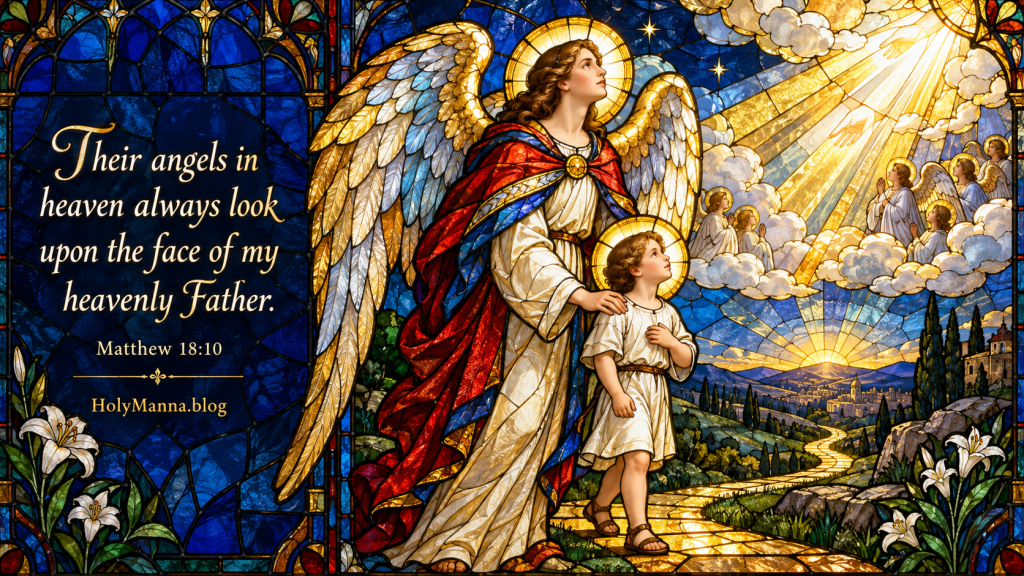
Verse 10: “See that you do not despise one of these little ones, for I say to you that their angels in heaven always look upon the face of my heavenly Father.”
This verse carries the day’s revelation. The little ones, meaning children and all who become childlike in humility, have angels, and those angels are not minor functionaries. They enjoy the beatific vision, always beholding the Father’s face, the privilege of the highest court of heaven. In the royal courts of the ancient world, only the most trusted officials were admitted to see the king’s face. Jesus reveals that the beings assigned to guard the smallest and least impressive people on earth hold that very access in heaven. To despise a little one is therefore to insult someone whose personal advocate stands before God without interruption.
Teachings
The Church has received this verse with full seriousness. CCC 328 declares that “the existence of the spiritual, non-corporeal beings that Sacred Scripture usually calls ‘angels’ is a truth of faith. The witness of Scripture is as clear as the unanimity of Tradition.” On their guardianship, CCC 336 teaches, “From its beginning until death, human life is surrounded by their watchful care and intercession. ‘Beside each believer stands an angel as protector and shepherd leading him to life.’ Already here on earth the Christian life shares by faith in the blessed company of angels and men united in God.” The inner quotation belongs to Saint Basil the Great, Doctor of the Church. Saint Jerome, commenting on this very verse, wrote words that Saint Thomas Aquinas would enshrine in Summa Theologiae I, q. 113, a. 2: “Great is the dignity of souls, for each one to have an angel deputed to guard it from its birth.” And Saint Bernard of Clairvaux, whose sermon the Church reads in the Office of Readings for this Memorial, drew out the practical response: “These words should fill you with respect, inspire devotion and instil confidence; respect for the presence of angels, devotion because of their loving service, and confidence because of their protection.” He added, “So let us be devoted and grateful to such great protectors; let us return their love and honour them as much as we can and should.” Humility remains the doorway to all of it, for as CCC 2559 teaches, “He who humbles himself will be exalted; humility is the foundation of prayer.”
Reflection
The disciples wanted to know who mattered most, and Jesus answered by pointing to the person who mattered least in the world’s accounting. That answer still stings, because the modern scoreboard of followers, titles, and salaries is simply the ancient question in new packaging. Yet the same Gospel that demolishes worldly ambition delivers extraordinary consolation: you have never walked alone. From the beginning of your life, an angel who beholds the face of God has been assigned to your care. Concrete steps follow naturally. Recover the childhood prayer, “Angel of God, my guardian dear, to whom God’s love commits me here, ever this day be at my side, to light and guard, to rule and guide,” and pray it each morning with adult sincerity. Practice Saint Bernard’s three responses: reverence, by avoiding in private what would shame you before a holy witness; devotion, by thanking your angel nightly; confidence, by entrusting fears to God through his protection. Finally, honor the little ones around you, the child, the new hire, the elderly neighbor, remembering whose advocates they have. Whom are you tempted to overlook or despise, and how does verse 10 change the way you see them? What would change in your private choices if you lived consciously in the presence of your guardian angel?
Walking the Everlasting Way with Unseen Friends
The readings of October 2nd tell one continuous story. It begins in a storm, where the Lord asks Job whether he has ever commanded the morning, and Job, wisely, puts his hand over his mouth. It continues in a psalm, where that same unsearchable God turns out to know every thought, every journey, and every rest of every soul He has knit together, and where His right hand guides and holds fast even at the farthest limits of the sea. It reaches its summit in Capernaum, where the God of the whirlwind, now standing among His disciples in human flesh, places a child at the center of the circle and reveals that the smallest people on earth have the greatest advocates in heaven, angels who always behold the Father’s face.
This is the Catholic vision of reality: a universe governed by a providence too vast to comprehend and too tender to overlook a single little one. The guardian angels are living proof that these two truths are one truth. The greatness that silences Job is the same greatness that assigns a protector to every child in the womb, every struggling worker, every forgotten soul in a nursing home. Let every reader take one step today. Pray the Angele Dei with fresh conviction, thank God for the unseen friend who has kept watch since birth, and choose one small act of humility, because in the Kingdom, becoming little is how anyone becomes great. The everlasting way stretches ahead, and no one walks it alone. God’s hand guides, His angel accompanies, and His Father’s face shines at the end of the road.
Engage With Us!
Reflections, stories, and questions are warmly welcome in the comments below. This community grows stronger every time someone shares how God’s Word landed in real life, so please do not be shy about joining the conversation, especially on a Memorial as personal as this one. Nearly everyone has a moment they cannot fully explain, a near miss, a sudden prompting, a strange peace, and today is the perfect day to tell that story.
- In Job 38:1, 12-21 and Job 40:3-5, God answers Job’s suffering with questions rather than explanations, and Job responds with humble silence. When has an encounter with God’s greatness brought you more peace than an explanation ever could?
- In Psalm 139:1-3, 7-10, 13-14ab, 24b, the psalmist marvels that God’s hand guides and holds fast even at the farthest limits of the sea. Where in your life right now do you most need to pray, “Guide me, Lord, along the everlasting way”?
- In Matthew 18:1-5, 10, Jesus teaches that the humble are the greatest and that the little ones’ angels always behold the Father’s face. How might daily awareness of your guardian angel change your private habits, your prayers, and your treatment of those the world overlooks?
- Taken together, the readings reveal a God whose infinite majesty stoops to guard the small. What is one concrete way you can embrace holy littleness this week so that God’s greatness can carry you?
Keep walking the everlasting way with courage. Live each day in reverence, devotion, and confidence beside the guardian God has given, and do everything, the seen and the unseen alike, with the love and mercy Jesus taught us.
Sacred Heart of Jesus, we trust in You!
Immaculate Heart of Mary, pray for us!
Saint Michael the Archangel, defend us in battle!
Follow us on YouTube, TikTok, Instagram and Facebook for more insights and reflections on living a faith-filled life.


Leave a comment