The Little Way That Reached the Whole World
Every October 1st, the Church celebrates a young woman who, by every worldly measure, accomplished almost nothing. Saint Thérèse of the Child Jesus and of the Holy Face never founded a religious order, never wrote a theological treatise, never preached to crowds, and never traveled as a missionary. She entered a cloistered Carmelite convent in a small Norman town at 15 and died there of tuberculosis at 24, unknown outside her monastery walls. And yet, within 28 years of her death, she had been canonized before a crowd of tens of thousands in Rome, and in 1997 Saint John Paul II declared her a Doctor of the Church, the youngest person ever to receive that title and only the 3rd woman.
How did a hidden nun become one of the most beloved saints in the history of the Church? The answer lies in her “Little Way,” a spirituality of complete confidence in God’s merciful love, lived out in small, ordinary acts done with extraordinary love. Her autobiography, Story of a Soul, published the year after her death, swept across the world and has never gone out of print. The Church herself quotes Thérèse repeatedly in the Catechism, including her definition of prayer: “For me, prayer is a surge of the heart; it is a simple look turned toward heaven, it is a cry of recognition and of love, embracing both trial and joy” (CCC 2558).
Thérèse holds patronages that seem almost impossible for a nun who never left her convent. Pope Pius XI proclaimed her universal patroness of the missions, alongside Saint Francis Xavier, on December 14th, 1927. Pope Pius XII declared her secondary patroness of France, alongside Saint Joan of Arc, in 1944. She is also popularly honored as patroness of florists and gardeners, a devotion flowing from her promise of a shower of roses, and she is widely invoked by missionaries, aviators, and the sick.
A Little Flower Planted in Normandy
Marie-Françoise-Thérèse Martin was born on January 2nd, 1873, in Alençon, a town in Normandy, France, and was baptized 2 days later at the church of Notre-Dame. Her parents were remarkable in their own right. Louis Martin was a watchmaker who had once hoped to become a monk; Zélie Guérin ran a successful lace-making business and had once hoped to become a religious sister. God had other plans, and their marriage became a school of holiness. They had 9 children, 4 of whom died in infancy or early childhood, and all 5 surviving daughters entered religious life. On October 18th, 2015, Pope Francis canonized Louis and Zélie Martin together, making them the first married couple in the history of the Church to be canonized as a couple. Their family life illustrates what the Church teaches about the home: “The Christian family constitutes a specific revelation and realization of ecclesial communion, and for this reason it can and should be called a domestic church” (CCC 2204).
Sorrow entered early. Zélie died of breast cancer on August 28th, 1877, when Thérèse was only 4 years old. The grieving family moved to Lisieux, to a house called Les Buissonnets, to be near relatives. Thérèse, once a cheerful and lively child, became painfully sensitive and easily wounded. When her sister Pauline, whom she had chosen as her second mother, entered the Carmel of Lisieux in 1882, the loss struck Thérèse so deeply that she fell into a mysterious and frightening illness marked by tremors, comas, and hallucinations. On May 13th, 1883, as her sisters prayed before the family’s statue of Our Lady of Victories, the 10-year-old girl saw the Blessed Virgin smile at her, and she was instantly and completely cured. Thérèse testified to this grace under oath during her life, and the statue is venerated to this day as Our Lady of the Smile. She made her First Communion on May 8th, 1884, an encounter she later described as a fusion of her heart with the heart of Jesus.
Still, her hypersensitivity remained, along with a long battle with scruples, until the night the Church now calls her Christmas conversion. After Midnight Mass on December 25th, 1886, the 13-year-old overheard her exhausted father complain about the childish custom of filling her shoes with gifts. The old Thérèse would have dissolved into tears. Instead, in a single instant of grace, she swallowed her hurt, ran downstairs, and opened her presents with genuine joy. She later wrote in Story of a Soul that on that night Jesus accomplished in a moment what she had been unable to do in 10 years, restoring the strength of soul she had lost at her mother’s death and filling her with charity and the desire to work for the conversion of sinners.
That desire was tested almost immediately. In the summer of 1887, France was gripped by the case of Henri Pranzini, a murderer condemned to death who showed no sign of repentance. Thérèse adopted him in prayer, begging God for a sign of his conversion. On August 31st, 1887, moments before his execution, Pranzini seized the crucifix offered by the priest and kissed the wounds of Christ 3 times. Thérèse called him “my first child.” The story is documented in the newspapers of the day and in her own manuscript, and it reveals her missionary heart.
Convinced that God was calling her to Carmel at the age of 15, Thérèse met a wall of refusals. The ecclesiastical superior of the Carmel said no. She appealed to the Bishop of Bayeux. Then, on a diocesan pilgrimage to Rome for the priestly jubilee of Pope Leo XIII, she did the unthinkable. At the papal audience on November 20th, 1887, despite explicit instructions that no one speak to the Holy Father, the teenage girl looked up at the Pope and pleaded, “Holy Father, in honor of your Jubilee, permit me to enter Carmel at the age of fifteen!” Leo XIII answered her, “Go… go… You will enter if God wills it!” Guards had to lift her away. God did will it. With the bishop’s permission, Thérèse entered the Carmel of Lisieux on April 9th, 1888, at 15 years of age.
The Hidden Genius of the Little Way
Life inside Carmel was no romantic idyll; it was cold, plain, and rigid, and the community included difficult personalities, among them a prioress whose changing moods tested everyone. Thérèse embraced it all. She received the habit on January 10th, 1889, a day on which, to her delight, snow fell over Lisieux just as she had secretly wished, a small favor from Jesus that she recorded with childlike gratitude in Story of a Soul. She made her religious profession on September 8th, 1890, the feast of the Nativity of Mary, taking the full religious name Sister Thérèse of the Child Jesus and of the Holy Face.
Here is where honesty about her life matters, because it is the very point of her sanctity. Thérèse worked no public wonders during her lifetime. There were no crowds, no cures, no prophecies drawing pilgrims to her door. Some of her own sisters, on the day she died, wondered what could possibly be written about her in the customary obituary circular. The miracle of her life was hidden, and it was this: a soul burning with a desire for heroic sanctity discovered that the path to it runs through littleness.
Thérèse longed to be a priest, a missionary, a martyr, an apostle, and knew she could be none of these things in the eyes of the world. Searching the Scriptures, she found her answer in the words of Christ, “unless you turn and become like children, you will never enter the kingdom of heaven” (Matthew 18:3), and in the invitation of divine Wisdom, “Whoever is a little one, let him come to me” (Proverbs 9:4). In an age of new inventions, she reached for a strikingly modern image, writing in her final manuscript that she was too small to climb the steep stairway of perfection and so would seek an elevator instead: “The elevator which must raise me to heaven is Your arms, O Jesus!” Holiness, she saw, is not the achievement of the strong but the surrender of the small. This is precisely what the Church teaches about grace and merit, and the Catechism chooses Thérèse herself to say it, quoting her Act of Oblation: “In the evening of this life, I shall appear before you with empty hands, for I do not ask you, Lord, to count my works” (CCC 2011).
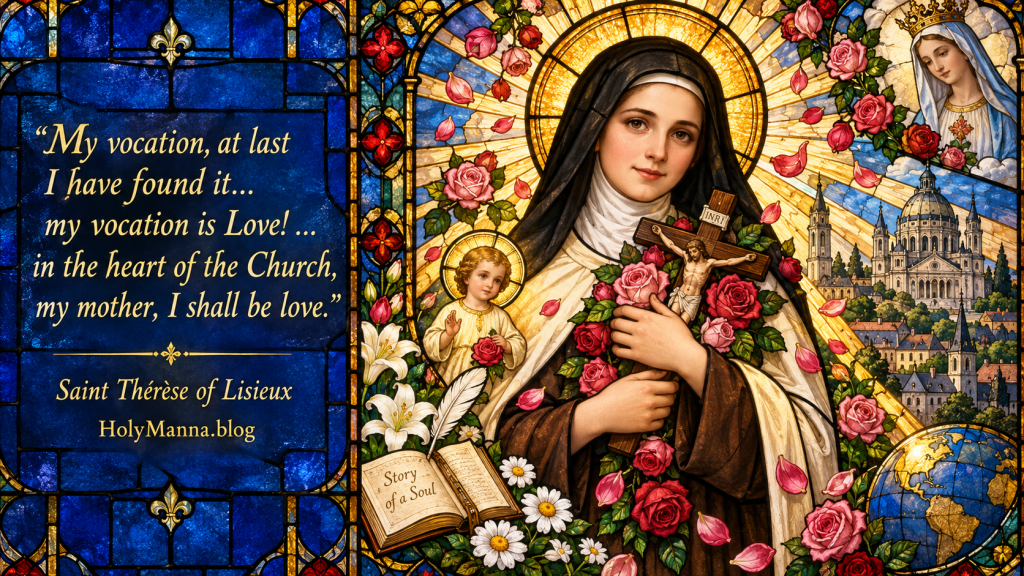
She made that Act of Oblation to Merciful Love on June 9th, 1895, Trinity Sunday, offering herself not to God’s justice, as some devout souls of her era did, but to His merciful love, asking to be consumed by it entirely. A year earlier she had begun, under obedience, to write down her childhood memories for her sister Pauline, by then Mother Agnès of Jesus. Two further manuscripts followed, one for her sister Marie and one for the prioress, Mother Marie de Gonzague. Together they became Story of a Soul. In the second manuscript, written in September 1896, she recorded the discovery that resolved all her contradictory desires at once. Reading Saint Paul’s hymn to charity in 1 Corinthians 13, she understood that love contains every vocation, and she burst out: “my vocation, at last I have found it… my vocation is Love!” The Church treasures this passage so much that the Catechism quotes it to explain the very holiness of the Church: “in the heart of the Church, my mother, I shall be love” (CCC 826).
Her daily life showed what this love looked like in practice. From 1893 she helped form the novices, guiding younger sisters with a wisdom far beyond her years. She was assigned as a spiritual sister to 2 missionary priests, supporting their work in China and Africa through prayer and letters, a cloistered nun with a missionary’s heart. She made a point of seeking out the sisters who were hardest to love. Each evening she patiently escorted the elderly and famously cranky Sister Saint-Pierre from chapel to refectory, enduring complaints at every step and finishing with her warmest smile. When another sister’s fidgeting in choir grated on her nerves like fingernails on slate, Thérèse chose to listen to the maddening noise as if it were a concert offered to Jesus. She fed her prayer above all on Scripture, and the Catechism again lets her speak for the whole Church: “But above all it’s the Gospels that occupy my mind when I’m at prayer; my poor soul has so many needs, and yet this is the one thing needful” (CCC 127). Small things, all of them. That is the genius. Anyone, in any state of life, can do what Thérèse did, which is exactly why the Church holds her up as proof that “all Christians in any state or walk of life are called to the fullness of Christian life and to the perfection of charity” (CCC 2013).
The Night of Nothingness and the Bed of Suffering
Thérèse was not a martyr in the formal sense; no executioner took her life. But her path was a slow martyrdom of body and soul, and the Church has always seen in her endurance a heroism equal to any arena.
The first great trial was the humiliation of her beloved father. Beginning in 1889, Louis Martin suffered a series of strokes that ravaged his mind, and for 3 years he was confined at the Bon Sauveur asylum in Caen. In a small town, gossip was merciless; some even whispered that Thérèse’s entry into Carmel had broken him. The daughters called this period their great trial, and Thérèse, who had lovingly called her father her “king,” could do nothing but offer her helplessness to God. Louis died on July 29th, 1894, and his final years of diminishment became, in Thérèse’s eyes, a share in the Holy Face of the suffering Christ whose name she bore.
The second trial came for her body. In the night between Holy Thursday and Good Friday, April 2nd to 3rd, 1896, Thérèse coughed up blood for the first time. She recognized the hemoptysis for what it was and welcomed it with joy as a distant call from her Bridegroom. Tuberculosis then consumed her over 18 months, in an age with no effective treatment and little pain relief. The remedies of the day, including painful cauterizations, added suffering rather than easing it. By the summer of 1897 she could no longer keep down food, gasped for every breath, and endured pain so severe that she admitted understanding how the desperately ill could be tempted to despair, which is why, she said, such souls must never be left alone.
The deepest trial, though, was invisible. From Easter 1896 until her death, this soul who had lived on the thought of heaven was plunged into a terrifying darkness concerning heaven’s very existence. She wrote in her final manuscript that God permitted her soul to be invaded by the thickest darkness, and that the thought of heaven, once so sweet, became a source of struggle and torment; an interior voice mocked her hope with the promise of the night of nothingness. She described herself as seated at the table of sinners, eating the bread of sorrow beside unbelievers, and begging pardon for her brothers. She kept faith by sheer will, writing that she had made more acts of faith in that final year than in all the rest of her life. In an era wrestling with atheism, one very much like the present one, Thérèse became the saint who understands the doubter from the inside, and who chose to believe anyway.
Through it all, her trust never curdled into bitterness. On June 5th, 1897, as recorded by Mother Agnès in the Last Conversations, she said the words that summarize her entire life: “Everything is grace.” On September 30th, 1897, after a final agony lasting hours, Thérèse fixed her eyes on her crucifix and spoke her last attested words: “My God, I love You!” She was 24 years old. Months earlier she had written to a missionary priest a sentence the Catechism now uses to teach every Catholic how to face death: “I am not dying; I am entering life” (CCC 1011).
A Shower of Roses That Never Stopped Falling
During her final illness, as recorded by her sisters in the Last Conversations, Thérèse made 2 promises that would define her afterlife in the Church. On June 9th, 1897, she said, “After my death I will let fall a shower of roses,” and on July 17th, 1897, “I want to spend my heaven in doing good on earth.” The exact wording of these sayings varies slightly across editions, since they were recorded by her sisters rather than written by her own hand, but the substance is solidly attested. The Catechism itself quotes the second promise when it teaches about the intercession of the saints (CCC 956).
Heaven wasted no time. On September 30th, 1898, exactly 1 year after her death, the Carmel published Story of a Soul in a modest print run of 2,000 copies. It spread like wildfire through convents, families, seminaries, and battlefields; soldiers in the trenches of the First World War carried her picture and reported her protection. Letters poured into Lisieux by the thousands reporting cures, conversions, and favors, so many that the Carmel published entire volumes of them under the title Pluie de Roses, the Shower of Roses. One of the earliest widely told accounts concerns Reine Fauquet, a 4-year-old girl blind from birth, who is reported to have received her sight in 1908 after praying at Thérèse’s grave; this account circulated as one of the first great favors attributed to her, though it belongs to the tradition of reported favors rather than the formally decreed miracles, and as a reported favor it cannot be independently verified.
The miracles the Church did formally verify are striking enough. For her beatification, the Church approved the healing of Sister Louise of Saint-Germain, a religious of the Daughters of the Cross dying of a hemorrhagic stomach ulcer, and the healing of Father Charles Anne, a young seminarian of Lisieux dying of galloping pulmonary tuberculosis, whose examining doctor testified that his destroyed lungs had been replaced by healthy ones functioning normally. Pope Pius XI beatified Thérèse on April 29th, 1923, in Saint Peter’s Basilica and called the new Blessed the star of his pontificate. For her canonization, 2 further miracles from 1923 were approved: the healing of Sister Gabrielle Trimusi of Parma, whose chronic knee and spinal disease vanished at the end of a novena, and the healing of Maria Pellemans of Schaerbeek, Belgium, whose tuberculosis of the lungs and intestines, unrelieved even by a pilgrimage to Lourdes, disappeared instantly as she knelt at Thérèse’s tomb in March 1923. Pius XI canonized her on May 17th, 1925, before 23 cardinals, roughly 250 bishops, and a basilica overflowing with tens of thousands of the faithful; reported crowd figures vary across sources.
The honors kept coming, each one more improbable for a hidden nun. On December 14th, 1927, Pius XI declared her universal patroness of the missions, equal to Saint Francis Xavier, because her prayer and sacrifice for missionaries revealed the contemplative engine of all evangelization. In 1944, with France under occupation, Pius XII named her secondary patroness of France beside Joan of Arc, the warrior saint whom Thérèse had lovingly portrayed in plays she wrote and performed in the convent. On October 19th, 1997, World Mission Sunday, Saint John Paul II proclaimed her a Doctor of the Church in the apostolic letter Divini Amoris Scientia, placing the science of divine love taught by a 24-year-old with no formal theological training alongside the wisdom of Augustine, Aquinas, and her Carmelite mother Teresa of Ávila. In 2023, Pope Francis devoted an entire apostolic exhortation to her, C’est la confiance, teaching a new generation that it is confidence, and confidence alone, that leads to Love.
Her presence in the world remains astonishingly physical. The Basilica of Saint Thérèse in Lisieux, consecrated in 1954, is one of the largest churches built in the 20th century, and Lisieux is the most visited pilgrimage site in France after Lourdes, drawing pilgrims by the hundreds of thousands each year. Since the mid-1990s her relics have traveled to more than 60 countries on every inhabited continent, from the Philippines to Iraq to the United States, drawing millions of venerators, an irony she would savor: the cloistered nun who never traveled has become one of history’s most traveled saints. Her parents are canonized saints; the cause of her sister Léonie has been opened. One famous story attaches her to French popular culture: it is told that the singer Édith Piaf, blind as a small child, recovered her sight in 1922 after a household pilgrimage to Lisieux; Piaf herself credited Thérèse and remained devoted to her for life, but this story cannot be verified.
Walking the Little Way Today
Thérèse’s Little Way was made for people who feel unremarkable, which is to say, it was made for almost everyone. She is the answer to a culture that measures worth in followers, metrics, and highlight reels. In a feed-scrolling age where everything must be seen to count, Thérèse insists that the things that count most are precisely the ones nobody sees. The Church confirms her instinct: holiness is not a career for spiritual elites, for “all Christians in any state or walk of life are called to the fullness of Christian life and to the perfection of charity” (CCC 2013), and prayer itself begins in littleness, for “humility is the foundation of prayer” (CCC 2559).
Living her Way this week could look shockingly simple. Answer the passive-aggressive email with genuine kindness and tell no one. Let someone merge into rush-hour traffic without a sigh. Do the household chore that is not yours and keep it secret. Sit with the coworker everyone avoids, the modern Sister Saint-Pierre, and give your warmest smile. Offer each small act to Jesus the moment it is done, the way Thérèse offered her concert of annoying noises. When prayer feels dry or heaven feels dark, remember that a Doctor of the Church spent her final 18 months in the night of nothingness and still chose to say, “Everything is grace.” Doubt endured with love is not the opposite of faith; it can be faith at its most heroic.
Which small, hidden act of love have you been avoiding because no one would ever notice it? When your prayer feels empty, do you walk away, or do you stay at the table like Thérèse and love anyway? What would change in your week if you truly believed that your worth comes from being God’s little one rather than from your performance?
Engage With Us!
Readers are warmly invited to share their thoughts and reflections in the comments below. Has Saint Thérèse ever answered a prayer in your life, perhaps with a rose of her own? The HolyManna community would love to hear your story. Here are some questions to spark reflection and discussion:
- Thérèse found her vocation in the simple words “my vocation is Love.” In one sentence, how would you name the vocation hiding inside your ordinary daily life?
- The Christmas conversion healed Thérèse’s hypersensitivity in a single moment of grace. What wound or habit have you stopped asking God to heal because you assume it is permanent?
- Thérèse prayed a hardened murderer into a final act of repentance and called him her first child. Who is the “Pranzini” you have quietly given up on, and will you adopt that person in prayer this week?
- During her trial of faith, Thérèse made more acts of faith than in all the rest of her life. How do you respond when God feels absent, and what would it look like to love Him through the silence?
- If Thérèse could become the patroness of the missions without ever leaving her convent, what mission field is God entrusting to you exactly where you already are?
Sanctity is not reserved for the extraordinary; it is offered to the little ones who let themselves be carried in the arms of Jesus. Take one small, hidden thing today, a chore, a kindness, an irritation patiently borne, and do it with all the love your heart can hold. Then do another tomorrow. That is the Little Way, and it leads all the way to heaven. Live this day, and every day, in a life of faith, doing everything with the love and mercy that Jesus taught us.
Saint Thérèse of Lisieux, the Little Flower, pray for us!
Follow us on YouTube, TikTok, Instagram and Facebook for more insights and reflections on living a faith-filled life.


Leave a comment