The Deacon Who Swallowed a Song
Every Christmas for the past 15 centuries, the churches of the Byzantine tradition, Catholic and Orthodox alike, have opened the feast of the Nativity with a single line of poetry: “Today the Virgin gives birth to the Transcendent” (On the Nativity I, Proemium). The man who first sang that line was not a bishop, not an emperor’s court poet, and not, according to the stories handed down about him, even a good singer. He was a deacon named Romanos, born around the year 490 in Emesa, the city known today as Homs in Syria, and the Church remembers him on October 1st as Saint Romanos the Melodist, the greatest hymn writer the Greek-speaking Church has ever produced.
Romanos is honored across the whole Church. He is venerated in the Catholic Church, the Eastern Orthodox Church, and the Armenian Apostolic Church, and he holds a place in the Roman Martyrology on October 1st. In the Roman Rite that same day belongs to the Memorial of Saint Thérèse of the Child Jesus, which makes for a beautiful pairing; both saints teach that littleness and hiddenness are no obstacle to God. Pope Benedict XVI devoted an entire General Audience to Romanos on May 21st, 2008, calling him a theologian, poet, and composer who “belonged to the great ranks of theologians who transformed theology into poetry” (General Audience, May 21st, 2008). Later scholars have called him the Pindar of rhythmic poetry, comparing him to the greatest lyric poet of ancient Greece.
Romanos is the patron saint of cantors, church singers, and church musicians. That patronage is not a polite honorary title. It flows straight from his life, and from the conviction of the Church that music is not decoration but worship. The Catechism teaches that “the musical tradition of the universal Church is a treasure of inestimable value, greater even than that of any other art” (CCC 1156). Romanos is one of the chief reasons that treasure exists.
From Emesa to the Ambo
Romanos was born into a family that, according to the earliest traditions about him, was Jewish. A Greek hymn composed in his honor describes him as being of Hebrew stock, and scholars have long noticed the Semitic turns of phrase woven through his Greek verse, an echo of the household he grew up in. He was baptized as a young boy, though the sources do not tell us whether his parents entered the Church with him. That detail alone makes his story worth sitting with. Romanos stands in the long line of sons and daughters of Israel who recognized in Jesus of Nazareth the Messiah promised to their fathers, and who brought the poetry of the Psalms and the prophets with them into the Church.
The historical record for his life is thin but consistent. The Catholic Encyclopedia notes that the only real authority for his biography is the account preserved in the Menaion, the liturgical book of the Byzantine Church, for the month of October. From that account, and from the details Pope Benedict XVI gathered in his catechesis, a clear outline emerges. Romanos received the rudiments of Greek and Syrian culture in Emesa, then moved to Berytus, the city known today as Beirut, where he completed a classical education and studied rhetoric. Around the year 515 he was ordained a permanent deacon and served at the Church of the Resurrection in Berytus, where he preached for about 3 years.
It matters that Romanos was a deacon and remained one his whole life. Some popular summaries mistakenly promote him to the priesthood, but the Vatican’s own account is explicit that he was a permanent deacon. The Catechism teaches that deacons, “strengthened by sacramental grace, in communion with the bishop and his group of priests,” serve the People of God “in the ministry of the liturgy, of the word, and of charity” (CCC 1570). Romanos poured his entire life into exactly those three things: the liturgy he served, the word he sang, and the charity he preached.
Around the year 518, toward the end of the reign of Emperor Anastasius I, Romanos moved to Constantinople, the capital of the Christian East. One strand of the tradition places his arrival earlier, during the patriarchate of Euphemius between 490 and 496, and the sources honestly disagree on the date. What they agree on is where he landed. He settled in a monastery attached to the Church of the Theotokos, the Mother of God, in the Kyros quarter on the edge of the city, and the traditions add that he also loved to keep night vigils at the famous Church of the Theotokos at Blachernae. A young deacon from the provinces, praying through the night in churches dedicated to Mary, first to arrive and last to leave. That is the man on whom heaven was about to act.
The Night the Mother of God Handed Him a Scroll
Here the story reaches the episode for which Romanos is remembered above all others, and honesty requires saying up front what kind of account it is. It comes from the Synaxarion, the collection of the lives of the saints read in the Byzantine Church, and it is a treasured tradition rather than documented history.
According to that tradition, Romanos was not gifted. His voice was harsh and unremarkable, and he was not considered a talented reader or singer, though the clergy loved him for his humility and his tireless service. Around the year 518, during the All-Night Vigil for the Feast of the Nativity of Christ, Romanos was assigned to chant from the Psalter. He performed so poorly that another reader had to take his place, and some of the lesser clergy ridiculed him for it. Humiliated, he sat down in one of the choir stalls, and, overcome by weariness and sorrow, he fell asleep.
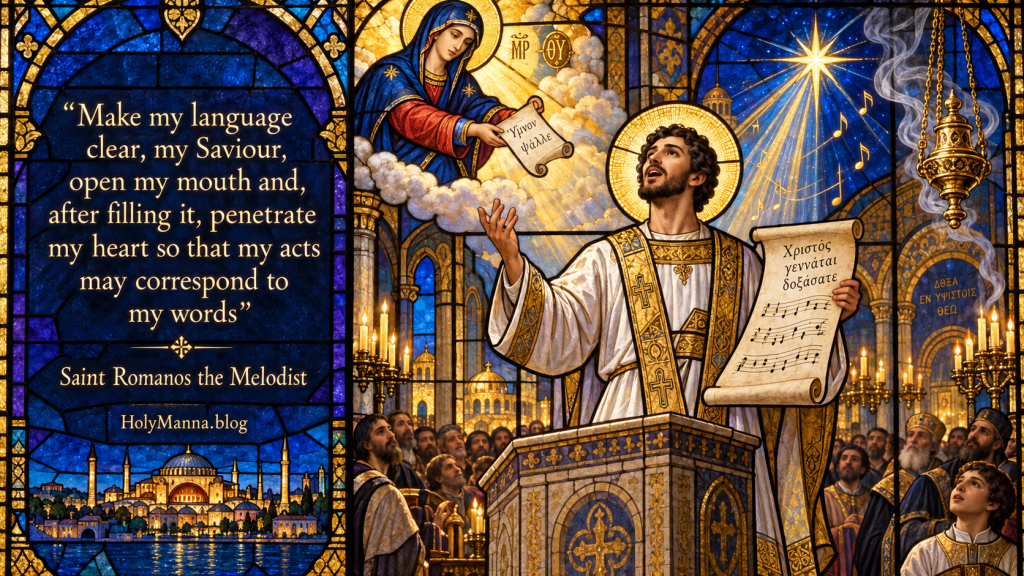
As he slept, the tradition says, the Most Holy Theotokos appeared to him. She told him not to despair, and, blessing him with her right hand, she held out a scroll with her left and said, “Take the scroll and eat it.” In his dream, Romanos opened his mouth and swallowed the parchment. He awoke on Christmas morning, marveling and glorifying God, mounted the ambo in the center of the church, and sang, in a voice no one had ever heard from him, the hymn that begins “Today the Virgin gives birth to the Transcendent.” This story cannot be verified, and the Church has never asked anyone to believe it as established fact; it is told here as the tradition it is.
Whatever happened that night, two things are certain. First, the hymn is real, and the Byzantine Church still sings it at Christmas 15 centuries later. Second, the image of the swallowed scroll is not an invention out of thin air; it is Scripture. The Lord commanded the prophet Ezekiel, “Son of man, eat what is offered to you; eat this scroll, and go, speak to the house of Israel,” and Ezekiel testified, “Then I ate it; and it was in my mouth as sweet as honey” (Ezekiel 3:1 to 3). Whoever first told the story of Romanos understood something true about him: the Word of God had gotten inside this man, and it came back out as song.
From that point forward, Romanos became what Benedict XVI called a homilist-cantor. His art form was the kontakion, a sung sermon in metrical verse; the word itself means little rod, and it seems to refer to the staff around which a manuscript scroll was wound. He would stand on the ambo in the middle of the church, sometimes pointing to the murals and icons around him, sometimes putting whole dialogues into the mouths of biblical figures, and he would sing the faith to ordinary people in their own language. Benedict XVI stressed this point: Romanos deliberately avoided the solemn Greek of the imperial court and wrote in the simple Greek of the people. Tradition credits him with 1,000 kontakia; 89 have come down to us bearing his name, of which modern critical scholars accept about 59 as certainly authentic. His humility survives in the poems themselves, because the first letters of the stanzas spell out an acrostic signature that usually reads not “Romanos” but “the humble Romanos.”
His range was astonishing. For the Feast of the Presentation he prayed to Christ with an image any young adult juggling burnout and hope can feel: “I long to hold you in my hand like a lamp; indeed, anyone who carries an oil lamp among men and women is illuminated without being burned. Illuminate me, then, You who are the light that never burns out” (The Presentation, 8). Before preaching he begged for integrity between his lips and his life: “Make my language clear, my Saviour, open my mouth and, after filling it, penetrate my heart so that my acts may correspond to my words” (Mission of the Apostles, 2). And for Pentecost he described the Apostles with the boldness of a fisherman’s son: “They took up the Cross of Christ as a pen, they used words like ‘fishing nets’ and set them to ‘catch’ the world, they used the Word of God as a sharp hook and as bait they used the flesh of the Sovereign One of the universe” (Pentecost 2:18).
Why does he matter? Because in his day the sung homily was practically the only catechesis most believers ever received, and Romanos made that catechesis unforgettable. He did not traffic in the technical controversies tearing at the theologians of his time. He sang the plain, solid Christology of the great Councils: “Christ was a man, but he was also God, yet he was not divided in two: He is One, the Son of a Father who is One alone” (The Passion, 19). That is exactly the faith the Catechism confesses when it teaches that the Church “confesses that Jesus is inseparably true God and true man” (CCC 469). Romanos proved that doctrine does not have to be dry. It can be sung, and when it is sung well, people carry it home in their hearts.
His tenderness reached its peak in his Good Friday kontakion, a dramatic dialogue between Mary and her Son on the road to Calvary. Mary cries out, “Where are you going, my Child? For whose sake are you finishing this swift race?” Jesus answers her, “Why, mother, do you weep?… Lest I suffer? Lest I die? How then should I save Adam?” And then he consoles her while reminding her of her mission: “Put aside your grief, mother, put it aside; mourning is not right for you who have been called ‘Full of Grace’” (Mary at the Foot of the Cross, 1 to 2; 4 to 5). Centuries before the Stabat Mater, Romanos gave the Church words for the mystery the Catechism describes when it teaches that Mary’s union with her Son “in the work of salvation is made manifest from the time of Christ’s virginal conception up to his death” (CCC 964). Grateful to the Virgin for the gift he believed she had given him, Romanos mentioned her at the end of nearly every hymn he wrote.
Mocked, Shaken, and Still Singing
Romanos was not a martyr. He died in peace in Constantinople, most likely around 555 or 556, and his path to holiness ran not through the arena but through humiliation, discipline, and a lifetime of fidelity in a violently unstable world.
The first hardship the traditions record is the one already told: public ridicule. There are few wounds a young man feels more sharply than being laughed at by his own colleagues for failing at his job in front of everyone. The tradition says Romanos answered that wound not with resentment and not by quitting, but by weeping in prayer before the Mother of God. That response is itself a lesson. The Catechism teaches that “humility is the foundation of prayer” (CCC 2559), and Romanos, whose acrostic signature called him the humble one, built his entire life on that foundation.
The second hardship was the age he lived in. The Constantinople of Romanos was not a postcard of golden domes. He arrived under Emperor Anastasius I, whose sympathies for the Monophysite party inflamed the bitter controversy over the natures of Christ that was splitting the Christian East. Romanos took his stand quietly but firmly by what he sang: the faith of the Councils, Christ true God and true man, one Person undivided. Then, under Emperor Justinian, the city itself seemed to come apart around him. The Nika riots of 532 left much of the capital burned, including the great church of Hagia Sophia, which Justinian rebuilt into the wonder that still stands. A devastating plague swept the empire in 542. In the 550s, a series of violent earthquakes shook Constantinople and the Near East, and scholars actually use the apparent references to those earthquakes in his hymns to date the end of his life; one of his surviving kontakia, known as On Earthquakes and Fires, turns even civic catastrophe into a call to repentance and trust in God’s mercy.
Through all of it, the sources paint the same picture of the man: ascetic, prayerful, and constant. He kept vigil through the nights, disciplined his body, and served the liturgy day after day for roughly 4 decades in the same churches of the Mother of God. There is a hidden heroism in that kind of endurance. Most Christians will never face a executioner, but every Christian faces the long, unglamorous test of staying faithful through mockery, instability, grief, and fatigue. Romanos passed that test singing, and his moral preaching shows where his eyes were fixed. He preached the Last Judgment and called his hearers to conversion, penance, and fasting, but he insisted that the crown of it all was love. Of the wise virgins of the Gospel parable he sang, “Ten virgins possessed the virtue of virginity intact but for five of them the difficult practice proved unfruitful. The others shone with their lamps of love for humanity and for this reason the bridegroom invited them in” (The Ten Virgins, 1). The Catechism teaches the same order of things: charity is “the theological virtue by which we love God above all things for his own sake, and our neighbor as ourselves for the love of God” (CCC 1822), and “the exercise of all the virtues is animated and inspired by charity” (CCC 1827).
Sung for Fifteen Centuries
Romanos died on October 1st and was buried in the Church of the Theotokos where he had served, and his feast was celebrated there for generations. Honesty requires saying plainly that no formal catalog of documented posthumous miracles has come down to us for Romanos; there is no shrine of recorded healings, no register of cures at his tomb. What the record shows instead is something the Church also counts as the fruit of holiness: veneration that spread fast and never stopped. Within a few decades of his death, Romanos was honored as a saint in Byzantium and in Armenia, and after the 9th century his veneration spread through Russia and the Slavic lands. It is told in some accounts that his Nativity kontakion was sung each year at the imperial Christmas banquet in Constantinople for centuries after his death; that tradition cannot be verified.
If any wonder is attached to Romanos after death, it is the sheer persistence of his song. The proemium of his Nativity kontakion is still chanted every Christmas in the Byzantine liturgy, in Greek, Arabic, Slavonic, English, Spanish, and dozens of other tongues. A hymn first sung by a humiliated deacon around the year 518 is, right now, in the repertoire of parishes on every continent. When Catholics of the Eastern Churches, and their Orthodox brothers and sisters, open the celebration of Christmas, they are praying in the words of Romanos. The Catechism teaches that the saints in heaven “do not cease to intercede with the Father for us” (CCC 956), and for 1,500 years church singers in particular have asked the intercession of the one they call their patron.
His memory also lives in sacred art. The classic icon of Saint Romanos shows a young man in the white vestments of a deacon, standing on a raised platform in the middle of a church, holding the scroll of his Nativity kontakion, with the Patriarch, the Emperor, and the congregation gathered around him. In the Slavic tradition his feast on October 1st coincides with the feast of the Protection of the Mother of God, and icons of that feast often include Romanos in the lower register, singing beneath the outstretched veil of the Theotokos, the singer and his Lady together forever. One correction is worth making for anyone researching him online: the beloved Akathist Hymn to the Mother of God is very often attributed to Romanos, but modern scholarship rejects that attribution as unsupported, so it should not be counted among his works.
His modern rediscovery in the West owes much to Pope Benedict XVI, who held Romanos up in 2008 as proof of what faith does to a culture. “Faith is love and therefore creates poetry and music. Faith is joy, therefore it creates beauty,” the Pope said, and he pointed to Romanos as evidence that “if faith is alive, Christian culture can never become ‘obsolete’ but on the contrary will remain alive and present” (General Audience, May 21st, 2008). The Catechism echoes the point, teaching that sacred art is true and beautiful when it evokes and glorifies “the transcendent mystery of God” (CCC 2502), and that song and music fulfill their purpose in worship in “the beauty expressive of prayer, the unanimous participation of the assembly at the designated moments, and the solemn character of the celebration” (CCC 1157). Fifteen centuries on, Romanos remains the standard.
When Weakness Becomes the Instrument
The story of Saint Romanos lands differently once you notice whose story it really is. It is the story of the guy who froze during the big presentation. The lector whose voice cracked at the Easter Vigil. The young adult who feels certain that everyone else at the parish, at the office, in the group chat, is more talented, more polished, more qualified. Romanos was that person, and the Church did not get its greatest hymn writer in spite of that humiliation but through it. Saint Paul heard the Lord say it plainly: “My grace is sufficient for you, for my power is made perfect in weakness” (2 Corinthians 12:9). Where in your life right now are you tempted to believe that your weakness disqualifies you from serving God?
Notice, too, where Romanos took his humiliation. He did not take it to cynicism, and he did not nurse it into resentment against the clergy who mocked him. He took it to the Mother of God, in tears, in the middle of the night. The Catechism teaches that the Church’s devotion to Mary “is intrinsic to Christian worship” and that Mary is honored as the Mother of God “to whose protection the faithful fly in all their dangers and needs” (CCC 971). Romanos flew to her protection with a wound to his pride, and she answered him with a mission. When you are embarrassed, passed over, or laughed at, what do you actually do with that pain, and what would change if you brought it straight to prayer?
There are concrete ways to let Romanos shape an ordinary week. Replace one commute’s worth of background noise with sacred music, and let it catechize you the way his kontakia catechized Constantinople. Memorize a single line of Scripture each week until, like the scroll in the vision, the Word is genuinely inside you and can come back out when someone needs it. If you serve at your parish in any capacity, as a cantor, a lector, a catechist, an usher, or the person who stacks chairs, do it the way Romanos served, first to arrive and last to leave, without needing applause. Pray his preacher’s prayer before any conversation where your witness matters, asking God to make your acts correspond to your words. And take his final lesson to heart: discipline and devotion are unfruitful without love, so attach one deliberate act of charity, a meal, a call, a bill quietly paid, to every devotion you practice. If your faith were set to music, would the melody sound like joy, and would anyone want to sing along?
Engage With Us!
The community would love to hear from you, so share your thoughts and reflections in the comments below. The story of Saint Romanos touches on failure, humility, Marian devotion, and the power of beauty to carry the Gospel, and every reader brings a different verse to that song. To get the conversation started, consider these questions.
- Have you ever experienced a public failure or humiliation that God later turned into an unexpected gift or calling?
- What piece of sacred music has most powerfully drawn you closer to God, and why do you think beauty reaches places that arguments cannot?
- Romanos signed his hymns “the humble Romanos.” What would it look like for you to sign your daily work, seen or unseen, with humility this week?
- When life feels unstable, as Constantinople did amid riots, plague, and earthquakes, what practices keep your faith steady and singing?
- To whom do you turn first in moments of discouragement, and how might entrusting those moments to the Blessed Mother change them?
Saint Romanos the Melodist stands as living proof that God delights in taking the overlooked, the ridiculed, and the seemingly unqualified and filling their mouths with a new song. The same God who met a weeping deacon in a choir stall is ready to meet you exactly where you are, in your cubicle, your kitchen, your parish pew, and to make something beautiful out of your offering. So live this day with courage and a lifted heart. Sing to the Lord the new song only you can sing, serve without needing to be noticed, fly to the Mother of God in every need, and do everything, absolutely everything, with the love and mercy that Jesus taught us.
Saint Romanos the Melodist, pray for us!
Follow us on YouTube, TikTok, Instagram and Facebook for more insights and reflections on living a faith-filled life.


Leave a comment