Memorial of Saint Thérèse of the Child Jesus, Virgin and Doctor of the Church – Lectionary: 458
A Hope Stronger Than the Dust
Some words are so true that a dying man wants them carved in stone. On October 1st, the Church celebrates the Memorial of Saint Thérèse of the Child Jesus, Virgin and Doctor of the Church, and the Mass readings, drawn from Thursday of the 26th Week in Ordinary Time, fit her like a glove. Job, scraping his sores on an ash heap, abandoned by friends who have become prosecutors, suddenly cries out that his Vindicator lives and that he will see God with his own eyes. The psalmist, hemmed in and pleading, plants his flag on one conviction: he will see the good things of the Lord in the land of the living. Then Jesus, setting his face toward Jerusalem, sends seventy-two ordinary disciples ahead of him with nothing but peace on their lips and the Kingdom in their hands.
The thread running through all three readings is confident hope, the kind that is forged inside suffering and then refuses to stay put. Hope that sees beyond the dust does not curl up and wait; it goes out to announce what it has seen. Nobody embodies this better than Thérèse Martin. She entered the Carmel of Lisieux at 15, never traveled again, endured a crushing trial of faith during her final 18 months, and died of tuberculosis at 24 on September 30th, 1897. Yet Pius XI named this cloistered nun Co-Patroness of the Missions in 1927, and Saint John Paul II declared her a Doctor of the Church in 1997. Her secret was Job’s secret and the psalmist’s secret: absolute confidence that the Redeemer lives, and that love hidden in the heart of the Church moves the whole harvest.
First Reading — Job 19:21-27
A Cry from the Ash Heap That Echoes to the Empty Tomb
The Book of Job belongs to Israel’s wisdom literature and tells the story of a righteous man from the land of Uz, east of the Holy Land, who loses his children, his wealth, and his health in rapid succession. His three friends arrive to comfort him but end up interrogating him, because the conventional theology of the ancient Near East insisted that suffering always proves hidden sin. By chapter 19, Job has been worn down to almost nothing. His wife has urged him to curse God, his friends have become his accusers, and his own body is failing. It is precisely here, at rock bottom, that the book reaches its highest peak. Out of the ashes comes one of the most astonishing professions of hope in the entire Old Testament, a passage the Church has prayed for centuries in her liturgy for the dead, and one that Christian tradition, led by Saint Gregory the Great, has always heard as a prophecy of the Resurrection. On the memorial of a young saint who kept believing through her own night of faith, Job’s cry sets the tone for the whole day.
Job 19:21-27
Job said:Pity me, pity me, O you my friends,
for the hand of God has struck me!
Why do you hound me as though you were divine,
and insatiably prey upon me?Oh, would that my words were written down!
Would that they were inscribed in a record:
That with an iron chisel and with lead
they were cut in the rock forever!
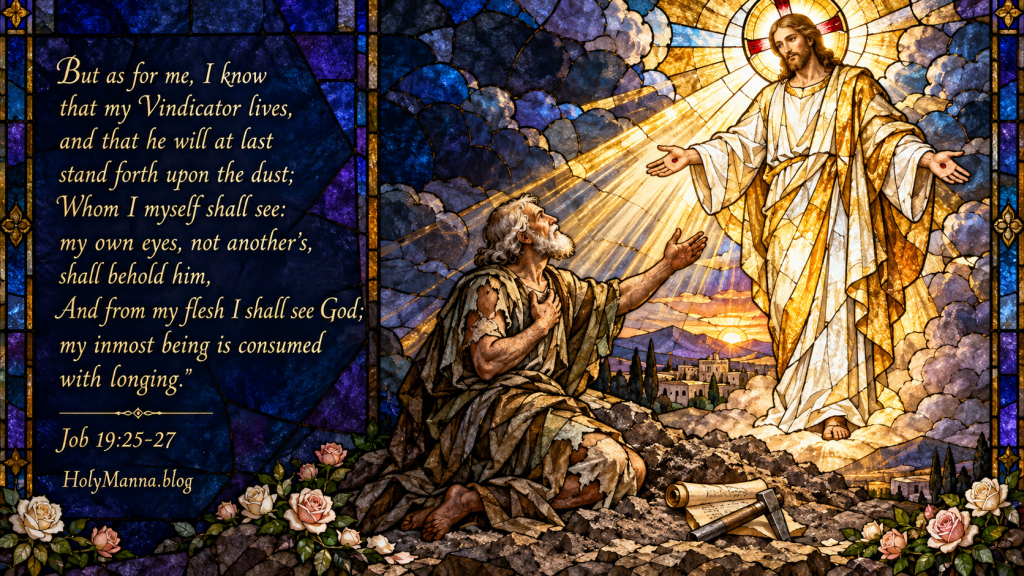
But as for me, I know that my Vindicator lives,
and that he will at last stand forth upon the dust;
Whom I myself shall see:
my own eyes, not another’s, shall behold him,
And from my flesh I shall see God;
my inmost being is consumed with longing.
Detailed Exegesis
Verse 21: “Pity me, pity me, O you my friends, for the hand of God has struck me!” The doubled plea reveals a man begging for basic human compassion and receiving theology lectures instead. Job does not deny that God’s hand is at work; what wounds him most is that the people who should have wept with him chose to argue with him. The verse stands as a permanent warning against turning someone’s suffering into a debate.
Verse 22: “Why do you hound me as though you were divine, and insatiably prey upon me?” Job accuses his friends of usurping God’s role as judge. They have appointed themselves prosecutors of a case only God can try. The Church reads here a caution against rash judgment, since only God sees the heart, and against the cruelty of adding condemnation to affliction.
Verse 23: “Oh, would that my words were written down! Would that they were inscribed in a record:” Job longs for a permanent testimony, a legal deposition that will outlive him and vindicate him after death. Providence answered this wish beyond his imagining, for his words were indeed written down in inspired Scripture and are proclaimed at Mass to this day.
Verse 24: “That with an iron chisel and with lead they were cut in the rock forever!” Ancient monumental inscriptions were sometimes carved into rock and filled with molten lead so the letters would never fade. Job wants his testimony made indestructible, because what he is about to say matters more than his life.
Verse 25: “But as for me, I know that my Vindicator lives, and that he will at last stand forth upon the dust;” This is the summit. The Hebrew word behind “Vindicator” is go’el, the kinsman-redeemer of Leviticus 25 and the Book of Ruth, the relative bound by blood to buy back a family member’s land, freedom, or honor. Job dares to claim that God himself will act as his next of kin. The verb “lives” is emphatic: while everything around Job dies, his Redeemer lives. Christian faith hears in “stand forth upon the dust” the risen Christ standing upon the very earth of the grave, and Job’s kinsman language finds its fulfillment in the Incarnation, when God truly became humanity’s blood relative.
Verses 26 and 27: “Whom I myself shall see: my own eyes, not another’s, shall behold him, And from my flesh I shall see God; my inmost being is consumed with longing.” The Hebrew of these verses is famously difficult, and translations vary, a fact worth stating honestly. Yet the thrust is unmistakable: Job expects a personal, bodily encounter with God. Not a report, not a proxy, but his own eyes. The phrase “from my flesh” gestures, however dimly for its original audience, toward what the Church now professes clearly: the resurrection of the body and the beatific vision. The final line, that his inmost being is consumed with longing, is the oldest ache of the human heart, the desire to see the face of God.
Teachings
Saint Gregory the Great devoted his massive Moralia in Job to this book, and in Book XIV he reads this very passage as a confession of Christ. Commenting on the words “I know that my Redeemer liveth,” he writes: “Thus our Redeemer underwent death, that we might not fear to die; He manifested the resurrection, that we might have a sure hope that we are capable of rising again.” For Gregory, Job’s hope is not wishful thinking but a share, in advance, in Easter faith. The Catechism professes what Job glimpsed. CCC 989 declares: “We firmly believe, and hence we hope that, just as Christ is truly risen from the dead and lives for ever, so after death the righteous will live for ever with the risen Christ and he will raise them up on the last day.” And CCC 990 adds: “The ‘resurrection of the flesh’ (the literal formulation of the Apostles’ Creed) means not only that the immortal soul will live on after death, but that even our ‘mortal body’ will come to life again.” Saint Thérèse lived this passage from the inside. During her last 18 months, ravaged by tuberculosis, she endured a profound trial of faith, a darkness in which heaven seemed closed. Like Job, she kept professing hope she could no longer feel, trusting the Redeemer she could not see.
Reflection
Job teaches that faith does not require pretending things are fine. He complains, he protests, he begs for pity, and in the middle of all of it he makes the greatest act of hope in the Old Testament. You are allowed to bring your unedited pain to God; what matters is where the sentence ends. Try this concrete practice: memorize verse 25 and pray it aloud in your hardest moments, letting it be the anchor that holds when feelings fail. Consider also how you respond to suffering people. Job’s friends showed up, which was good, and then talked too much, which was devastating. Presence heals; prosecution wounds. When suffering strikes, does your prayer end in complaint or in confession that your Redeemer lives? Is there someone in your life right now who needs your silent, patient presence more than your explanations?
Responsorial Psalm — Psalm 27:7-9abc, 13-14
The Prayer of a Heart That Refuses to Stop Seeking
Psalm 27 is attributed to David and moves in two great waves. The first, verses 1 through 6, radiates serene confidence: the Lord is light and salvation, so whom should the psalmist fear? The second wave, from which today’s verses are drawn, shifts into urgent pleading, as if the storm has actually arrived and confidence must now be exercised under fire. This structure mirrors real spiritual life, where trust is easy on calm days and costly on dark ones. The psalm’s vocabulary of “seeking the face” of God comes from the language of the Jerusalem Temple, where pilgrims went up to appear before the Lord. For ancient Israel, the “land of the living” meant this earthly life, where God’s blessings could be tasted. The Church, praying the Psalter in the light of the Resurrection, hears something greater: the true land of the living is eternal life, and the face the psalmist seeks is the face Job longed to see with his own eyes. Sandwiched between Job’s cry and the sending of the seventy-two, this psalm is the bridge of the day, the prayer of everyone who stands between suffering and mission.
Psalm 27:7-9abc, 13-14
R. (13) I believe that I shall see the good things of the Lord in the land of the living.
Hear, O LORD, the sound of my call;
have pity on me, and answer me.
Of you my heart speaks; you my glance seeks.
R. I believe that I shall see the good things of the Lord in the land of the living.
Your presence, O LORD, I seek.
Hide not your face from me;
do not in anger repel your servant.
You are my helper: cast me not off.
R. I believe that I shall see the good things of the Lord in the land of the living.
I believe that I shall see the bounty of the LORD
in the land of the living.
Wait for the LORD with courage;
be stouthearted, and wait for the LORD.
R. I believe that I shall see the good things of the Lord in the land of the living.
Detailed Exegesis
The Refrain: “I believe that I shall see the good things of the Lord in the land of the living.” The congregation repeats the psalmist’s boldest line, making his act of faith its own. Sung on the memorial of Saint Thérèse, it becomes the anthem of a young woman who believed through darkness that she would see God.
Verse 7: “Hear, O LORD, the sound of my call; have pity on me, and answer me.” The psalmist asks for the very thing Job begged his friends for, pity, but addresses the request to the only One who can truly answer. Prayer begins with the humble confidence that God hears.
Verse 8: “Of you my heart speaks; you my glance seeks.” The heart itself has become a voice, and the eyes have become seekers. This is the interior life in a single verse: an orientation of the whole person toward God, prior to any words. The Temple pilgrim’s search for God’s presence becomes a portrait of contemplative prayer.
Verse 9abc: “Your presence, O LORD, I seek. Hide not your face from me; do not in anger repel your servant. You are my helper: cast me not off.” The psalmist names the deepest fear of the praying soul, the hidden face of God. Notice that he does not stop seeking when God seems hidden; the hiddenness intensifies the search. Calling God “my helper” while feeling repelled is faith at its most muscular.
Verse 13: “I believe that I shall see the bounty of the LORD in the land of the living.” Everything pivots on “I believe.” The psalmist has no proof in hand, only promise. Christian tradition reads “the land of the living” as heaven itself, where the bounty of the Lord is nothing less than God.
Verse 14: “Wait for the LORD with courage; be stouthearted, and wait for the LORD.” The psalm ends not with resolution but with a command, repeated for emphasis. Biblical waiting is not passivity; it is courageous, stouthearted endurance, holding position under fire. It is the posture Job held on the ash heap and the posture Thérèse held in her final darkness.
Teachings
The Catechism defines the virtue this psalm sings. CCC 1817 teaches: “Hope is the theological virtue by which we desire the kingdom of heaven and eternal life as our happiness, placing our trust in Christ’s promises and relying not on our own strength, but on the help of the grace of the Holy Spirit.” The psalmist’s stouthearted waiting is hope in action, and CCC 1821 seals it with the prayer of Saint Teresa of Ávila, the great Carmelite mother of Thérèse’s own order: “Hope, O my soul, hope. You know neither the day nor the hour. Watch carefully, for everything passes quickly, even though your impatience makes doubtful what is certain, and turns a very short time into a long one.” Thérèse distilled the same doctrine into a single sentence written to her sister Marie, a sentence Pope Francis chose as the title and opening of his 2023 apostolic exhortation C’est la Confiance: “It is confidence and nothing but confidence that must lead us to Love.” Her Little Way is simply Psalm 27 lived out: seeking God’s face in ordinary duties, refusing to interpret his hiddenness as rejection, and waiting with courage.
Reflection
This psalm gives you words for the seasons when God feels hidden. Instead of concluding that he is absent, do what the psalmist does: keep seeking, keep speaking, keep waiting. A practical step is to pray verse 14 slowly each morning this week, especially before whatever you are dreading that day. Another is to name one situation where you have been waiting on God, and consciously convert your anxious waiting into stouthearted waiting by entrusting it to him in a short daily act of hope. Thérèse would add her own counsel: bring God confidence, not performance. Where in your life is God asking you to wait with courage rather than demand an immediate answer? When his face seems hidden, do you stop seeking, or does the hiddenness make you seek harder?
Holy Gospel — Luke 10:1-12
Seventy-Two Ordinary People and One Extraordinary Mission
Only The Gospel of Luke records this scene, and its placement is deliberate. At Luke 9:51, Jesus resolutely sets his face toward Jerusalem, toward the Cross, and everything that follows happens on the road to Calvary. Along that road, he does something remarkable: beyond the Twelve, he commissions seventy-two others, ordinary disciples whose names are never given, and sends them ahead of him in pairs. Ancient manuscripts vary between seventy and seventy-two, and both numbers are loaded with meaning. The Table of Nations in Genesis 10 counts seventy peoples in the Hebrew text and seventy-two in the Greek Septuagint, so the number quietly announces a mission destined for every nation on earth. It also recalls the elders who received a share of Moses’ spirit in Numbers 11. The message is unmistakable: mission is not a specialty for the Twelve; it belongs to the whole company of disciples. That is why this Gospel lands so perfectly on the memorial of Saint Thérèse, a nun behind cloister walls whom the Church named Co-Patroness of the Missions. The harvest is gathered not only by those who travel, but by everyone whose hope in the living Redeemer overflows into love.
Luke 10:1-12
Jesus appointed seventy-two other disciples
whom he sent ahead of him in pairs
to every town and place he intended to visit.
He said to them,
“The harvest is abundant but the laborers are few;
so ask the master of the harvest
to send out laborers for his harvest.
Go on your way;
behold, I am sending you like lambs among wolves.
Carry no money bag, no sack, no sandals;
and greet no one along the way.
Into whatever house you enter, first say,
‘Peace to this household.’
If a peaceful person lives there,
your peace will rest on him;
but if not, it will return to you.
Stay in the same house and eat and drink what is offered to you,
for the laborer deserves his payment.
Do not move about from one house to another.
Whatever town you enter and they welcome you,
eat what is set before you,
cure the sick in it and say to them,
‘The Kingdom of God is at hand for you.’
Whatever town you enter and they do not receive you,
go out into the streets and say,
‘The dust of your town that clings to our feet,
even that we shake off against you.’
Yet know this: the Kingdom of God is at hand.
I tell you,
it will be more tolerable for Sodom on that day
than for that town.”
Detailed Exegesis
Verse 1: “Jesus appointed seventy-two other disciples whom he sent ahead of him in pairs to every town and place he intended to visit.” The disciples go ahead of Jesus, preparing hearts for his arrival, which remains the Church’s job description. Sending them in pairs reflects the biblical requirement of two witnesses and teaches that mission is communal, never a solo act.
Verse 2: “The harvest is abundant but the laborers are few; so ask the master of the harvest to send out laborers for his harvest.” Before strategy comes prayer. Jesus sees the crowds as a ripe harvest, not a lost cause, and makes intercession for vocations the first missionary task, one that every believer can perform.
Verse 3: “Go on your way; behold, I am sending you like lambs among wolves.” Jesus promises danger, not comfort. The disciples’ defenselessness is deliberate, for lambs conquer wolves only by resembling the Lamb of God, who overcame the world through meekness and sacrifice.
Verse 4: “Carry no money bag, no sack, no sandals; and greet no one along the way.” Radical lightness makes the messenger depend on God and keeps the message credible. The command to skip greetings reflects the lengthy, ceremonial greetings of the ancient Near East; the Kingdom is too urgent for social lingering.
Verse 5: “Into whatever house you enter, first say, ‘Peace to this household.’” The first gift is peace, shalom, the wholeness that comes from God. The Gospel enters the world household by household, which is why the Church still calls the family the domestic church.
Verse 6: “If a peaceful person lives there, your peace will rest on him; but if not, it will return to you.” Grace offered is never wasted. Rejection does not diminish the messenger, for the peace returns to the one who carried it. This frees disciples from measuring their worth by results.
Verse 7: “Stay in the same house and eat and drink what is offered to you, for the laborer deserves his payment. Do not move about from one house to another.” Missionaries are to receive hospitality gratefully and stay put, avoiding the appearance of shopping for better accommodations. The principle that the laborer deserves his payment became the Church’s basis for supporting those who serve the Gospel full time.
Verse 8: “Whatever town you enter and they welcome you, eat what is set before you,” Eating what is offered meant crossing purity boundaries and honoring the host’s table. The Gospel adapts to every culture it enters without watering down its message.
Verse 9: “cure the sick in it and say to them, ‘The Kingdom of God is at hand for you.’” Deed and word travel together. Healing demonstrates what the proclamation announces, that God’s reign has drawn near in Jesus. Charity without proclamation is incomplete, and proclamation without charity is hollow.
Verse 10: “Whatever town you enter and they do not receive you, go out into the streets and say,” Rejection is anticipated, not feared. The disciples respond publicly and honestly, without retaliation and without pretending nothing happened.
Verse 11: “‘The dust of your town that clings to our feet, even that we shake off against you.’ Yet know this: the Kingdom of God is at hand.” Devout Jews reportedly shook foreign dust from their feet when returning to the Holy Land, so the gesture declares that a town rejecting the Gospel has made itself foreign territory. Yet even in judgment the message stands: the Kingdom is at hand, whether embraced or refused.
Verse 12: “I tell you, it will be more tolerable for Sodom on that day than for that town.” Sodom, the Old Testament’s byword for wickedness, never received the visitation these towns received. Greater grace brings greater responsibility, a sobering word for everyone who has grown up with easy access to the sacraments.
Teachings
Saint Gregory the Great preached directly on this passage in his Homily 17 on the Gospels, and his lament still stings: “That the harvest is good but the laborers are few cannot be said without a heavy heart, for although there are many to hear the good news there are only a few to preach it.” The Catechism teaches in CCC 765: “The Lord Jesus endowed his community with a structure that will remain until the Kingdom is fully achieved. Before all else there is the choice of the Twelve with Peter as their head.” That same paragraph adds that the Twelve and the other disciples, the seventy-two among them, share in Christ’s mission, his power, and his lot. And CCC 863 insists: “All members of the Church share in this mission, though in various ways.” Saint Thérèse is the living proof. She wrote in Story of a Soul that after searching for her place in the Body of Christ, she discovered it at last: “In the heart of the Church, my Mother, I shall be Love.” She promised on her deathbed, as her sisters recorded in her last conversations: “I will spend my heaven doing good on earth.” In 1927, Pius XI named this cloistered nun Co-Patroness of the Missions alongside Saint Francis Xavier, who baptized multitudes across Asia. The pairing teaches that hidden love and prayer send just as many laborers into the harvest as ships ever did.
Reflection
Notice that Jesus did not send the most qualified; he sent the willing, in pairs, traveling light. You are one of the seventy-two. A few concrete steps this week: pray daily for vocations, since verse 2 makes that the first missionary act; speak an intentional word of peace into your household each morning; and identify one person in your life who is part of the abundant harvest, then take one small step toward them, an invitation, a conversation, a coffee. Travel light too, asking what money bag or sack of comfort keeps you from going. If Jesus sent you ahead of him this week, into your office, your classroom, or your group chat, what would he want prepared before his arrival? What is one possession, habit, or fear you need to leave behind to labor freely in his harvest?
The Little Flower and the Great Harvest
The readings of October 1st trace a single arc from the ash heap to the mission field. Job, stripped of everything, discovers the one thing that cannot be taken: his Vindicator lives, and one day his own eyes will behold God. The psalmist takes that hope and turns it into a discipline, seeking the Lord’s face and waiting for him with courage, certain of seeing his goodness in the land of the living. Then Jesus reveals what such hope is for. It is not a private treasure to be buried but a harvest to be gathered, and he sends seventy-two ordinary people, lambs among wolves, to carry his peace from household to household and announce that the Kingdom of God is at hand.
Saint Thérèse of the Child Jesus gathered all of it into 24 short years. She suffered like Job, believing through a darkness in which heaven felt sealed shut. She prayed like the psalmist, with confidence and nothing but confidence. And though she never left her Carmel, she labored in the harvest like the seventy-two, so fruitfully that the Church placed the world’s missions under her patronage and her doctrine of the Little Way among the teachings of the Doctors. Her life proves that sanctity is not reserved for the extraordinary; it is offered to anyone willing to do small things with great love.
Every believer stands somewhere on that same arc today, some on the ash heap, some in the waiting, some already sent. Wherever this day finds a soul, the invitation is identical: trust that the Redeemer lives, seek his face without ceasing, and then go, lightly and joyfully, into whatever corner of the harvest Providence has planted nearby. Heaven, as the Little Flower promised, is already busy doing good on earth.
Engage With Us!
Reflections, questions, and stories from fellow travelers make this community what it is, so please share in the comments below how today’s readings and the witness of Saint Thérèse spoke to your heart. To help you pray with the Scriptures a little longer, here are some questions to carry through the day:
- In Job 19:21-27, Job professes hope at his lowest moment. What would it look like for you to declare “I know that my Vindicator lives” in the hardest circumstance you are facing right now?
- In Psalm 27:7-9 and 13-14, the psalmist resolves to wait for the Lord with courage. Where is God inviting you to trade anxious waiting for stouthearted, hope-filled waiting?
- In Luke 10:1-12, Jesus sends the seventy-two ahead of him with nothing but his peace and his message. Who is one person in your daily life to whom Jesus may be sending you this week, and what small step could you take toward them?
- Taking all the readings together with the witness of Saint Thérèse, how can confident hope in seeing God one day change the way you love, serve, and evangelize today?
Living a life of faith does not require grand gestures. It requires a heart that trusts the living Redeemer, waits for him with courage, and does the small thing in front of it with great love. Go into this day as one of the seventy-two, and do everything with the love and mercy Jesus taught us.
Sacred Heart of Jesus, we trust in You!
Immaculate Heart of Mary, pray for us!
Saint Michael the Archangel, defend us in battle!
Follow us on YouTube, TikTok, Instagram and Facebook for more insights and reflections on living a faith-filled life.


Leave a comment