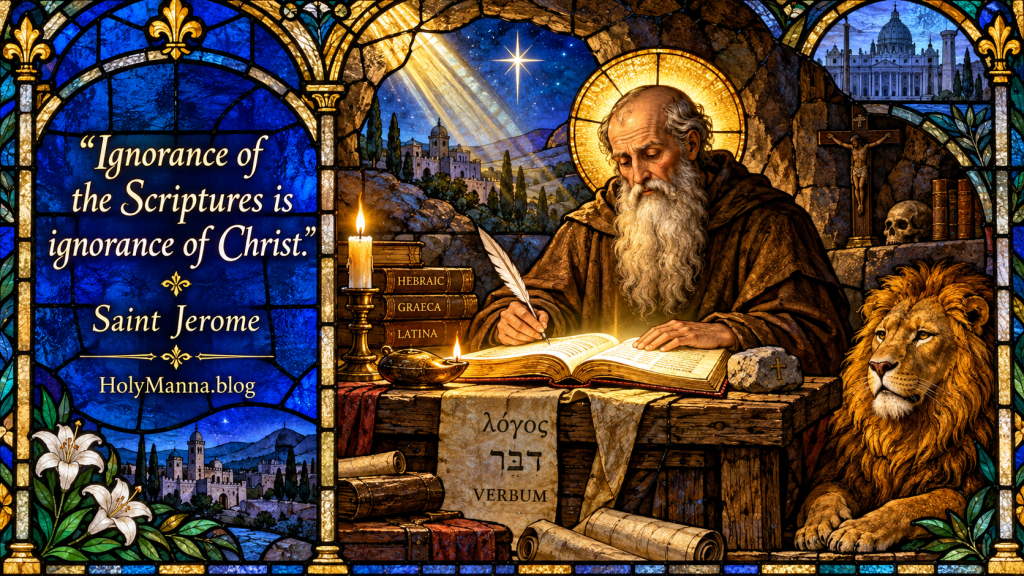
The Lion of Bethlehem
Every September 30th, the Church celebrates the Memorial of Saint Jerome, priest and Doctor of the Church, and one of the most brilliant, most demanding, and most gloriously human saints in the entire calendar. Jerome is the man who gave Western Christianity its Bible. Commissioned by Pope Damasus I in the year 382, he spent decades translating the Scriptures into Latin from the original Hebrew and Greek, producing the version history would call the Vulgate, the common Bible of the West for well over a thousand years and the text the Council of Trent would later affirm as the authoritative Latin edition of Sacred Scripture. When the Church teaches in CCC 133 that she “forcefully and specifically exhorts all the Christian faithful to learn the surpassing knowledge of Jesus Christ by frequent reading of the divine Scriptures,” she seals that exhortation with Jerome’s own immortal warning: “Ignorance of the Scriptures is ignorance of Christ.”
Yet Jerome was no serene academic floating above the fray. He was a hot-tempered, sharp-tongued, penitential fire of a man who wept over his sins, battled his own passions in the desert, buried his dearest friends, and kept translating by candlelight while the Roman world collapsed around him. In 1298, Pope Boniface VIII numbered him among the 4 great Latin Doctors of the Church, alongside Saint Ambrose, Saint Augustine, and Saint Gregory the Great. Today he is honored as the patron of Bible scholars, translators, librarians, libraries, archivists, archaeologists, and students. Pope Francis, marking the 1,600th anniversary of his death in the apostolic letter Scripturae Sacrae Affectus, described Jerome’s legacy as a “living and tender love” for the written word of God. That love is the thread running through everything that follows.
From Stridon to the Catacombs
Jerome was born Sophronius Eusebius Hieronymus in the town of Stridon, on the frontier between the Roman provinces of Dalmatia and Pannonia, somewhere in the western Balkans of today. The town itself was destroyed in his lifetime and its exact location is lost to history. Even his birth year is uncertain; the Catholic Encyclopedia places it around 340 to 342, while much modern scholarship prefers a date closer to 347. What is certain is that he was born to Christian parents of comfortable means, in an age when children of Christian homes were commonly enrolled as catechumens and baptized later in life.
Around the age of 12, his parents sent him to Rome with his childhood friend Bonosus to receive the finest education the empire could offer. There he studied grammar, rhetoric, and the liberal arts under Donatus, the most famous grammarian of the age, and there he fell head over heels in love with the great pagan authors, above all Cicero and Virgil. Their polished Latin became the standard by which he judged everything he read, including, to his embarrassment, the rough and unadorned style of the old Latin Scriptures. Rome also tested his soul. By his own later admission, the young Jerome fell into the sins common to students in the capital, and he carried the memory of those falls with a penitent’s sorrow for the rest of his life. Yet grace was already at work. On Sundays he would descend with his friends into the catacombs, praying at the tombs of the martyrs, letting the darkness of those corridors preach to him about death, judgment, and the blood that had purchased his faith. In Rome, at about the age of 19, he was baptized, most likely by Pope Liberius, around the year 366.
The years that followed were restless ones. He traveled to Trier in Gaul, where he first encountered the monastic ideal and began serious theological study, copying out works of Saint Hilary of Poitiers by hand. He joined a circle of ascetics at Aquileia under Bishop Valerian, alongside his friend Rufinus. Then, around 373, he set out for the East, passing through Thrace and Asia Minor and arriving, exhausted and seriously ill, at Antioch. It was there, in the crucible of sickness and solitude, that God confronted him directly.
In his famous Letter 22 to Eustochium, Jerome recounts a fevered vision that changed the course of his life. Dragged before the judgment seat of God, he was asked who he was, and he answered that he was a Christian. The Judge replied, “Thou liest; thou art a Ciceronian, not a Christian; for where thy treasure is, there will thy heart be also.” Jerome describes being scourged in the vision, yet tormented far more by the fire of his own conscience. This was no external miracle but his own testimony of an interior conversion, and he told it against himself so that others would learn from it. From that moment, the greatest classical stylist of his generation resolved that his genius would serve one Book alone.
The Desert, the Dream, and the Birth of the Vulgate
Jerome took his conversion into the wilderness. From roughly 374 to 379 he lived as a hermit in the desert of Chalcis, southwest of Antioch, in a landscape of scorpions, hunger, and blistering heat. He fasted, wept, and prayed, yet he discovered what every honest soul discovers: the desert does not silence temptation, it exposes it. In Letter 22 he confesses that even there, with his face pale from fasting, “I often found myself amid bands of dancing girls,” his imagination burning with the pleasures of the Rome he had left behind. His remedy was as brilliant as it was humbling. He asked a Jewish convert to teach him Hebrew, a harsh, guttural discipline for a man in love with Ciceronian cadences, precisely so that the labor of it would crucify his fantasies. Without knowing it, he was forging the exact tool God would need.
Ordained a priest at Antioch, though he never wished to exercise regular ministry and preferred the monk’s life, Jerome went on to Constantinople around 380, where he studied Scripture under Saint Gregory Nazianzen and deepened his knowledge of the Greek exegetical tradition. In 382 he arrived in Rome for a council and was quickly taken up by Pope Damasus I as his secretary and adviser. Damasus, recognizing that the Latin Church was drowning in a chaos of conflicting and often clumsy Bible translations, gave Jerome the commission of a lifetime: produce a reliable Latin text of the Scriptures. By 384 Jerome had revised the 4 Gospels against the best Greek manuscripts and produced a revision of the Psalter. After settling in Bethlehem, he undertook something far more radical for his day, translating the Old Testament directly from the Hebrew rather than from the Greek Septuagint, a labor he carried on until about 405. The result, received slowly at first and even resisted, became the Vulgate, the common Bible of Western Christendom by the 8th century. The Council of Trent in 1546 declared it the authoritative Latin edition of Scripture, and its revised form, the Nova Vulgata, remains the Church’s official Latin Bible to this day. The Church’s teaching in CCC 106 that God inspired the human authors of the sacred books, true authors who wrote whatever He wanted written and no more, was the conviction that drove Jerome’s obsessive care for every word of the original text.
His Roman years bore another kind of fruit. Jerome became spiritual father to a remarkable circle of aristocratic women, among them the widow Saint Marcella, the widow Saint Paula, and Paula’s young daughter Saint Eustochium, who devoted themselves to prayer, Scripture study, and radical charity. Under his direction, some of the wealthiest women in Rome learned Hebrew, memorized the Psalms, and gave their fortunes to the poor. Here it must be said honestly that Jerome worked no recorded wonders of healing or nature during his lifetime; the earliest and most reliable sources present a saint whose miracle was of a different kind, the transformation of a proud, pleasure-loving genius into a penitent servant of the Word, and the gift of that Word to every generation after him. As CCC 2015 teaches, “The way of perfection passes by way of the Cross,” and Jerome’s cross was the slow martyrdom of the desk, the lexicon, and his own temper. Why does the Church ask the faithful to remember and emulate him? Because he shows that scholarship can be sanctity, that a bad temper does not disqualify a soul from greatness, and that a life poured out over the Scriptures is a life poured out for Christ Himself.
A Temper Tried by Fire
Jerome was never martyred; he is venerated as a confessor. But his life reads like a long, grinding purification, and he endured hardships that would have broken a softer man.
The first blow came in Rome. When Pope Damasus died in December of 384, Jerome lost his protector overnight. His biting criticisms of worldly clergy, his promotion of fasting and consecrated virginity, and his closeness to Paula’s circle had earned him powerful enemies, and they struck hard. He was slandered viciously, his reputation dragged through the streets, and vile insinuations were spread about his relationship with Paula, a calumny made crueler by the fact that when Paula’s young daughter Blaesilla died after a period of severe asceticism, Roman gossip blamed Jerome’s direction. Wounded and disgusted, he left Rome in August of 385, shaking its dust from his feet. Paula and Eustochium followed, and after a pilgrimage through the Holy Land and Egypt, the little company settled at Bethlehem in 386. With Paula’s fortune they built a monastery for men under Jerome, a convent for women under Paula, a hospice for pilgrims, and a free school where Jerome, the greatest scholar alive, taught local children their letters. He would spend his final 34 years working in a cave adjoining the very grotto where Christ was born.
Peace, however, kept its distance. Jerome’s zeal for orthodoxy pulled him into nearly every doctrinal battle of his era. He wrote against Helvidius, who denied the perpetual virginity of Mary, a truth the Church holds firmly, teaching in CCC 499 that Christ’s birth “did not diminish his mother’s virginal integrity but sanctified it.” He wrote against Jovinian, who scorned the excellence of consecrated virginity, and against Vigilantius, who mocked the veneration of relics and vigils. The Origenist controversy cost him something more personal, a bitter public rupture with Rufinus, the beloved friend of his youth, a wound that never fully healed. His pen was a sword, and he sometimes swung it with more force than charity; Jerome knew this about himself, did penance for it, and is often depicted in art striking his breast with a stone. Tradition preserves the wry remark attributed to Pope Sixtus V before such an image, that the stone was well deserved, though that anecdote itself cannot be verified.
Then the world itself gave way. In August of 410, Alaric and the Goths sacked Rome, and the shock rolled across the empire like a wave. Refugees poured into the Holy Land, and Jerome, the fierce controversialist, set aside his manuscripts to feed and shelter them, writing that he had to translate the words of Scripture into deeds. Grief compounded grief. Paula had died in 404, leaving him so devastated he could barely work. Marcella died in 410 of injuries suffered when the Goths assaulted her in her own home. Eustochium, who had become like a daughter to him, died around 419. Around 416, armed partisans, widely believed to be Pelagian sympathizers enraged by his Dialogue Against the Pelagians, attacked and burned his monasteries, killing a deacon; the elderly Jerome escaped only by taking refuge in a fortified tower. Nearly blind, frail, his voice failing, he dictated his commentary on The Book of Jeremiah to the end, and died in his cell at Bethlehem on September 30th, 420. He was buried near Paula and Eustochium, close to the Grotto of the Nativity, as near to the manger of his Lord in death as he had chosen to live.
The Lion, the Relics, and a Legacy Written into Every Bible
The most beloved story attached to Saint Jerome comes not from his contemporaries but from later tradition. As the story is told, a lion limped into Jerome’s monastery one evening, scattering the terrified monks. Jerome alone stood his ground, examined the animal, and found a thorn buried deep in its paw. He drew it out, cleaned the wound, and the grateful lion refused ever to leave him, living tamely among the monks and guarding the monastery’s donkey. It is a beautiful image of how holiness restores the peace of Eden, and it is the reason a lion sits beside Jerome in a thousand paintings. But honesty requires two admissions. Scholars note that an almost identical account is reliably told of Saint Gerasimus of the Jordan, a monk of the following generation, and that the tale likely migrated to Jerome through a confusion of names, since Jerome appears in later Latin as Geronimus. This story is a tradition, not documented history, and it cannot be verified.
Medieval devotion also circulated dramatic accounts of miracles surrounding Jerome’s death and intercession, including visions and healings described in letters attributed to Eusebius of Cremona, Saint Augustine, and Saint Cyril of Jerusalem. Those letters are recognized today as pious forgeries composed centuries later, and so the miracle stories they contain, however lovingly told in the Middle Ages, are traditions that cannot be verified. The Church needs no embellishment here, for she teaches in CCC 828 that in canonizing certain of the faithful, she “recognizes the power of the Spirit of holiness within her,” and Jerome’s holiness is written into history in a way few miracles could match.
His veneration spread quickly and has never faded. Tradition holds that his relics were translated from Bethlehem to Rome, traditionally in the 7th century as Muslim armies advanced through the Holy Land, and enshrined in the Basilica of Saint Mary Major, fittingly the great Roman church of Christ’s Nativity, which remains his principal shrine; the precise details of that translation, and even the exact present location of the relics within the basilica, are not documented with certainty, and that too should be said plainly. Pilgrims still descend into Saint Jerome’s cave beneath the Church of the Nativity in Bethlehem, a few steps from the place of Christ’s birth, where he worked for those final 34 years. His cultural footprint is almost beyond measuring. The Vulgate shaped the liturgy, theology, law, art, and languages of the West for more than a millennium. Renaissance masters from Leonardo da Vinci to Caravaggio to Dürer painted him obsessively, the penitent with his stone or the scholar in his study with his lion. Pope Benedict XV honored him with the encyclical Spiritus Paraclitus on the 1,500th anniversary of his death in 1920, and Pope Francis did the same with Scripturae Sacrae Affectus in 2020, affectionately calling him the Lion of Bethlehem. Even the secular world bows to him without knowing it, for September 30th, his feast, is now observed worldwide as International Translation Day.
What the Lion of Bethlehem Asks of You
Jerome’s life leaves the modern reader with no place to hide, because his central conviction is aimed straight at every baptized soul: “Ignorance of the Scriptures is ignorance of Christ.” That line, from the prologue of his Commentary on Isaiah, is not a compliment to scholars; it is a summons to ordinary Christians. The Church makes the same summons in CCC 2653, urging the faithful to learn the surpassing knowledge of Jesus Christ by frequent reading of the divine Scriptures, remembering that “prayer should accompany the reading of Sacred Scripture, so that God and man may talk together.” In practical terms, that can begin tonight. Keep a Bible where the phone usually sits. Read the daily Mass readings each morning, even 10 minutes, and let one verse follow you through the day. Try the ancient practice of lectio divina, reading a short passage slowly, meditating on it, praying from it, and resting in God’s presence. When was the last time you opened the Scriptures not to study them, but to let God speak to you through them?
Jerome also consoles everyone who has ever hated their own weaknesses. He was irritable, sarcastic, and quick to wound, and he knew it, doing penance for his tongue until the end of his life. Sanctity did not erase his temperament; grace worked through it, turning a fighter’s ferocity into a lifelong defense of truth. His example whispers that God does not wait for polished people. He takes restless minds, sharp tongues, and old sins dragged to Confession, and He builds Doctors of the Church out of them. What flaw in your own character have you written off as permanent, instead of handing it to God as raw material? And Jerome teaches the dignity of hidden, patient work. No crowds cheered a man alone in a cave comparing Hebrew manuscripts by lamplight, yet that quiet fidelity fed the souls of a hundred generations. Whatever desk, kitchen, hospital ward, or job site fills the reader’s days can become a Bethlehem cave, if the work is done for Christ with that same stubborn love. What ordinary daily labor could you begin offering to God as your own translation of faith into action?
Engage With Us!
Saint Jerome still has plenty to say, and now it is the reader’s turn. Share your thoughts and reflections in the comments below; this community grows every time someone opens up honestly about their walk with Christ. Here are a few questions to pray with and to spark the conversation.
- Jerome heard the words “thou art a Ciceronian, not a Christian” and let them change his life. If Christ named the “treasure” competing for your heart today, what would He call you?
- Ignorance of Scripture is ignorance of Christ. What is one concrete commitment, however small, that you can make this week to read the Bible daily?
- Jerome’s fiery temper never disappeared, but grace redirected it. Which of your own rough edges might God want to redeem rather than remove?
- When Rome fell and refugees flooded Bethlehem, Jerome set down his books to serve them. When has God interrupted your plans to put a person in front of you?
- Jerome did his greatest work hidden in a cave, unseen and unapplauded. Where is God asking you to be faithful in obscurity right now?
Whatever answers rise up, do not let them stay theoretical. Open the Book Jerome gave his life to hand on, and let the Word of God read you. Live this day, and every day, with the courage of the Lion of Bethlehem, and above all with the love and mercy that Jesus taught us, for as Psalm 119:105 sings, “Your word is a lamp for my feet, a light for my path.”
Saint Jerome, pray for us!
Follow us on YouTube, TikTok, Instagram and Facebook for more insights and reflections on living a faith-filled life.


Leave a comment