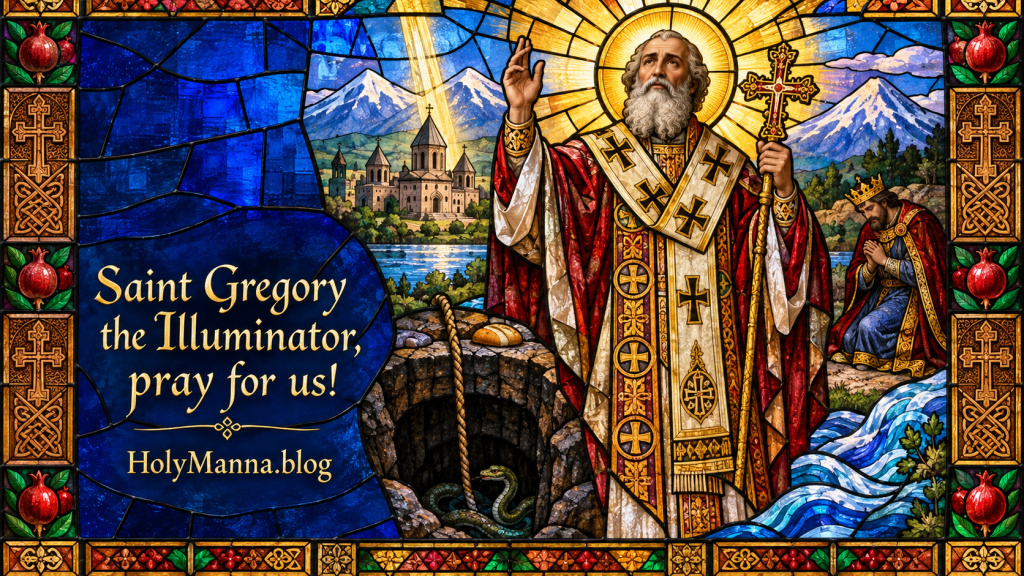
The Apostle to the First Christian Nation
Some saints are remembered for a single miracle, a single book, or a single moment of heroic witness. Saint Gregory the Illuminator, whom the Church commemorates on September 30th in the Roman Martyrology, is remembered for something almost unheard of in the history of the world. Through his suffering, his preaching, and his prayers, an entire kingdom laid down its idols and took up the Cross. Armenia became the first nation on earth to embrace Christianity as its faith, traditionally in the year 301, more than a decade before the Emperor Constantine legalized Christianity in the Roman Empire. That is why the Armenian people call him Lusavorich, the Illuminator, the one through whom the light of Christ first flooded their land.
Gregory holds the patronage of Armenia, and he is honored as its apostle and national saint. He is venerated not only in the Catholic Church but also in the Armenian Apostolic Church, the Eastern Orthodox Churches, and other ancient Christian communities, which makes him a rare bridge figure, a saint whom divided Christians still gather around together. His story reads like something out of an epic: a child rescued from a massacre, a servant who forgave the son of his family’s killer, a prisoner left to die in a snake-filled pit for thirteen years, a healer who restored a mad king, and a bishop who baptized a nation. Behind all the drama stands a simple truth the Church never tires of proclaiming. As The Catechism of the Catholic Church teaches, “By canonizing some of the faithful, i.e., by solemnly proclaiming that they practiced heroic virtue and lived in fidelity to God’s grace, the Church recognizes the power of the Spirit of holiness within her” (CCC 828). Gregory’s life is one long demonstration of that power.
What would it look like if the light of Christ so filled one person that it changed everyone around them? That is the question Gregory’s life puts to every reader.
Born of Blood, Raised in Grace
Gregory’s story begins in tragedy, and it is important to say up front that nearly everything known about his life comes to the Church through a fifth century historian named Agathangelos, who wrote The History of the Armenians roughly a century and a half after the events. Agathangelos claimed to be a secretary of the Armenian king, and his account weaves together genuine history and devotional storytelling. The Church has always read him the way she reads all such sources, treasuring the truth he preserves while distinguishing documented fact from later tradition. The core of the story, that Gregory evangelized Armenia, converted its king, and became its first chief bishop, is accepted history. Many of the vivid details belong to tradition, and this post will say so plainly wherever that is the case.
According to that tradition, Gregory was born around the year 257, the son of Anak, a Parthian noble. Anak assassinated the Armenian King Khosrov, and in retaliation the king’s men wiped out Anak’s entire family. Only the infant Gregory survived, spirited away by his nurse to Caesarea in Cappadocia, in what is now central Turkey. Consider the weight of that beginning. Gregory grew up knowing that his father was a murderer, that his family had been destroyed because of it, and that the royal house of Armenia had every reason to hate his name.
Yet in Caesarea, God was writing a different story. Gregory was raised as a Christian and educated in a Greek Christian environment, in the very city that would later form great saints like Basil. There he married a devout Christian woman, and the couple had two sons, Vrtanes and Aristakes, both of whom would one day become bishops themselves. Gregory’s early life shows something the Church constantly affirms, that grace can take the worst inheritance imaginable and transform it. He was the son of an assassin, and God made him the father of a nation’s faith.
As a grown man, Gregory made a decision that defines his whole sanctity. He returned to Armenia and entered the service of King Tiridates III, the son of the very king his own father had murdered. Tradition holds that he went back deliberately, seeking to atone for his father’s crime by bringing the Gospel to the people his father had wounded. He did not return to reclaim status or settle scores. He returned to serve. The Scriptures could not describe his path more perfectly than the words of Jesus in The Gospel of Matthew: “Love your enemies and pray for those who persecute you” (Mt 5:44). Gregory lived that verse before he ever suffered for it.
The Healer of a King and the Baptizer of a Nation
Gregory’s public witness began with a refusal. While serving at the royal court, he would not offer sacrifice to the pagan goddess Anahit during a national festival. In a court where religion and loyalty were fused together, this was seen as treason. Worse still, Tiridates soon learned that this stubborn Christian was the son of Anak, his father’s assassin. The king’s fury fell on Gregory with full force, and the sufferings that followed will be told in the next section. What matters here is what God did through Gregory once those sufferings had run their course.
Tradition, recorded by Agathangelos, recounts that while Gregory languished in prison, a community of consecrated virgins fled Roman persecution and took refuge in Armenia. Among them were Hripsime and their abbess Gayane. Tiridates, captivated by Hripsime’s beauty, sought to take her for himself, and when she refused him for the sake of Christ, the king had her, Gayane, and their companions tortured and put to death. The Armenian Church venerates them to this day as its protomartyrs. Soon after this crime, the tradition continues, Tiridates was struck with a horrifying madness. He abandoned his palace and wandered like a wild boar among the marshes, and his court fell into affliction with him. Then the king’s sister, Khosrovidukht, received a dream in which she learned that only Gregory, the prisoner everyone assumed was long dead, could heal her brother. This entire dramatic episode comes from Agathangelos and cannot be independently verified as history, and it is told here as the sacred tradition of the Armenian people rather than as established fact.
What happened next changed the world. Gregory, drawn up alive from his pit after thirteen years, did not curse the man who had buried him. He prayed for him. Through Gregory’s prayers and preaching, Tiridates was healed in body and soul, and the persecutor became a son of the Church. Around the year 301, the king proclaimed Christianity the religion of Armenia, making it the first Christian nation in history. Honesty requires noting that some modern historians place the conversion closer to 314, after the Edict of Milan, and the sources genuinely conflict on the date. What no serious source disputes is the fact itself. Armenia converted, Gregory was the instrument, and the nation has held that faith through seventeen centuries of empire, invasion, and even genocide.
Gregory then traveled to Caesarea, where he was consecrated a bishop, and returned to shepherd the newborn Church. Tradition says he baptized the king, the army, and vast crowds of the people in the waters of the Euphrates. Reading that scene through Catholic eyes, it is impossible not to hear The Catechism: “Holy Baptism is the basis of the whole Christian life, the gateway to life in the Spirit, and the door which gives access to the other sacraments” (CCC 1213). Gregory did not merely win an argument or a royal decree. He opened the door of divine life to a whole people.
One more treasured tradition belongs to this period. Agathangelos recounts that Gregory received a vision in which Christ Himself, the Only Begotten Son of God, descended from heaven in a blaze of light and struck the earth with a golden hammer, showing Gregory where the mother cathedral of Armenia was to be built. The great cathedral of Etchmiadzin rose on that spot, and its very name means “the Only Begotten descended.” Etchmiadzin still stands today as one of the oldest cathedrals in the world and the spiritual heart of Armenian Christianity. The vision itself is a story handed down in tradition and cannot be verified.
Gregory spent his remaining years building the Church he had fathered. He tore down pagan shrines, established churches and schools, and ordained clergy across the land. He consecrated his own sons Vrtanes and Aristakes as bishops, and Aristakes represented Armenia at the First Council of Nicaea in 325, the council that gave the Church the Creed still professed at every Sunday Mass. The office of chief bishop, the catholicos, remained in Gregory’s family for generations. Later ages attributed many letters, homilies, canons, and prayers to Gregory’s pen, including a long catechesis known as The Teaching of Saint Gregory, but scholars, including the old Catholic Encyclopedia, judge that these texts were composed well after his lifetime, and no verified verbatim sayings of the saint survive. His true legacy was never a book. It was a Church. In his final years, Gregory did something remarkable for a man who had converted a kingdom. He walked away from all of it. He handed on his office, withdrew to a cave in the wilderness of Mount Sebuh, and lived out his days as a hermit in prayer, dying around the year 331, though sources give conflicting dates ranging from about 328 to 337.
Thirteen Years in the Pit of Oblivion
Gregory was not martyred. He died in peace as a hermit. Yet few martyrs suffered more than this confessor did, and his hardships deserve to be told in full, because they are the soil out of which every one of his triumphs grew.
When Gregory refused to sacrifice to Anahit, and when his identity as Anak’s son came to light, Tiridates resolved to break him. Tradition counts twelve distinct tortures inflicted on the saint, a catalogue of cruelty preserved by Agathangelos, and while the precise list belongs to tradition rather than verifiable history, the memory of extreme torture is at the heart of every ancient account of his life. Through it all, Gregory would not deny Christ.
When torture failed, the king ordered something worse than execution. Gregory was cast into Khor Virap, the deep pit of the royal prison at Artashat. The name means exactly what it sounds like, the deep dungeon, and Armenians remembered it as the pit of oblivion, the place from which no one returned. It was a dark hole in the earth, remembered in tradition as crawling with snakes and scorpions, where condemned men were thrown and simply forgotten. Gregory was left there to die, and he stayed there, according to the tradition, for thirteen years.
Thirteen years. Sit with that number for a moment. It is longer than most people hold a job, longer than a child takes to grow from birth to adolescence. Thirteen years in the dark, presumed dead by the world above. Tradition says that Gregory survived because a Christian widow, obedient to a prompting from God, secretly lowered bread to him day after day, year after year, and that like Daniel in the lions’ den the creatures of the pit never harmed him. This story of the widow and Gregory’s preservation comes from tradition and cannot be verified. What can be said with confidence is that the Armenian Church has always confessed that Gregory entered that prison a condemned man and emerged from it alive, and that his endurance became the seed of a nation’s faith.
The psalmist could have been describing Gregory when he sang, “He drew me up from the desolate pit, out of the miry bog, and set my feet upon a rock” (Ps 40:2). And the Lord’s own words in The Gospel of John explain why those hidden years bore such fruit: “unless a grain of wheat falls into the earth and dies, it remains alone; but if it dies, it bears much fruit” (Jn 12:24). Gregory was buried alive like a seed, and the harvest was a Christian nation. Saint John Paul II, preaching alongside the Armenian Catholicos in the year 2000, saw the same pattern and said of him, “Following the Good Shepherd, Saint Gregory laid down his life for his sheep.” The Catechism teaches that “Christian prayer extends to the forgiveness of enemies” (CCC 2844), and Gregory’s whole ordeal is that teaching written in flesh. The man who climbed out of the pit had every human reason to hate Tiridates. Instead he healed him.
A Legacy Seventeen Centuries Strong
Gregory died alone in his mountain solitude, and tradition says that shepherds who came upon his body, not knowing who he was, buried him under a pile of stones. Generations later, the tradition continues, a hermit named Garnik, said to be a disciple of the saint, was shown the location of the grave in a vision and translated the relics to the village of Thortan for honorable burial. Scholars contest the dating of this discovery, and the entire episode of the vision and the finding of the relics rests on tradition and cannot be verified.
From Thortan, the relics of Saint Gregory began a journey almost as remarkable as his life. Portions were taken to Constantinople, and tradition holds that during the iconoclast persecutions of the eighth century, nuns fleeing the Byzantine Empire carried relics of the saint to Naples in Italy. There, in the heart of the old city, stands the church and monastery of San Gregorio Armeno, Saint Gregory the Armenian, one of the great Baroque complexes of Naples, where the head of the saint has been venerated for centuries. In a delightful twist of Providence, the street outside that church is today world famous as the street of the Nativity scene makers, where artisans craft creche figures all year long. Pilgrims still gather there; as recently as 2025, Armenian faithful from across Europe converged on San Gregorio Armeno to pray before his relics on his feast.
The most treasured relic of all is the Right Hand of Saint Gregory, kept at the Mother See of Holy Etchmiadzin in Armenia, with another arm relic at the Holy See of Cilicia. Once every seven years, the Catholicos of All Armenians uses that relic in the solemn blessing of the Holy Chrism, the sacred oil sent to Armenian churches around the world for baptisms and consecrations. Think about what that means. Seventeen hundred years after his death, the hand that baptized a king still, in a real and tangible sign, blesses the oil that brings new Christians into the life of grace. This is exactly the logic of the communion of saints that The Catechism describes when it teaches that the saints in heaven “do not cease to intercede with the Father for us” (CCC 956).
The modern era has only deepened Gregory’s legacy, and it has made him a living bridge between Rome and the Armenian people. In November of the Jubilee Year 2000, Saint John Paul II presented relics of Saint Gregory to Catholicos Karekin II in Rome. In 2001, the seventeen hundredth anniversary of Armenia’s conversion, a vast new cathedral of Saint Gregory the Illuminator was consecrated in Yerevan as the symbol of that anniversary, housing holy remains of the saint brought from Naples, and John Paul II himself visited it during his pilgrimage to Armenia. On January 19, 2005, the same pope consecrated a monumental marble statue of Gregory, over five and a half meters tall, in an exterior niche of Saint Peter’s Basilica itself, so that the Illuminator of Armenia now stands watch at the heart of the Catholic world. And in 2016, Pope Francis ended his apostolic visit to Armenia by praying at Khor Virap itself, descending to the pit where Gregory suffered, within sight of Mount Ararat.
Khor Virap today is one of the great pilgrimage sites of the Christian world. The monastery built over the prison welcomes streams of visitors, and pilgrims can still climb down a narrow ladder into the actual underground chamber, roughly six meters deep, where tradition says the saint spent his thirteen years. Armenia itself is Gregory’s living monument. The nation kept the faith he planted through Persian domination, Arab conquest, Ottoman rule, the genocide of 1915, and seventy years of Soviet atheism, and it remains a Christian nation today. The Armenian Church keeps multiple feasts in his honor across the year, commemorating his sufferings, his descent into the pit, his emergence from it, and the discovery of his relics, while the Roman Martyrology commemorates him on September 30th, and Pope Gregory XVI added his heavenly namesake to the Roman Calendar in 1837.
Lessons from the Man Who Would Not Stay Buried
So what does a third century Armenian bishop have to say to a reader scrolling through this post seventeen centuries later? More than might be expected.
First, Gregory teaches that no one is trapped by their family’s past. He was the son of an assassin, born under a name that meant betrayal and blood. He could have spent his life running from that inheritance or being crushed by it. Instead, he let grace rewrite it, and he deliberately returned to serve the very family his father had wounded. Many people carry family wounds, histories of addiction, divorce, estrangement, or worse, and quietly fear that those histories define them. Gregory stands as proof that they do not. What inherited wound or family history has felt like a life sentence, and what would it mean to hand it over to God for healing?
Second, Gregory teaches perseverance in the dark. Thirteen years in a pit is an extreme image, but seasons in the pit are universal: the long unemployment, the illness that will not lift, the prayers that seem to hit the ceiling, the years when God feels silent. Gregory’s pit was not the end of his story, and it was precisely there, hidden and forgotten, that God prepared him for his greatest work. The Catechism speaks of prayer as a battle and insists that “prayer is both a gift of grace and a determined response on our part” (CCC 2725). Gregory’s determined response lasted thirteen years. Where in life does God seem to be asking for patient endurance right now, and what daily bread, the Eucharist, Scripture, a faithful friend, is He lowering into that darkness?
Third, Gregory teaches the world-changing power of forgiveness. The single hinge on which all of Armenian Christianity turns is the moment a tortured prisoner chose to pray for his torturer instead of cursing him. Forgiveness did not just free Gregory’s soul; it converted a king and, through him, a nation. Everyone has a Tiridates, someone whose name still stings. The Lord’s command in The Gospel of Matthew to “Love your enemies and pray for those who persecute you” (Mt 5:44) is not a suggestion for saints only. It is the family rule of the Kingdom. Who is the one person that seems impossible to forgive, and what would it cost to pray for them by name this week?
Finally, Gregory teaches that real evangelization flows from holiness, not volume. He did not convert Armenia with clever arguments or marketing. He converted it with fidelity, suffering, prayer, and the visible power of a life given completely to Christ. Words matter, and Gregory preached tirelessly once freed, but the pit came before the pulpit. Anyone who wants to share the faith with coworkers, friends, or family can start where Gregory started, with quiet faithfulness that refuses to bow to the idols of the age, whether those idols are made of stone or of status, money, and comfort. As Saint Peter wrote of all the baptized, God has called His people “out of darkness into his marvelous light” (1 Pt 2:9), and people who live in that light become, like Gregory, illuminators themselves.
Engage With Us!
Saint Gregory the Illuminator climbed out of a pit and lit up a nation, and his story still has light to give. Readers are warmly invited to share their thoughts and reflections in the comments below. Which part of Gregory’s story landed hardest, the forgiveness, the pit, or the baptism of a whole people? The conversation is better with more voices in it, so here are some questions to get things started.
- Gregory returned to serve the family his own father had wronged. Is there a relationship in your life where God might be calling you to take the first humble step toward reconciliation?
- Tradition says a widow faithfully lowered bread into Gregory’s pit for thirteen years, never knowing her small act was sustaining the future apostle of a nation. What hidden, unglamorous act of service might God be asking of you right now?
- Tiridates was healed when the man he persecuted prayed for him. Have you ever experienced the healing power of forgiving someone, or of being forgiven when you did not deserve it?
- Armenia has held onto the faith Gregory planted through seventeen centuries of persecution. What practices help you hold onto your faith when the culture around you pulls the other way?
- Gregory ended his life not in a cathedral but in a hermit’s cave, choosing prayer over prestige. What would it look like to build more silence and prayer into your daily routine this month?
Whatever the answer, do not let this story stay on the screen. Take one lesson from the Illuminator, forgiveness, endurance, or hidden faithfulness, and put it into practice before the week is out. The same Christ who drew Gregory up out of the pit is at work today, drawing every soul out of darkness into His marvelous light. Go and live a life of faith, boldly and joyfully, and do everything with the love and mercy that Jesus taught.
Saint Gregor the Illuminator, pray for us!
Follow us on YouTube, TikTok, Instagram and Facebook for more insights and reflections on living a faith-filled life.


Leave a comment