Memorial of Saint Jerome, Priest and Doctor of the Church – Lectionary: 457
The Saint Who Never Let Go of the Word
Some days the readings comfort. Other days they take a reader by the shoulders. September 30th, the Memorial of Saint Jerome, Priest and Doctor of the Church, is one of the second kind. Job stands before a God who moves mountains and seals up the stars, and admits that no argument, no matter how airtight, can win a case against the Almighty. The psalmist prays from the darkest corner of the entire Psalter, asking whether wonders are worked for the dead, and hears no answer, yet keeps praying anyway. Then Jesus, having “resolutely determined to journey to Jerusalem” just a few verses earlier in The Gospel of Luke, meets three men on the road and tells them what following Him will actually cost: no den, no nest, no funeral delay, no farewell party.
The thread running through all of it is this: God is too great to be argued with and too good to be followed halfway. The readings strip away the fantasy of a negotiated discipleship, the kind where a person keeps one hand on the plow and one hand on a backup plan.
The Church could hardly have picked a better patron for such a day. Jerome, born around the year 347 in Stridon, gave up a brilliant career in Rome and spent roughly the last 34 years of his life in a cave beside the Basilica of the Nativity in Bethlehem, translating the Scriptures into the Latin Vulgate until his death in the year 420. He wrestled with the Word of God the way Job wrestled with God Himself, and he never looked back. His life is the answer to the question these readings pose: what does it look like to surrender completely to a God beyond all reckoning?
First Reading — Job 9:1-12, 14-16
The Case No Man Can Win
Job speaks here in reply to his friend Bildad, who had insisted that God never bends justice, so Job’s suffering must prove hidden sin. Job’s answer is stunning: he agrees with the theology and still refuses the conclusion. Yes, God is just. But justice between God and man is not a courtroom between equals. This chapter belongs to the ancient wisdom tradition, and its hymn to God’s cosmic power reads like a creation psalm turned loose in a lawsuit. It sets the day’s theme perfectly: before the God past finding out, the only honest posture is surrender, not argument.
Job 9:1-12, 14-16
Job answered his friends and said:I know well that it is so;
but how can a man be justified before God?
Should one wish to contend with him,
he could not answer him once in a thousand times.
God is wise in heart and mighty in strength;
who has withstood him and remained unscathed?He removes the mountains before they know it;
he overturns them in his anger.
He shakes the earth out of its place,
and the pillars beneath it tremble.
He commands the sun, and it rises not;
he seals up the stars.He alone stretches out the heavens
and treads upon the crests of the sea.
He made the Bear and Orion,
the Pleiades and the constellations of the south;
He does great things past finding out,
marvelous things beyond reckoning.Should he come near me, I see him not;
should he pass by, I am not aware of him;
Should he seize me forcibly, who can say him nay?
Who can say to him, “What are you doing?”How much less shall I give him any answer,
or choose out arguments against him!
Even though I were right, I could not answer him,
but should rather beg for what was due me.
If I appealed to him and he answered my call,
I could not believe that he would hearken to my words.
Detailed Exegesis
Verses 1-2: “Job answered his friends and said: I know well that it is so; but how can a man be justified before God?”
Job concedes Bildad’s premise while exposing its limits. Saint Gregory the Great notes that Job humbly accepts the truth even from a flawed messenger. The question of justification before God will echo through Scripture until Saint Paul answers it in Christ.
Verse 3: “Should one wish to contend with him, he could not answer him once in a thousand times.”
The language is legal. To “contend” is to file suit. In Hebrew thought the number one thousand signifies totality, so Job admits that not a single argument out of the whole of them would stand before the divine Judge.
Verse 4: “God is wise in heart and mighty in strength; who has withstood him and remained unscathed?”
Wisdom and might together mean God cannot be deceived and cannot be escaped. Every rebellion against the Creator, from the fallen angels onward, ends in the rebel’s own confusion.
Verses 5-6: “He removes the mountains before they know it; he overturns them in his anger. He shakes the earth out of its place, and the pillars beneath it tremble.”
Ancient peoples pictured the earth resting on pillars. Job declares that even the most permanent things in creation are, before God, as movable as furniture. Nothing in this world is as fixed as it feels.
Verse 7: “He commands the sun, and it rises not; he seals up the stars.”
Pagan neighbors of Israel worshiped the sun and stars as deities. Job demotes them to servants who obey orders and can be sealed away like documents in a drawer.
Verse 8: “He alone stretches out the heavens and treads upon the crests of the sea.”
The sea symbolized chaos in the ancient world, and God walks on it. The Fathers heard in this verse a foreshadowing of Christ walking on the waters of Galilee, the Creator treading His own creation.
Verse 9: “He made the Bear and Orion, the Pleiades and the constellations of the south; “
Job names the constellations his culture knew. The point is polemical and pastoral at once: the stars that pagans consulted for their fates are simply God’s handiwork, hung in place by Him.
Verse 10: “He does great things past finding out, marvelous things beyond reckoning.”
This is the hinge of the whole passage. God’s works are not merely large; they are unsearchable. Human understanding does not run out because God is irrational, but because He is inexhaustible.
Verse 11: “Should he come near me, I see him not; should he pass by, I am not aware of him;”
God’s presence is real but not always perceptible. Fallen humanity, Gregory teaches, lost the eyes of the mind, so a soul often cannot tell whether a given moment is grace or trial.
Verse 12: “Should he seize me forcibly, who can say him nay? Who can say to him, ‘What are you doing?’”
No creature can audit the Creator. This is not tyranny; it is the simple arithmetic of being made from nothing by Someone infinitely good and infinitely wise.
Verses 14-15: “How much less shall I give him any answer, or choose out arguments against him! Even though I were right, I could not answer him, but should rather beg for what was due me.”
Here Job abandons litigation for supplication. Even a righteous man does not stand on his record before God; he asks for mercy. The whole Gospel of grace is hiding in this verse.
Verse 16: “If I appealed to him and he answered my call, I could not believe that he would hearken to my words.”
Job’s faith is shaken but not broken. He keeps appealing even while doubting he is heard, which is precisely the condition the Responsorial Psalm will voice next.
Teachings
Saint Gregory the Great devoted his masterpiece, the Moralia in Job, to this book, and Book IX treats this very chapter. On Job’s opening question he writes, “For man being put under God receives righteousness; being put with God he loses it: for everyone that compares himself with the Author of all good things, bereaves himself of the good which he had received.” On verse 10 he adds, “For then we more thoroughly compass the deeds of Divine Might, when we acknowledge that we can never compass them; we then speak with greater eloquence, when we are silent on these, being struck dumb with astonishment.” And on verse 15 he concludes, “And if I should grow to the practising of virtue, I am made vigorous to life, not by merit, but of pardoning grace.”
The Catechism teaches the same mystery in CCC 272: “Faith in God the Father Almighty can be put to the test by the experience of evil and suffering. God can sometimes seem to be absent and incapable of stopping evil. But in the most mysterious way God the Father has revealed his almighty power in the voluntary humiliation and Resurrection of his Son, by which he conquered evil.”
Saint Jerome knew this book intimately, translating it twice, and confessed in his preface to Job that the Hebrew text is so oblique and slippery that it behaves “as if you would hold tightly an eel or a little murena fish, when you press harder, then the sooner it escapes.” He even paid a Hebrew instructor from Lydda to help him understand it. The greatest biblical scholar of his age approached Job on his knees.
Reflection
Job’s surrender is not despair; it is realism about who God is. Modern life trains people to demand explanations from everyone, including God, and to withhold trust until the explanation arrives. Job models the opposite: trust first, understanding later, and maybe not until heaven. A practical step is to take one unresolved suffering, name it honestly in prayer, and then deliberately end that prayer not with a demand but with the words of verse 15, begging mercy rather than pressing a case. Another step is to spend 5 minutes under the night sky this week, letting the actual stars preach verse 9. Where in life is there a temptation to put God on trial? What would it cost, and what would it heal, to drop the case and simply kneel?
Responsorial Psalm — Psalm 88:3, 10bc-15
The Prayer That Keeps Praying in the Dark
Psalm 88 is the darkest prayer in the entire Psalter. Attributed to Heman the Ezrahite of the sons of Korah, it is the only individual lament that never turns the corner into praise. There is no “but I will trust in you” at the end. And yet the Church has never removed it from her prayer; she assigns it to Night Prayer on Fridays in the Liturgy of the Hours, the night the faithful keep watch with the crucified Lord. That placement is the key. This psalm gives Job’s anguish a liturgical voice and prepares the heart for the Gospel, because only a person who has prayed through darkness can follow Christ without looking back.
Psalm 88:3, 10bc-15
R. (3) Let my prayer come before you, Lord.
Daily I call upon you, O LORD;
to you I stretch out my hands.
Will you work wonders for the dead?
Will the shades arise to give you thanks?
R. Let my prayer come before you, Lord.
Do they declare your mercy in the grave,
your faithfulness among those who have perished?
Are your wonders made known in the darkness,
or your justice in the land of oblivion?
R. Let my prayer come before you, Lord.
But I, O LORD, cry out to you;
with my morning prayer I wait upon you.
Why, O LORD, do you reject me;
why hide from me your face?
R. Let my prayer come before you, Lord.
Detailed Exegesis
Verse 3: “Let my prayer come before you, Lord. Daily I call upon you, O LORD; to you I stretch out my hands.”
The refrain and the opening plea establish the miracle of this psalm: the psalmist is still praying. Stretched-out hands are the ancient posture of supplication, the body refusing to give up even when the heart is exhausted. Daily persistence in prayer, not emotional satisfaction, is the measure of fidelity.
Verses 10bc-11: “Will you work wonders for the dead? Will the shades arise to give you thanks? Do they declare your mercy in the grave, your faithfulness among those who have perished?”
The psalmist argues with God the way only intimates can. In the Old Testament understanding, Sheol was a shadowy existence where the dead, the rephaim or “shades,” could no longer praise God. The questions are rhetorical pleas: save me now, Lord, while praise is still possible. Christian ears hear the answer these questions await, because on Easter morning God did work wonders for the dead.
Verses 12-13: “Are your wonders made known in the darkness, or your justice in the land of oblivion?”
“The land of oblivion” is one of Scripture’s bleakest phrases, the place of forgetting. The psalmist fears being erased from God’s memory. Revelation had not yet unveiled the resurrection, so this prayer stands at the frontier of hope, pressing against a door that Christ alone would open when His soul descended to the realm of the dead.
Verses 14-15: “But I, O LORD, cry out to you; with my morning prayer I wait upon you. Why, O LORD, do you reject me; why hide from me your face?”
The psalm ends with a “why” that receives no answer within the psalm itself. Yet the discipline remains: morning prayer, daily crying out, continued waiting. The Church hears in these verses the voice of Christ in His agony, who prayed the laments of Israel from the Cross and answered them from the empty tomb.
Teachings
The Catechism teaches in CCC 2559, “Prayer is the raising of one’s mind and heart to God or the requesting of good things from God. But when we pray, do we speak from the height of our pride and will, or ‘out of the depths’ of a humble and contrite heart?” Psalm 88 is prayer from the depths in its purest form. CCC 2657 adds, “The psalms especially, with their concrete and varied language, teach us to fix our hope in God.” Even this psalm teaches hope, precisely because it never stops addressing God. A person who has truly despaired stops talking to heaven; the psalmist never does.
CCC 164 names the experience honestly: “Even though enlightened by him in whom it believes, faith is often lived in darkness and can be put to the test. The world we live in often seems very far from the one promised us by faith. Our experiences of evil and suffering, injustice, and death, seem to contradict the Good News; they can shake faith and become a temptation against it.” The spiritual tradition of the Church, especially in the Carmelite teaching of Saint John of the Cross on the dark night, treats such seasons not as God’s absence but as His purifying nearness, stripping the soul of every consolation so that it learns to love God for Himself. Saint Jerome, who battled loneliness, controversy, and his own fiery temperament in the Judean desert and later in Bethlehem, lived long stretches of exactly this kind of prayer.
Reflection
Everyone eventually prays Psalm 88, whether after a diagnosis, a betrayal, a lost job, or a season when the tabernacle feels empty. The psalm gives permission to bring the whole unedited mess to God, and it gives a rule: keep the appointment anyway. A concrete practice is to set a fixed morning prayer time this week, even 5 minutes, and keep it on the days it feels most pointless, because verse 14 says the psalmist waited on God specifically with morning prayer. Another practice is to pray this psalm aloud on a Friday night, in union with Christ crucified, for someone who is suffering. When prayer feels unanswered, is the response to pray less or to pray more honestly? Who in life needs to hear that faithful prayer and dark feelings can coexist?
Holy Gospel — Luke 9:57-62
Three Men, One Road, No Looking Back
This scene sits at a turning point in The Gospel of Luke. Just verses earlier, in Luke 9:51, Jesus “resolutely determined to journey to Jerusalem,” beginning the long travel narrative that ends at the Cross. Everything He now says about discipleship is spoken by a Man walking toward Calvary. Three would-be followers approach on the road, and Jesus answers each with a demand that sounds almost harsh until it is heard as an invitation into His own total self-gift. The passage completes the day’s arc: Job learned that God cannot be argued with, the psalmist learned to pray without answers, and now Jesus reveals what surrender looks like with feet on the road.
Luke 9:57-62
As Jesus and his disciples were proceeding
on their journey, someone said to him,
“I will follow you wherever you go.”
Jesus answered him,
“Foxes have dens and birds of the sky have nests,
but the Son of Man has nowhere to rest his head.”
And to another he said, “Follow me.”
But he replied, “Lord, let me go first and bury my father.”
But he answered him, “Let the dead bury their dead.
But you, go and proclaim the Kingdom of God.”
And another said, “I will follow you, Lord,
but first let me say farewell to my family at home.”
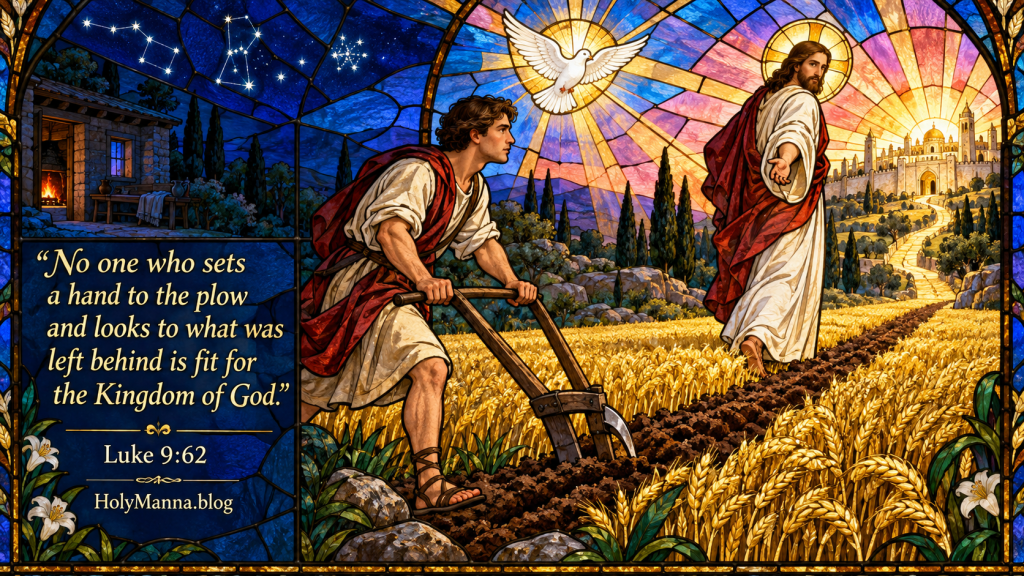
Jesus answered him, “No one who sets a hand to the plow
and looks to what was left behind is fit for the Kingdom of God.”
Detailed Exegesis
Verse 57: “As Jesus and his disciples were proceeding on their journey, someone said to him, ‘I will follow you wherever you go.’”
The first man volunteers, full of enthusiasm. Luke places the offer “on their journey” to Jerusalem, meaning the man is unknowingly offering to follow Jesus to a cross. Generous impulses are good, but Jesus insists they be counted out in real cost.
Verse 58: “Jesus answered him, ‘Foxes have dens and birds of the sky have nests, but the Son of Man has nowhere to rest his head.’”
Jesus, the Creator of foxes and birds, chose to own less than they do. This is the poverty of the Incarnation itself, from the manger in Bethlehem to the borrowed tomb. The disciple is invited into that same freedom from the need for security.
Verse 59: “And to another he said, ‘Follow me.’ But he replied, ‘Lord, let me go first and bury my father.’”
This time Jesus issues the call directly. Burying a father was among the most sacred duties in Jewish life, taking precedence even over reciting the Shema. The man’s request is not frivolous; it is the best excuse anyone has ever given. That is exactly the point.
Verse 60: “But he answered him, ‘Let the dead bury their dead. But you, go and proclaim the Kingdom of God.’”
The Fathers, including Saint Augustine, read “the dead” as the spiritually dead, those without the life of grace, who can tend to the affairs of this passing world. The Kingdom is life itself, and proclaiming it cannot wait for a more convenient season. Jesus claims priority over even the holiest natural obligation, a claim only God can make.
Verse 61: “And another said, ‘I will follow you, Lord, but first let me say farewell to my family at home.’”
The third man says “I will follow you, but,” and the “but” is the whole problem. His request deliberately echoes 1 Kings 19:19-21, where Elisha asks Elijah for permission to kiss his father and mother goodbye, and Elijah grants it. Jesus is about to demand more than Elijah could.
Verse 62: “Jesus answered him, ‘No one who sets a hand to the plow and looks to what was left behind is fit for the Kingdom of God.’”
Anyone who has plowed knows the image: look backward and the furrow goes crooked. Elisha slaughtered his oxen and burned his plowing equipment to follow Elijah; Jesus asks for that same burning of bridges, immediately and without a farewell tour. Divided attention is not partial discipleship; it is unfitness for the work.
Teachings
Saint Cyril of Alexandria, in his Commentary on the Gospel of Luke, explains that the Lord’s answer to the first man was given “not in order to reproach him, but rather for his correction, that he might of his own accord grow better, and become earnest in following the ways of virtue.” In the Catena Aurea of Saint Thomas Aquinas, commenting on the parallel scene in The Gospel of Matthew, Saint Jerome hears Jesus asking the man, “Why do you seek to follow Me for the sake of the riches and gain of this world, when My poverty is such that I have neither lodging nor home of My own?” Saint John Chrysostom adds in the same place that “This was not to send him away, but rather to convict him of evil intentions; at the same time permitting him if he would to follow Christ with the expectation of poverty.”
The Catechism gathers these threads. CCC 2544 teaches, “Jesus enjoins his disciples to prefer him to everything and everyone, and bids them ‘renounce all that [they have]’ for his sake and that of the Gospel.” And CCC 1618 states, “Christ is the center of all Christian life. The bond with him takes precedence over all other bonds, familial or social.” Saint Jerome did not merely comment on this Gospel; he lived it, abandoning the ambitions of Rome for a cave in Bethlehem, where he served the Word of God until his death on September 30th in the year 420. The Church honors him as the great witness that “Ignorance of the Scriptures is ignorance of Christ,” his own words enshrined in CCC 133.
Reflection
Every believer has a “first let me.” First let me get established in the career, first let me get through this busy season, first let me sort out my life, then real discipleship begins. Jesus answers that the plow is already in hand and the field is today. A concrete step is to name the one “first let me” that most delays a deeper following of Christ, write it down, and bring it to Confession or to prayer this week. Another is to imitate Saint Jerome in the simplest way possible: open the Bible daily, even for 10 minutes, and let the Word set the direction of the furrow. What is behind that keeps drawing the eyes backward? If Jesus said “Follow me” audibly today, what would honestly come after the word “but”?
Straight Furrows to Bethlehem
Put the three readings side by side and a single story emerges. Job stands beneath the constellations and admits that the God who made Orion cannot be subpoenaed, and that even a righteous man must beg rather than argue. The psalmist takes that same overwhelming God and refuses to stop talking to Him, stretching out his hands daily from the darkest room in the Psalter. Then Jesus walks by, face set toward Jerusalem, and shows what Job and Heman were reaching for all along: not answers, but a Person worth following anywhere, with both hands on the plow.
Saint Jerome ties it all together with his life. He knew Job so well that he compared translating it to gripping an eel. He knew darkness, loneliness, and his own sharp edges. And when the call came, he did not say “first let me.” He left Rome, the center of the world, for a cave beside the place where the Son of Man was born with nowhere to rest His head, and there he gave the Church the Vulgate, the Scriptures in the language of the people. He looked back at nothing.
The invitation today is wonderfully simple. Stop litigating with God over the things that make no sense yet. Keep the morning appointment of prayer even when heaven feels quiet. And take one deliberate step forward on the road, today, without checking over the shoulder. The God past finding out has made Himself findable in Jesus Christ, in His Word, and in His Eucharist. The furrow does not have to be long today. It only has to be straight. Grace will do the rest, one faithful row at a time, all the way home.
Engage With Us!
Share your reflections in the comments below! This community grows every time someone honestly wrestles with the Word, just like Job, just like Saint Jerome, and every voice adds to the conversation.
- In Job 9:1-12, 14-16, Job admits that no one can answer God “once in a thousand times.” Where is there a temptation right now to demand explanations from God as a condition for trusting Him, and what would surrender look like instead?
- In Psalm 88:3, 10-15, the psalmist keeps praying daily even though the psalm never resolves into praise. What helps sustain prayer during seasons when God seems silent, and what daily anchor could be added this week?
- In Luke 9:57-62, Jesus tells three would-be disciples that following Him permits no delays and no looking back. What “first let me” is currently sitting between the heart and a fuller following of Christ?
- Taking all the readings together with the witness of Saint Jerome: What one concrete thing could be left behind this week in order to grip the plow with both hands and follow Jesus without reservation?
Living a life of faith does not require having every answer; it requires staying on the road with the One who does. Keep praying in the dark, keep opening the Scriptures, and keep moving forward with the love and mercy Jesus taught, one straight furrow at a time. He is faithful, and He finishes what He begins.
Sacred Heart of Jesus, we trust in You!
Immaculate Heart of Mary, pray for us!
Saint Michael the Archangel, defend us in battle!
Follow us on YouTube, TikTok, Instagram and Facebook for more insights and reflections on living a faith-filled life.


Leave a comment