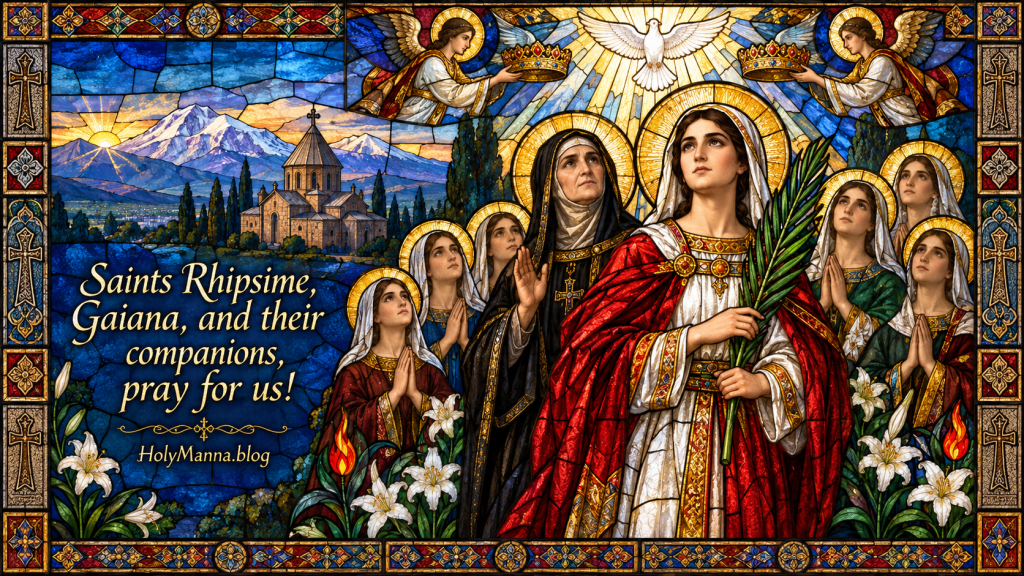
The Women Who Baptized a Nation in Their Blood
On September 29th, the Roman Martyrology remembers a group of women whose names most Catholics in the West have never heard, and yet whose deaths changed the map of Christianity forever. Saints Rhipsime, Gaiana, and their companions, virgins and martyrs, died at Vagharshapat in Armenia around the turn of the fourth century, and the Church of both East and West honors them as the protomartyrs of Armenia, the very first to shed their blood for Christ in the land that would soon become the first Christian nation on earth. Their story is one of the oldest and most beloved in all of Eastern Christianity, told and retold for seventeen centuries, painted on cathedral walls, and guarded in stone churches that still stand today near Mount Ararat.
Rhipsime was a consecrated virgin renowned for her extraordinary beauty. Gaiana was her spiritual mother, the superior of the community of consecrated women to which Rhipsime belonged. Their companions, numbering around 35 in most accounts, shared their vows, their flight, and finally their crowns. What makes them worth remembering is not the drama of their deaths, though the drama is real, but the simple, immovable conviction underneath it: they had given themselves entirely to Jesus Christ, and no emperor and no king could take back what had been given to God. The Church teaches that consecrated virgins are “betrothed mystically to Christ, the Son of God” and are “consecrated to God” as “a transcendent sign of the Church’s love for Christ” (CCC 923). Rhipsime and Gaiana lived that teaching to its furthest edge, and their fidelity became the seed from which an entire people’s faith would grow.
A word of honesty before the story begins, because honesty is owed to the saints most of all. Nearly everything known about these women comes from the History of the Armenians attributed to Agathangelos, a work written in the fifth century, more than a hundred years after the events it describes. Butler’s Lives of the Saints states frankly that while the martyrs themselves are certainly historical, and while their veneration is ancient and widespread, the detailed circumstances of their passion cannot be verified. This post will tell the traditional account as the treasure it is, will clearly mark what is documented history and what is tradition, and will never pretend to certainty the sources do not give.
A Flight from an Emperor’s Desire
According to the traditional account preserved by Agathangelos, Rhipsime was a young woman of noble Roman birth. She belonged to a community of consecrated virgins in Rome who lived a hidden life of prayer, fasting, and work under the direction of their abbess, Gaiana. These were women who had made a deliberate and radical choice. In an empire that measured a woman’s worth by her marriage and her sons, they had chosen Christ as their only Bridegroom, echoing the words of Saint Paul in The First Letter to the Corinthians, where the unmarried woman is “anxious about the affairs of the Lord, so that she may be holy in body and spirit” (1 Cor 7:34).
The tradition tells that the emperor Diocletian, the same Diocletian who would later unleash the most savage persecution the early Church ever endured, decided to take a wife. He sent painters throughout the empire to make portraits of the most beautiful women in his realm so that he might choose among them. One of those portraits was of Rhipsime, and when Diocletian saw it, he was captivated and demanded her in marriage. For a Roman woman, this was the summit of every worldly ambition: the palace, the purple, the throne of the world. Rhipsime refused it all, because she was already spoken for. She had vowed her virginity to Christ, and as the accounts put it, she could marry no earthly suitor because she was betrothed to a heavenly Bridegroom.
Refusing an emperor was not a decision a person survived by staying put. Gaiana gathered the community, and together the women fled Rome. The traditional account says they traveled first to Alexandria in Egypt and then made their way east, finally settling near Vagharshapat, the royal capital of Armenia, where they lived quietly and poorly, supporting themselves by their own labor. They had crossed most of the known world to keep a promise to God. This entire episode, from the portraits to the flight, comes from the traditional account and cannot be verified.
What can be said with confidence is this: at the end of the third century, a community of Christian consecrated women was present in pagan Armenia, at a moment when Christianity there was a persecuted minority and the king himself, Tiridates III, was an ally of Rome and an enemy of the Church. Into that tinderbox these women walked, and there God had prepared for them a role no one could have imagined.
The Refusal That Shook a Throne
The traditional account continues that Diocletian, furious at being spurned, wrote to King Tiridates III of Armenia, telling him to find the fugitive Rhipsime and send her back, or, if he pleased, to keep her for himself. When Tiridates’ men located the women and reported Rhipsime’s astonishing beauty, the king decided he would indeed keep her. He sent royal garments and an invitation to the palace. Rhipsime paid the gifts no attention and remained with her sisters in prayer.
Here the tradition records one of its most cherished details. As the community prayed, a voice from heaven was heard saying, “Be brave and fear not, for I am with you.” The words echo the promise of the Lord throughout Scripture, from The Book of Isaiah, “Fear not, for I am with you, be not dismayed, for I am your God” (Is 41:10), to the final promise of the risen Christ in The Gospel of Matthew, “And behold, I am with you always, to the close of the age” (Mt 28:20). This heavenly consolation is part of the traditional account and cannot be verified.
Rhipsime was seized and brought to the royal chamber. Tiridates, a man famed in Armenian memory for his enormous physical strength, tried to force himself upon her, and the tradition says that God gave the young virgin strength greater than the king’s, so that this warrior who had won victories in battle could not overpower a praying woman. Humiliated, he then summoned Gaiana and ordered the old abbess to persuade her spiritual daughter to yield. Gaiana did the opposite. Standing before a king who held her life in his hands, she encouraged Rhipsime to hold fast to her Bridegroom and to remember the crown that Christ had prepared for her, calling to mind the promise of The Book of Revelation, “Be faithful unto death, and I will give you the crown of life” (Rev 2:10). The account of the king’s defeat in the chamber and Gaiana’s exhortation belongs to the traditional narrative and cannot be verified.
Why does any of this matter to a reader today? Because these women demonstrate what the Church means when she says that “chastity includes an apprenticeship in self-mastery which is a training in human freedom” (CCC 2339). Rhipsime was not a victim of her circumstances. She was the freest person in that palace. The king was enslaved to his appetites; the emperor was enslaved to his pride; Rhipsime belonged wholly to God, and so she belonged wholly to herself. That is the freedom the saints keep offering to every generation, and it is the reason the Church holds her up as a model rather than merely a casualty of ancient cruelty.
The Night Armenia’s Protomartyrs Won Their Crowns
What followed was one of the most brutal martyrdoms recorded in the early Church. Enraged by his humiliation, Tiridates handed Rhipsime over to torture. The traditional account spares no detail: her tongue was cut out, she was burned, her body was broken, and she was finally put to death and dismembered. The abbess Gaiana and companions who had encouraged her were executed in their turn, and then soldiers fell upon the rest of the community. In most accounts around 35 women died in all; some later Byzantine accounts speak of as many as seventy. The Roman Martyrology wisely says simply “companions.” Some traditions add that a single member of the community escaped, a woman called Christiana, later identified in some sources with Saint Nino, the apostle of Georgia; this identification is a later development and cannot be verified.
However the details ran, the core fact stands on the earliest and most universal testimony of the Church: these women were truly martyred in Armenia under Tiridates, and they were venerated as martyrs from a very early date, not only in Armenia but as far away as Egypt and Ethiopia, where Rhipsime is loved under the name Arsema. Their deaths are usually dated around the year 300, though the sources conflict, giving dates ranging from about 290 to 312.
The Catechism teaches that “martyrdom is the supreme witness given to the truth of the faith: it means bearing witness even unto death” and that the martyr “endures death through an act of fortitude” (CCC 2473). The Church further teaches that “the Church has painstakingly collected the records of those who persevered to the end in witnessing to their faith” and calls these “the acts of the Martyrs,” which “form the archives of truth written in letters of blood” (CCC 2474). The story of Rhipsime and Gaiana is exactly such an archive: imperfectly preserved, embroidered by love over the centuries, but written at its core in real blood, shed by real women, for the real Christ.
And then God did something with that blood that no one saw coming.
The Blood That Became the Seed of a Nation
The ancient Christian writer Tertullian famously declared in his Apologeticus, “The blood of Christians is seed.” Nowhere in history has that sentence proved more literally true than in Armenia.
The traditional account says that soon after the massacre, King Tiridates was struck down by a horrifying affliction. Agathangelos describes him as being changed into, or behaving as, a wild boar, wandering in madness, an image the author deliberately patterns on the humbling of King Nebuchadnezzar in The Book of Daniel, who “was driven from among men, and ate grass like an ox” (Dan 4:33). Other accounts describe a disfiguring disease. This story of the king’s transformation cannot be verified.
The king’s sister, Khosrovidukht, then received a vision: only Gregory could heal her brother. Gregory was a Christian whom Tiridates had thrown into a deep pit called Khor Virap some thirteen to fifteen years earlier, both for his faith and because Gregory’s father had assassinated the king’s father. Everyone assumed Gregory was long dead. He was not. Sustained through years in that pit, according to tradition by a widow who secretly lowered bread to him, Gregory emerged alive. His first act was not vengeance and not even the healing of the king. His first act was to gather the broken bodies of Rhipsime, Gaiana, and their companions and bury the martyrs with honor.
Then Gregory prayed over the king, and Tiridates was healed. The proud monarch was brought before the relics of the very women he had slaughtered, and there he repented. The persecutor became a penitent, and the penitent became an apostle. In the year 301, Tiridates III proclaimed Christianity the religion of his kingdom, and Armenia became the first Christian nation in the history of the world, a full dozen years before Constantine’s Edict of Milan gave Christians mere toleration in the Roman Empire. Gregory, ordained a bishop at Caesarea, became the first chief shepherd of the Armenian Church and is honored forever as Saint Gregory the Illuminator. The details of the healing and conversion come to us through the traditional account, but the great historical fact at their center is beyond dispute: Armenia embraced Christ at the opening of the fourth century, and Armenian memory has always insisted that the door was opened by the martyrdom of these women. The Church teaches that “the witnesses who have preceded us into the kingdom, especially those whom the Church recognizes as saints, share in the living tradition of prayer by the example of their lives” and that “their intercession is their most exalted service to God’s plan” (CCC 2683). Rhipsime and Gaiana interceded for their murderer, and their intercession won him, and with him a nation.
Stone Churches, a Golden Hammer, and Seventeen Centuries of Devotion
The veneration of these martyrs began immediately and has never stopped. The traditional account says that Tiridates himself, as an act of penance, carried enormous stones down from Mount Ararat on his own royal back to build the first shrines, called martyria, over the places where Rhipsime and her companions died. This story of the king’s penitential labor cannot be verified, but the shrines themselves are gloriously real.
Tradition also tells of a magnificent vision granted to Saint Gregory at Vagharshapat: Christ Himself descended from heaven in a shaft of light and struck the ground with a golden hammer, marking the spot where the mother cathedral of Armenia should be built. The city has been called Etchmiadzin ever since, a name meaning “the Only-Begotten descended.” This vision is part of the traditional account and cannot be verified, but the cathedral rose on that spot and stands there still, the oldest cathedral in the Christian world by many reckonings.
Around it stand the churches of the martyrs. Saint Hripsime Church, consecrated in the year 618 on the site of her martyrdom, is one of the masterpieces of early Christian architecture, and beneath it, in the crypt, rests the tomb of the saint herself. Saint Gayane Church, built in 630, honors the fearless abbess nearby. The whole ensemble was inscribed on the UNESCO World Heritage List in the year 2000, and Saint Hripsime Church remains one of the most visited pilgrimage shrines in Armenia. Travelers of past centuries knew the place by the old Turkish name Ütsch Kilisse, “Three Churches,” precisely because of the martyrs’ shrines clustered around the cathedral. In 1604 Persian invaders carried off some of the relics, and they were restored in 1638; through invasion, genocide, and seventy years of Soviet atheism, the Armenian people never let go of these women. To this day, Hripsime remains a common and beloved given name for Armenian girls, so that the saint walks the streets of Yerevan in the names of schoolgirls and grandmothers alike. Her fame spread far beyond the Caucasus; the Coptic and Ethiopian churches venerate her, and churches bearing the name Arsema dot the Ethiopian highlands.
The Catholic Church joined this river of devotion at its source. The Roman Martyrology commemorates Rhipsime, Gaiana, and their companions on September 29th, the Byzantine churches keep September 30th, and the Armenian Apostolic Church honors Rhipsime and Gaiana on separate days in early June. When Pope Saint John Paul II traveled to Armenia in September 2001 to celebrate the 1,700th anniversary of the nation’s baptism, he stood as a pilgrim in the land these virgins watered with their blood, a living sign of the Catechism’s teaching that the Church is “the communion of saints” in which “the least of our acts done in charity redounds to the profit of all” (CCC 953).
What a 4th Century Virgin Says to a 21st Century Heart
It would be easy to file this story under ancient history, admire the stained glass, and move on. That would be a mistake, because Rhipsime and Gaiana are asking the modern reader some very uncomfortable and very freeing questions.
Start with Rhipsime. She was offered everything the world had to give, literally the hand of the most powerful man alive, and she said no, because she had already said yes to Someone greater. Most people will never face an emperor, but everyone faces the daily bidding war for their soul: the job that demands the conscience be left at the door, the relationship that demands the faith be kept quiet, the culture that insists the body is a commodity and purity is a punchline. The Catechism teaches that “all the baptized are called to chastity” and that every member of the faithful is called to lead a chaste life “in keeping with their particular states of life” (CCC 2348). Rhipsime’s witness is that this call is not a cage. It is a betrothal. What has God already claimed in your life that the world keeps trying to buy back?
Then look at Gaiana. She was the elder, the abbess, the one responsible for the others, and when the moment came she did not tell her daughter to save herself. She strengthened her for heaven. Every parent, godparent, mentor, and friend faces smaller versions of that moment constantly: the choice between telling a loved one what is easy and telling them what is true. Real spiritual friendship sometimes means encouraging someone toward a harder, holier road. Is there someone in your life who needs you to be Gaiana for them this week, someone who needs courage more than comfort?
Finally, look at Tiridates, because his place in this story is the most hopeful of all. The man who ordered the massacre became the man who carried stones for the martyrs’ shrines and led a nation to the font. The Church teaches that “there is no offense, however serious, that the Church cannot forgive” and that “Christ who died for all men desires that in his Church the gates of forgiveness should always be open to anyone who turns away from sin” (CCC 982). No reader is too far gone. No past is too heavy. The same mercy that reached a murderous king through the intercession of his victims is on offer at every confessional this Saturday.
In practical terms, the lessons weave into ordinary life simply. Guard the promises already made to God, in baptism, in confirmation, in marriage or vows, with the jealousy of a bride. Speak courage into the people God has entrusted to each of us, even when silence would be more comfortable. And never, ever write off the Tiridates in your own story, the difficult coworker, the estranged family member, the version of yourself from ten years ago, because the blood of Christ, which the martyrs merely imitated, is still seed.
Engage With Us!
HolyManna would love to hear from you. Share your thoughts and reflections on Saints Rhipsime, Gaiana, and their companions in the comments below, and let this community of faith grow the way the early Church did, one honest conversation at a time. Here are a few questions to pray with:
- Rhipsime turned down an empire because she had already given her heart to Christ. What is one concrete “offer” in your life right now that competes with your commitment to Him, and what would saying no to it look like this week?
- Gaiana strengthened her spiritual daughter for martyrdom instead of urging her to compromise. Who in your life needs you to speak hard, holy truth with love, and what is holding you back?
- King Tiridates went from persecutor to penitent to apostle of a nation. Where have you seen God bring stunning good out of sin or suffering in your own story?
- Armenia became the first Christian nation because a handful of hidden, praying women were faithful in obscurity. How does that change the way you think about the “small” and unseen acts of faithfulness in your daily routine?
- These martyrs have been venerated for seventeen centuries across Armenia, Rome, Egypt, and Ethiopia. How can you draw more deliberately on the communion of saints, perhaps by asking Saints Rhipsime and Gaiana to intercede for a specific intention this month?
Take heart from these valiant women. The same God who whispered “Be brave and fear not, for I am with you” into a cave near Ararat is with you in your commute, your kitchen, your hospital waiting room, and your hardest conversations. Live this day, and every day, with the courage of Rhipsime, the wisdom of Gaiana, and above all with the love and mercy that Jesus taught us, and your faithfulness, however hidden, will bear fruit you may not live to see but heaven will never forget.
Saints Rhipsime, Gaiana, and their holy companions, pray for us!
Follow us on YouTube, TikTok, Instagram and Facebook for more insights and reflections on living a faith-filled life.


Leave a comment