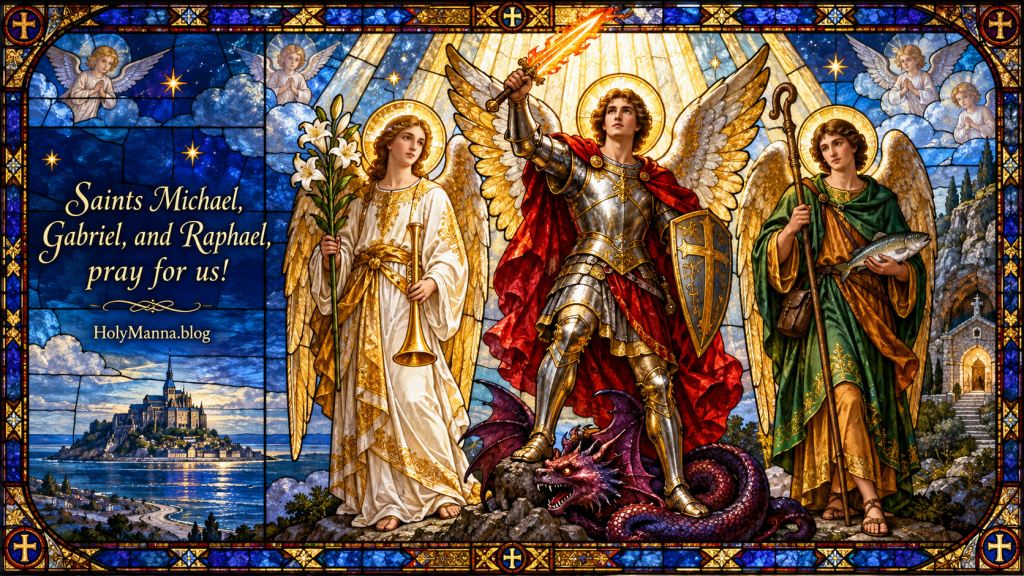
The Archangels Who Stand Before God
Every September 29th, the Catholic Church celebrates something rare on her calendar: a feast for three saints who were never born, never grew up, and never died. Saints Michael, Gabriel, and Raphael are the only three angels named in the canonical Scriptures, and the Church honors them together because their stories, taken as one, reveal the whole shape of God’s care for humanity. Michael defends. Gabriel announces. Raphael heals. Behind every one of those verbs stands the same God, working through His messengers.
The Church does not treat angels as poetry or metaphor. The Catechism of the Catholic Church teaches that “the existence of the spiritual, non-corporeal beings that Sacred Scripture usually calls ‘angels’ is a truth of faith” (CCC 328). It adds that “the whole life of the Church benefits from the mysterious and powerful help of angels” (CCC 334). These three archangels are not mascots or decorations on holy cards; they are living persons, brilliant created intelligences who stand in the presence of God and are sent into human history at its most decisive moments.
Each archangel holds real patronages recognized by the Church. Saint Michael is honored as the protector of the universal Church and is the patron of police officers, soldiers, paramedics, mariners, grocers, the sick, and the dying. Saint Gabriel was declared the heavenly patron of telecommunications and of all who work in that field by Pope Pius XII in an Apostolic Brief of January 12th, 1951, and Pope Saint Paul VI later named him patron of postal workers on December 9th, 1972; he is also honored as the patron of messengers and diplomats. Saint Raphael is the patron of travelers, physicians, nurses, the blind, and happy meetings, and generations of young Catholics have asked his intercession in finding a holy spouse.
For a generation that scrolls through bad news, fights invisible battles with anxiety and temptation, and longs for direction, these three archangels are not relics of a medieval imagination. They are reinforcements.
Born of No Woman
Most saints have a birthplace, a mother, a hometown parish. The archangels have none of these, because they are pure spirits, created by God before He formed the visible world. Their origin story is not found in a baptismal register but in the act of creation itself. The Catechism teaches that “as purely spiritual creatures angels have intelligence and will: they are personal and immortal creatures, surpassing in perfection all visible creatures” (CCC 330). Their family background, so to speak, is God Himself, and their formation was the first choice ever made by created freedom: the choice to serve God or to refuse Him.
Even their names are missions rather than biographies. Saint Gregory the Great, a Doctor of the Church, preached in his Homily 34 on the Gospels that “the word ‘angel’ denotes a function rather than a nature”, and the Catechism quotes Saint Augustine making the same point: “‘Angel’ is the name of their office, not of their nature. If you seek the name of their nature, it is ‘spirit’; if you seek the name of their office, it is ‘angel’: from what they are, ‘spirit,’ from what they do, ‘angel’” (CCC 329).
The three names carry their meanings openly. Michael, in Hebrew, means “Who is like God?”, a question hurled like a spear against every creature tempted to make itself a god. Gabriel means “God is my strength”, or in another rendering, the strength of God. Raphael means “God heals.” Saint Gregory the Great drew the lesson beautifully in that same homily, teaching that whenever some act of wondrous power must be performed, Michael is sent, so that his very name declares that no one can do what God alone can do.
If conversion means turning decisively toward God, then the archangels underwent the most dramatic conversion moment in all of creation, a single, irrevocable act of love and loyalty at the dawn of their existence, while a third of their brethren, according to the imagery of Revelation 12:4, turned away forever. Scripture gives glimpses of the ranks of these faithful spirits, and the Book of Tobit lets Raphael describe his own standing: “I am Raphael, one of the seven angels who stand and serve before the Glory of the Lord” (Tobit 12:15). Standing before God, seeing His face, and being sent by Him: that is the entire résumé of an archangel, and it is more than enough.
Interventions That Changed Salvation History
What the archangels are most known for is not who they are but what God has done through them, and Scripture records those interventions with striking detail.
Michael appears first in the Book of Daniel, where he is called “one of the chief princes” who comes to the aid of God’s messenger (Daniel 10:13), and where Daniel is told of the last days: “At that time there shall arise Michael, the great prince, guardian of your people” (Daniel 12:1). From the beginning, Michael’s role is protective. He is the guardian of Israel in the Old Covenant and, by the constant understanding of the Church, the guardian of the Church in the New. Even his one recorded sentence is a defense. The Letter of Jude recounts that when Michael contended with the devil over the body of Moses, he did not presume to condemn the enemy by his own authority but said only, “The Lord rebuke you!” (Jude 9). There is a whole spirituality in that single line: even the commander of Heaven’s armies fights with humility, wielding God’s power rather than his own.
Gabriel is Heaven’s herald. In the Book of Daniel, he is sent twice to the prophet to interpret visions and to announce the timeline of the coming of the Messiah (Daniel 8:16 to 26 and Daniel 9:21 to 27). Centuries later, the same messenger steps into the Temple in Jerusalem to tell the aged priest Zechariah that his prayers have been heard and that his son John will prepare the way of the Lord. When Zechariah doubts, Gabriel answers with the credentials of Heaven: “I am Gabriel, who stand before God. I was sent to speak to you and to announce to you this good news” (Luke 1:19).
Six months later comes the moment for which Gabriel is remembered above all others. In a forgotten village called Nazareth, he greets a young virgin with words the world has never stopped repeating: “Hail, full of grace! The Lord is with you” (Luke 1:28). He announces that she will conceive and bear a son and name Him Jesus, and he answers her question with a promise that has steadied believers ever since: “Nothing will be impossible for God” (Luke 1:37). The Catechism teaches that “from the Incarnation to the Ascension, the life of the Word incarnate is surrounded by the adoration and service of angels” (CCC 333), and Gabriel stands at the head of that service. Every Hail Mary ever prayed begins with an archangel’s greeting.
Raphael’s mission unfolds across the entire Book of Tobit, and it reads like a road trip written by Providence. Old Tobit, blinded and praying for death in exile, and young Sarah, tormented because a demon named Asmodeus has killed seven bridegrooms on her wedding nights, both cry out to God on the same day. God’s answer is Raphael, sent in the disguise of a traveler called Azariah. He walks beside Tobit’s son Tobiah on a long journey, teaches him to use the gall, heart, and liver of a great fish, arranges his marriage to Sarah, drives the demon away, recovers the family’s money, and finally heals Tobit’s blindness. Only at the end does he reveal himself, telling the family that when they prayed, it was he who presented the record of their prayer before the Glory of the Lord (Tobit 12:12), before declaring, “I am Raphael, one of the seven angels who stand and serve before the Glory of the Lord” (Tobit 12:15).
The Catechism sums up why these stories matter: “Angels have been present since creation and throughout the history of salvation, announcing this salvation from afar or near and serving the accomplishment of the divine plan” (CCC 332). The reader should remember and emulate the archangels because each one models a virtue that modern life starves: Michael’s courage, Gabriel’s obedience in delivering God’s word faithfully, and Raphael’s patient, hidden companionship with a struggling family. They show what it looks like to live entirely for the mission God assigns.
The Battle That Never Ends
The archangels were never martyred, because spirits cannot be killed, but Scripture and Tradition reveal that they have known combat more terrible than any earthly persecution. The Book of Revelation pulls back the curtain: “Then war broke out in heaven; Michael and his angels battled against the dragon. The dragon and its angels fought back, but they did not prevail” (Revelation 12:7 to 8). The dragon, “the ancient serpent, who is called the Devil and Satan” (Revelation 12:9), was thrown down to the earth with his angels.
The Church teaches this fall as sober fact, not mythology. The Catechism states that “Scripture and the Church’s Tradition see in this being a fallen angel, called ‘Satan’ or the ‘devil’”, and that “the Church teaches that Satan was at first a good angel, made by God” (CCC 391). Their sin was a free and radical rejection of God, and it is “the irrevocable character of their choice, and not a defect in the infinite divine mercy, that makes the angels’ sin unforgivable” (CCC 393). Michael’s great hardship, then, was to face beings who had once been his brothers, creatures of dazzling intelligence, and to oppose them not with hatred but with fidelity, armed with the question that is his name: who is like God?
That war did not end at the dawn of time. The Catechism is blunt about the world believers actually inhabit: human history is “a hard battle against the powers of evil” that stretches “from the very dawn of history until the last day” (CCC 409). When Catholics pray “deliver us from evil” in the Our Father, the Church teaches that “evil is not an abstraction, but refers to a person, Satan, the Evil One, the angel who opposes God” (CCC 2851). The hardships of the archangels are therefore ongoing. Michael still contends for souls. Gabriel’s message of the Incarnation is still mocked and ignored. Raphael’s healing is still refused by hearts that prefer their wounds.
The archangels endure this long war the way they endured the first battle, by total reliance on God’s power rather than their own. Saint Michael’s example in Jude 9 remains the Church’s model for spiritual combat: no fascination with the enemy, no bravado, no negotiation, only “The Lord rebuke you!” Catholics who feel outmatched by temptation, addiction, cynicism, or despair are not being asked to win by willpower. They are being asked to fight the way Michael fights, calling on a strength that is not theirs. That is why the Church places the sick and the dying under Michael’s patronage and asks him, in her funeral liturgy, to lead the departed into the holy light. The fiercest warrior in creation is also the gentlest escort at the hour of death.
Apparitions, Shrines, and a World Marked by Angels
Because the archangels never died, their “miracles after death” are really their interventions across the whole sweep of Church history, and few saints have left a deeper mark on the map of the Christian world.
The most famous begins on a rocky promontory in southern Italy. According to tradition, near the end of the fifth century, a wealthy man of Siponto lost a bull from his herd and found it kneeling at the mouth of a cave on Monte Gargano. An arrow shot at the animal turned back and struck the archer, and after the bishop ordered three days of prayer and fasting, Saint Michael appeared to him, declaring the cave under his protection and asking that it be dedicated in his honor and in honor of all the angels. Catholic sources conflict on the date, giving variously 490, 492, or 493, and the story itself cannot be verified. What is documented is the result: the Sanctuary of Monte Sant’Angelo sul Gargano became one of the oldest and most visited Michael shrines in the world, a pilgrimage destination for popes and peasants alike for some fifteen centuries, and a later tradition ties a May 8th commemoration to a Lombard victory near Siponto attributed to Michael’s help.
Rome carries Michael’s mark in its skyline. Tradition holds that in the year 590, while Pope Saint Gregory the Great led a penitential procession through a city devastated by plague, Saint Michael was seen above the mausoleum of Hadrian, sheathing his flaming sword as a sign that the chastisement was ending. The plague lifted, and the fortress has been called Castel Sant’Angelo, the Castle of the Holy Angel, ever since, crowned to this day by a statue of Michael returning his sword to its scabbard. This story is a tradition and cannot be verified.
In France, tradition tells that in the year 708 Saint Michael appeared three times in dreams to Saint Aubert, Bishop of Avranches, commanding him to build an oratory on the tidal rock then called Mont Tombe. The story adds that when Aubert hesitated, the archangel pressed his finger into the bishop’s skull, leaving a mark that pilgrims still associate with a relic skull kept at Avranches, and that a first church was dedicated on October 16th, 708, with relics brought from Monte Gargano. The apparition story cannot be verified. The abbey that rose there, Mont-Saint-Michel, is entirely verifiable, one of the most beloved sanctuaries in Christendom, a marvel of faith and stone rising from the sea, and for over a thousand years a magnet for pilgrims who called the dangerous crossing of its sands the path of Saint Michael.
History records Michael’s presence in one more remarkable place: a courtroom. At her trial in 1431, preserved in official documents, Saint Joan of Arc testified under oath that Saint Michael had appeared to her from her childhood, accompanied by other angels, and had set her on her mission for France. The trial record is documented history; the apparitions themselves belong to private revelation, which the Church never places on the level of public revelation.
Devotion to the archangels also shaped the Church’s prayer. In 1886, Pope Leo XIII composed the Prayer to Saint Michael and ordered it prayed after Low Mass: “Saint Michael the Archangel, defend us in battle. Be our protection against the wickedness and snares of the devil. May God rebuke him, we humbly pray; and do thou, O Prince of the heavenly host, by the power of God, cast into hell Satan and all the evil spirits who prowl about the world seeking the ruin of souls. Amen.” A widely repeated story claims that Leo XIII wrote the prayer after collapsing during a terrifying vision on October 13th, 1884, in which he overheard Satan boasting that he could destroy the Church if given a century. That story circulates in many versions and cannot be verified. The prayer itself, however, is fully documented, and countless parishes have revived it after Mass in recent years. The Chaplet of Saint Michael, honoring the nine choirs of angels, traces to a reported private revelation to the Portuguese Carmelite Antónia d’Astónaco and was encouraged by Blessed Pope Pius IX in 1851; as private revelation, it invites devotion without binding belief.
The cultural footprint of the feast runs deep. In England, September 29th became Michaelmas, one of the four quarter days that organized rents, school terms, and harvests, celebrated with a roast goose and the purple bloom of Michaelmas daisies. Folk tradition even warned against picking blackberries after Michaelmas, telling that Satan, cast out of Heaven, landed in a bramble bush and cursed the fruit; this is a folk story and cannot be verified. Gabriel, for his part, became the patron of Vatican Radio and of the whole modern world of broadcasting and telecommunications, a striking sign that the Church sees every honest transmission of truth as an echo of the Annunciation. Michael appears on the coat of arms of Kyiv and has been invoked for centuries as a protector of France, of Germany, and of Christian peoples under threat. A famous chain of shrines dedicated to Michael stretches across Europe, from Skellig Michael off the Irish coast, through Mont-Saint-Michel and the Sacra di San Michele in Piedmont, down to Monte Gargano; popular claims that these sites align on a perfectly straight sword of Saint Michael are a devotional observation rather than any teaching of the Church, but the shrines themselves testify to how completely this archangel captured the Christian imagination.
Living Under the Protection of the Angels
It would be easy to file the archangels under beautiful ideas and move on, but the Church insists that angelic help is present tense. The Catechism teaches that “from its beginning until death, human life is surrounded by their watchful care and intercession”, and quotes Saint Basil the Great: “Beside each believer stands an angel as protector and shepherd leading him to life” (CCC 336). The question is not whether the angels are on duty. The question is whether anyone is paying attention.
Michael’s lesson is courage rooted in humility. He never fights in his own name. In an age that treats faith as a private embarrassment, his very name pushes back against every idol, whether it is a career, an algorithm, an ideology, or a mirror. When something in life quietly demands the kind of loyalty that belongs only to God, what would it look like to answer it with Michael’s question, who is like God? A practical start is small and concrete: praying the Saint Michael Prayer daily, especially before situations that require moral backbone, and refusing to negotiate with habitual sin instead of entertaining it.
Gabriel’s lesson is faithful communication. He delivered God’s word exactly, gently, and to unlikely people in unlikely places. Anyone with a phone is now a broadcaster, which makes Gabriel’s patronage of telecommunications feel almost prophetic. Do the words sent out each day, in texts, posts, comments, and conversations, announce good news or add to the noise? Imitating Gabriel can mean something as simple as sending one message of genuine encouragement each day, speaking truth without cruelty, and praying the Angelus at noon, letting Gabriel’s own words, “Hail, full of grace”, interrupt the workday with the memory of the Incarnation.
Raphael’s lesson is hidden companionship. For most of the Book of Tobit, nobody knows he is an angel; he is simply the reliable friend on a hard road. God still heals mostly through disguised Raphaels: the friend who checks in, the nurse on the night shift, the stranger with the right word at the right moment. Who in ordinary life might be carrying God’s healing right now without realizing it, and for whom could this reader become that companion? Practically, that can mean traveling with prayer instead of only playlists, asking Raphael’s intercession for doctors, for the sick, for safe journeys, and for those longing for a good marriage, and choosing to walk patiently beside one struggling person instead of offering advice from a distance.
The Catechism gathers all of it into a single sentence worth memorizing: “Angels are spiritual creatures who glorify God without ceasing and who serve his saving plans for other creatures” (CCC 350). To honor the archangels is to enroll in that same service: defending the weak, announcing the truth, and healing what is wounded, one ordinary day at a time.
Engage With Us!
The conversation does not end here, and every reader is warmly invited to share thoughts, experiences, and reflections in the comments below. Stories of answered prayers, favorite shrines, or simply honest questions about the angels are all welcome, because faith grows when it is shared. To spark that reflection, here are some questions to sit with this week.
- Which archangel’s mission, Michael’s defense, Gabriel’s message, or Raphael’s healing, speaks most directly to this season of your life, and why?
- Where are you currently fighting a battle in your own strength that you need to hand over to God, the way Michael says only “The Lord rebuke you!”?
- If Gabriel audited the messages you sent this week, would they read like good news? What is one way you could communicate more truth and encouragement tomorrow?
- Raphael walked beside Tobiah for the whole journey before revealing who he was. Who has been a hidden angel in your story, and have you ever thanked God for them?
- What is one concrete practice from this post, the Saint Michael Prayer, the Angelus, or intentional companionship with someone who is struggling, that you will commit to for the next seven days?
The archangels stand before the face of God, yet God sends them to walk with ordinary people on dusty roads, in temple shadows, and in small-town kitchens in Nazareth. That is how much Heaven cares about every single life, including yours. So take up Michael’s courage, Gabriel’s good news, and Raphael’s compassion, and carry them into your home, your work, and your friendships. Live this week as someone surrounded by the watchful care of the angels, and do everything with the love and mercy that Jesus taught us.
Saints Michael, Gabriel, and Raphael, pray for us!
Follow us on YouTube, TikTok, Instagram and Facebook for more insights and reflections on living a faith-filled life.


Leave a comment