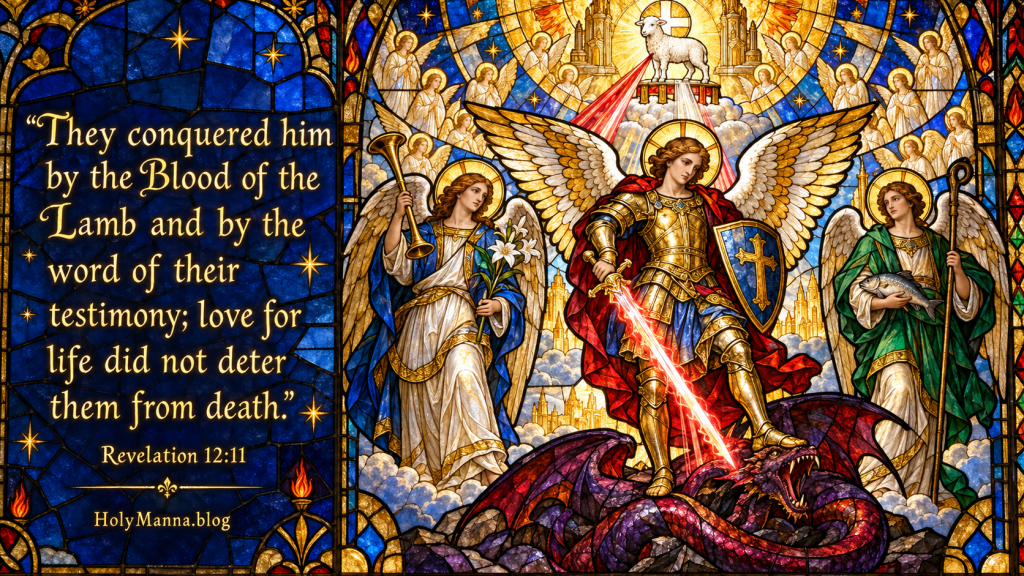
Feast of Saints Michael, Gabriel, and Raphael, Archangels – Lectionary: 647
When the Curtain Between Worlds Grows Thin
Some days the veil between heaven and earth feels almost transparent, and September 29th is one of them. The Church celebrates the Feast of Saints Michael, Gabriel, and Raphael, the only three angels named in all of Sacred Scripture. This date has deep roots. In the 5th century, a basilica in honor of Saint Michael was dedicated on the Via Salaria north of Rome, and the anniversary of that dedication became the beloved feast long known as Michaelmas. For centuries Gabriel was honored on March 24th and Raphael on October 24th, until the 1969 revision of the General Roman Calendar gathered all three archangels into this single, radiant celebration.
The readings for this feast share one central theme: heaven stands open, and every angel in it serves the Kingship of Jesus Christ, the Son of Man. In Daniel 7, thousands upon thousands of ministering spirits attend the throne as One like a son of man receives everlasting dominion. In Revelation 12, Michael and his angels cast down the dragon, yet the victory belongs to the Blood of the Lamb. In Psalm 138, the psalmist sings God’s praise in the sight of the angels, and in John 1, Jesus promises Nathanael that he will see heaven opened and the angels of God ascending and descending on the Son of Man.
The world of the angels is not a decoration on the edges of the faith. It is the unseen half of reality, and today the Church throws the doors open. What might change if heaven felt that close every single day?
First Reading (Option 1) — Daniel 7:9-10, 13-14
A Courtroom in Heaven and a King Who Cannot Be Dethroned
The Book of Daniel was written for believers living under the crushing weight of pagan empires, and chapter 7 is its beating heart. The vision comes to Daniel during the Babylonian exile, in the first year of King Belshazzar. Four terrifying beasts rise out of the churning sea, ancient Israel’s image of chaos, each beast representing a brutal earthly kingdom. Just when the nightmare peaks, the scene changes. Daniel is lifted into the courtroom of heaven, where God reigns in fire and light, surrounded by countless angelic attendants. This is the world of Michael, Gabriel, and Raphael, and it is the reason the Church chose this reading for their feast. The beasts rage below, but the court above is already in session, and the Kingdom being handed to the Son of Man can never be taken away.
Daniel 7:9-10, 13-14
As I watched:Thrones were set up
and the Ancient One took his throne.
His clothing was bright as snow,
and the hair on his head as white as wool;
His throne was flames of fire,
with wheels of burning fire.
A surging stream of fire
flowed out from where he sat;
Thousands upon thousands were ministering to him,
and myriads upon myriads attended him.The court was convened, and the books were opened.
As the visions during the night continued, I sawOne like a son of man coming,
on the clouds of heaven;
When he reached the Ancient One
and was presented before him,
He received dominion, glory, and kingship;
nations and peoples of every language serve him.
His dominion is an everlasting dominion
that shall not be taken away,
his kingship shall not be destroyed.
Detailed Exegesis
Verse 9
As I watched: Thrones were set up and the Ancient One took his throne. His clothing was bright as snow, and the hair on his head as white as wool; His throne was flames of fire, with wheels of burning fire.
Daniel calls God the Ancient One, or Ancient of Days, a title expressing eternity itself. Snow-white clothing and wool-white hair speak of absolute purity and timeless wisdom, while the flaming throne with burning wheels recalls the throne-chariot Ezekiel saw by the river Chebar in Ezekiel 1. Fire in Scripture signals the consuming holiness of God, for Deuteronomy 4:24 declares that the Lord is a consuming fire. The beasts of the earlier verses looked unstoppable, but they are not even mentioned here. God does not compete with empires; He judges them.
Verse 10
A surging stream of fire flowed out from where he sat; Thousands upon thousands were ministering to him, and myriads upon myriads attended him. The court was convened, and the books were opened.
Here the angels enter the vision, and their number defies counting. The word “ministering” is liturgical language; the angels are not idle courtiers but worshipers and servants, engaged in the ceaseless liturgy of heaven. The opened books declare that nothing in history is forgotten or hidden from divine justice. Every injustice the beasts committed is on record, and the Judge has taken His seat. On this feast, the Church invites believers to see Michael, Gabriel, and Raphael among these myriads, standing closest to the throne.
Verse 13
As the visions during the night continued, I saw One like a son of man coming, on the clouds of heaven; When he reached the Ancient One and was presented before him,
After beasts rising from the sea, a figure appears who is fully human in form and who comes not from the chaos below but on the clouds of heaven, the biblical vehicle of divine presence. Jesus claimed this exact scene for Himself. Standing on trial before the high priest, He declared, you will see the Son of Man seated at the right hand of the Power and coming with the clouds of heaven (Mark 14:62). The title Son of Man, which Jesus used of Himself roughly 80 times in the Gospels, is drawn straight from this verse.
Verse 14
He received dominion, glory, and kingship; nations and peoples of every language serve him. His dominion is an everlasting dominion that shall not be taken away, his kingship shall not be destroyed.
The beasts had power for a season; the Son of Man receives a Kingdom without end. The Church confesses this every Sunday in the Creed, professing that His kingdom will have no end. The Catechism ties this verse directly to the Ascension: Being seated at the Father’s right hand signifies the inauguration of the Messiah’s kingdom, the fulfillment of the prophet Daniel’s vision concerning the Son of man (CCC 664). The angels celebrated today are servants of that unshakable Kingdom.
Teachings
The Church teaches plainly that the angelic world Daniel glimpsed is real. The Catechism states, The existence of the spiritual, non-corporeal beings that Sacred Scripture usually calls “angels” is a truth of faith. The witness of Scripture is as clear as the unanimity of Tradition (CCC 328). Saint Augustine, quoted in the Catechism, explains what these beings are: “Angel” is the name of their office, not of their nature. If you seek the name of their nature, it is “spirit”; if you seek the name of their office, it is “angel”: from what they are, “spirit,” from what they do, “angel” (CCC 329). And the Catechism insists that the myriads around the throne belong to Jesus: Christ is the center of the angelic world. They are his angels (CCC 331). Saint Thomas Aquinas, the Angelic Doctor, devoted an entire section of the Summa Theologiae to the angels, teaching that these pure spirits surpass all visible creation, a truth the Catechism echoes when it says they are personal and immortal creatures, surpassing in perfection all visible creatures, as the splendor of their glory bears witness (CCC 330).
Reflection
Daniel’s vision is medicine for anyone tempted to believe the beasts are winning. The news cycle, workplace politics, family struggles, and personal battles can all feel like chaos rising from the sea. This reading says to look up. The court is convened, the books are open, and the King has already received His Kingdom. A practical way to live this is to begin each morning by acknowledging Christ’s kingship before checking a phone, even with a single sentence of praise. Another is to pray the Sanctus at Mass with full attention, knowing it echoes the worship of the myriads Daniel saw. When life feels ruled by beasts, where does your attention go first, to the chaos below or the throne above? What would change if you started each day in that heavenly courtroom?
First Reading (Option 2) — Revelation 12:7-12ab
The War That Was Won Before It Reached Us
The Book of Revelation was written around the year 95, when the Emperor Domitian was pressuring Christians across Asia Minor and John was exiled on the island of Patmos. Chapter 12 pulls back the curtain on the real conflict behind that persecution. Michael, whose name in Hebrew forms the defiant question “Who is like God?”, appears in Scripture as Israel’s guardian in Daniel 10:13 and Daniel 12:1, as the one who contended with the devil in Jude 9, and here as the commander of heaven’s armies. Yet the passage holds a surprise. The dragon is not defeated by angelic strength alone but by the Blood of the Lamb. The feast of the archangels turns out to be, at its core, a feast of the Cross.
Revelation 12:7-12ab
War broke out in heaven;
Michael and his angels battled against the dragon.
The dragon and its angels fought back,
but they did not prevail
and there was no longer any place for them in heaven.
The huge dragon, the ancient serpent,
who is called the Devil and Satan,
who deceived the whole world,
was thrown down to earth,
and its angels were thrown down with it.Then I heard a loud voice in heaven say:
“Now have salvation and power come,
and the Kingdom of our God
and the authority of his Anointed.
For the accuser of our brothers is cast out,
who accuses them before our God day and night.
They conquered him by the Blood of the Lamb
and by the word of their testimony;
love for life did not deter them from death.
Therefore, rejoice, you heavens,
and you who dwell in them.”
Detailed Exegesis
Verse 7
War broke out in heaven; Michael and his angels battled against the dragon. The dragon and its angels fought back,
Scripture does not present evil as an impersonal force but as a rebellion led by real, fallen creatures. The dragon has “its angels” because some angels freely chose against God. The Catechism teaches, Scripture speaks of a sin of these angels. This “fall” consists in the free choice of these created spirits, who radically and irrevocably rejected God and his reign (CCC 392). Michael leads the faithful angels, and his very name is his battle cry, for no creature can answer the question “Who is like God?” with anything but silence.
Verse 8
but they did not prevail and there was no longer any place for them in heaven.
The Catholic faith rejects every form of dualism. Good and evil are not two equal armies locked in eternal stalemate. The dragon does not prevail, and pride finds no foothold before the face of God. Evil is real, but it is derivative, parasitic, and already dislodged from heaven.
Verse 9
The huge dragon, the ancient serpent, who is called the Devil and Satan, who deceived the whole world, was thrown down to earth, and its angels were thrown down with it.
John stacks the titles deliberately. The dragon is the ancient serpent, the very tempter of Genesis 3; the Devil, from the Greek word for slanderer; and Satan, from the Hebrew word for adversary. The Catechism connects these threads: Behind the disobedient choice of our first parents lurks a seductive voice, opposed to God, which makes them fall into death out of envy. Scripture and the Church’s Tradition see in this being a fallen angel, called “Satan” or the “devil” (CCC 391). The one who deceived humanity at the beginning is unmasked at the end.
Verse 10
Then I heard a loud voice in heaven say: “Now have salvation and power come, and the Kingdom of our God and the authority of his Anointed. For the accuser of our brothers is cast out, who accuses them before our God day and night.”
Satan’s characteristic work is accusation, the relentless voice insisting that sinners are beyond mercy. That voice has been cast out of heaven’s courtroom. In its place stands an Advocate, for 1 John 2:1 declares that believers have an intercessor with the Father, Jesus Christ the righteous one. The Kingdom announced here is the same Kingdom Daniel saw given to the Son of Man.
Verse 11
They conquered him by the Blood of the Lamb and by the word of their testimony; love for life did not deter them from death.
This verse is the summit of the passage. The martyrs of John’s day, and every believer since, conquer the dragon not with angelic weapons but with the Blood of the Lamb poured out on Calvary and offered in every Mass, joined to the courageous word of their testimony. Michael’s war and the martyrs’ witness are one victory with one source, the Cross of Jesus Christ.
Verse 12ab
Therefore, rejoice, you heavens, and you who dwell in them.
Heaven’s response to the dragon’s fall is not anxiety but jubilation. The angels who dwell there rejoice, and the Church on earth is invited into that same confident joy.
Teachings
The Church walks a careful line on spiritual warfare, taking the devil seriously without granting him grandeur. The Catechism teaches, The power of Satan is, nonetheless, not infinite. He is only a creature, powerful from the fact that he is a pure spirit, but still a creature. He cannot prevent the building up of God’s reign (CCC 395). Devotion to Saint Michael as defender flows from this balance. In 1886, Pope Leo XIII directed that a prayer to Saint Michael be recited after Low Mass throughout the Church. A frequently repeated story holds that he composed it after a disturbing mystical experience following Mass; that account cannot be verified and should be received simply as a story, but the prayer itself is a treasure of the Church: Saint Michael the Archangel, defend us in battle. Be our protection against the wickedness and snares of the devil. May God rebuke him, we humbly pray; and do thou, O Prince of the heavenly host, by the power of God, cast into hell Satan and all the evil spirits who prowl about the world seeking the ruin of souls. Amen.
Reflection
Spiritual warfare is real, but it is not symmetrical. Believers fight from victory, not for it, because the decisive battle ended on Good Friday and Easter Sunday. Concrete ways to live this reading include returning to the Sacrament of Confession, where the accuser’s voice is silenced by absolution; receiving the Eucharist with awareness that it is the very Blood of the Lamb by which the dragon is conquered; and praying the Saint Michael prayer daily, perhaps after Mass or before bed. Where in your life does the accuser’s voice speak loudest, and have you let the Blood of the Lamb answer it? What would it look like to fight this week from victory instead of fear?
Responsorial Psalm — Psalm 138:1-5
Singing Where the Angels Can Hear You
Psalm 138 is a thanksgiving psalm attributed to David, the prayer of someone who called out to God in trouble and was answered. Its opening line carries a fascinating history. The Hebrew text says the psalmist sings “before the elohim,” a word that can mean heavenly beings, and the ancient Greek translation known as the Septuagint rendered it “before the angels.” The Church received that reading into her liturgy, which is exactly why this psalm was chosen for the feast of the archangels. The refrain, In the sight of the angels I will sing your praises, Lord, transforms every act of worship into a shared liturgy. Whenever the faithful praise God, the angels are listening, and heaven and earth sing together.
Psalm 138:1-5
R. (1) In the sight of the angels I will sing your praises, Lord.
I will give thanks to you, O LORD, with all my heart,
for you have heard the words of my mouth;
in the presence of the angels I will sing your praise;
I will worship at your holy temple
and give thanks to your name.
R. In the sight of the angels I will sing your praises, Lord.
Because of your kindness and your truth;
for you have made great above all things
your name and your promise.
When I called, you answered me;
you built up strength within me.
R. In the sight of the angels I will sing your praises, Lord.
All the kings of the earth shall give thanks to you, O LORD
when they hear the words of your mouth;
And they shall sing of the ways of the LORD
“Great is the glory of the LORD
R. In the sight of the angels I will sing your praises, Lord.
Detailed Exegesis
Verse 1
I will give thanks to you, O LORD, with all my heart, for you have heard the words of my mouth; in the presence of the angels I will sing your praise;
The psalmist holds nothing back, thanking God with all his heart because prayer was actually heard. Singing in the presence of the angels means human worship is never a solo performance. It rises into a heavenly assembly already gathered around the throne, the same myriads Daniel saw ministering to the Ancient One.
Verse 2
I will worship at your holy temple and give thanks to your name. Because of your kindness and your truth; for you have made great above all things your name and your promise.
Worship is directed toward the temple, the place where God chose to dwell among His people. The psalmist praises two divine qualities that the Hebrew Scriptures pair again and again, steadfast kindness and unshakable truth. God has exalted His own name and promise above all things, meaning His word can be leaned on with full weight.
Verse 3
When I called, you answered me; you built up strength within me.
This is testimony, plain and personal. God did not merely remove the problem; He built strength within the one who prayed. Answered prayer often looks less like changed circumstances and more like a fortified soul.
Verse 4
All the kings of the earth shall give thanks to you, O LORD, when they hear the words of your mouth;
The psalmist’s private gratitude widens into a prophecy. The kings of the earth, the very powers that so often oppose God’s people, will one day join the song. This echoes Daniel 7:14, where nations and peoples of every language serve the Son of Man.
Verse 5
And they shall sing of the ways of the LORD: “Great is the glory of the LORD.”
The psalm ends with earthly rulers turned into choir members, singing the same praise the angels never cease to offer. History is headed toward worship.
Teachings
The Catechism teaches that this joining of voices is not poetic exaggeration but liturgical reality: In her liturgy, the Church joins with the angels to adore the thrice-holy God (CCC 335), and the same paragraph notes that the Church celebrates the memory of certain angels more particularly, naming Saint Michael, Saint Gabriel, Saint Raphael, and the guardian angels. This is why the priest at Mass leads into the Sanctus with words such as And so, with Angels and Archangels, with Thrones and Dominions, and with all the hosts and Powers of heaven, we sing the hymn of your glory, as without end we acclaim (Roman Missal). The Catechism also hands on a beautiful line from Saint Thomas Aquinas: The angels work together for the benefit of us all (CCC 350, citing Summa Theologiae I, 114, 3). The whole life of the Church, it adds, benefits from the mysterious and powerful help of angels (CCC 334).
Reflection
Imagine walking into Sunday Mass knowing the room is fuller than it looks. Every Gloria, every Sanctus, every hymn sung slightly off-key joins a liturgy the angels have been celebrating since before the world began. A concrete practice is to pause at the words of the preface before the Sanctus and consciously unite your voice with the angels and archangels being named. Another is to keep a simple gratitude list, since this psalm was born from remembered answered prayers. When you sing at Mass, do you sing as though the angels can hear you? What answered prayer from this past year deserves a psalm of your own?
Holy Gospel — John 1:47-51
The Ladder Jacob Saw Has a Name
This Gospel scene comes from the very first chapter of The Gospel of John, during the calling of the first disciples. Philip has just found Nathanael, whom tradition identifies with the Apostle Bartholomew, and invited him to come and see Jesus of Nazareth. The conversation that follows is saturated with the story of the patriarch Jacob. Jacob was the schemer who deceived his father Isaac in Genesis 27, yet God renamed him Israel and gave him the famous dream at Bethel in Genesis 28, a stairway between heaven and earth crowded with angels. Jesus greets Nathanael as everything Jacob was not, a true Israelite without deceit, and then makes a staggering claim. The ladder Jacob saw was never a thing. It was a person, and Nathanael is standing in front of Him.
John 1:47-51
Jesus saw Nathanael coming toward him and said of him,
“Here is a true child of Israel.
There is no duplicity in him.”
Nathanael said to him, “How do you know me?”
Jesus answered and said to him,
“Before Philip called you, I saw you under the fig tree.”
Nathanael answered him,
“Rabbi, you are the Son of God; you are the King of Israel.”
Jesus answered and said to him,
“Do you believe
because I told you that I saw you under the fig tree?
You will see greater things than this.”
And he said to him, “Amen, amen, I say to you,
you will see heaven opened
and the angels of God ascending and descending on the Son of Man.”
Detailed Exegesis
Verse 47
Jesus saw Nathanael coming toward him and said of him, “Here is a true child of Israel. There is no duplicity in him.”
The compliment is a pointed contrast. The original Israel, Jacob, was famous for duplicity before grace transformed him. Nathanael embodies the nation’s vocation purified, an Israelite marked by honesty before God. Jesus sees the heart directly, echoing Psalm 139, where the Lord searches and knows each person completely.
Verse 48
Nathanael said to him, “How do you know me?” Jesus answered and said to him, “Before Philip called you, I saw you under the fig tree.”
Rabbinic tradition associated sitting under a fig tree with the study of the Law and with prayer, and the prophets used the image of resting under vine and fig tree, as in Micah 4:4 and Zechariah 3:10, as a picture of messianic peace. Whatever Nathanael was doing there, he understood that no ordinary man could have seen it. Jesus reveals a knowledge that belongs to God alone.
Verse 49
Nathanael answered him, “Rabbi, you are the Son of God; you are the King of Israel.”
One moment of being truly known produces a torrent of faith. Nathanael’s double confession, Son of God and King of Israel, reaches back to the royal theology of the Psalms and forward to the everlasting kingship the Son of Man receives in Daniel 7:14. The skeptic of a few verses earlier becomes one of the first to confess who Jesus is.
Verse 50
Jesus answered and said to him, “Do you believe because I told you that I saw you under the fig tree? You will see greater things than this.”
Jesus receives the confession and immediately stretches it. Faith that begins with a small personal sign is meant to grow into vision of far greater realities. The Christian life is never finished at the first act of belief.
Verse 51
And he said to him, “Amen, amen, I say to you, you will see heaven opened and the angels of God ascending and descending on the Son of Man.”
The solemn double Amen introduces the promise that gives this feast its Gospel. At Bethel, Jacob dreamed of a stairway rested on the ground, with its top reaching to the heavens; and God’s angels were going up and down on it (Genesis 28:12). Jesus places Himself where the ladder stood. He is the true Bethel, the house of God, the living meeting point of heaven and earth, and the angels of God ascend and descend on Him. Saint Augustine, preaching on this passage in his Tractates on the Gospel of John, taught that Christ Himself is the ladder of Jacob’s vision, joining heaven to earth in His own person. By calling Himself the Son of Man, Jesus binds this promise to Daniel’s enthroned King.
Teachings
The classic Catholic teaching on the angels of this feast comes from Saint Gregory the Great, whose Homily 34 on the Gospels the Church still reads in the Office of Readings for September 29th. He explains, You should be aware that the word “angel” denotes a function rather than a nature. Those holy spirits of heaven have indeed always been spirits. They can only be called angels when they deliver some message. He then unfolds the meaning of the three names: Thus, Michael means “Who is like God”; Gabriel is “The Strength of God”; and Raphael is “God’s Remedy.” Each name is a mission. Gabriel announced the Incarnation to the Virgin Mary in The Gospel of Luke, Raphael healed and guided in The Book of Tobit, declaring, I am Raphael, one of the seven angels who stand and serve before the Glory of the Lord (Tobit 12:15), and Michael defends the people of God. The Catechism gathers all of this into one sentence: Angels have been present since creation and throughout the history of salvation, announcing this salvation from afar or near and serving the accomplishment of the divine plan (CCC 332).
Reflection
Two invitations rise from this Gospel. The first is Nathanael’s honesty. Jesus praised a man without duplicity, and He sees every hidden fig tree moment, the quiet prayers, the private struggles, the integrity no one else witnesses. The second is confidence in angelic help, for the Catechism promises, From its beginning until death, human life is surrounded by their watchful care and intercession. “Beside each believer stands an angel as protector and shepherd leading him to life” (CCC 336). A concrete step is to revive the simple daily prayer to your guardian angel, perhaps each morning, and to practice one act of transparent honesty in a place where pretending would be easier. Where is your fig tree, the hidden place where Jesus already sees you? What duplicity, however small, is He inviting you to leave behind?
Heaven Is Closer Than It Looks
The Feast of Saints Michael, Gabriel, and Raphael tells a single story from four angles. Daniel saw the courtroom of heaven, where thousands upon thousands of angels minister as the Son of Man receives a Kingdom that cannot be destroyed. John saw the war behind history, where Michael casts down the dragon and the true weapon is the Blood of the Lamb. The psalmist stood in an earthly temple and sang loudly enough for the angels to hear, trusting that even the kings of the earth will one day join the song. And Nathanael stood before Jesus and learned that the ladder Jacob dreamed about has a face, a name, and a voice that says come and see.
The archangels are not mythology for children or artwork for cathedral ceilings. They are living servants of Christ the King, and their names preach: Who is like God, the Strength of God, God’s Remedy. Every Mass places believers in their company, every temptation is fought in a war they are already winning, and every honest heart is seen by the Lord on whom they ascend and descend.
So take the feast personally. Return to Mass with the awareness that the room is crowded with unseen worshipers. Pray the Saint Michael prayer when the accuser grows loud. Ask Gabriel for courage to announce good news, and Raphael for healing in the wounded places. Above all, keep the eyes of faith lifted toward the open heaven, because the promise Jesus made to Nathanael still stands for everyone who believes. Greater things are coming, and the angels of God are already on the move.
Engage With Us!
The conversation does not end here, and every reflection shared helps someone else see the readings with new eyes. Share your thoughts in the comments below and join a community learning to live with heaven in view. Here are some questions to pray with today:
- In Daniel 7:9-10, 13-14, Daniel sees the heavenly court in session while the beasts still rage on earth. Where in your life do you most need to remember that the Son of Man has already received an everlasting Kingdom?
- In Revelation 12:7-12, the faithful conquer the dragon by the Blood of the Lamb and the word of their testimony. What testimony could you share this week, and how might Confession and the Eucharist strengthen you for the battle?
- In Psalm 138:1-5, the psalmist sings God’s praise in the presence of the angels. How would your participation at Mass change if you truly believed the angels were singing beside you?
- In John 1:47-51, Jesus sees Nathanael under the fig tree and promises him an open heaven. Where is your fig tree, and what greater things might Jesus be inviting you to see?
- Taking all the readings together, heaven stands open and every angel serves the Kingship of Jesus Christ. What is one concrete way you can live this week as a citizen of that open heaven?
Living a life of faith means walking each day in the company of angels and under the reign of a King whose Kingdom cannot fail. Go forward with courage, honesty, and joy, and do everything with the love and mercy Jesus taught us.
Sacred Heart of Jesus, we trust in You!
Immaculate Heart of Mary, pray for us!
Saint Michael the Archangel, defend us in battle!
Follow us on YouTube, TikTok, Instagram and Facebook for more insights and reflections on living a faith-filled life.


Leave a comment